

Buying backlinks remains one of the most debated — and widely practiced — tactics in SEO. In 2026, the question isn’t whether professionals purchase links. According to the editorial.link State of Link Building report, 91.89% of SEO professionals believe their competitors buy backlinks. The real question is where, how, and at what price point the investment actually delivers rankings without triggering algorithmic or manual consequences.
This guide covers the best places to buy backlinks in 2026 — from self-serve marketplaces and agency-based providers to PBN link services and freelance platforms — with real pricing, honest evaluations, and practical guidance for SEO agencies, affiliate marketers, and website owners making informed decisions.
Why Buying Backlinks Is Still Used in SEO Strategies
High-quality backlinks remain the single strongest external ranking signal in competitive SERPs. According to Backlinko, pages ranking first on Google have an average of 3.8× more backlinks than pages ranking in positions 2–10. That statistical reality has not changed despite every algorithm update in the past decade.
Speed of Authority Acquisition
Organic link building is time-intensive and unpredictable. Publishing linkable content, running outreach campaigns, and earning editorial mentions take months — often 6–12 months before meaningful authority transfers. For websites competing in aggressive niches like finance, SaaS, legal, or affiliate verticals, that timeline is commercially unacceptable. Purchasing backlinks from authoritative sites compresses the authority-acquisition curve. A well-placed contextual backlink from a domain with DR 50–70 and verified organic traffic can influence rankings within weeks rather than quarters.
Google’s AI Overviews and AI search engines like Perplexity, ChatGPT, and Gemini also pull from the same trust signals. Brands cited on authoritative sites rank higher in both traditional SERPs and AI-generated responses. Ahrefs found that brand mentions correlate 3× more strongly with AI visibility than backlinks alone. Purchased editorial links accelerate both dimensions of search presence simultaneously.

Mon-Fri: 09:00 AM – 06:00 PM
Control Over Anchor and Placement
Paid link-building gives campaign managers precise control over anchor text, target URL, and editorial context. Organic acquisition produces links with brand-name or URL anchors by default — rarely the exact-match or partial-match terms that drive competitive keyword rankings. Purchased backlinks allow SEO agencies to implement deliberate anchor text strategies: partial-match anchors targeting priority pages, branded anchors building entity recognition, and natural variations preventing over-optimization signals.
Placement context also matters. Contextual backlinks embedded in the body of relevant, well-indexed editorial content pass significantly more authority than footer links, sidebar placements, or links buried in author bios. Purchased placements from verified providers allow specification of placement type, position within article, and topical context — inputs that organic link acquisition cannot guarantee.
What “Cheap Backlinks” Actually Means in SEO
The word “cheap” in link building requires precise interpretation. Historically, it meant low-quality. In 2026, it more accurately describes cost-efficient acquisition relative to authority, traffic verification, and niche relevance.
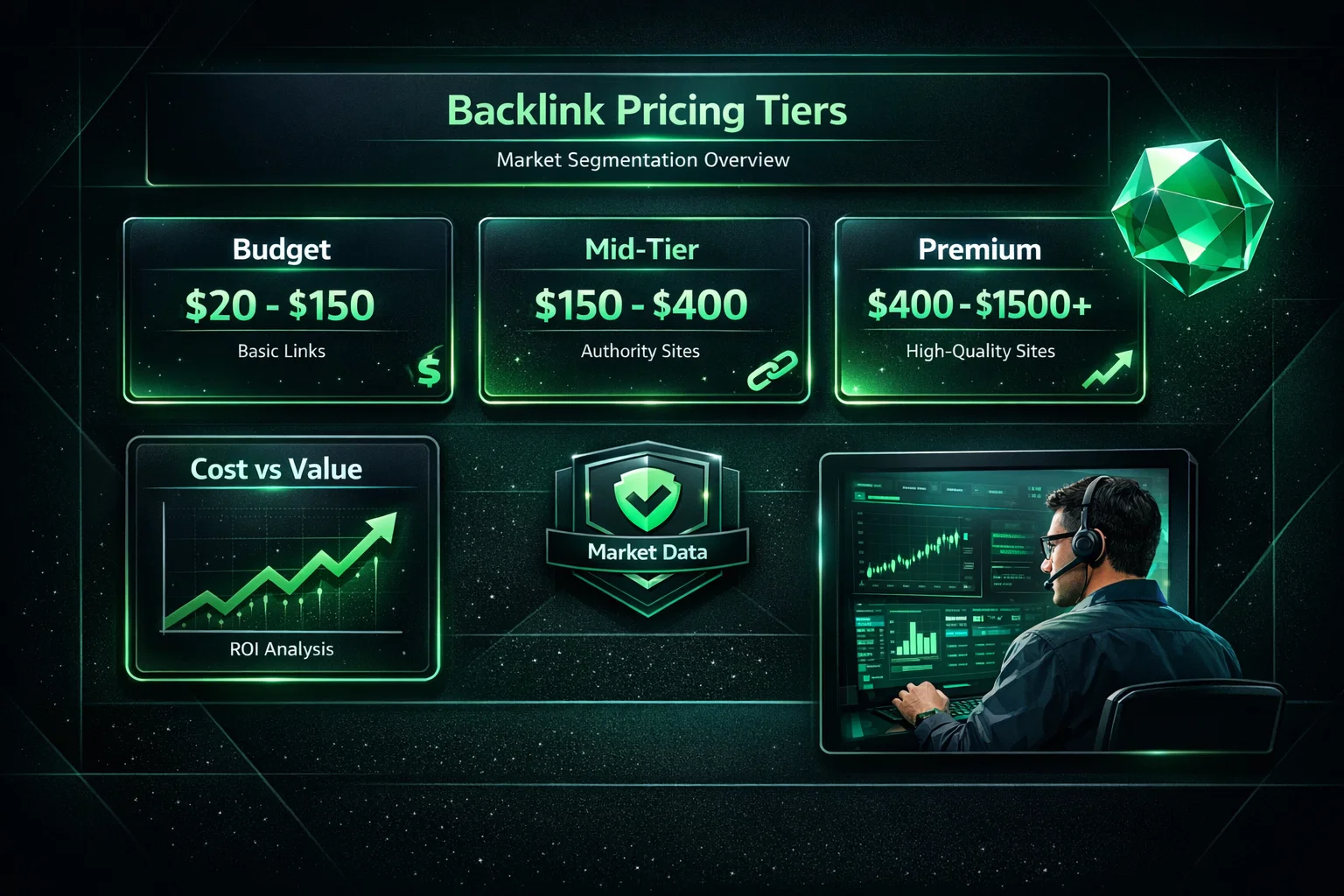
Cost vs Value Interpretation
Cheap backlinks are defined by cost-efficiency, not link quality. According to OutreachZ data, the average cost of a single quality backlink is approximately $370–$509. BuzzStream reports guest post backlinks average around $365, while premium editorial placements can reach $930 or more. Against those benchmarks, a DR 40+ contextual placement from a niche-relevant site with verified organic traffic secured for $80–$150 qualifies as genuinely cost-efficient — not as a spammy compromise.
The lowest-cost links — “50 links for $500” packages — consistently deliver the worst ROI. Google’s SpamBrain system is trained to identify paid link patterns, and bulk-volume, low-quality packages produce link profiles that are either algorithmically devalued or ignored entirely. In both cases, the buyer pays for nothing. Cost-efficiency requires evaluating value delivered per dollar, not minimizing the dollar amount in isolation.
Market Segmentation
The backlink market in 2026 is distributed across three tiers with distinct quality, risk, and use-case profiles:
| Tier | Price Range | Link Types | Best Use Case |
| Budget | $20–$150/link | Basic guest posts, niche edits, rental links | New sites, initial authority building |
| Mid-tier | $150–$400/link | Authority placements, manual outreach, and guest posts | Competitive niches, ongoing campaigns |
| Premium | $400–$1,500+/link | Editorial, digital PR, high-DR placements | Enterprise SEO, high-competition SERPs |
Best Places to Buy Cheap Backlinks (2026 Overview)
The following providers are evaluated across pricing transparency, link quality, niche relevance capabilities, and platform integrity based on 2026 market data, independent reviews, and direct operational assessment.
Bazoom
Bazoom is a full-service link-building platform with access to 80,000+ media outlets worldwide, charging no subscription or entry fees — buyers pay only for links purchased, with prices including both content and publication.
Key specs: 80,000+ publishers, integrations with Ahrefs, Moz, SEMrush, Google Search Console, 8-day average turnaround, AI strategy builder.
| Link Type | Price Range | DR Range |
| Entry-level placements | From $100/link | DR 20–40 |
| Mid-authority placements | $100–$500/link | DR 40–60 |
| Premium (e.g. UK finance sites) | $100–$2,180/link | DR 50+ |
| Copywriting add-on | $20–$40/article | — |
Best for: Agencies needing scalable global coverage with transparent per-link pricing and no subscription overhead. Note that agencies using intermediaries typically mark up Bazoom marketplace pricing 40–200%; direct platform access eliminates this cost layer.
PBN Backlinks Service
PBN Backlinks Service is a specialized provider of private blog network backlinks built on aged domains with verified authority, designed for controlled and predictable link acquisition in competitive niches.
Key specs: DR 40–75 domains, contextual placements, unique hosting/IP setup, niche relevance filtering, manual placement, controlled link velocity, indexation verification.
Placement Type / Pricing Overview
| Placement Type | Price Range | Notes |
| Starter PBN links | From ~$50–$100/link | DR 40–55 domains, entry-level campaigns |
| Growth PBN links | $100–$200/link | DR 45–65, niche-relevant placements |
| Authority PBN links | $200–$400+/link | DR 55–75, competitive niches |
| Bulk / agency packages | Custom pricing | Scaled campaigns, multiple URLs |
Advantages of This Approach
- Full control over anchor text, placement, and delivery timing
- Aged domains with clean backlink history and existing authority
- Diversified hosting (separate IPs, registrars, DNS) to reduce footprints
- Contextual links placed inside original, niche-relevant content
- Strict outbound link limits to preserve link equity
- Predictable delivery and faster ranking impact compared to outreach
Best for
SEO specialists, affiliate marketers, and agencies working in competitive niches who need controlled authority injection, scalable link building, and faster ranking movement than traditional outreach methods.
Collaborator.pro
Collaborator.pro is a fast, safe PR marketplace that allows publication on 38,000+ verified websites and Telegram channels, with Ahrefs data, GA-verified traffic, and a 3-month guarantee against link deletion.
Key specs: 38,000+ websites, 3,000+ Telegram channels, 150+ countries, 50+ languages, 40+ filters, official Ahrefs integration, 10% commission on deposits.
| Placement Type | Price Range | Notes |
| Entry-level placements | From ~$20/article | Smaller niche sites |
| Mid-tier placements | $50–$200/article | Verified traffic, niche relevant |
| High-authority placements | $200–$500+/article | High DR, real traffic |
| Extended link protection | Small additional fee | Up to a 12-month guarantee |
Best for: SEO specialists and agencies wanting transparent publisher data, direct publisher communication, and verified GA traffic metrics before purchase.
Serpzilla
Serpzilla uses a flexible payment model billed daily, only for the days the link is actually live on the linking site — if a link disappears, payment stops automatically. The platform covers 150,000+ websites and over 1 billion indexed pages.
Key specs: 150,000+ publisher sites, 1B+ pages, rental link model (daily billing), niche edits, guest posts, sitewide packages, indexation guarantee available.
| Link Type | Price Range | Notes |
| Niche edit / rental links | From $0.15/month avg | Charged daily, pay only when live |
| Guest posts | Variable, low–mid range | Filter by DR, traffic, category |
| Sitewide backlink packages | From $0.30/month per 100 links | Bulk volume model |
| High-DR premium placements | Up to hundreds/month | Competitive niches |
Best for: SEOs running large-scale campaigns who need flexible pricing, automated link placement, and volume across a wide publisher base without manual outreach overhead.
Editorial.Link
Editorial.Link charges from $350 per link with no minimum contract spend and no advance payment required, offering monthly plans starting at $1,750 for 5 editorial backlinks up to $17,500/month for enterprise packages of 50 links.
Key specs: Premium editorial placement focus, no open marketplace interface, managed outreach into ranking content, link-insertion model.
| Package | Price | Links Included |
| Per-link (no package) | From $350/link | 1+ |
| Startup plan | $1,750/month | 5 links |
| Growth plan | Custom pricing | 10–25 links |
| Enterprise plan | $17,500/month | 50 links |
Best for: SaaS companies and B2B brands targeting competitive, editorial-quality placements inside already-ranking content. Not suitable for budget campaigns or high-volume link strategies.
Authority Builders
Authority Builders is a premium guest post marketplace founded by Matt Diggity in 2016, requiring every publisher domain to meet a verified 1,000+ monthly organic visits minimum — a real quality gate most competitors don’t enforce.
Key specs: ~2,000 publisher sites, verified traffic floor, Moz DA / Ahrefs DR / Majestic TF filters, 1-year link replacement guarantee, masked domains pre-purchase.
| Service | Price Range |
| Individual guest post links | $100–$450/link |
| Mid-tier links (DR 30–50) | $200–$400/link |
| High-authority placements (DR 50+) | $500+/link |
| ABC Plus managed campaign | $1,000–$3,000/month |
| ABC Platinum managed campaign | $3,000–$12,000/month |
| Digital PR campaign | $2,750–$10,000/month |
Best for: Niche site operators and established brands wanting traffic-verified placements with marketplace transparency. Note that publisher URLs are revealed only post-placement, which limits pre-purchase vetting.
FatJoe
FatJoe is a UK-based link-building marketplace operating since 2012, offering blogger outreach, niche edits, press release distribution, and managed “Grow” packages with a lifetime link replacement guarantee.
Key specs: 10,000+ publisher sites, white-label reporting, 28-day delivery (14-day express available), lifetime link guarantee, no minimum spend.
| Service | Price Range | DR Tier |
| Blogger outreach (guest post) | $85–$675+/link | DR 10–70+ |
| Niche edits | $81–$378+/link | DR 10–50+ |
| Media placements | From $510/link | High authority |
| Managed “Grow” packages | From $700/order | Mixed DR |
| Content writing add-on | $12–$110+/article | — |
Best for: Agencies needing predictable delivery timelines and white-label reporting infrastructure. Independent reviews note that FatJoe applies significant markup over marketplace equivalents — the same placements are often available at 30–60% lower cost through direct platforms like Collaborator.
Searcharoo
Searcharoo is a UK-based link-building agency operating since 2018, evaluating link quality by real traffic value (minimum $1,000 traffic value per placement) rather than surface DA/DR metrics alone.
Key specs: Guest posts, niche edits, digital PR, tier-2 link building, white-label reports, 6-month link guarantee, 30–40% savings versus agency-markup competitors.
| Package Type | Price Range | Notes |
| Entry-level packages | From ~$320 (€300) | Basic, mixed DR |
| Standard packages | $320–$1,500 | DR 20–50 placements |
| Premium packages | Up to ~$3,200 (€3,000) | DR 50+ authority sites |
| Individual links (a la carte) | From ~$213/link (5-link min) | Traffic-value verified |
Best for: Agencies and brands wanting traffic-verified placements with white-label delivery, competitor gap analysis, and a provider focused on real ranking outcomes rather than metric gaming.
Freelance and Open Platforms
| Platform | URL | Avg. Price/Link | Quality Control | Best Use |
| Fiverr | fiverr.com | ~$77 avg (wide range) | None — individual vetting required | Budget testing, low-competition niches |
| Upwork | upwork.com | Varies by hourly rate / project | None at the platform level | Outreach coordination, campaign management |
| SEOClerks | seoclerks.com | $5–$50 typical | Minimal marketplace moderation | Foundational/tiered links, experimental |
Each category differs in transparency, pricing consistency, and quality control. Freelance platforms require buyers to perform all quality verification independently — traffic checking via Ahrefs, spam score assessment, content quality review, and outbound link profile analysis before committing to any placement.
Types of Places to Buy Backlinks
Not all backlink sources operate the same way. Understanding the model behind each type of provider helps SEOs evaluate transparency, pricing consistency, and risk exposure before committing budget.
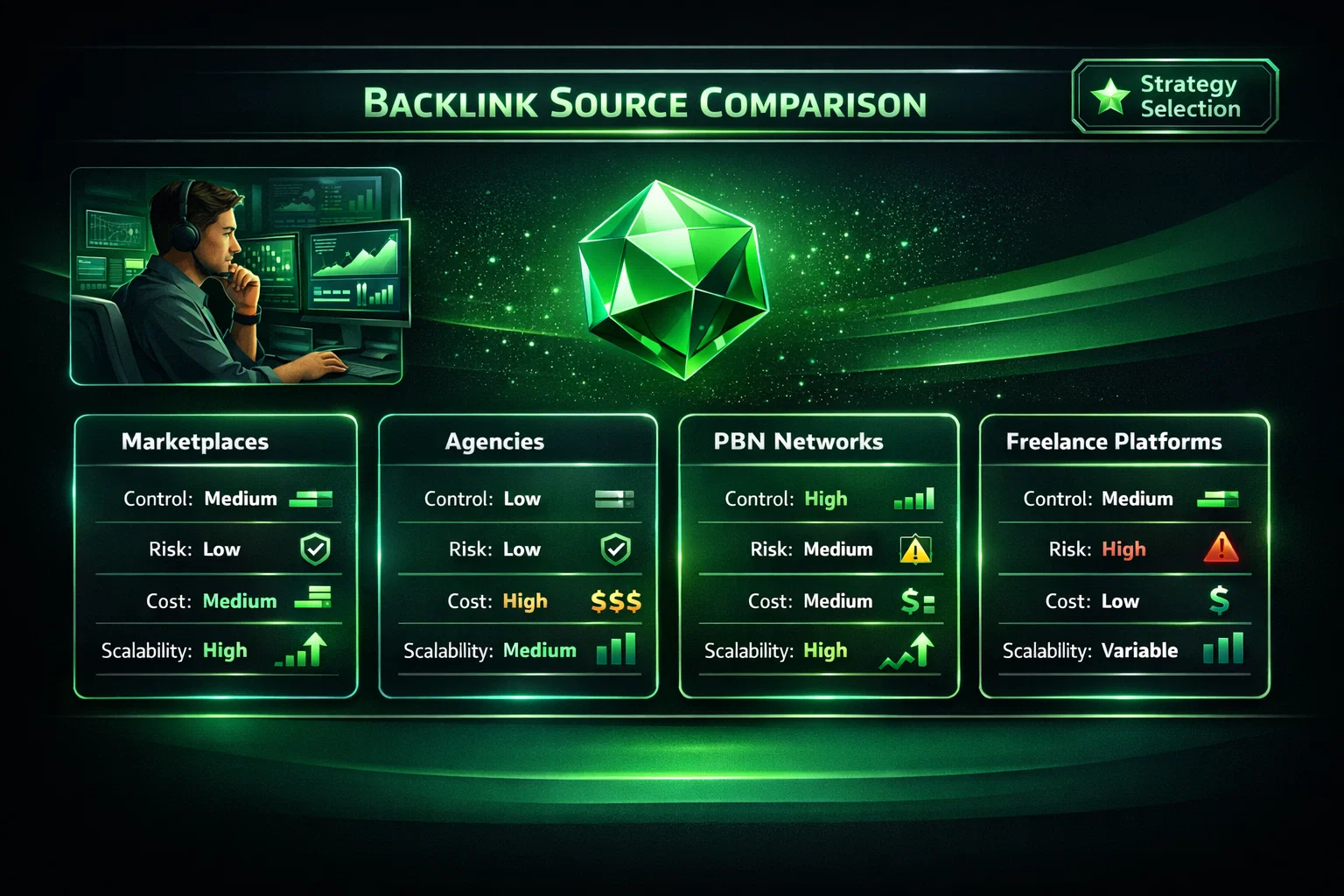
Link Building Marketplaces
Link building marketplaces are self-serve platforms offering a structured inventory of publisher sites filterable by DR, organic traffic, niche, price, and language. Buyers browse the catalog, select placements, pay through the platform, and receive links within a defined delivery window. Marketplaces like Collaborator, Bazoom, and Serpzilla handle logistics — publisher communication, content coordination, and placement verification — in exchange for a commission on each transaction.
The marketplace model is the most transparent pricing environment in the industry. Every placement is priced before purchase, and metrics are visible in real time through integrations with Ahrefs, Moz, SEMrush, and Google Analytics. The primary risk is quality variance: large catalogs inevitably contain low-traffic, low-value publishers alongside genuinely authoritative sites. Careful filtering and manual vetting remain necessary even on well-managed platforms.
SEO Agencies and Resellers
SEO agencies and resellers provide managed link-building services — outreach, placement, content creation, and reporting — as a done-for-you operation. Providers like FatJoe, Authority Builders, and Searcharoo handle the full workflow, allowing clients to receive placed backlinks without running outreach campaigns internally.
Agency-based providers carry higher per-link costs than self-serve marketplaces, reflecting the operational overhead of manual outreach and content creation. The primary advantage is predictability: agencies define quality standards, enforce traffic verification, and provide replacement guarantees if links are removed. For in-house teams without dedicated outreach capacity, agency models reduce overhead while maintaining link quality controls.
PBN Link Providers and Private Networks
Private blog network (PBN) providers operate controlled networks of aged domains built specifically for link placement. Unlike marketplaces that aggregate open publisher pools, PBN agencies own and manage the publisher infrastructure — acquiring aged domains, building content, distributing hosting across separate IPs, and publishing contextual backlinks to client sites.
The PBN model offers advantages that open marketplaces cannot replicate. Full control over anchor text, placement context, indexing speed, and link velocity creates highly predictable SEO outcomes. A typical PBN backlink service operates a network of domains with DR 30–70, aged profiles, and diversified hosting to ensure zero footprint overlap across client campaigns.
The key distinction between PBN agencies and marketplaces: PBN providers work with controlled site infrastructure, not an open publisher pool. Evaluation criteria differ accordingly — footprint management, hosting diversification, content quality, and domain history analysis become primary quality signals rather than third-party traffic metrics.
Freelance Platforms
Freelance platforms like Fiverr, Upwork, and SEOClerks offer access to individual link builders and outreach specialists at variable price points. According to Fiverr’s own data, backlink experts on the platform charge an average of $76.57 per service. Upwork enables hourly or fixed-price contracts for outreach campaigns and guest posting work across budget ranges.
The risk profile of freelance platforms is higher than structured marketplaces or agencies. Quality is entirely dependent on individual seller vetting — there is no platform-level quality verification for link placements. Experienced SEOs use freelance platforms for specific tactical tasks — identifying outreach contacts, building spreadsheets of prospects, or scaling low-competition niche campaigns — rather than relying on them for premium editorial link acquisition.
Private Deals and Outreach
Direct agreements with site owners eliminate intermediary margins and provide greater flexibility over placement terms, anchor text, and pricing. A direct outreach deal on a DR 45 site with 8,000 monthly visitors might cost $120–$250 compared to $300–$500 through a marketplace or agency for an equivalent placement.
Building direct publisher relationships requires time investment — prospecting, relationship development, and negotiation — that many agency campaigns cannot absorb at scale. For SEO professionals managing a defined niche footprint over multiple years, direct outreach compounds in value as publisher relationships deepen and placement costs stabilize through long-term agreements.
Forums and Black Hat Boards
Black hat forums and link-trading boards represent the highest-risk environment for backlink acquisition. Providers on these platforms operate with minimal transparency, inconsistent quality verification, and no replacement guarantees. Links are frequently placed on penalty-risk domains, link farms, or sites with artificial DR inflation that collapses within months of purchase.
For established sites or brand-sensitive SEO campaigns, black hat board links are incompatible with any sustainable SEO goals. The only defensible use case is experimental testing in isolated, expendable domains where risk tolerance is absolute. Even then, the low signal-to-noise ratio makes identifying genuinely effective placements extremely difficult.
How to Evaluate a Backlink Seller?
Selecting a backlink provider without systematic evaluation exposes campaigns to algorithmic devaluation, wasted budget, or — in aggressive link schemes — manual penalties that can take months to recover from.
Key Quality Indicators
The four most reliable quality signals for any backlink placement are organic traffic of the linking site, the referring domain profile of that site, niche relevance to the client domain, and editorial placement within body content. Third-party metrics like Ahrefs DR and Moz DA provide a useful starting point but can be manipulated — DR inflation through reciprocal link exchanges is documented and widespread. A DR 50 site with 300 monthly organic visitors and no real readership provides less ranking value than a DR 35 site with 15,000 verified monthly visitors in your niche.
Traffic verification using Ahrefs Site Explorer or SEMrush Organic Research should be the primary quality gate. Any site showing steep, unrecovered traffic drops in its historical data should be avoided regardless of current DR. Google penalties and algorithm hits leave permanent traffic signatures that indicate instability.
PBN-Specific Evaluation Criteria
Private blog network links require evaluation criteria that differ from standard marketplace or outreach placements. Domain history and backlink cleanliness are the highest-priority factors. A domain that previously carried adult content, pharmaceutical spam, or a manual penalty retains toxicity regardless of its current content quality. Domain acquisition history should be verified through the Wayback Machine, WHOIS history tools, and Ahrefs historical data before any network inclusion.
Hosting diversity and footprint management separate professional PBN operations from detectable network clusters. Networks using the same IP ranges, nameservers, hosting providers, or CMS configurations across multiple sites are vulnerable to algorithmic identification at scale. Content quality across network sites must reflect genuine editorial effort — spun, templated, or thin content is the most common footprint signal that devalues and eventually deindexes network sites.
Outbound link ratios are a frequently overlooked evaluation point. Sites that link to dozens of external domains from a single article signal link-selling operations to Google’s crawlers. Professionally managed PBNs limit outbound links per article to 2–5 external references and maintain healthy internal linking structures to preserve domain authority.
Red Flags to Avoid
| Red Flag | Risk Level | Explanation |
| Guaranteed rankings | High | No ethical provider can guarantee specific positions |
| Bulk links at extremely low prices ($5–$20 for 100+ links) | High | Indicates automated link farms or link directories |
| No traffic data available | Medium-High | Sites with no verifiable organic traffic pass negligible authority |
| Reused or templated content across network sites | High | Primary PBN footprint detection signal |
| DR that doesn’t correspond to traffic | Medium-High | Indicates artificial DR inflation through link schemes |
| No replacement policy | Medium | Reliable providers guarantee link permanence or replacement |
Best Practices for Safe Link Buying
Anchor Text Distribution
Natural anchor text ratios prevent over-optimization signals that trigger algorithmic review. FatJoe’s best-practice guidelines provide a useful benchmark: 50% brand anchors, 25% partial-match anchors, 15% natural/generic anchors (“click here,” “read more”), and 10% exact-match keyword anchors. Over-weighting exact-match anchors — particularly across low-quality domains — is the most consistent link-building pattern associated with manual penalties.
Anchor text strategy must also account for existing backlink profile composition. Sites with no existing brand anchors should establish branded and URL anchors before introducing keyword-rich anchors. New sites with excessive exact-match anchors in their early link profiles send obvious unnatural signals to Google’s evaluation systems.
Link Velocity Management
Gradual link acquisition that mirrors natural editorial patterns prevents algorithmic identification of paid link schemes. A site that acquires 200 backlinks in a single month after months of minimal link growth triggers pattern detection regardless of individual link quality. For most campaigns, acquiring 5–20 new backlinks monthly maintains velocity within natural ranges.
New site link-building requires particular caution. Building 30–50 foundational links — social profiles, business directories, and citations — before beginning any paid link acquisition ensures the backlink profile has organic-looking breadth before targeted authority-building begins.
Diversification Strategy
Combining marketplaces, direct outreach, and PBN links within the same campaign creates a backlink profile that mirrors genuine editorial acquisition patterns. Profiles consisting exclusively of one link type — all guest posts, all niche edits, or all PBN links — are more detectable than diversified profiles that include multiple placement types across varied DR ranges, geographies, and anchor text distributions.
Hybrid link profiles are the industry standard in competitive SEO environments. The ratio of purchased to organically acquired links should increase as domain authority matures — early-stage sites need more purchased links to establish baseline authority; established domains rely on purchased links primarily for specific page-level ranking pushes.
Risks of Cheap Backlinks and How to Avoid Them
Algorithmic Devaluation
The most common consequence of low-quality cheap backlinks is not a penalty — it’s algorithmic devaluation. Google’s SpamBrain system is trained to identify and ignore link patterns from known link farms, automated networks, and low-quality guest post sites. Devalued links don’t improve rankings; they simply fail to pass authority, converting marketing budget into zero SEO return.
Identifying devalued link sources requires monitoring whether acquired backlinks actually move rankings or domain metrics. If a significant volume of new links produces no measurable change in target keyword positions or domain authority over 60–90 days, the links are likely being filtered. Tools like Ahrefs’ Link Intersect and referring domain traffic analysis identify which acquired links correlate with ranking improvements versus which contribute nothing.
Manual Penalties
Aggressive link schemes — large volumes of obviously paid links, manipulated anchor text ratios, or links from clearly non-editorial sources — increase the risk of manual actions from Google’s Search Quality Reviewer team. Manual penalties require submitting a disavow file, demonstrating link cleanup efforts, and submitting a reconsideration request — a process that typically takes 3–6 months and introduces significant traffic disruption.
The risk of manual penalties is dramatically lower for campaigns using legitimate editorial placements, verified traffic sources, and natural anchor text distribution. The “link scheme” language in Google’s guidelines targets large-scale, manipulative practices — not selective, relevance-focused link acquisition from real publishers. Understanding this distinction allows SEO professionals to pursue effective link-building strategies within acceptable risk parameters.
PBN-Specific Risks
Private blog network links carry a specific set of risks that differ from open-marketplace placements:
- Footprint detection: Identifiable patterns across network sites — shared IPs, registrar clusters, CMS configurations, or content style — allow algorithmic identification at scale, resulting in network-wide deindexing.
- Network deindexing: If a PBN network is identified and deindexed, all links from that network lose value simultaneously — a concentrated risk that doesn’t exist with diversified marketplace placements.
- Link devaluation at scale: Google’s ability to identify link networks improves continuously. Networks built on poor footprint management that pass value today may be algorithmically neutralized in future updates.
Mitigation requires selecting PBN providers who operate with rigorous domain vetting, genuine content, hosting diversification, and strict outbound link limits — the practices that distinguish professional private network management from detectable link farm operations.
Long-Term Ranking Instability
Cheap backlinks from low-quality sources produce a recognizable ranking trajectory: modest initial gains followed by plateau or decline. Sites boosted primarily through low-quality link acquisition lack the genuine authority signals that sustain top rankings across algorithm updates. According to 2026 market data from Reporter Outreach, 62% of SEOs now prioritize link quality over quantity — only 9% still prioritize volume — a direct response to the instability of volume-first link strategies.
Alternative Low-Cost Link Building Strategies
Guest Posting
Guest posting on niche-relevant sites with real editorial standards provides the highest control and relevance combination at mid-tier cost. Unlike pure link marketplaces, genuine guest post outreach requires creating substantive, topic-relevant content — which creates natural editorial context that strengthens the link’s topical authority signal. Platforms like Collaborator and Serpzilla offer guest post placements with transparent pricing from $20 for smaller sites, while direct outreach to niche publishers can yield equivalent placements at $50–$150 with the right content pitch.
Digital PR
Digital PR earns high-authority backlinks through content-driven campaigns — original research, expert commentary, and newsworthy data placements on major publications. The average digital PR placement achieves DR 70+ on editorial publications — significantly above the DR 30–60 range typical of marketplace guest posts. According to Ahrefs, brand mentions generated through digital PR correlate 3× more strongly with AI search visibility than standard link placements. Digital PR costs more per placement ($1,250–$1,500+ at agencies like Reporter Outreach) but delivers authority that cannot be purchased directly through any marketplace at any price.
Content-Based Link Attraction
Publishing original research, data studies, or comprehensive resource content generates organic backlinks from publishers who cite your work without outreach or payment. This method has the highest long-term ROI but the least predictable timeline — Backlinko’s own data-driven studies generate thousands of natural links annually, but replicating that model requires investment in original data collection, research methodology, and content production that most small teams cannot sustain consistently.
Strategic Approach: Combining Paid and Organic Links
Balanced link acquisition strategies consistently outperform isolated approaches. The most effective campaigns in competitive SERPs combine purchased contextual backlinks — including selective PBN usage for authority precision — with organic editorial acquisition through digital PR and content-driven link attraction. This hybrid model distributes risk across acquisition methods while ensuring no single link source failure eliminates campaign value.
Hybrid models are increasingly standard in professional SEO environments. According to the 2026 Reporter Outreach state of link building data, digital PR now ranks as the #1 most effective link building method for 34% of SEOs — nearly twice the rate of guest posting — but it works best when combined with contextual placements that target specific page-level authority needs. Guest posts and niche edits handle precision; digital PR handles domain-wide authority and AI search visibility; PBN links provide velocity control on priority pages.
The strategic sequence for most campaigns: establish foundational authority through mid-tier marketplace placements → build domain-level authority through digital PR → apply targeted PBN or niche edit links to specific priority pages competing for high-value keywords. Executed with anchor text diversity and gradual velocity, this sequence produces stable, compounding ranking improvements that resist algorithm updates.
Frequently Asked Questions
Cheap backlinks are safe only when quality and relevance criteria are verifiably met. Safety is determined not by price but by three factors: the organic traffic and editorial standards of the linking site, the niche relevance between linking and target domains, and the placement context within genuine editorial content. A $30 link from a verified DR 35 niche site with 5,000 monthly visitors is safer than a $200 link from an inflated-DR site with 400 visitors and 50 outbound links per page.
Monthly backlink acquisition volume depends on niche competition, current link velocity, and the competitive gap between client domain authority and target ranking positions. For new sites in low-competition niches, 3–8 links per month maintain natural velocity. For established sites competing in mid-tier niches, 10–20 monthly placements support meaningful authority growth. For competitive SERPs in finance, SaaS, or legal verticals, 25–50+ monthly placements may be necessary — though this volume requires careful diversity management across source types and anchor text ratios.
Yes — in low-competition niches and for long-tail keywords, cost-efficient backlinks from DR 20–50 sites with verified traffic can produce meaningful ranking improvements. In low-competition environments, even 5–15 well-placed contextual links consistently outrank competitors with weak or non-existent link profiles. In mid-to-high-competition niches, cheap backlinks alone are insufficient — they must be integrated with higher-authority placements, technical SEO, and content quality signals to produce competitive rankings. The ceiling of cheap backlink effectiveness correlates directly with the authority of the competition being targeted.