

Key Takeaways
- An expired domain passes through up to four distinct phases before it re-enters the public pool: the auto-renew grace period, the Redemption Grace Period (RGP), pending delete, and finally release for re-registration.
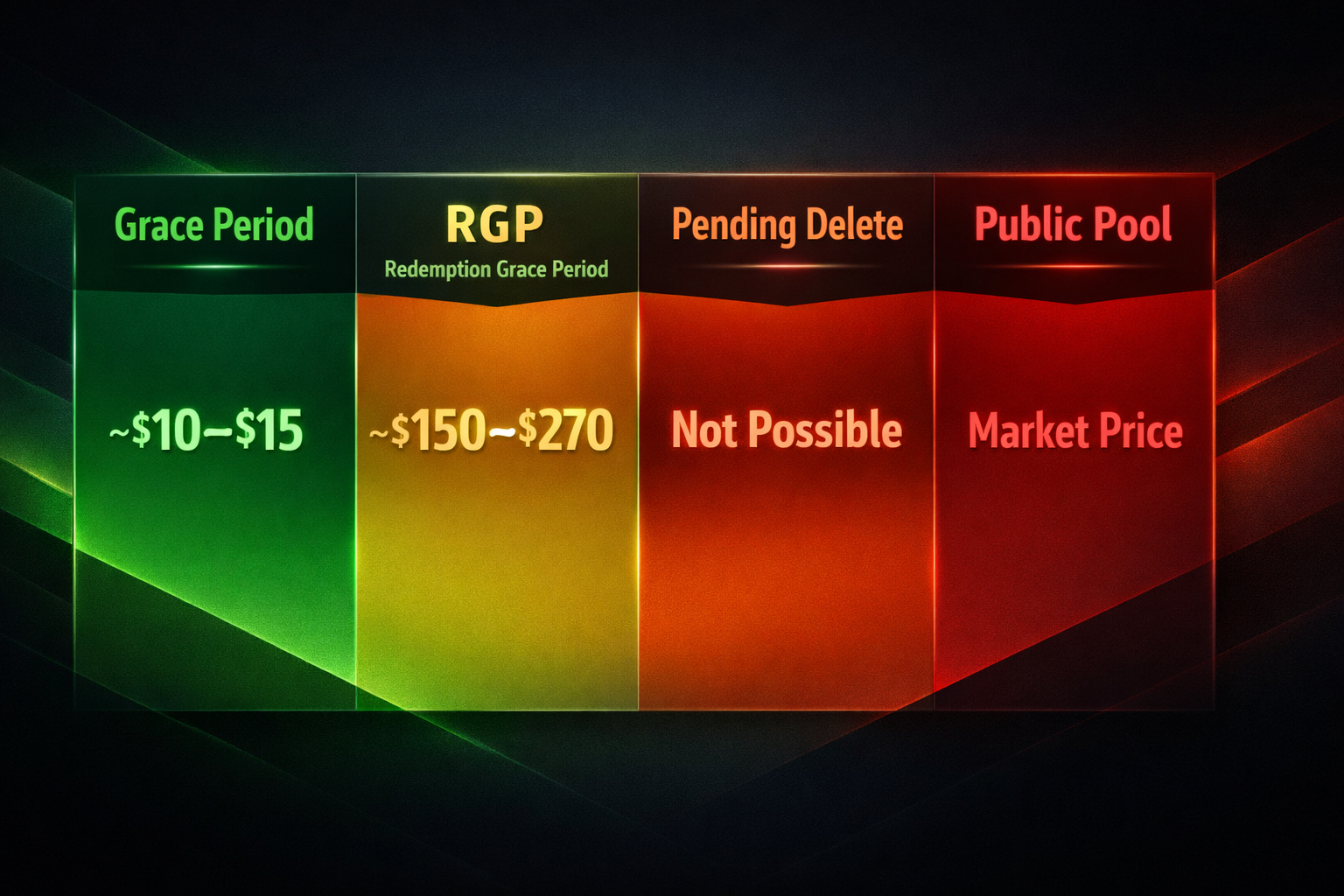
- Recovery costs escalate sharply at each stage — from a standard renewal fee during the grace period to a restore fee of roughly $150–$270 during the RGP, and zero recovery options once a domain enters pending delete.
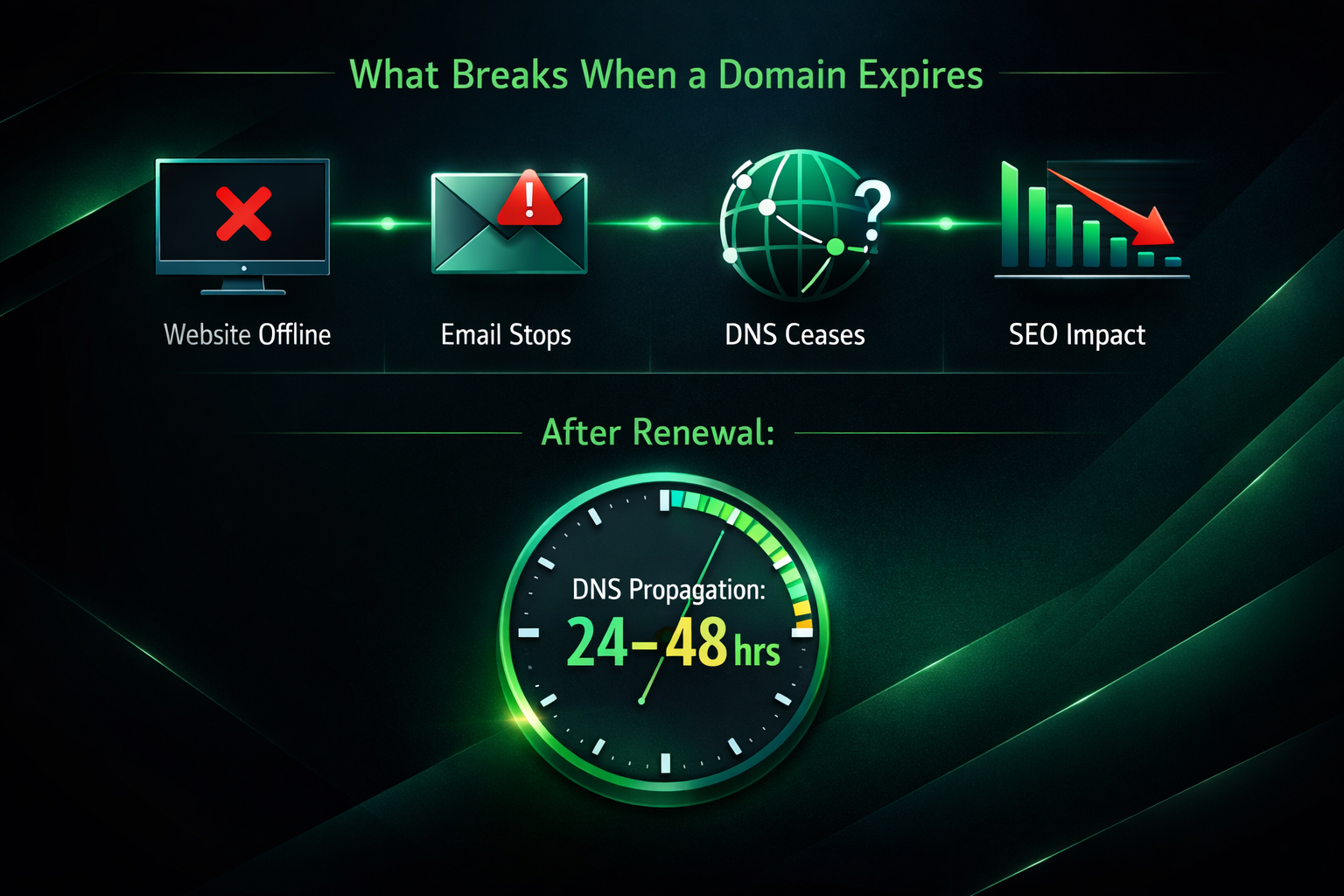
- When a domain expires, your website goes offline, email stops working, and DNS resolution ceases — often before most domain owners realise what has happened.
- Country-code TLDs (ccTLDs) do not always follow the same timeline as generic TLDs (gTLDs) — some skip the grace period entirely or enter redemption with little warning.
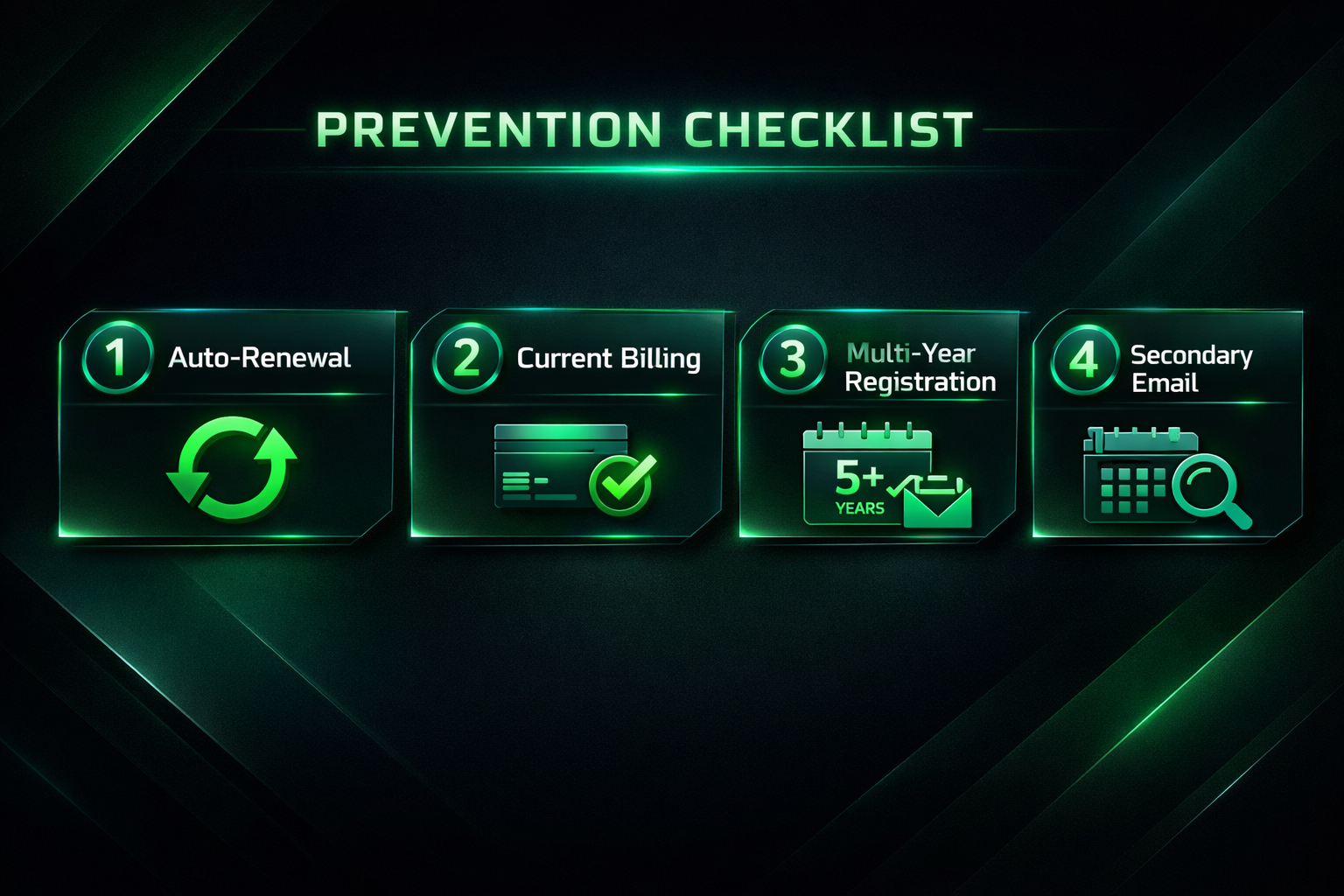
- Prevention through auto-renewal, current billing details, and multi-year registration is far simpler and cheaper than any recovery option.
What Is the Domain Life Cycle?
The domain life cycle is the sequence of statuses a domain name passes through from initial registration to the point where it either gets renewed or permanently released back to the public. Understanding this cycle matters whether you are a domain registrant trying to protect an existing domain or someone looking to acquire a dropped domain on the aftermarket.
For most gTLD domains — those ending in .com, .net, .org, and similar generic extensions — the life cycle follows an ICANN-regulated framework with clearly defined stages and specific time windows at each phase. The stages are: Active → Expired → Auto-Renew Grace Period → Redemption Grace Period → Pending Delete → Released. Each stage changes what you can do, how much recovery will cost, and whether recovery is even possible.
ccTLD domains — country-code extensions such as .eu, .uk, .au, and .de — are governed by their own registry authorities and often follow different, sometimes shorter, timelines. Some ccTLDs skip the grace period entirely or allow only a brief window before the domain becomes unrecoverable. Understanding whether your domain is a gTLD or ccTLD is therefore the first practical step when dealing with an expiration situation.
Stage 1: Active Domain
During the active phase, a registered domain resolves normally. The zone file — the DNS record that tells the internet where to direct traffic — is live, your website loads, and email delivers correctly. Domains are registered for a period of one to ten years, and the registration expiration date is recorded in the public WHOIS record for anyone to check.
Most registrars send renewal reminder emails starting roughly 60 days before the expiration date, with follow-up notices at 30 days, 15 days, and again on the expiration date itself. Enabling auto-renewal with a valid payment method on file is the most reliable way to remain in the active stage indefinitely without manual intervention.
Stage 2: Domain Expiration and the Auto-Renew Grace Period
When a domain’s registration period ends without a successful renewal, it enters the auto-renew grace period. For most gTLDs, this window lasts between 0 and 45 days, though many registrars set it at around 30 days. During this phase, the domain is still held by the original registrar, and the domain registrant can renew at the standard renewal fee — typically $10–$15 for common gTLDs — with no penalty or surcharge.
What actually changes for the registrant during this period depends on the registrar and the specific TLD. For many gTLDs, the domain may be removed from the zone file shortly after expiration, meaning the website goes offline and email stops functioning even while the grace period is still running. The WHOIS status code typically changes to autoRenewPeriod, which you can verify by running a WHOIS lookup on your domain. If you see this status, standard renewal is still straightforward and inexpensive.
Some registrars begin listing expiring domains in their auction systems during this phase, allowing other buyers to bid while the original owner still has priority to renew. This creates an overlap between the grace period and the domain aftermarket that can be confusing — the original registrant retains the right to renew at the standard fee, but auction activity is already beginning in the background.
Stage 3: Redemption Grace Period (RGP)
If the domain is not renewed during the auto-renew grace period, it moves into the Redemption Grace Period, commonly abbreviated as RGP. For ICANN-regulated gTLDs, the RGP lasts approximately 30 days. The WHOIS status code changes to redemptionPeriod, the domain is removed from the zone file if it has not been already, and both the website and email remain offline.
Recovery during the RGP is still possible, but it is significantly more expensive. The registrar must submit a restoration request to the registry, and the registry charges a restore fee — typically ranging from around $150 to $270 depending on the TLD and registrar. This fee is separate from the standard renewal fee, which is also charged on top of it. Only the previous registrant can request restoration during this period, and the request must go through the original registrar.
The RGP exists as a safeguard against accidental deletion, giving domain owners who missed the grace period one final — though costly — chance to recover their domain. If you check your WHOIS status and see redemptionPeriod, act immediately. Every day of delay does not reduce the cost, but it does reduce the time remaining to act before the domain becomes unrecoverable.
Stage 4: Pending Delete — The Point of No Return
After the RGP expires without a successful restoration, the domain enters the pending delete phase. For gTLDs, this stage lasts exactly five days. During pending delete, the domain is locked by the registry, no registrar can restore it, and the original registrant has no further recourse. This is the point of no return in the domain life cycle.
The WHOIS status code changes to pendingDelete. No renewal, restoration, or transfer request can be processed. The only thing that happens during these five days is a countdown to the moment the domain is cleared from the registry database and queued for release back to the public.
Domain speculators and drop-catch services are acutely aware of the pending delete phase. Automated dropcatching systems monitor domains approaching release and attempt to register them the moment they become available. For a high-value domain, multiple competing services may attempt to catch it simultaneously, and the outcome is often decided by speed measured in fractions of a second.
Stage 5: Release and Re-Registration
Once the pending delete period ends, the domain is released into the public pool and becomes available for registration on a first-come, first-served basis — though in practice, dropcatching systems mean that highly sought-after domains are captured within milliseconds of release rather than sitting available for general registration.
A domain backorder service allows anyone — including the original owner — to pre-register interest in a dropping domain. Multiple backorder services competing for the same domain may route the result through a domain auction, where the highest bidder secures the domain. Prices at auction can range from a few dollars for obscure domains to thousands or even more for valuable expired domains with established backlinks and traffic history.
The domain aftermarket also includes closeout or reverse-auction listings, where domains that received no bids during the primary auction period are offered at declining prices until they sell or enter standard availability. Services such as GoDaddy Auctions, SnapNames, and similar platforms facilitate this secondary market.
What Actually Breaks When Your Domain Expires
Many domain owners underestimate how quickly and completely an expired domain disrupts their operations. The practical consequences begin as soon as the domain is removed from the zone file — which can happen at the start of the grace period, not just after it ends.
- Website goes offline: Without an active DNS record pointing to your web server, visitors see a browser error rather than your website. Depending on the registrar and TLD, this can happen within hours of expiration.
- Email stops delivering: Mail servers use DNS MX records to route email. When the domain is removed from the zone file, inbound email cannot be delivered and may bounce back to senders. Outbound email from addresses on that domain may also fail.
- DNS resolution ceases: Any service that relies on your domain’s DNS — subdomains, API endpoints, third-party integrations — stops functioning. SSL certificates tied to the domain may also be affected, causing security warnings even if partial resolution briefly resumes.
- SEO impact begins immediately: Search engine crawlers that attempt to reach your site during the outage may record errors, and the loss of DNS resolution can damage accumulated rankings. Backlinks pointing to your domain continue to exist but deliver no benefit while the domain is offline.
After successful renewal or restoration, the site does not return instantly. DNS propagation — the process by which updated DNS records spread across global servers — typically takes between a few hours and 48 hours. During this window, some users may see the site normally while others still reach an error page.
Recovery Costs at Each Stage
| Stage | Duration (gTLD) | Approximate Recovery Cost | Who Can Recover | Website Status |
|---|---|---|---|---|
| Auto-Renew Grace Period | 0–45 days | Standard renewal fee (~$10–$15) | Original registrant | Often offline |
| Redemption Grace Period (RGP) | ~30 days | Restore fee (~$150–$270) + renewal fee | Original registrant only | Offline |
| Pending Delete | 5 days | Not recoverable | Nobody | Offline |
| Released / Public Pool | Varies | Market price (auction or standard registration) | Anyone | Offline until re-registered |
How gTLD and ccTLD Timelines Differ
The stages described above apply primarily to ICANN-regulated gTLDs. Country-code domains operate under the rules of their national registry authorities, and the timelines can differ substantially — sometimes dramatically shortening the window available for recovery.
| TLD | Grace Period | Redemption Period | Pending Delete | Notable Difference |
|---|---|---|---|---|
| .com / .net / .org | 0–45 days | ~30 days | 5 days | Standard ICANN timeline |
| .eu | None | Begins ~1 day before expiration | Varies | No grace period; redemption starts before the expiration date |
| .uk family (.co.uk, .org.uk) | 30-day reactivation | ~60 days | 5 days | Longer redemption window than most gTLDs |
| .to | Exists but domain goes offline immediately | Varies | Varies | Website offline from the start of grace period |
| .au | Registry-specific | Registry-specific | Registry-specific | Managed by auDA; timelines differ from ICANN gTLDs |
The practical implication is straightforward: if you hold a ccTLD, do not assume you have the same recovery windows as a .com domain. Check with your registrar or the relevant national registry for the exact timeline applicable to your domain extension.
Security and Brand Risks of Losing a Domain
Beyond the operational disruption of a website and email going offline, losing control of a domain creates genuine security and brand risks that are often underestimated. Once a domain enters the public pool and is registered by a third party, the original owner has no administrative rights and limited legal remedies.
Cybercriminals sometimes monitor expiring domains specifically to acquire them for phishing campaigns, brand impersonation, or to intercept email that continues to be directed at the domain. A business that loses its primary domain may find that suppliers, customers, or partners continue sending sensitive emails to an address that is now controlled by someone else.
Competitors or domain speculators may register the domain defensively or with the intent to sell it back at a significant premium. Recovering a domain after it has been re-registered by a third party typically requires either a negotiated purchase — often at a price far exceeding the original registration and even the RGP restore fee — or a legal process such as an ICANN Uniform Domain-Name Dispute-Resolution Policy (UDRP) complaint or a trademark-based claim. These legal routes are slow, uncertain, and expensive, and they require demonstrating that the registrant has no legitimate interest in the domain and acted in bad faith.
Accumulated brand equity, inbound backlinks, and SEO authority built over years can be severely damaged or lost if a competitor or speculator takes control and redirects the domain to unrelated or harmful content.
How to Check Your Domain’s Current Status
A WHOIS lookup provides the current status of any domain and is the fastest way to identify which stage of the life cycle a domain has reached. Most registrars provide a WHOIS tool on their website, or you can use authoritative lookup services such as the ICANN WHOIS portal at lookup.icann.org or InterNIC.
The key WHOIS status codes to understand are:
- ok — The domain is active and resolving normally.
- autoRenewPeriod — The domain has expired and is in the auto-renew grace period. Standard renewal is still available at normal cost.
- redemptionPeriod — The domain has entered the Redemption Grace Period. Restoration is possible but expensive; act immediately.
- pendingDelete — The domain is locked and queued for deletion. No recovery is possible at this stage.
Checking the WHOIS status of your domain before expiration and setting a calendar reminder to verify the renewal was processed is a simple step that can prevent a costly situation.
How to Prevent Domain Expiration
Domain expiration is almost always avoidable. The following measures, used together, provide reliable protection for business continuity and brand integrity:
- Enable auto-renewal: Most registrars offer automatic renewal as a default or optional setting. Enabling it means the domain renews automatically when the billing date arrives without requiring manual action.
- Keep billing information current: Auto-renewal fails if the saved payment method has expired or been replaced. Verify your card details with your registrar whenever they change.
- Register for multiple years: Extending the registration period to two, five, or even ten years reduces the frequency of renewal events and the risk of missing one.
- Maintain multiple renewal reminder contacts: Registrar reminder emails sometimes end up in spam folders. Adding a secondary contact email — such as a personal address rather than the domain’s own email — ensures reminders reach you even if the primary address is affected by an outage.
- Monitor expiration dates across all domains: Organisations with multiple domains should maintain a centralised record of all expiration dates with calendar alerts set well in advance.
Using Backorder Services Defensively
Domain backorder services are most commonly discussed in the context of domain hunters trying to acquire valuable dropped domains. However, the original domain owner can also use these services defensively if they discover their domain has entered or is approaching pending delete and recovery through the registrar is no longer possible.
A domain backorder placed with a reputable drop-catch service instructs the service’s automated system to attempt registration of the domain the instant it is released from the pending delete phase. If successful, the domain is transferred to the person who placed the backorder. If multiple services or individuals are competing for the same domain, the result is typically resolved through a domain auction among the competing backorder holders.
This is not a guaranteed recovery method — especially for popular domains that attract multiple competing drop-catch attempts — but it is the only practical option once a domain has passed the point of no return in the RGP and entered pending delete. Placing a backorder as early as possible, including before the pending delete period begins, is advisable since most services accept backorders at any point before the domain is released.
Frequently Asked Questions
Can I get my domain back after it enters pending delete?
No. Once a domain’s WHOIS status shows pendingDelete, the registry has locked the domain for deletion and no registrar, including your original one, can process a restoration or renewal request. The only option at this point is to place a domain backorder and attempt to re-register the domain after it is released into the public pool — which is not guaranteed.
How long is the grace period for a .com domain?
The auto-renew grace period for a .com domain is typically up to 45 days, though registrars may set shorter internal periods. During this time, renewal is available at the standard renewal fee with no additional penalty. However, your website and email may be offline during part or all of this period even though the domain is still in the grace phase.
What is the difference between the grace period and the Redemption Grace Period?
The auto-renew grace period is the first stage after expiration, during which renewal costs the standard fee (typically $10–$15). The Redemption Grace Period (RGP) is the subsequent stage, lasting around 30 days for gTLDs, during which recovery requires a formal restoration request and a restore fee of approximately $150–$270 plus the renewal fee. The RGP is significantly more expensive and involves more administrative steps.
Does my website come back immediately after I renew an expired domain?
Not instantly. After a successful renewal or restoration, the zone file must be updated and DNS propagation must complete before the website and email become accessible again. This process typically takes between a few hours and 48 hours, during which some visitors may still reach an error page depending on which DNS servers their connection queries.
Can someone else register my domain while it is still in the grace period?
No. During the auto-renew grace period and the Redemption Grace Period, the domain remains assigned to the original registrant, and only that registrant can renew or restore it. However, registrar auction systems may begin listing the domain during the grace period, so competing interest is building even though ownership has not changed. The domain only becomes available to others after it clears the pending delete phase and is released into the public pool.
Are ccTLD timelines the same as .com timelines?
No. Country-code TLDs are governed by their own national registry authorities and often have different — sometimes significantly shorter — timelines. For example, .eu domains have no traditional grace period and enter redemption approximately one day before the official expiration date. Always confirm the specific timeline with your registrar when managing a ccTLD.
What happens to my email if my domain expires?
When a domain is removed from the zone file after expiration, the DNS records that route email — including MX records — stop functioning. Inbound email sent to addresses on the expired domain will bounce or be undeliverable. If the domain is later re-registered by a third party, they may be able to receive emails directed at your former addresses, which creates a significant security risk.
When Should You Act on an Expired or Expiring Domain?
The clearest takeaway from the domain life cycle is that every stage of delay increases cost and reduces options. Renewing during the active phase or the auto-renew grace period costs a standard renewal fee and causes minimal disruption. Waiting until the Redemption Grace Period multiplies the cost tenfold or more and requires administrative steps that take time. Waiting until pending delete removes the option entirely.
If you are a domain owner who has just discovered an expiration situation, checking the WHOIS status immediately and acting within whatever window remains is the highest priority. If the domain has already entered the RGP, contact your registrar directly rather than attempting to manage the situation through self-service tools, as restoration requests require registrar involvement at the registry level. If the domain has reached pending delete, begin researching backorder services promptly so that a drop-catch attempt is in place before the five-day deletion window closes.
For anyone managing multiple domains or domains critical to their organisation’s operations, treating domain renewal with the same seriousness as any other infrastructure renewal — with auto-renewal enabled, billing details kept current, and expiration dates monitored — is the most cost-effective and least disruptive approach available.