

Quick Comparison
| Factor | Cloud Stacking | Private Blog Networks (PBNs) |
|---|---|---|
| Infrastructure | Cloud-hosted properties on platforms like AWS, Google Cloud, Azure | Aged or expired domains on separate hosting accounts |
| Risk Level | Lower to moderate (gray-hat SEO territory) | High — clearly violates Google’s spam policies |
| Cost | ~$3–$10/month per property for cloud hosting | $50–$300+ per domain (acquisition, hosting, content) |
| Link Equity Source | Borrowed domain authority from cloud platforms | Residual authority from aged or expired domains |
| Footprint Detection Risk | Lower — uses legitimate infrastructure | High — shared IPs, WHOIS patterns, thin content |
| Speed of Results | Moderate — depends on content quality and interlinking | Fast initially — drops sharply if penalized |
| Long-term Viability | Moderate — depends on execution and content quality | Low — increasingly targeted by SpamBrain |
| Best Use Case | Local SEO, brand signals, Tier 2 amplification | Short-term campaigns, testing, competitive niches |
| Google Policy Status | Gray area — can become a link scheme if abused | Explicitly prohibited link scheme |
What Is Cloud Stacking?
Cloud stacking is an SEO strategy that involves creating interconnected web entities hosted on major cloud infrastructure platforms — such as Amazon S3, Google Cloud Storage, Microsoft Azure, IBM Cloud, and Bunny CDN — and then linking those properties toward a target website. The underlying logic is domain authority inheritance: because these pages are hosted on the same root domains as major cloud providers, they carry a degree of trust and authority that self-hosted websites do not automatically possess.
In a typical cloud stacking setup, an SEO practitioner builds a network of static HTML pages or publicly accessible cloud buckets, each containing relevant content. These cloud-hosted properties are interlinked with each other in a hub and spoke structure and ultimately point link equity toward the money site — the website whose rankings are the actual target. Platforms commonly used include Dropbox public links, Oracle Cloud, Wasabi, and similar services alongside the major cloud providers.
Cloud stacking SEO is sometimes marketed as a safer alternative to private blog networks precisely because the hosting infrastructure is legitimate and widely trusted. However, the strategy’s actual effectiveness and safety depends heavily on how it is implemented. Used with genuinely useful content and proper moderation, it occupies gray-hat SEO territory. Deployed at scale with spammy, thin, or automated content, it can move firmly into territory that Google’s spam policies target.
What Are Private Blog Networks (PBNs)?
A private blog network is a collection of websites — typically built on aged or expired domains that retain historical backlink profiles and domain authority — all owned or controlled by the same person or organization. These sites exist primarily to pass link equity to a money site, manipulating its rankings without earning genuine editorial endorsement. PBNs are an explicitly prohibited link scheme under Google’s webmaster guidelines.
The appeal of PBNs has historically been control: you own the sites, you choose the anchor text, you decide which pages receive links, and you can act quickly. Tiered link building using PBNs involves pointing Tier 1 links directly at a money site and using Tier 2 links to amplify the Tier 1 properties. Anchor text diversity can be managed deliberately, which was a significant advantage when PBN detection was less sophisticated.
Building a PBN typically requires acquiring expired domains through auction platforms, securing separate hosting accounts to avoid footprint detection, creating content for each site, and maintaining those sites over time. The cost per site — once you account for domain acquisition, hosting, and content — can range from $50 to several hundred dollars, and a meaningful network requires dozens of sites to compete in moderately competitive niches. The ongoing maintenance overhead is substantial.
How Google Detects PBNs
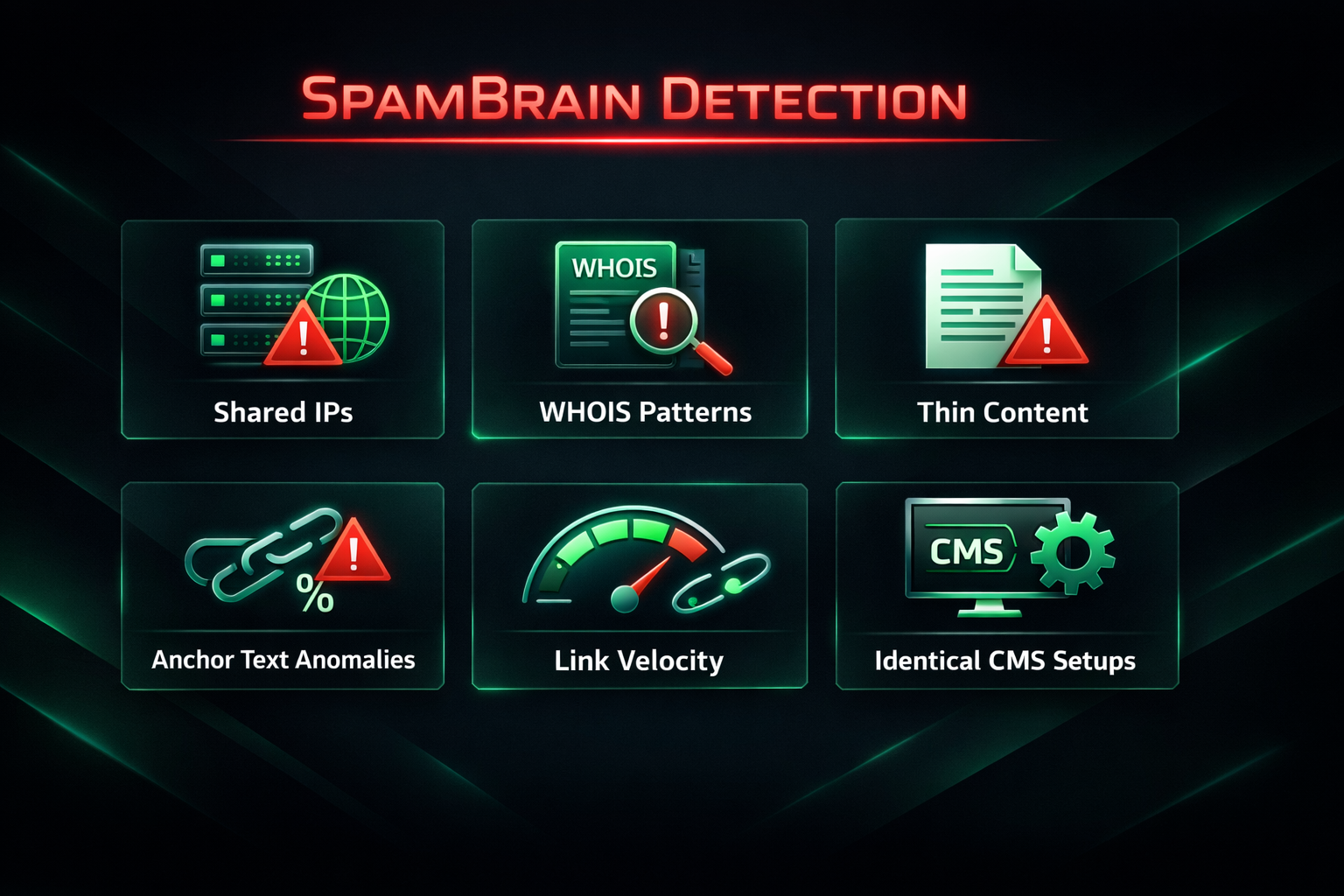
Google’s ability to identify and penalize private blog networks has advanced considerably with the deployment of SpamBrain, its AI-powered spam detection system. SpamBrain analyzes linking patterns, content quality signals, and network-level characteristics simultaneously rather than evaluating individual sites in isolation. This makes footprint detection significantly more effective than earlier algorithmic approaches.
The most common PBN detection signals include shared IP addresses or hosting environments across network sites, WHOIS registration data pointing to the same registrant, identical or overlapping content management system setups, thin content with low engagement signals, unnaturally similar anchor text patterns across the network, and link velocity inconsistencies that don’t match the expected behavior of genuine editorial publishers. When Google identifies a PBN, the consequences are severe: the network sites may be de-indexed, and the money site can receive a manual action or algorithmic penalty that strips rankings overnight.
Post-Helpful Content Update, Google has also increased its capacity to evaluate whether content serves genuine reader intent or exists solely to host links. PBN sites that were previously passable under older quality thresholds are increasingly being caught by this combination of AI pattern recognition and content quality evaluation. The risk calculus for PBNs in 2025 is materially worse than it was even three years ago.
How Google Approaches Cloud Stacking
Cloud stacking occupies a more ambiguous position in Google’s enforcement landscape. Because the underlying platforms — AWS, Google Cloud, Azure — are legitimate and widely used for real business purposes, Google cannot simply de-index all content hosted on those domains without affecting enormous amounts of legitimate web content. This is the foundation of cloud stacking’s perceived lower risk compared to PBNs.
However, Google evaluates the intent and quality of content regardless of where it is hosted. If cloud-hosted properties consist of thin, repetitive, keyword-stuffed HTML pages with no genuine value to readers, they represent a link scheme by intent even if the hosting platform is legitimate. The borrowed domain authority from the cloud platform does not provide permanent protection against algorithmic quality signals. At sufficient scale and with sufficiently low content quality, cloud stacking operations attract the same SpamBrain scrutiny as other manipulative link-building approaches.
Entity SEO and brand signals matter here too. Cloud properties that reference consistent business information — name, address, topical relevance — and link naturally to a money site with appropriate anchor text diversity behave more like structured citations than like a link scheme. This distinction is what separates lower-risk cloud stacking from the kind that eventually invites algorithmic consequences.
Risk Comparison: Cloud Stacking vs PBNs
PBNs carry a categorically higher risk profile than cloud stacking under almost any implementation scenario. PBNs are explicitly named as a prohibited link scheme in Google’s spam policies, meaning there is no compliant version of a PBN — the entire model is built on deception. When a PBN is detected, the money site loses the link equity it was receiving and may receive a manual action that requires a disavow process and reconsideration request to resolve. Recovery from a significant PBN-related Google penalty can take months and is not guaranteed.
Cloud stacking’s risk profile is more conditional. A well-executed cloud stacking strategy using quality content, legitimate cloud-hosted properties, proper topical relevance, and natural interlinking is unlikely to trigger a manual action. The risk increases proportionally with the volume of low-quality content deployed, the degree of anchor text manipulation, and the extent to which the strategy resembles an automated link scheme at scale. The absence of an explicit policy prohibition on cloud hosting does not mean cloud stacking is immune from algorithmic penalties if its execution mirrors a link scheme in practice.
For brand-sensitive businesses — clinics, law firms, financial services, e-commerce brands with significant organic traffic — the risk of any PBN association is particularly acute. A manual action affecting a well-established brand site can cause immediate and visible commercial harm. Cloud stacking represents a lower floor of risk in this context, though it is not without risk entirely.
Cost Comparison
Cloud stacking is considerably more cost-accessible than building a meaningful PBN. Cloud platform accounts on services like Amazon S3, Google Cloud Storage, or Azure often offer free tiers or entry-level packages starting at $3–$5 per month per property. A modest cloud stacking structure spanning ten to twenty properties can be assembled and maintained for well under $100 per month in platform costs, with the primary ongoing expense being content creation.
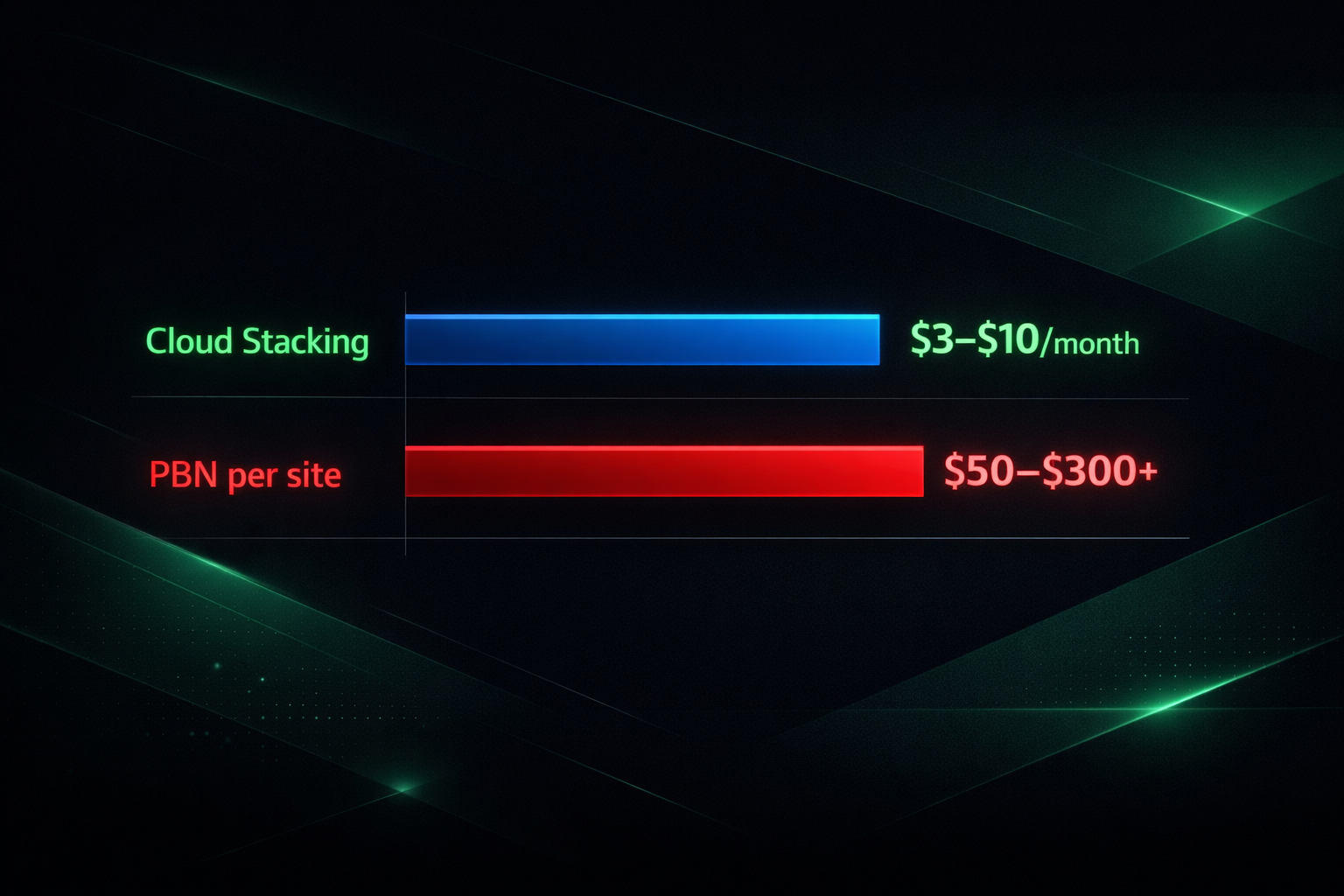
PBNs involve substantially higher upfront and ongoing costs. Acquiring aged or expired domains with meaningful domain authority metrics requires participation in domain auctions, where competitive domains regularly sell for $100–$300 or more. Each domain then requires separate hosting — ideally on different hosting providers to reduce footprint detection signals — and content that is at least superficially plausible as a real website. A ten-site PBN built to a functional standard might cost $1,000–$3,000 to establish and require ongoing content and maintenance expenditure to remain viable. Scaling a PBN to compete in competitive niches multiplies these costs significantly.
Speed and Longevity of Results
PBNs have historically offered faster ranking movement than most other link-building methods because the link equity from aged domains with established backlink profiles can be passed quickly and anchor text can be set precisely. For short-term campaigns — affiliate promotions, time-limited offers, or situations where speed matters more than long-term stability — this speed advantage has made PBNs appealing despite their risks.
Cloud stacking typically produces more gradual results because the authority being borrowed from cloud platforms is subdomain-level rather than root-domain level in many implementations. The interlinked structure takes time to establish topical relevance signals, and the content quality requirements for the strategy to function at all add to setup time. However, a cloud stacking structure that survives algorithm updates provides more durable link equity than PBN links that may disappear entirely if the network is detected and de-indexed.
Algorithm update resilience strongly favors cloud stacking over PBNs in most scenarios. Each major Google algorithm update — including the Helpful Content Update and SpamBrain improvements — has disproportionately affected PBN-dependent sites. Cloud stacking, when implemented with quality content and genuine topical relevance, has shown greater stability across update cycles, though this is not a guarantee of immunity from future algorithmic changes.
Cloud Stacking for Local SEO
One area where cloud stacking holds a distinct practical advantage over PBNs is local SEO. Cloud-hosted properties can include consistent business entity information — name, address, phone number — functioning similarly to structured local citations. These properties can point link equity toward a Google Business Profile or local landing page while simultaneously reinforcing entity SEO signals that help Google associate a business with its geographic area and service categories.
PBNs are less well-suited to local SEO because their artificial nature makes it difficult to create the kind of consistent, coherent brand signals that Google’s local ranking algorithm values. A PBN site pretending to be a local resource rarely contributes meaningful entity or brand signals beyond raw link equity, and that link equity is at constant risk of disappearing. For local businesses — medical clinics, law firms, service businesses — the cloud stacking approach, when executed with genuine content and proper NAP consistency, is likely the lower-risk and more strategically aligned option of the two.
Hybrid Strategy: Cloud Stacking as Tier 2
One of the more sophisticated applications of cloud stacking is using it as a Tier 2 link-building layer rather than pointing cloud links directly at a money site. In this approach, cloud-hosted properties link to Tier 1 assets — such as guest posts on real editorial websites, digital PR placements, or niche edits on established sites — rather than directly to the money site itself. This amplifies the authority of genuinely earned Tier 1 links without exposing the money site to direct contact with cloud-stacked content.
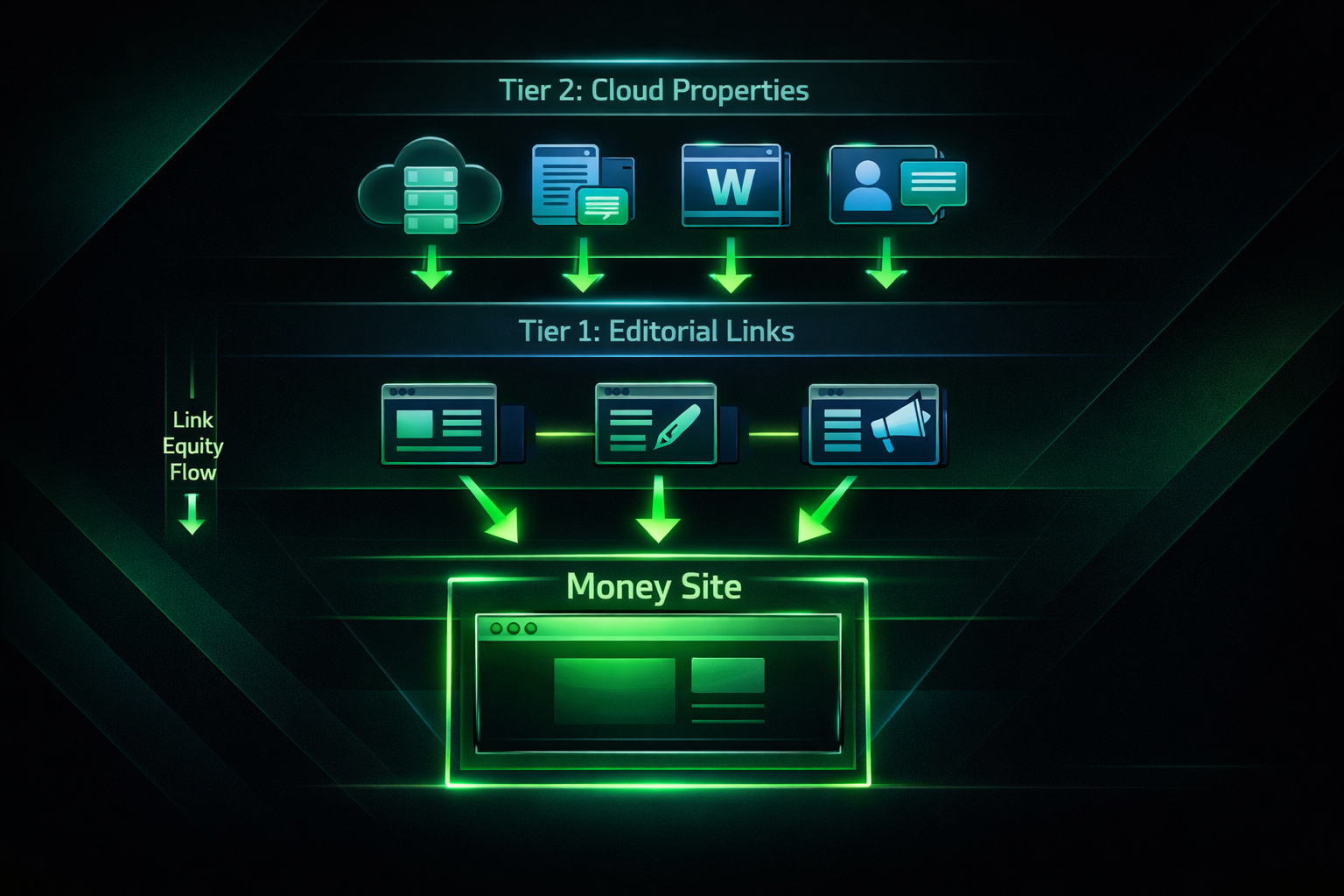
This tiered link building approach offers better algorithm update resilience than either tactic used in isolation. The money site’s backlink profile consists of real editorial links, while the cloud properties strengthen those links at the second tier. If any cloud property is eventually devalued algorithmically, the money site retains its Tier 1 link profile. This is a meaningfully different risk structure than pointing PBN links or cloud stacks directly at a money site, and it represents a more defensible long-term strategy for sites where maintaining rankings through algorithm updates is a priority.
Limitations and Honest Counterpoints
Cloud stacking has credible critics. One perspective held by some experienced SEOs is that cloud stacking is an overrated tactic built on a partial understanding of how domain-level authority signals actually function. The authority of cloud platforms like AWS or Google Cloud does not automatically transfer to any page hosted within their infrastructure at a scale that meaningfully moves competitive rankings. Subdomain-level authority and root-domain authority are different things, and treating cloud-hosted pages as equivalent in link equity to editorial placements on high-authority publications misrepresents how link signals work.
At scale, cloud stacking also drifts closer to the link scheme territory it claims to avoid. A network of hundreds of thin HTML pages hosted across cloud providers, interlinked artificially, and all pointing toward the same money site is structurally similar to a PBN regardless of the hosting platform used. The hosting platform provides a degree of insulation from detection, not a permanent exemption from Google’s guidelines. Practitioners relying heavily on cloud stacking as a primary link-building strategy — rather than as a supporting element within a broader approach — may find themselves with an artificially inflated backlink profile that is fragile under sustained algorithmic scrutiny.
For PBNs, the limitations are starker. The strategy requires ongoing investment, ongoing risk management, and ongoing exposure to a risk that compounds as Google’s detection capabilities improve. There is no compliant path forward for PBNs; the only exit strategy if a network is detected is disavowal and recovery — a process that can take substantial time and may not fully restore prior rankings.
Alternatives Worth Considering
Both cloud stacking and PBNs exist within a broader link-building landscape that includes substantially safer and more durable alternatives. Digital PR — earning genuine media coverage through newsworthy angles, original data, or expert commentary — produces editorial links from high-authority publications that carry real topical relevance and brand signals. A handful of well-placed digital PR links from established media outlets will typically outperform dozens of cloud-stacked or PBN links in both authority and durability.
Niche edits — inserting links into existing, indexed content on real websites through outreach — and traditional guest posting on genuine editorial sites offer more defensible backlink profiles than either tactic discussed here, though quality varies significantly across providers. Parasite SEO, which involves publishing content on high-authority third-party platforms, shares some structural similarities with cloud stacking but typically relies on platforms with genuine audiences and engagement signals.
For businesses with the patience and resources for it, building genuinely linkable assets — original research, useful tools, comprehensive guides — generates links that represent real editorial endorsement. These links are inherently algorithm update resilient because they reflect genuine interest from other webmasters, which is precisely what Google’s link signals are designed to reward.
Frequently Asked Questions
Is cloud stacking white hat or black hat SEO?
Cloud stacking occupies gray-hat SEO territory. When implemented with quality content, genuine topical relevance, and natural linking patterns, it is closer to legitimate citation building. When deployed at scale with thin or automated content purely to manipulate rankings, it functions as a link scheme and falls into black-hat territory under Google’s spam policies.
Can Google detect cloud stacking?
Google can identify cloud stacking operations that exhibit link scheme characteristics — particularly those using thin content, unnatural anchor text patterns, and large-scale interlinked networks targeting a single money site. The cloud hosting platform provides some insulation from detection, but it does not make cloud stacking invisible to SpamBrain or Google’s quality review processes.
Are PBNs ever worth the risk?
For short-term campaigns where ranking speed matters and the site has low brand sensitivity, some practitioners accept the PBN risk. However, given that PBNs are explicitly prohibited, detection can result in a manual action that takes months to recover from, and Google’s detection capabilities have substantially improved, the risk-to-reward ratio for PBNs has deteriorated significantly in recent years.
How much does cloud stacking cost compared to a PBN?
Cloud-hosted properties typically cost $3–$10 per month in platform fees, making cloud stacking considerably more affordable at the infrastructure level. A meaningful PBN requires domain acquisition ($100–$300+ per domain), separate hosting per site, and ongoing content costs, making it substantially more expensive to build and maintain.
Which is better for local SEO: cloud stacking or PBNs?
Cloud stacking is generally better suited to local SEO because it can incorporate consistent business entity information — name, address, phone number — that reinforces local brand signals alongside link equity. PBNs provide link equity but contribute little to the entity and citation signals that Google’s local ranking algorithm values.
What is the best way to use cloud stacking safely?
The most defensible cloud stacking approach uses quality content with genuine topical relevance, maintains anchor text diversity, and uses cloud properties as Tier 2 amplification for existing editorial links rather than as direct links to a money site. Limiting scale and avoiding automation reduces the risk of the strategy being flagged as a link scheme.
Cloud Stacking or PBNs: Choosing the Approach That Fits Your Risk Tolerance
Cloud stacking and private blog networks represent two distinct points on the risk-reward spectrum of manipulative link building. PBNs offer speed and control but carry explicit policy violations, high detection risk from SpamBrain, and potentially severe consequences including manual action and de-indexation. Cloud stacking is more accessible, less risky in well-executed implementations, and better suited to use cases like local SEO and Tier 2 link amplification — but it is not without limitations, and treating it as a standalone solution for competitive national keywords overstates what cloud-hosted properties can reliably deliver.
For most businesses, particularly those with established brands or meaningful organic traffic to protect, neither tactic should be the foundation of a link-building strategy. The most algorithm update resilient backlink profiles are built on genuine editorial links, digital PR, and well-executed outreach — assets that reflect real endorsement rather than artificial construction. Cloud stacking can play a supporting role within that broader strategy; PBNs represent a risk that grows larger as Google’s detection capabilities continue to develop.
If you are evaluating either approach for your website, consider the long-term cost of a penalty against the short-term ranking benefit. Speaking with an experienced SEO professional who can assess your specific competitive landscape, risk tolerance, and current backlink profile will provide better guidance than any general framework can offer.