

Inheriting a private blog network — whether through a business acquisition, an agency handover, or a partnership arrangement — puts you in control of an asset whose full history and construction quality you may not know. Before you route any links through inherited PBN sites or invest in maintaining them, a structured operational audit helps you understand what you actually have: which domains carry meaningful link equity, which sites present footprint concerns, which content is thin or outdated, and which placements are already pointing to your target URLs. The audit does not need to be exhaustive on day one, but it does need to be systematic enough to inform a clear decision about which parts of the network are worth keeping, which need remediation, and which should be retired.
Key Takeaways
- An inherited PBN audit covers four interconnected layers: domain quality, site-level operational health, content and placement quality, and network-wide footprint assessment.
- Third-party metrics such as Domain Rating (Ahrefs), Domain Authority (Moz), and Trust Flow (Majestic) are useful starting points but are not interchangeable and do not directly reflect Google’s internal scoring.
- Footprint analysis — covering hosting, registration patterns, CMS configuration, and interlinking — is one of the most operationally important parts of auditing a network you did not build yourself.
- Content quality, topical relevance, and placement context matter as much as domain-level metrics when assessing whether a PBN site can deliver useful link equity to a target page.
- The audit output should produce a tiered action plan: sites to keep and maintain, sites to remediate, and sites to retire or replace.
Why an Operational Audit Matters Before You Use an Inherited Network
A PBN you inherit is not a blank slate. Every domain in the network carries a history — how it was registered, what content was published on it, how it was hosted, which sites it links to, and how it has been maintained. If the previous operator built the network carefully, that history is an asset. If the network was assembled quickly with minimal attention to quality or footprint management, that history may create operational problems that affect the link equity the network can deliver and the risk profile it carries for your target sites.
The practical reason to audit before using the network is straightforward: you need to know whether the sites are indexed, whether the domains have clean backlink profiles, whether the content is topically coherent, and whether the hosting and registration patterns create an obvious shared footprint. Acting on those questions before you place new links — or before you continue existing placements — gives you the information needed to make deliberate decisions rather than inheriting someone else’s operational choices without review.
An audit also establishes a baseline. Once you know the current state of each domain and each placement, you can monitor changes over time: indexing status, referring domain counts, metric movements, and any manual action notifications that appear in Google Search Console accounts associated with the network’s sites.
Layer One: Domain-Level Quality Assessment
The first layer of any inherited PBN audit focuses on the domains themselves. For each domain in the network, you want to answer four questions: Does the domain have a meaningful backlink profile? Is that profile clean? Is the domain’s historical topical relevance consistent with its current use? And is the domain currently indexed?
Backlink Profile Review
Pull each domain’s backlink profile using Ahrefs, Semrush, or Majestic — ideally more than one tool, since each crawler has different coverage. Look at the number of referring domains, the quality distribution of those referring domains, and the anchor text spread. A domain with a large proportion of referring domains from link directories, comment spam, or unrelated foreign-language sites may have a profile that search engines have already discounted or flagged. Anchor text that is heavily weighted toward exact-match commercial terms can indicate previous aggressive link building that may have attracted algorithmic scrutiny.
Trust Flow and Citation Flow from Majestic give a useful signal about the quality ratio of a domain’s inbound links, though these are proprietary metrics and not direct proxies for Google’s assessment. Domain Rating from Ahrefs reflects the strength of the referring domain graph but similarly does not map directly to ranking influence. Use these metrics comparatively across the network rather than treating any single score as a pass/fail threshold.
Indexing Status
Check whether each PBN domain is currently indexed in Google. A simple site: search gives a rough indication, though it is not exhaustive. If a domain has been deindexed — meaning Google has removed it from its index entirely — that domain cannot pass link equity through its outbound links regardless of its metric scores. Deindexation may result from a manual action, a crawl budget issue, thin content, or previous spam. Identifying deindexed domains early prevents you from routing links through sites that are not contributing to your campaign.
Domain History and Topical Relevance
Use the Wayback Machine to review archived versions of each domain. You want to understand what the domain was used for before it was acquired for the PBN, whether its content history is topically consistent with its current use, and whether it was previously used as a PBN site under different ownership. A domain that was a legitimate niche publication before acquisition generally carries more useful historical context than one that cycled through multiple unrelated uses or was previously a link farm. Topical relevance between the PBN site’s subject matter and the target page it links to is a meaningful quality factor for the link placement itself.
Layer Two: Site-Level Operational Health
Once you have assessed the domains, the next layer examines each site as a functioning web property. This covers technical configuration, content quality, and the operational signals that distinguish a maintained site from one that has been neglected.
Technical Configuration Checks
Crawl each site using Screaming Frog or a comparable tool. Look for broken internal links, missing meta tags, duplicate content across pages, crawl errors, and pages that are blocked from indexing by robots.txt or noindex directives. A site with significant technical problems may not be crawled efficiently, which affects how reliably its outbound links are discovered and processed.
Check that each site loads over HTTPS and that SSL certificates are valid. Review page speed using Google’s PageSpeed Insights or a similar tool. Sites with very slow load times or persistent technical errors present a weaker operational foundation than well-maintained properties, and they may also be less likely to attract natural engagement signals that support their continued indexing.
Content Quality and Freshness
Review the content on each PBN site. Thin content — pages with very little substantive information, pages that are clearly templated, or posts that exist only to host an outbound link — is a quality concern both for the site’s own indexing and for the value of the link placement it contains. Content that is topically coherent, reasonably detailed, and updated periodically presents a stronger operational profile than static thin pages that have not been touched since the domain was acquired.
Note the publication dates of existing content and whether any new content has been added recently. A site that has not been updated in two or more years may have declining crawl frequency, which affects how quickly new placements on that site are discovered. If the inherited network includes sites with outdated or thin content, a content remediation plan is a practical part of the audit’s output.
Google Search Console Access
If the previous operator maintained Google Search Console accounts for the network’s sites, gaining access to those accounts is a high-priority operational step. Search Console provides direct information about indexing coverage, crawl errors, manual actions, and search performance. A manual action notification in Search Console for a PBN site is a significant finding that affects how you treat that site going forward. Not every inherited network will have Search Console accounts set up, but where they exist, the data they contain is more authoritative than any third-party metric.
Layer Three: Footprint Analysis
Footprint analysis is the part of a PBN audit that is most specific to inherited networks. When you build a network yourself, you make deliberate choices about hosting, registration, CMS configuration, and interlinking. When you inherit a network, you need to reconstruct those choices and assess whether they create patterns that could associate the sites with each other or with the target properties they link to.
Hosting and IP Distribution
Identify the hosting provider and IP address for each site in the network. Sites hosted on the same IP address or within the same IP class C block share a hosting footprint that may be visible to search engine crawlers. The significance of shared hosting in footprint detection is a subject of ongoing SEO industry discussion, and no public threshold or enforcement formula has been published by Google. However, from an operational quality standpoint, distributing sites across different hosting providers and IP ranges is a standard practice in well-constructed networks, and an inherited network that concentrates all its sites on a single host or a small number of IPs is worth noting as a remediation candidate.
Domain Registration Patterns
Review the WHOIS records for each domain, where available. Domains registered through the same registrar account, with the same contact details, or with identical registration and expiry patterns may share a registration footprint. Privacy protection services reduce the visibility of registrant details, but registration timing patterns can still be visible. An inherited network where all domains were registered in the same short window, or where privacy protection was inconsistently applied, presents a more visible footprint than one where registration was distributed across time and registrars.
CMS and Theme Patterns
Check the CMS and theme configuration of each site. A network where every site runs the same WordPress theme, the same set of plugins, and the same default configuration presents a more uniform technical fingerprint than one where configuration has been varied deliberately. This does not mean every site needs a completely unique setup, but identical configurations across a large number of sites in the same network is an operational pattern worth addressing during remediation.
Interlinking Between Network Sites
Map any direct links between sites within the inherited network. Interlinking between PBN sites — where Site A links to Site B, which links to Site C — creates a visible connection between properties that may otherwise appear independent. Review whether the inherited network contains systematic interlinking and whether those links serve a content purpose or exist purely as a structural pattern. Excessive interlinking between network sites without topical justification is a footprint concern that remediation should address.
Layer Four: Placement and Link Profile Review
The fourth layer of the audit focuses on the outbound links from the network’s sites — specifically, which target URLs are being linked to, what anchor text is being used, and whether the placement context is appropriate for the target page.
Mapping Existing Placements
Create a complete map of every outbound link from every site in the network. For each placement, record the source URL, the target URL, the anchor text, the position of the link within the content, and whether the link is followed or nofollowed. This map gives you a clear picture of which target sites are currently receiving links from the network, how many placements each target site has, and what the anchor text distribution looks like across the network’s outbound profile.
Anchor Text Distribution
Anchor text strategy is a meaningful quality factor in any link-building campaign. Review the anchor text used across all existing placements in the inherited network. A profile that is heavily concentrated on exact-match commercial anchors — particularly if those anchors are repeated across multiple placements to the same target URL — presents a different risk profile than one where anchor text is varied across branded, partial-match, topical, and navigational terms. The appropriate anchor text distribution depends on the target site’s existing backlink profile and competitive context, but an inherited network with a rigid exact-match anchor pattern is worth flagging for adjustment.
Placement Context and Topical Relevance
For each existing placement, assess whether the link appears within content that is topically relevant to the target page it points to. A contextual link within a substantive article on a topically related PBN site presents a stronger placement than a link dropped into an unrelated post or placed in a site footer. Review whether the surrounding content makes the link placement natural in context, and whether the PBN site’s overall subject matter aligns with the niche of the target page. Placements that lack topical coherence are candidates for content remediation or replacement.
Building Your Audit Output: A Tiered Action Plan
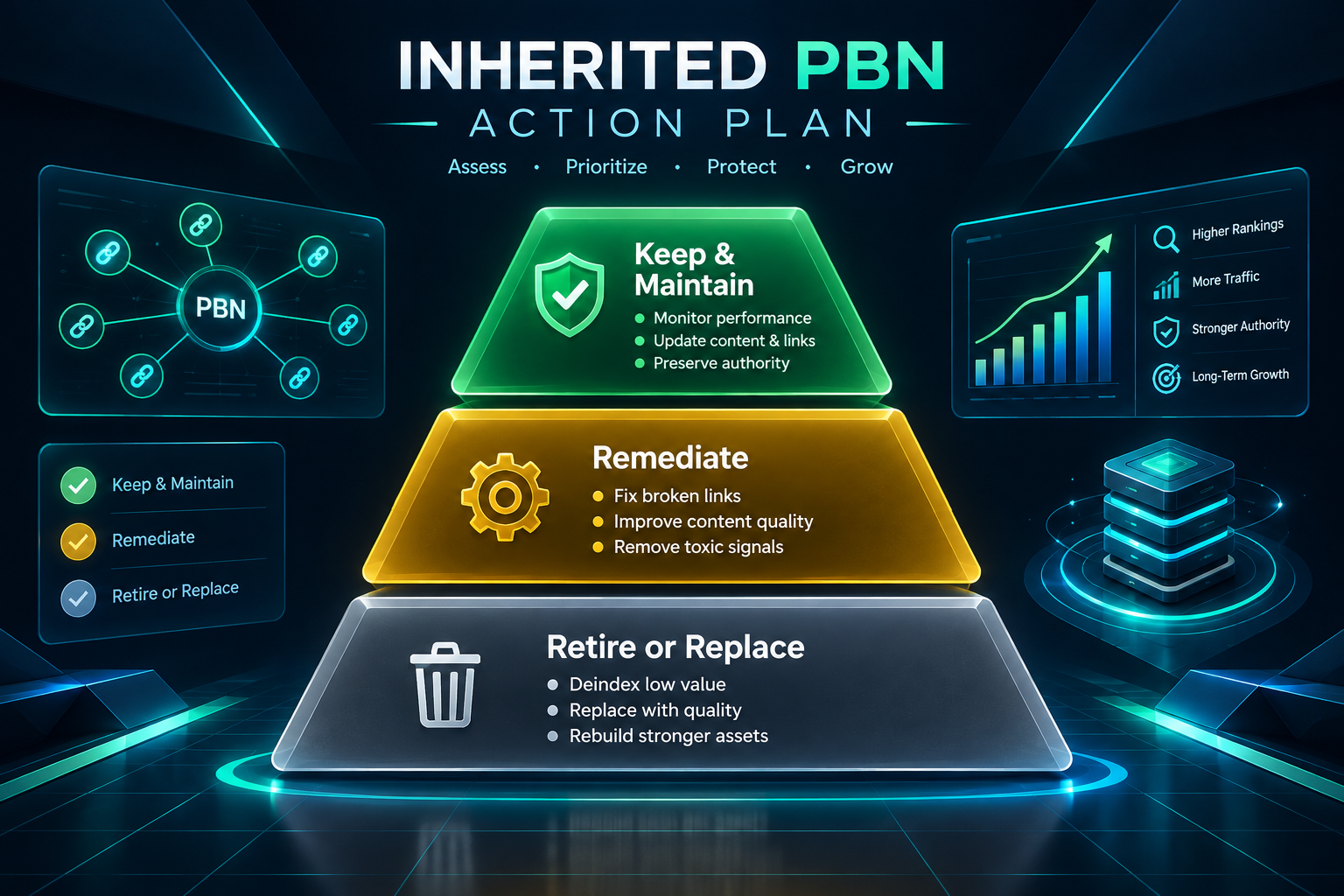
The goal of the audit is not just documentation — it is a prioritized action plan that tells you what to do with each part of the inherited network. A practical tiered structure organizes the network’s sites into three categories based on audit findings.
- Tier One — Keep and Maintain: Domains with clean backlink profiles, consistent topical history, current indexing, reasonable content quality, and no significant footprint concerns. These sites are operational assets that can be used for new placements after confirming anchor text strategy and placement context.
- Tier Two — Remediate: Domains with addressable issues — thin content that can be improved, outdated posts that can be refreshed, minor technical errors that can be corrected, or hosting arrangements that can be migrated. These sites have underlying domain quality worth preserving but need operational work before they are fully reliable placement sources.
- Tier Three — Retire or Replace: Domains that are deindexed, carry heavily spammy backlink profiles, have no topical coherence, or present footprint concerns that cannot be practically resolved. Continuing to use these sites for placements may not deliver meaningful link equity and may create operational complications for the target sites they link to. Retiring these domains and replacing them with higher-quality properties is the more productive path.
Monitoring After the Initial Audit
An inherited PBN audit is not a one-time event. Once you have completed the initial review and implemented your action plan, ongoing monitoring keeps you informed about changes that affect the network’s operational health. Set up Google Search Console for any network sites that do not already have it configured. Monitor indexing status periodically for each domain, particularly after content updates or hosting migrations. Track referring domain counts for each PBN site using Ahrefs or Semrush to identify unexpected link loss or profile changes. Review the target sites’ backlink profiles regularly to confirm that placements remain live and that anchor text distribution stays within the parameters of your strategy.
If a PBN site loses indexing after the audit, investigate the cause before routing new placements through it. If a target site experiences a significant ranking change, review the full backlink profile and technical SEO context rather than attributing the change to a single placement without evidence. Monitoring provides the data needed to make informed adjustments rather than reactive decisions.
Frequently Asked Questions
How long does a thorough PBN audit typically take?
The time required depends on the size of the network. A network of ten to twenty sites can typically be audited at the domain and site level within a few days using tools like Ahrefs, Screaming Frog, and the Wayback Machine. Larger networks of fifty or more sites may require a week or more, particularly if footprint analysis and content review are conducted in detail. Prioritizing the highest-metric domains first allows you to make early decisions about the most valuable assets while the full audit continues.
Which tools are most useful for auditing an inherited PBN?
Ahrefs and Semrush are the most commonly used tools for backlink profile analysis and domain metric assessment. Majestic provides Trust Flow and Citation Flow, which offer a useful additional perspective on link quality. Screaming Frog is practical for site-level technical crawls. The Wayback Machine is essential for reviewing domain history. Google Search Console, where accessible, provides the most authoritative data on indexing and manual actions for individual sites.
What should I do if I find a manual action on one of the inherited sites?
A manual action on a PBN site means Google has taken a specific enforcement action against that property. The nature and scope of the action — whether it is page-level or sitewide — affects how you treat the site. Review the manual action details in Search Console, assess whether the site’s issues are addressable, and make a deliberate decision about whether remediation is practical or whether retiring the domain is the more efficient path. Do not continue routing new placements through a site with an active manual action without first understanding its scope.
Can I use an inherited PBN site that has lost some referring domains over time?
Referring domain loss is common for aged domains and does not automatically disqualify a site from use. The relevant question is whether the remaining backlink profile is clean and whether the domains that were lost were high-quality links or low-quality ones. A domain that has shed spammy referring domains over time may actually have a cleaner profile than it did at acquisition. Review the current profile quality rather than focusing solely on the count of referring domains.
How do I assess topical relevance for an inherited PBN site?
Review the site’s current content categories, the archived content from the Wayback Machine, and the anchor text and source topics of its inbound links. A site that has consistently covered a specific niche — home improvement, personal finance, health and wellness — has clearer topical relevance than one that has published content across unrelated subjects. Match the site’s topical profile against the niche of the target page it is intended to link to, and assess whether the placement context makes the link editorially coherent within the site’s subject matter.
Should I disclose the inherited PBN to the target site’s owner?
If you are auditing a PBN on behalf of a client whose site is the link target, transparency about the network’s structure and quality findings is a practical part of the professional relationship. The decision about disclosure beyond that context depends on the specific business arrangement and is outside the scope of a technical audit. The audit itself should document findings accurately regardless of what disclosure decisions follow.
Deciding What to Do With an Inherited PBN After the Audit
Completing an inherited PBN audit gives you a factual foundation for decisions that would otherwise be made on assumption. You know which domains have clean, relevant backlink profiles and which carry historical baggage. You know which sites are indexed, which have technical problems, and which have content that supports credible placement context. You know whether the network’s hosting, registration, and CMS patterns create a visible shared footprint, and you know what the existing placements look like in terms of anchor text distribution and topical coherence.
The practical output of that knowledge is a tiered action plan: maintain the network’s strongest assets, remediate the sites with addressable issues, and retire the properties that do not justify the operational investment. That plan is more useful than a binary keep-or-discard decision applied to the whole network, because most inherited networks contain a mix of quality levels rather than being uniformly strong or uniformly weak.
If the audit reveals that a significant portion of the inherited network needs replacement or that the existing placements do not align with your target site’s anchor text strategy, reviewing your broader link-building requirements with an experienced provider is a practical next step. PBN Backlinks Service can help you assess placement quality, evaluate domain suitability, and structure a campaign that complements the network assets worth keeping. The audit tells you where you stand; the action plan tells you where to go from there.