

When you restore or rebuild a website on an expired domain for use in a private blog network, one of the most overlooked practical questions is what to do with the images that were originally on that site. The archived content may still be accessible through the Wayback Machine, and some operators assume that because the domain is now theirs, the old photographs, graphics, and illustrations are theirs to use as well. That assumption is legally and practically incorrect in most cases, and understanding why matters for anyone managing a PBN site at scale.
Key Takeaways
- Owning or registering an expired domain does not transfer the copyright in images that were previously published on that domain. Image rights belong to the original creator or rights holder, not the domain registrant.
- Restoring archived content from the Wayback Machine or a cached copy and republishing it on a rebuilt PBN site creates potential copyright exposure unless you can verify the original license terms.
- Freely licensed images, public domain visuals, and original images created for the restored site are the most straightforward options for populating a rebuilt PBN property with usable media.
- Image licensing decisions on a PBN site are separate from the site’s link-building function, but poor content quality — including improperly used visuals — can affect how the site is perceived by crawlers and human reviewers.
- A practical image strategy for a restored PBN site focuses on relevance, originality, and clear licensing rather than recycling whatever was previously hosted on the domain.
What Happens to Images When a Domain Expires?
When a domain expires and is eventually acquired by a new registrant, the transfer covers the domain name itself — the address that resolves to a server. It does not transfer any intellectual property that was previously associated with the website hosted at that address. Copyright in photographs, illustrations, infographics, and other visual content belongs to the creator or to whoever the creator assigned those rights to, and that ownership is entirely independent of domain registration. A photographer whose work appeared on a travel blog does not lose their rights to those images simply because the blog’s domain lapsed and was picked up at auction.
This distinction matters practically because many PBN operators restore expired domains by pulling archived versions of the original site from the Wayback Machine or similar services. The archived HTML, text, and images may all be accessible, and it can be tempting to republish that content wholesale to preserve the site’s historical appearance and topical context. Doing so with images, however, means republishing copyrighted material without a license from the rights holder in the vast majority of cases. The original site owner may have licensed those images from a stock library, commissioned them from a photographer, or used images under terms that did not permit redistribution by a third party.
Why Image Licensing Matters on a PBN Site
PBN sites function as link-building assets. Their primary purpose is to host content that contains contextual backlinks pointing to a target website. The content quality, topical relevance, and overall presentation of each PBN property can influence how those links are evaluated, both by automated crawlers and, in some cases, by human reviewers. A site that appears thin, poorly assembled, or legally problematic is a weaker asset than one that reads as a credible, well-maintained web property.
Image licensing is part of that broader content quality picture. A site populated with improperly used images — particularly images that have been flagged or removed from other platforms for copyright reasons — can attract unwanted attention. More directly, a rights holder who discovers their images being used without permission on a rebuilt domain can file a DMCA takedown notice with the hosting provider. A successful takedown can result in content removal or, in more serious cases, hosting account suspension. Either outcome disrupts the PBN site’s availability and, by extension, the backlinks it hosts. For a PBN operator managing multiple properties, a pattern of DMCA complaints across a network is a meaningful operational risk that has nothing to do with search-engine link policies.
Beyond the legal dimension, image quality and relevance contribute to the overall credibility of a PBN property. A restored site that uses blurry, outdated, or obviously mismatched images from a decade-old archived version of the site looks less like a genuine web property and more like a hastily assembled placeholder. That presentation affects the site’s usefulness as a link-building asset over time.
Can You Legally Reuse Old Images Found on an Expired Domain?
The short answer is: not without verifying the original license terms, and in most cases the original license terms cannot be verified or do not permit reuse by a new domain owner. Here is why that is the practical reality for most restored PBN sites.
Stock photography licenses are typically granted to a specific licensee for a specific use. When a business licensed an image from Getty Images, Shutterstock, or a similar library to use on their website, that license covered that business’s use of the image on that website. The license did not transfer to whoever later acquired the domain. A new domain owner republishing those images is using them outside the scope of the original license, which constitutes infringement regardless of how the domain was acquired.
Custom photography and commissioned illustrations present the same problem. A business that hired a photographer to shoot product images or a designer to create custom graphics typically owns those images under a work-for-hire arrangement or a specific assignment of rights. Those rights belong to the original business, not to the domain. When that business ceases to operate and the domain expires, the images do not become ownerless or freely available.
Creative Commons licensed images are a partial exception, but only if the specific license terms permit the type of reuse you intend. Some Creative Commons licenses allow redistribution and adaptation; others require attribution, prohibit commercial use, or require that derivative works carry the same license. Even with a permissive Creative Commons license, you would need to identify the specific license version, comply with its attribution requirements, and confirm that the commercial context of a PBN site does not conflict with a non-commercial use restriction. Verifying all of this for images found in an archived version of an old website is rarely straightforward.
Public domain images are genuinely free to reuse without restriction. An image enters the public domain when its copyright term expires, when the creator explicitly dedicates it to the public domain, or when it was created by a government entity in a jurisdiction where government works are not copyrightable. If you can confirm that a specific image is in the public domain, you can use it freely. The challenge is that confirming public domain status for an image found in an archived website requires knowing the image’s origin, creation date, and the applicable copyright jurisdiction — information that is rarely available from the archived page alone.
Practical Image Strategies for Restored PBN Sites
Given that reusing old images from an expired domain’s archived content is legally problematic in most cases, the practical question becomes how to populate a restored PBN site with appropriate visuals efficiently and at reasonable cost. Several approaches work well depending on the scale of the operation and the topical focus of the site.
Use Freely Licensed Stock Images
Several platforms offer images under licenses that permit commercial use without payment or with minimal attribution requirements. Unsplash, Pexels, and Pixabay are widely used sources for freely licensed photography. Each platform has its own license terms, and it is worth reading those terms carefully, particularly regarding attribution and any restrictions on use in certain contexts. These libraries cover a wide range of general topics and are a practical starting point for most PBN sites that need to look like credible content properties without a large image budget.
Purchase Stock Images Under a Commercial License
For PBN sites in competitive niches where visual quality matters more, purchasing images from a stock library under a standard commercial license is a clean and straightforward solution. Platforms such as Shutterstock, Adobe Stock, and iStock offer subscription plans and on-demand purchasing. A commercial license from one of these platforms gives you clear rights to use the image on a website, and the license terms are documented. This approach costs more than free libraries but eliminates ambiguity about usage rights.
Create Original Images for the Site
Original images created specifically for a restored PBN site carry no licensing complications because you own the copyright from the moment of creation. This can include photographs taken for the purpose, custom graphics created in design tools, or AI-generated images produced using tools where the output is assigned to the user under the platform’s terms of service. AI image generation has become a practical option for PBN operators who need topically relevant visuals at scale without photography costs. The licensing terms for AI-generated images vary by platform, so reviewing the specific terms of the tool you use is important before relying on this approach commercially.
Use Public Domain Image Archives
For sites in certain niches — history, science, art, travel, nature — public domain archives such as the Library of Congress digital collections, Wikimedia Commons public domain category, and NASA’s image library offer high-quality images that are genuinely free to use without restriction. These sources require some research to identify relevant images, but they are a legitimate and cost-free option for appropriate topics.
How Image Decisions Affect PBN Site Quality
A restored PBN site’s value as a link-building asset depends partly on how convincingly it presents as a real, maintained web property. Images contribute to that presentation in several ways. Relevant, high-quality images make articles look more complete and professionally produced. They break up long text passages and improve the reading experience for any human visitor who lands on the page. They also provide additional on-page signals — through file names, alt text, and surrounding content — that can reinforce the topical relevance of the page hosting the backlink.
Conversely, missing images, broken image links, or obviously recycled visuals that do not match the current content can make a restored site look abandoned or hastily assembled. If the original site’s images were hosted on an external CDN or the original server, those image URLs will return 404 errors on the restored site, leaving visible gaps in the content. Replacing those broken image references with properly licensed alternatives is a straightforward improvement that makes the site look more complete and functional.
Alt text for images on a PBN site deserves the same attention as alt text on any other website. Descriptive, relevant alt text that reflects the image content and the surrounding article topic contributes to on-page relevance signals. Keyword-stuffed or generic alt text adds little value and can look unnatural. Writing accurate, concise alt text for each image is a small effort that improves the overall quality of the page.
Checking Archived Images Before Making Any Decision
If you want to assess whether any images from an expired domain’s archived content might be reusable, a structured review process reduces the risk of inadvertently using improperly licensed material. The following steps provide a practical framework for that assessment.
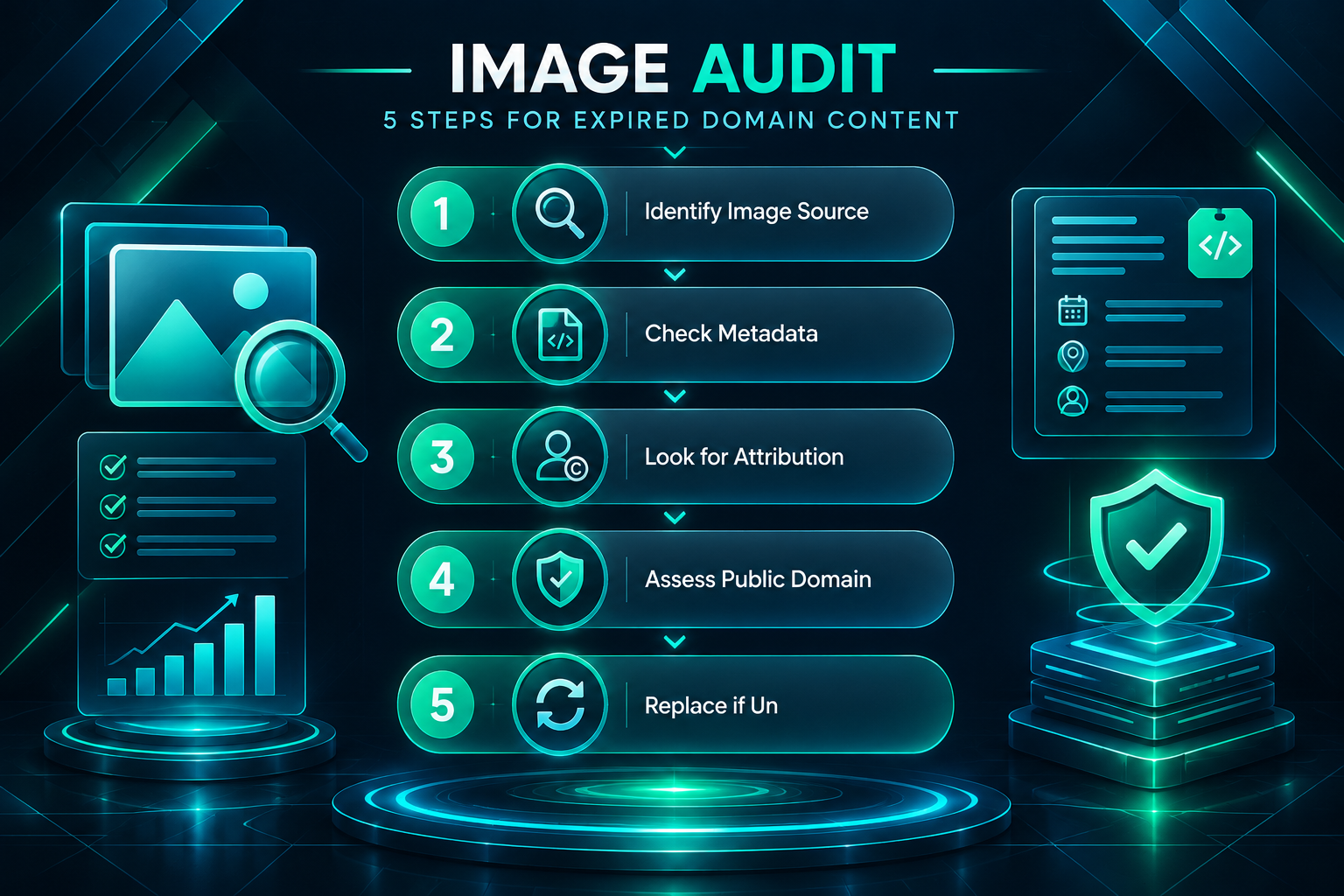
- Identify the image source. Use reverse image search tools such as Google Images or TinEye to find where each image has appeared online. If the image appears on a stock library’s website, it is almost certainly licensed material that requires a valid subscription or purchase to use.
- Check for embedded metadata. Some image files contain EXIF or IPTC metadata that identifies the photographer, copyright holder, or license terms. This metadata is often stripped during web publishing, but it is worth checking if you have access to the original files.
- Look for attribution or credit information. The original website may have included image credits in captions, footers, or page source code. A credit line pointing to a stock library or a named photographer confirms that the image is not freely reusable.
- Assess public domain eligibility. If the image appears to be a historical photograph, a government document image, or a work with a clearly expired copyright, research the specific copyright status before assuming it is in the public domain.
- Default to replacement when in doubt. If you cannot confirm that an image is freely licensed or in the public domain, replacing it with a properly licensed alternative is the lower-risk choice for maintaining the site’s operational stability.
Image Licensing in the Context of PBN Domain Selection
When evaluating expired domains for a private blog network, most due diligence focuses on backlink profile quality, domain history, topical relevance, and indexing status. Image licensing is rarely part of that initial assessment, but it becomes relevant during the restoration phase when decisions about content rebuilding are made. A domain that previously hosted a photography portfolio, a media publication, or a heavily visual niche site may have a larger proportion of licensed images in its archived content than a text-heavy blog or a service business website. Knowing the original site’s content type helps you anticipate the scale of the image replacement task before you commit to restoring that domain.
Topical relevance between the original site’s content and the PBN’s intended use also affects image strategy. If you are restoring a domain that previously covered a topic closely related to your target niche, the archived content’s images may be topically appropriate even if they need to be replaced with properly licensed versions. If the domain is being repurposed for a different topic, the original images are unlikely to be relevant regardless of their licensing status, making replacement straightforward from both a legal and a content quality perspective.
Frequently Asked Questions
Does buying an expired domain give me rights to the images that were on the original site?
No. Purchasing or registering an expired domain transfers the domain name only. Copyright in images, text, and other content created for the original website belongs to the original rights holders and does not transfer with the domain. You need a valid license to use any images from the original site’s content.
Can I use images from the Wayback Machine archive of an expired domain?
Accessing archived images through the Wayback Machine does not grant you a license to republish them. The Wayback Machine preserves copies of web content for archival purposes, but the copyright in those images remains with the original rights holders. Republishing archived images without a license is the same as republishing any other unlicensed image.
What is the safest image approach for a restored PBN site?
Using original images you create, AI-generated images under a platform license that permits commercial use, or images from reputable freely licensed libraries such as Unsplash or Pexels gives you clear usage rights without the ambiguity of archived content. Purchasing images under a documented commercial stock license is also a clean option for higher-priority sites.
How does a DMCA takedown affect a PBN site?
A successful DMCA takedown notice filed with a hosting provider can result in the removal of specific content or, in repeated cases, suspension of the hosting account. Either outcome takes the PBN site offline, which disrupts the backlinks it hosts and reduces the site’s value as a link-building asset. Avoiding unlicensed image use reduces this operational risk.
Do image alt texts on a PBN site affect SEO?
Alt text contributes to on-page relevance signals and helps search engines understand the content of an image. Descriptive, accurate alt text that reflects the image and the surrounding content is a straightforward quality improvement. Keyword-stuffed alt text is unlikely to add value and may look unnatural on a page that is otherwise well-written.
Should every image on a restored PBN site be replaced?
Not necessarily. If you can verify that specific images from the original site were published under a license that permits your intended use — such as a Creative Commons license with compatible terms — those images may be reusable with appropriate attribution. In practice, verification is often difficult, and replacing images with properly licensed alternatives is frequently the more efficient choice than researching each image individually.
Does image quality affect how a PBN site performs as a link-building asset?
Image quality contributes to the overall presentation of a PBN site as a credible web property. A site with relevant, well-chosen images looks more complete and professionally maintained than one with broken image links or obviously mismatched visuals. While image quality alone does not determine the ranking value of a backlink, it is part of the broader content quality that affects how the site is perceived.
Building a Practical Image Approach for Your PBN Properties
Image licensing on a restored PBN site is a practical operational matter rather than a complex legal specialty. The core principle is straightforward: owning a domain does not give you rights to the images that were previously hosted there, and republishing archived images without verifiable license terms creates unnecessary exposure. For most PBN operators, the efficient solution is to replace archived images with properly licensed alternatives during the restoration process rather than attempting to audit each original image’s provenance.
Freely licensed image libraries, commercial stock subscriptions, and AI-generated visuals each offer workable paths depending on the scale of your network and the budget allocated to each property. For high-priority PBN sites where content quality is a meaningful factor in the site’s long-term usefulness, investing in original or commercially licensed images is a reasonable part of the restoration budget. For lower-priority properties, freely licensed stock images from reputable sources provide adequate visual content without licensing complications.
The broader point is that image decisions are part of the content quality work that makes a restored PBN site a more durable and effective link-building asset. A site that looks complete, relevant, and properly maintained is a stronger property than one assembled from whatever archived material was easiest to recover. If you are evaluating how to build or restore PBN properties as part of a broader link-building strategy, PBN Backlinks Service can help you assess domain quality, content requirements, and placement options suited to your specific campaign goals.