

When a PBN site targets the same keywords as the money site it is meant to support, the two pages can end up competing against each other in search results rather than working together. This is a form of keyword cannibalization, and it is one of the more avoidable structural mistakes in private blog network management. Understanding how it happens, why it reduces the effectiveness of your link-building effort, and how to prevent it will help you get more value from every PBN placement you build or buy.
Key Takeaways
- Keyword cannibalization between a PBN site and a money site occurs when both pages target the same or closely overlapping search terms, causing them to compete rather than cooperate in rankings.
- PBN pages should be written to support the money site’s target keyword, not to rank for it directly — topical relevance and contextual framing are different goals.
- Anchor text strategy, content scope, and internal linking on PBN sites all influence whether a PBN placement reinforces or undermines the money site’s position.
- Cannibalization between a PBN and a money site is a structural and editorial problem, not an inherent feature of private blog networks — it can be avoided with deliberate planning.
- Monitoring which pages appear in search results for your target keywords helps identify cannibalization early, whether the competing page is on your money site or a PBN property.
What Keyword Cannibalization Means in a PBN Context
Keyword cannibalization is the condition where two or more pages on different domains — or the same domain — compete for the same search query. In a standard website context, it usually refers to multiple internal pages targeting the same term. In a PBN context, the same dynamic can emerge between a PBN post and the money site page it was created to support. When a PBN article is written to rank for the exact keyword the money site targets, search engines may index both pages as candidates for that query. Instead of the PBN page passing authority to the money site, the two pages split relevance signals and compete for the same position.
The distinction that matters here is between topical relevance and keyword targeting. A PBN page needs to be topically relevant to the money site’s subject matter so that the contextual link it contains carries meaningful relevance. However, topical relevance does not require the PBN page to target the same primary keyword. A PBN article about a related subtopic, a supporting concept, or a complementary angle can pass strong contextual authority through a link without directly competing for the same search query.
Why This Problem Occurs in Practice
The most common reason PBN pages end up cannibalizing money site keywords is that the content brief for the PBN post is written too closely to the money site’s own page. If the money site targets “best project management software for freelancers” and the PBN article is also optimized around that exact phrase, both pages may appear as candidates for that query. The PBN page, depending on the domain’s authority and the quality of its content, may even outrank the money site temporarily — which is the opposite of the intended outcome.
A second cause is over-optimization of anchor text combined with content that mirrors the money site’s page structure. When a PBN post uses the exact-match anchor text for the money site’s target keyword and then builds its own content around that same keyword, the page signals to search engines that it is itself a destination for that query rather than a supporting reference. The link from that page to the money site then carries less directional authority because the PBN page is competing for the same intent rather than clearly pointing toward the money site as the authoritative resource.
A third cause is the use of templated or thin PBN content that essentially replicates the money site’s page with minor rewording. This creates a near-duplicate situation where neither page benefits clearly, and the money site may actually be disadvantaged if the PBN page accumulates its own backlinks or engagement signals.
How to Structure PBN Content to Support Rather Than Compete
The practical solution is to treat PBN content as a supporting layer rather than a parallel ranking attempt. Each PBN page should address a related but distinct angle that naturally leads a reader — or a search engine — toward the money site as the primary resource. This means choosing a content topic for the PBN post that is semantically adjacent to the money site’s target keyword rather than identical to it.
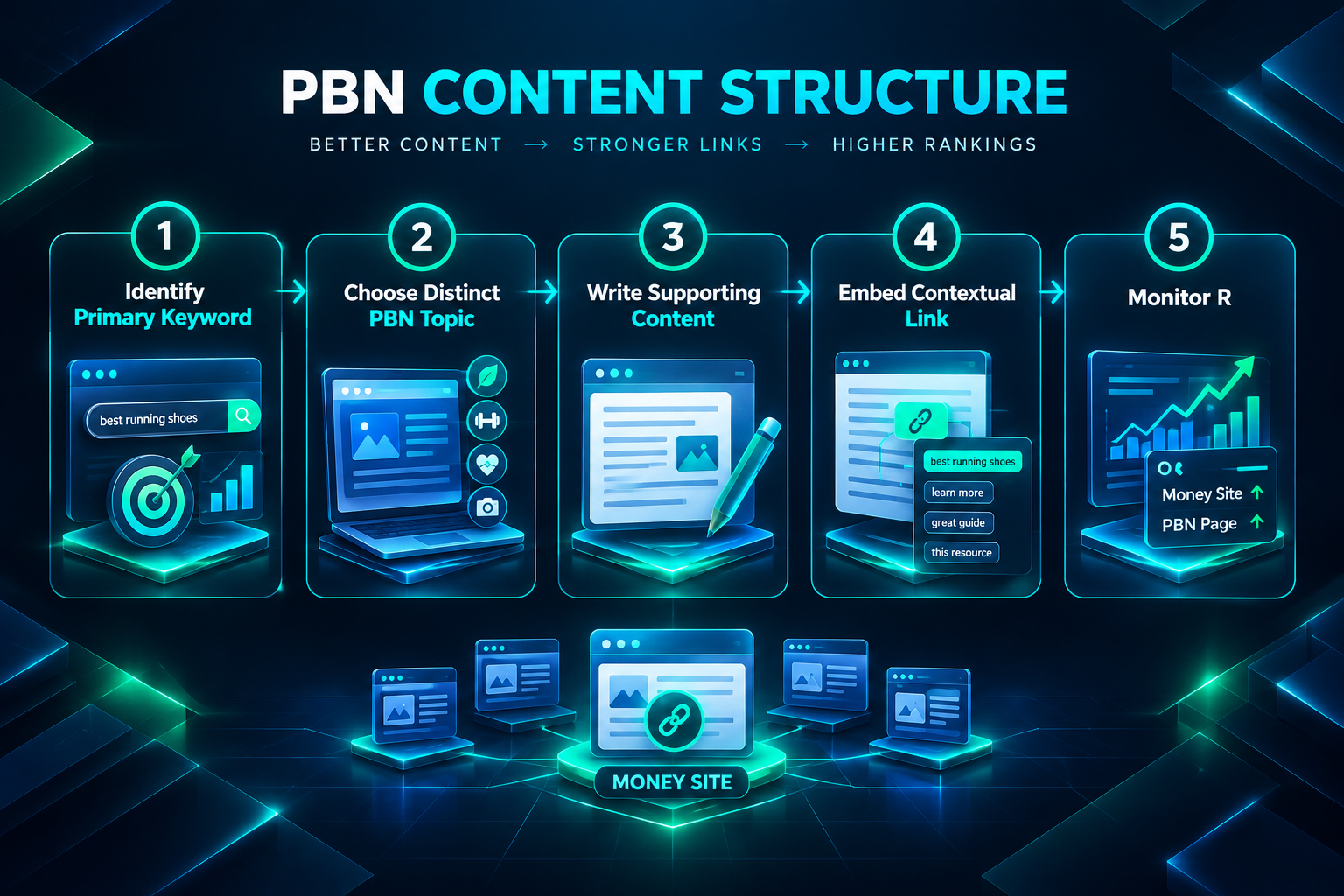
For example, if the money site’s target page covers “commercial cleaning services in Chicago,” a PBN post might address “what to look for when hiring an office cleaning company” or “how often commercial spaces should be professionally cleaned.” Both topics are topically relevant and allow a natural contextual link to the money site’s service page. Neither topic directly competes for the money site’s primary keyword. The PBN page serves as a contextual reference point rather than a competing destination.
This approach also improves the quality of the contextual link itself. A link embedded in content that discusses a related but distinct topic reads as a genuine reference rather than a self-referential loop. The anchor text can reflect the money site’s target keyword without the surrounding content competing for that keyword, because the PBN page’s own topical focus is clearly different.
Anchor Text Strategy and Cannibalization Risk
Anchor text selection plays a direct role in whether a PBN placement reinforces or dilutes the money site’s keyword targeting. Using the exact-match anchor text for the money site’s primary keyword is a common practice in PBN link building, but it needs to be paired with PBN content that does not itself target that keyword. If the PBN page’s title, headings, and body copy are all optimized around the same phrase used in the anchor text, the page becomes a competing document rather than a supporting one.
A more effective approach is to vary the anchor text across PBN placements while keeping the PBN page’s own content focused on a supporting topic. Partial-match anchors, branded anchors, and natural phrase anchors can all pass relevance to the money site’s target keyword without requiring the PBN page to optimize for that keyword directly. This reduces cannibalization risk while maintaining the contextual signal that makes PBN links valuable.
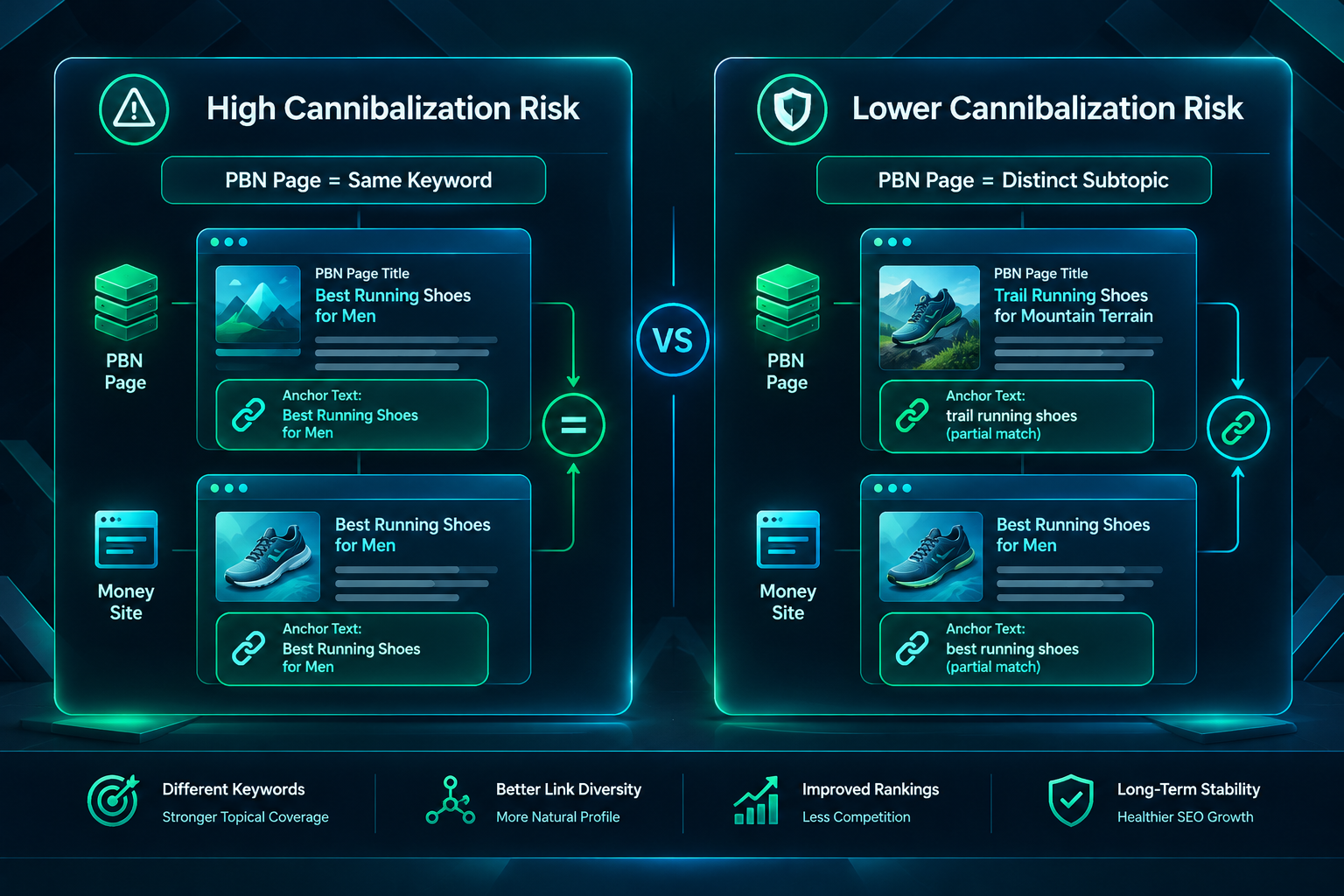
It is also worth considering the internal linking structure of the PBN site itself. If a PBN domain has multiple posts, those posts should not all target the same keyword cluster as the money site. Spreading PBN content across related but distinct subtopics creates a more natural topical profile for the PBN domain and reduces the chance that any single PBN page accumulates enough relevance signals to compete with the money site for its primary query.
Content Scope and Depth on PBN Pages
The depth and scope of PBN content affects cannibalization risk in a less obvious way. A PBN page that provides a comprehensive, well-structured answer to the money site’s exact target query may develop its own organic visibility over time, particularly if the PBN domain has strong historical authority. This is not always a problem — a PBN page that ranks for a related query and links to the money site can function as a useful traffic and authority funnel. However, if the PBN page begins ranking for the money site’s primary keyword, it becomes a direct competitor rather than a supporting asset.
Keeping PBN content focused on a narrower or more specific angle than the money site’s page helps prevent this. The money site’s target page should be the most comprehensive, authoritative resource for its primary keyword. PBN pages should address narrower questions, specific use cases, or supporting topics that naturally reference the money site without attempting to replace it as the primary answer to the main query.
This does not mean PBN content should be thin or low-effort. A well-written PBN page on a genuinely distinct topic provides a stronger contextual link than a brief, poorly structured post. The goal is topical differentiation combined with content quality, not brevity for its own sake.
Identifying Cannibalization Between a PBN and a Money Site
Detecting cannibalization between a PBN page and a money site requires monitoring which URLs appear in search results for the money site’s target keywords. If a PBN page begins appearing in the same search results as the money site for the same query, that is a clear signal that the PBN page has been indexed as a competing document rather than a supporting one.
A straightforward way to check this is to run a site-specific search or use a rank-tracking tool to monitor which pages appear for the target keyword. If a PBN domain appears alongside the money site for the same query, the PBN page’s content and optimization should be reviewed. The most common fixes are adjusting the PBN page’s title and headings to shift focus away from the competing keyword, updating the body content to address a more specific or adjacent topic, or changing the internal linking structure of the PBN site to reduce the page’s own keyword signals.
Google Search Console can help identify which queries are driving impressions and clicks to the money site. If impressions for the target keyword are split across multiple URLs — including any that belong to PBN properties — that pattern suggests cannibalization is affecting how search engines are interpreting the relevance of each page. However, Search Console only shows data for properties you have verified, so PBN pages will not appear there unless the PBN domain is also verified in your account, which is generally not advisable for footprint reasons.
Third-party rank-tracking tools that monitor specific keyword positions across multiple domains can provide a clearer picture of whether a PBN page is appearing in results for the money site’s target queries. Tracking this regularly, particularly after new PBN placements go live, allows you to catch and correct cannibalization before it becomes a persistent structural problem.
Domain Selection and Topical Relevance for PBN Placements
The choice of PBN domain affects cannibalization risk before a single piece of content is written. A PBN domain with a strong historical focus on the exact niche of the money site is topically relevant, which is generally desirable for link quality. However, if that domain’s existing content already targets the money site’s primary keywords, adding a new post that links to the money site may create a situation where the PBN domain as a whole competes with the money site for the same query cluster.
When selecting PBN domains for a placement campaign, it is worth reviewing the existing content on each domain to understand which keywords it already covers. A domain that covers a broadly related niche without directly targeting the money site’s primary keywords is often a better placement choice than a domain that has already built topical density around the exact same terms. This is particularly relevant when using aged or expired domains that carry historical content and backlink profiles — the existing topical signals on those domains will influence how search engines interpret new content added to them.
Topical relevance and keyword competition are not the same thing. A PBN domain can be highly relevant to the money site’s niche without targeting the same primary keywords. The goal is to find domains where the existing topical profile supports the money site’s subject matter without duplicating its keyword targets.
PBN Site Architecture and Internal Linking Considerations
The internal structure of a PBN site can either concentrate or distribute keyword signals across its pages. A PBN site where every post targets a variation of the same keyword cluster will develop strong topical density around that cluster, which increases the chance that individual pages on the PBN site begin competing with the money site for related queries. Distributing PBN content across a broader range of related topics reduces this concentration and makes it less likely that any single PBN page accumulates enough relevance to compete directly.
Internal linking on PBN sites should also be managed with cannibalization in mind. If a PBN site’s internal links consistently point to the page that links out to the money site, that page receives more internal authority and may develop stronger keyword signals of its own. A more distributed internal linking structure, where the PBN site’s pages link to each other across different topics, reduces the concentration of signals on any single page and keeps the outbound link to the money site functioning as a reference rather than a competing destination.
These structural considerations apply whether you are building PBN sites yourself or buying placements on an existing network. When evaluating a PBN placement provider, it is reasonable to ask about the content scope of the sites in their network and whether placements are made on pages that are topically distinct from the money site’s primary keyword targets.
Frequently Asked Questions
Can a PBN page outrank my money site for my target keyword?
It is possible, particularly if the PBN domain has strong historical authority and the PBN page is optimized around the same keyword as the money site. This is why PBN content should be written to address a related but distinct topic rather than targeting the money site’s primary keyword directly. If a PBN page does begin outranking the money site, adjusting the PBN page’s content focus and reducing its keyword optimization for that specific term is the most direct corrective step.
Does topical relevance on a PBN site always create cannibalization risk?
No. Topical relevance means the PBN site covers subject matter related to the money site’s niche, which is desirable for link quality. Cannibalization risk arises specifically when the PBN page targets the same primary keyword as the money site’s target page. A PBN page can be highly topically relevant without targeting the same keyword, by covering a supporting subtopic, a related question, or a complementary angle within the same niche.
How should I choose anchor text to avoid cannibalization?
Use anchor text that reflects the money site’s target keyword without requiring the PBN page itself to optimize for that keyword. Partial-match anchors, branded anchors, and natural phrase anchors can all pass relevance to the money site’s target page. The PBN page’s own title, headings, and content should focus on a distinct but related topic so that the anchor text functions as a directional reference rather than a signal that the PBN page is itself competing for that query.
What is the difference between a PBN page competing with my money site and a PBN page ranking for a related query?
A PBN page that ranks for a related but distinct query and links to the money site can function as a useful supporting asset, driving topical relevance and potentially some referral traffic toward the money site. The problem arises when the PBN page ranks for the same primary query as the money site, splitting relevance signals and reducing the money site’s ability to consolidate authority for that keyword. The distinction lies in whether the PBN page’s keyword target overlaps directly with the money site’s primary target or addresses a genuinely different angle.
How often should I check for cannibalization between my PBN placements and my money site?
Checking after each new PBN placement goes live is a reasonable practice, particularly for high-priority target keywords. Rank-tracking tools that monitor keyword positions across multiple domains can automate much of this monitoring. If you are running an ongoing PBN campaign with multiple placements, a monthly review of which URLs appear in results for your primary target keywords will help you catch cannibalization early and make content or structural adjustments before the problem compounds.
Does this issue apply to Tier 2 PBN links as well?
Tier 2 PBN links — placements that point to other PBN pages rather than directly to the money site — carry a lower direct cannibalization risk for the money site because they are not linking to it directly. However, if a Tier 2 PBN page targets the same keyword as the money site, it may still appear in search results for that query and create indirect competition. The same principle applies: Tier 2 content should be topically relevant to the linking chain without directly targeting the money site’s primary keyword.
Structuring Your PBN Strategy to Keep Money Site Rankings on Track
Keyword cannibalization between a PBN site and a money site is a structural and editorial problem, not an inherent feature of private blog networks. It emerges when PBN content is planned without sufficient attention to the distinction between topical relevance and keyword targeting. A PBN page that is topically relevant to the money site’s niche but focused on a distinct supporting topic will pass contextual authority through its outbound link without competing for the same search query. A PBN page that mirrors the money site’s keyword targets creates a situation where the two pages work against each other rather than in concert.
The practical steps to avoid this are straightforward: choose PBN content topics that address related subtopics or supporting angles rather than the money site’s primary keyword; use anchor text that references the money site’s target keyword without requiring the PBN page to optimize for it directly; distribute content across a range of related topics on each PBN domain rather than concentrating all posts around the same keyword cluster; and monitor which URLs appear in search results for your target keywords after each new placement goes live.
Domain selection also plays a role. PBN domains with existing content that already targets the money site’s primary keywords carry a higher cannibalization risk than domains whose topical profile covers the broader niche without duplicating the money site’s specific keyword targets. Reviewing the existing content on a PBN domain before placing a link is a useful step in assessing placement suitability.
If you are evaluating PBN placements for a campaign and want to ensure that the sites in a network are structured to support rather than compete with your money site, PBN Backlinks Service can help you assess placement options, content scope, and anchor text strategy relative to your specific target pages and keyword goals.