

When a single PBN domain links to your site more than once, a reasonable question arises: does each additional link pass its own independent ranking signal, or does the referring domain’s contribution reach a ceiling after the first placement? The short answer, supported by how major search engines have described link equity, is that the first link from a referring domain tends to carry the most weight, and additional links from that same domain generally deliver diminishing incremental value. Understanding why this happens, and what it means for how you plan PBN placements, is more useful than a simple yes or no.
Key Takeaways
- Search engines have long indicated that the first link from a unique referring domain carries the strongest signal; subsequent links from the same domain typically add less incremental equity to the target page.
- The number of unique referring domains pointing to a page is a more meaningful diversity signal than the raw count of total backlinks from a small set of sources.
- Multiple links from one PBN domain are not worthless, but their combined contribution is unlikely to equal what the same number of links from separate, independent domains would provide.
- Placement context, anchor text variation, and the target pages being linked still matter even when links originate from the same referring domain.
- A well-structured PBN campaign prioritizes domain diversity alongside placement quality rather than stacking multiple links from a single source.
How Search Engines Treat Multiple Links from the Same Domain
Search engines evaluate backlinks at two levels: the individual link and the referring domain as a whole. When Google’s systems crawl a page and find a link pointing to your site, they assess the linking page’s relevance, the anchor text used, the surrounding content, and the authority signals associated with the referring domain. The referring domain’s overall link profile, topical history, and trust signals contribute to how much weight any individual link from that domain can pass.
The concept of diminishing returns from a single referring domain is not a recent discovery. Google’s former head of web spam, Matt Cutts, addressed this in public statements over the years, explaining that PageRank-style signals from a domain do not multiply linearly with each additional link. The first link from a domain introduces that domain’s endorsement signal to your backlink profile. A second or third link from the same domain is processed by the same referring source, so it does not introduce a new, independent endorsement — it is another expression of the same source’s signal.
This does not mean additional links from the same domain pass zero value. A second contextual link from the same PBN domain, pointing to a different target page on your site with a different anchor, may still contribute some equity to that specific page. However, the marginal gain from each additional link from the same source is generally smaller than what a link from a genuinely new referring domain would provide.
Referring Domains vs. Total Backlinks: Why the Distinction Matters
Backlink analysis tools such as Ahrefs, Semrush, and Majestic report two separate figures: total backlinks and referring domains. These are not interchangeable metrics. A site with 500 backlinks from 10 referring domains has a very different profile from a site with 500 backlinks from 400 referring domains, even if the raw link count is identical.

Search engines treat referring domain diversity as a meaningful signal because a wide range of independent sources endorsing a page is harder to manufacture artificially than a high volume of links from a small number of sources. When a single domain links to your site ten times, the search engine’s systems recognize that all ten links originate from one source. The diversity signal — the breadth of independent endorsement — does not increase with each additional link from that same domain.
For PBN campaigns, this distinction has a direct practical implication. Stacking five links from one PBN domain is unlikely to produce the same ranking effect as five links from five separate PBN domains, even if each individual domain has comparable authority metrics such as Domain Rating (DR) in Ahrefs or Trust Flow (TF) in Majestic. Those proprietary metrics are not Google ranking scores, but they serve as proxies for the strength of a domain’s link profile — and that strength is domain-specific, not multiplied by the number of links placed on that domain.
When Multiple Links from One Domain Can Still Be Useful
There are scenarios where more than one link from a single PBN domain serves a legitimate strategic purpose, even given the diminishing-returns dynamic described above.
Linking to different target pages is the clearest case. If a PBN domain links to your homepage in one article and to a specific product or category page in a separate article, each link is directing equity toward a different destination. The target pages are distinct, so each link may contribute to the ranking signals for its respective destination page, even though both originate from the same referring domain. The equity passed to each target page is still subject to the same domain-level ceiling, but distributing links across multiple target pages can be a reasonable approach when a site has several pages that need support.
Anchor text variation across multiple placements from the same domain is another consideration. If the first link uses a branded anchor and a second link uses a partial-match keyword anchor pointing to a different page, the two placements serve different anchor-text purposes within the broader backlink profile. This does not overcome the diminishing-returns principle, but it means the second placement is not simply a duplicate of the first in terms of its contextual signal.
Topical reinforcement is a subtler benefit. A PBN domain with strong topical relevance to your niche may provide consistent thematic context across multiple placements. While the equity signal diminishes with each additional link, the topical association between the linking domain and your site’s subject matter is reinforced. Whether this produces a measurable ranking effect depends on the specific site, niche, and competitive environment.
The Footprint Consideration for Repeated Links
Beyond the question of link equity, placing multiple links from a single PBN domain raises a footprint consideration that is worth understanding separately from the equity question. A footprint, in the context of private blog networks, refers to patterns that could allow a search engine’s systems to identify a group of sites as part of a coordinated link scheme.
When one domain links to the same target site repeatedly across multiple pages or posts, that pattern is more visible in a backlink profile than a single link from that domain. Backlink analysis tools used by SEOs — and potentially by search engine quality reviewers — can identify that a particular referring domain has linked to a target site multiple times. Whether this pattern alone triggers any specific search engine response is not publicly documented with a defined threshold. Google does not publish a rule stating that a specific number of links from one domain causes a page-level or sitewide action.
What can be said is that a backlink profile where a small number of referring domains account for a disproportionately large share of total links is structurally different from a profile with broad referring domain diversity. The former is more concentrated and may attract closer scrutiny during a manual review, though the outcome of any such review depends on many factors specific to the site and its overall link profile. Treating footprint management as a quality and diversity consideration — rather than a guaranteed detection trigger — is the more accurate framing.
How This Affects PBN Campaign Planning
Understanding the diminishing-returns dynamic for links from a single referring domain should inform how PBN placements are distributed across a campaign, rather than leading to the conclusion that PBN links are ineffective. The practical implication is straightforward: domain diversity is a core quality factor in a well-structured PBN campaign.
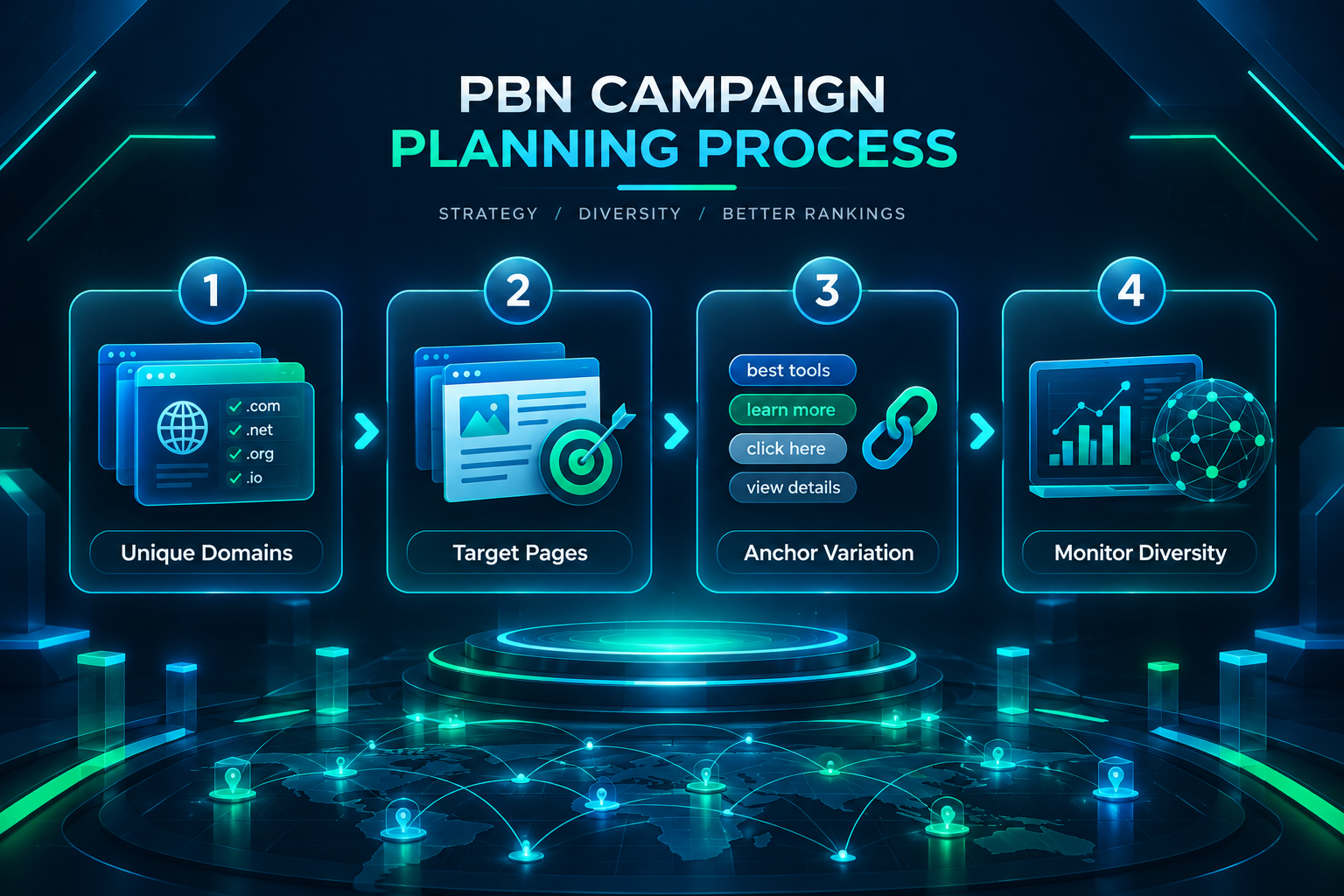
A campaign that sources placements from a larger pool of independent PBN domains — each with its own distinct link profile, hosting environment, content history, and topical context — is likely to build a more meaningful diversity signal than one that concentrates multiple placements on a small number of domains. This is true regardless of the authority metrics associated with those domains.
When evaluating a PBN backlink package or planning individual placements, the number of unique referring domains included in the campaign is a more informative figure than the total link count. A package offering ten links from ten separate domains will generally produce a stronger diversity signal than ten links from two or three domains, assuming comparable placement quality across both options.
Target page selection also becomes more relevant when multiple links from one domain are being considered. Distributing those links across different pages of the target site — rather than pointing all of them at the same URL — makes more strategic use of whatever equity the referring domain can pass, while also supporting a broader set of pages within the site’s ranking profile.
Anchor Text Strategy Across Multiple Placements from One Domain
Anchor text distribution is a separate but related consideration when a single PBN domain is used for more than one placement. Search engines use anchor text as a relevance signal, and an over-concentration of exact-match keyword anchors from any source — including a single referring domain — can produce an unnatural-looking anchor profile.
If a PBN domain places two or three links to the same target site, varying the anchor text across those placements is a basic quality practice. Using a branded anchor for one placement, a partial-match phrase for another, and a natural or generic anchor for a third keeps the anchor distribution from appearing mechanically optimized. This applies whether the links point to the same target page or to different pages within the site.
No publicly documented threshold defines how many exact-match anchors from a single referring domain constitute a problematic pattern. The appropriate anchor strategy depends on the target site’s existing backlink profile, the competitive landscape for the target keywords, and the overall mix of anchor types across all referring domains — not just the PBN placements. Reviewing the existing anchor distribution before adding new placements is a useful step in any link-building campaign.
Assessing Quality When a PBN Domain Links Multiple Times
If you are reviewing a backlink profile and notice that a PBN domain has linked to your site multiple times, a few quality checks are worth performing. First, confirm that each link points to a distinct target page rather than all pointing to the same URL. Second, check that the anchor text varies across placements rather than repeating the same exact-match phrase. Third, assess whether the linking pages on the PBN domain contain genuinely relevant content that provides useful context for each link, rather than thin or templated content that exists solely to host the link.
The quality of the linking page’s content and the relevance of the surrounding text to the target page’s topic are factors that affect how a contextual link is processed, regardless of how many links that domain has placed. A well-written, topically relevant article on a PBN domain that links naturally to a relevant target page is a stronger placement than a thin page that exists only to host a link, whether it is the first or the fifth link from that domain.
Monitoring tools such as Ahrefs, Semrush, or Google Search Console can help track how many links a specific referring domain has placed, which pages they point to, and what anchor text is used. Keeping this data organized makes it easier to assess whether additional placements from a domain are adding meaningful diversity or simply increasing the link count without proportionate benefit.
Frequently Asked Questions
Does a second link from the same PBN domain pass any equity at all?
A second link from the same referring domain is not guaranteed to pass zero equity, but the incremental value is generally lower than what a link from a new, independent referring domain would provide. The first link from a domain introduces that source’s endorsement signal; subsequent links from the same source are additional expressions of the same signal rather than independent endorsements.
Is it better to get one strong link from a high-DR domain or two links from two average domains?
This depends on the specific domains, target pages, and competitive context. As a general principle, two links from two separate referring domains contribute more to referring domain diversity than two links from one domain, even if the single domain has a higher authority metric. Domain diversity is a meaningful signal in its own right, separate from the strength of any individual domain.
Can multiple links from one PBN domain hurt my site?
No specific publicly documented threshold defines when multiple links from one domain become harmful. A concentrated backlink profile — where a small number of domains account for most links — may attract closer scrutiny during a manual review, but the outcome depends on many site-specific factors. Footprint management and domain diversity are quality considerations, not guaranteed penalty triggers.
Should all PBN links from one domain point to the same page?
Distributing multiple links from one domain across different target pages is generally a more strategic approach than pointing all of them at the same URL. Each target page benefits from whatever equity the referring domain can pass, and the distribution supports a broader set of pages within the site’s ranking profile.
How many links from a single PBN domain is too many?
No publicly documented rule specifies a maximum number of links from one referring domain. The practical consideration is that each additional link from the same source adds less incremental diversity value than a link from a new domain. Most well-structured PBN campaigns prioritize expanding the pool of unique referring domains rather than increasing the link count from existing sources.
Does anchor text variation matter when multiple links come from the same domain?
Yes. Varying anchor text across multiple placements from the same domain is a basic quality practice. Repeating the same exact-match anchor across multiple links from one source creates a more concentrated and potentially unnatural-looking anchor pattern than a varied distribution of branded, partial-match, and natural anchors.
Making the Most of PBN Placements Across Your Campaign
The core insight from understanding how repeated links from a single referring domain are weighted is that domain diversity is not just a nice-to-have feature of a PBN campaign — it is a structural quality factor that affects how much cumulative equity a set of placements can deliver. A campaign built around a larger pool of independent, topically relevant PBN domains, each contributing one well-placed contextual link, is likely to produce a stronger and more natural-looking backlink profile than one that relies on multiple placements from a small number of sources.
This does not mean that a second or third link from a high-quality PBN domain is without value, particularly when those links point to different target pages, use varied anchor text, and appear in genuinely relevant content. The diminishing-returns principle describes a reduction in marginal gain, not a complete absence of contribution. The strategic question is whether the resources allocated to additional placements from an existing domain would produce more benefit if directed toward securing a placement from a new, independent referring domain instead.
If you are planning a PBN campaign or reviewing an existing backlink profile, assessing the distribution of links across referring domains — alongside placement quality, anchor text variation, and target page selection — gives a more complete picture of what the campaign is likely to achieve. PBN Backlinks Service can help you review your current backlink profile and discuss placement options that prioritize domain diversity and contextual relevance for your specific site and goals.