

Domain renewals are one of the most predictable recurring costs in running a private blog network, yet they are frequently underestimated when operators first build out their networks. A PBN that starts with ten domains quickly becomes a meaningful annual expense, and as networks grow, renewal budgets can rival or exceed the original acquisition costs. Understanding how to plan for those renewals — which domains to prioritize, when to let domains drop, and how to spread costs across a calendar year — is a practical skill that directly affects the long-term value and stability of any private blog network.
Key Takeaways
- PBN domain renewal costs accumulate quickly across larger networks, making structured annual budgeting essential rather than optional.
- Not every domain in a network deserves renewal; regular quality reviews help identify which domains continue to justify their cost.
- Renewal pricing varies by registrar, TLD, and promotional status, so comparing options annually can reduce per-domain costs meaningfully.
- Staggering renewal dates and maintaining a cash reserve prevents cash-flow pressure when multiple domains renew simultaneously.
- Domains that have declined in link profile quality, lost referring domains, or become topically irrelevant may be better replaced than renewed.
Why PBN Domain Renewal Budgeting Deserves Dedicated Planning
Many PBN operators treat domain renewals as a background expense that gets handled when invoices arrive, rather than a line item that is planned in advance. This reactive approach creates two problems. First, it makes cash-flow management difficult when several domains renew in the same month. Second, it removes the opportunity to make deliberate decisions about which domains are worth keeping and which should be retired or replaced with stronger acquisitions.
A private blog network is an ongoing asset, not a one-time purchase. The domains within it depreciate or appreciate depending on how their referring domain profiles evolve, whether their content remains indexed and topically coherent, and whether the broader link landscape around them changes. Treating renewal decisions as a structured annual review — rather than an automatic payment — gives operators a regular checkpoint to assess whether each domain continues to contribute meaningful link equity to the target sites it supports.
The financial case for planning is straightforward. A network of thirty domains at an average renewal cost of fifteen dollars per year represents a four-hundred-and-fifty-dollar annual commitment at minimum. Networks using premium TLDs, aged domains registered through specialized registrars, or domains with privacy protection add-ons will see that figure rise considerably. Mapping those costs against a twelve-month calendar before they arrive is a basic financial discipline that prevents surprises and supports better decision-making.
Understanding the Cost Components of PBN Domain Renewals
The renewal cost for any individual PBN domain is not always the same as its original registration or acquisition price. Several factors influence what you will pay each year, and understanding them helps build a more accurate budget.
TLD and Registrar Pricing
The top-level domain is the single largest variable in renewal pricing. Standard .com renewals typically fall in the ten-to-fifteen-dollar range per year through mainstream registrars, while country-code TLDs such as .co.uk, .de, or .io carry their own pricing structures that can be higher or lower depending on the registry. Operators who built their networks using promotional first-year pricing — common with .org, .net, or newer generic TLDs — sometimes encounter a significant price increase at renewal when the promotional rate expires. Auditing your registrar invoices to identify which domains were registered at promotional rates is an important first step in building an accurate renewal forecast.
Privacy Protection and Add-On Services
WHOIS privacy protection, which masks registrant contact details, is now included at no extra cost by many registrars following ICANN policy changes, but some registrars still charge separately for it. If your PBN domains include privacy protection as a paid add-on, that cost should be factored into each domain’s annual renewal total. Similarly, any DNS management, email forwarding, or SSL certificate services attached to a domain at the registrar level will contribute to the true annual cost per domain.
Registrar Transfer Costs and Timing
Transferring a domain to a different registrar can sometimes reduce ongoing renewal costs, but transfers are subject to a sixty-day lock period after registration or previous transfer, and the transfer itself typically adds one year to the domain’s expiry date at the receiving registrar’s standard rate. If a domain is approaching renewal and a cheaper registrar is available, initiating the transfer before the renewal date — while accounting for the lock period — can reduce costs without losing the domain. This requires planning several months in advance rather than reacting when the renewal invoice arrives.
Building a Twelve-Month Renewal Calendar
The most practical tool for managing PBN domain renewal budgets is a simple spreadsheet that maps every domain in the network against its renewal date, registrar, TLD, annual cost, and a quality score or priority rating. This document becomes the foundation for both financial planning and domain retention decisions.
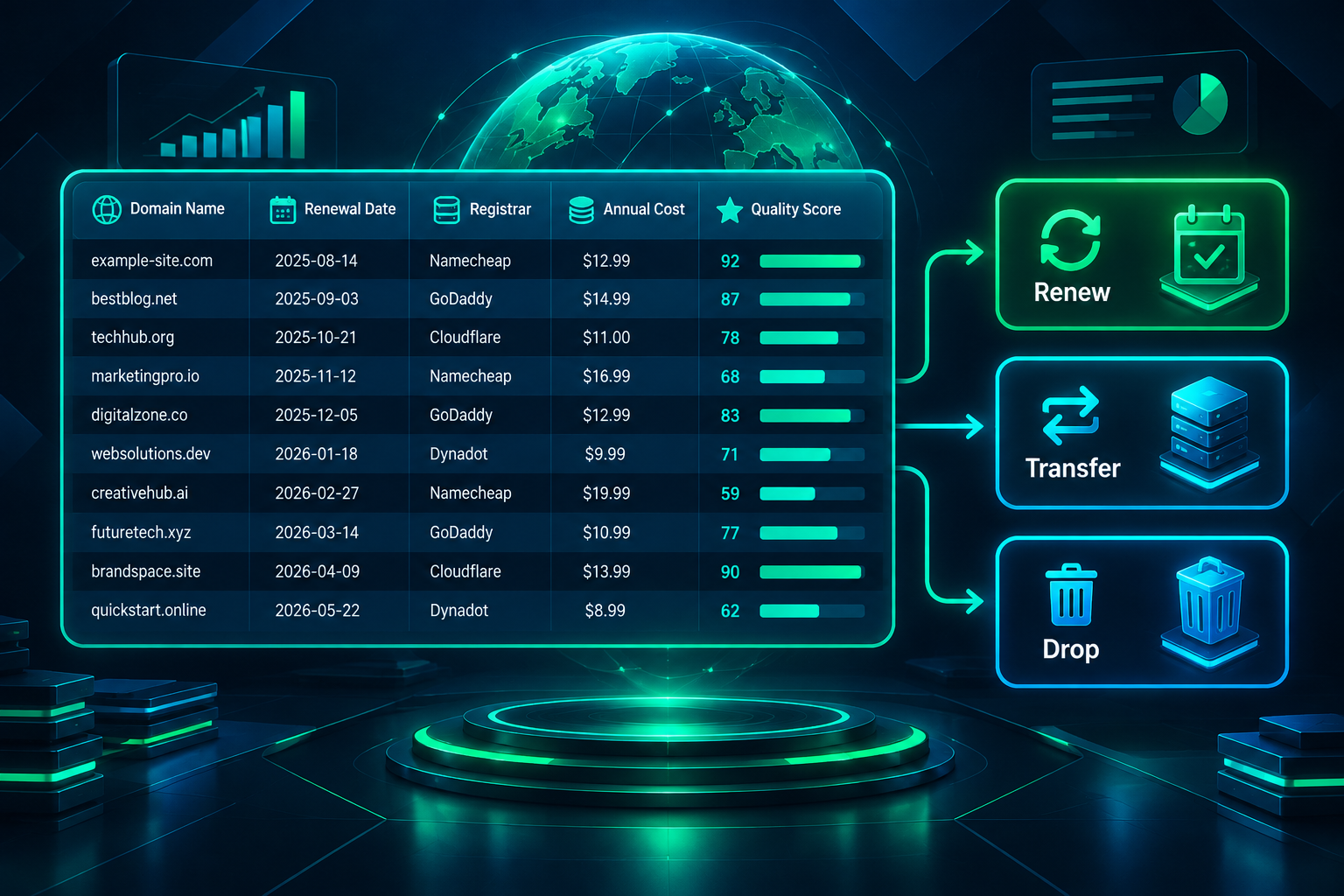
Auditing Your Current Network
Before building a renewal calendar, conduct a full audit of every domain in the network. For each domain, record the expiry date, the registrar, the annual renewal cost, the current referring domain count from a tool such as Ahrefs or Majestic, the domain’s topical relevance to the sites it links to, and whether the domain is currently indexed in Google. This audit will immediately surface domains that have lost significant referring domains since acquisition, domains that have drifted topically, and domains whose metrics no longer justify their renewal cost.
Referring domain counts can decline over time as sites that previously linked to an expired domain clean up their outbound links or themselves go offline. A domain acquired for its strong backlink profile may have shed a meaningful portion of those links within twelve to twenty-four months. Tracking this change at renewal time — rather than assuming the domain retains its original profile — is essential for making informed retention decisions.
Staggering Renewal Dates to Manage Cash Flow
If a large portion of your PBN domains were registered or acquired within a short window, their renewal dates will cluster together, creating a predictable cash-flow spike each year. When acquiring new domains, deliberately choosing registration periods that spread renewal dates across the calendar year reduces this pressure. For existing networks with clustered renewals, registering some domains for two years rather than one — when the registrar offers multi-year pricing — can shift future renewal dates and smooth out the annual payment schedule.
Multi-year registrations also provide a modest cost saving at some registrars and reduce the administrative overhead of managing annual renewals for every domain simultaneously. The trade-off is that you are committing renewal funds further in advance for domains that may later be assessed as lower priority. For high-performing domains with stable link profiles and strong topical relevance, a two-year renewal is generally a reasonable commitment. For domains whose quality is uncertain or declining, annual renewals preserve the option to exit without losing prepaid fees.
Prioritizing Which PBN Domains to Renew
Not every domain in a private blog network will continue to justify its renewal cost indefinitely. A structured prioritization framework helps allocate renewal budget toward the domains that deliver the most link equity and retire those that no longer contribute meaningfully.
Factors That Support Renewal
A domain is generally worth renewing when it retains a meaningful number of referring domains from its original acquisition profile, when those referring domains are from topically relevant and indexed sources, when the domain’s content remains indexed and contextually coherent, and when the target pages it links to are still active and relevant to the campaign. Domains that have maintained or grown their referring domain count since acquisition, and that link to pages with measurable ranking activity, represent the core of a network’s value and should be prioritized in the renewal budget.
Factors That Suggest Dropping or Replacing a Domain
A domain may not be worth renewing when its referring domain count has declined substantially since acquisition, when the remaining referring domains are from low-quality or irrelevant sources, when the domain has been deindexed or is experiencing persistent crawling issues, or when its topical relevance to the current campaign has become weak. In these cases, the renewal cost may be better redirected toward acquiring a replacement domain with a stronger and more current link profile.
Dropping a domain does not automatically harm the target sites it previously linked to, but it does remove a link source from the network. If the domain was contributing meaningful equity to a target page, replacing it before or shortly after dropping it maintains continuity. If the domain’s contribution was marginal, the renewal cost is better reallocated.
Creating a Priority Tier System
A simple three-tier system makes renewal decisions easier to apply consistently across a large network. Tier one domains — those with strong, stable referring domain profiles, good topical relevance, and active indexing — receive automatic renewal and may be candidates for multi-year registration. Tier two domains — those with moderate metrics, some referring domain loss, or partial topical relevance — receive annual renewal with a plan to reassess at the next cycle. Tier three domains — those with significant metric decline, indexing issues, or poor topical fit — are flagged for replacement rather than renewal.
Applying this framework at least once per year, ideally two to three months before the largest cluster of renewal dates, gives enough lead time to source replacement domains before dropping tier-three assets.
Estimating Your Annual PBN Renewal Budget
A realistic annual renewal budget for a private blog network combines the per-domain renewal costs across all tiers, a contingency allowance for unexpected price changes or add-on fees, and a replacement allocation for domains that will be retired and need to be substituted with new acquisitions.
Per-Domain Cost Estimation
Start by pulling the exact renewal price for each domain from your registrar account or the registrar’s published renewal pricing page. Do not rely on the original registration price, as promotional rates and TLD pricing changes can make the renewal cost different from what you initially paid. Sum the costs by month to identify which months carry the heaviest renewal load, then calculate the annual total.
For a network of twenty-five domains with an average renewal cost of fourteen dollars, the base annual renewal budget is three hundred and fifty dollars. Adding privacy protection at three dollars per domain where applicable brings that to four hundred and twenty-five dollars. A ten-percent contingency for price changes or add-ons adds roughly forty-two dollars, bringing the realistic annual budget to approximately four hundred and sixty-five dollars for that network size. Larger networks scale proportionally, and networks using premium TLDs or specialized registrars will see higher per-domain averages.
Replacement Domain Allocation
If your annual quality review identifies domains that should be retired, budget for their replacements separately from the renewal line. Acquiring a quality expired or aged domain for a PBN typically costs more than a standard renewal — expired domain auctions and aged domain marketplaces price domains based on their link profile quality, domain age, and topical relevance, which can range from modest amounts to several hundred dollars per domain depending on the metrics involved. Including a replacement allocation in the annual budget prevents the quality review from becoming a purely theoretical exercise that never results in actual network improvement.
Registrar Selection and Cost Reduction Strategies
Registrar choice has a meaningful impact on the total annual renewal cost for a large PBN. Mainstream registrars vary in their renewal pricing, and some offer bulk pricing or loyalty discounts for accounts managing large numbers of domains. Comparing renewal rates across two or three registrars annually — particularly for TLDs where pricing varies significantly between providers — can reduce costs without changing anything about the domains themselves.
Some operators distribute their PBN domains across multiple registrars as part of a broader footprint management strategy, which has the side effect of making direct cost comparison more complex. In this case, maintaining a registrar column in the renewal calendar spreadsheet makes it straightforward to identify which registrar is handling the most expensive renewals and whether a transfer would be cost-effective.
Auto-renewal settings deserve attention in any cost management review. Enabling auto-renewal on tier-one domains prevents accidental expiry of high-value assets. Disabling auto-renewal on tier-three domains — those flagged for retirement — ensures that a deliberate decision is required before funds are spent on a domain that may not be worth keeping. This simple configuration change prevents the common situation where a domain that should have been dropped is renewed automatically before the quality review takes place.
Monitoring Domain Health Between Renewal Cycles
Renewal decisions are most accurate when they are based on current data rather than the metrics recorded at acquisition. Monitoring each PBN domain’s referring domain count, indexing status, and content health between renewal cycles — rather than only at renewal time — allows problems to be identified and addressed earlier.
A quarterly check using a backlink analysis tool such as Ahrefs or Majestic takes relatively little time for a network of moderate size and surfaces referring domain losses before they become severe. Domains that show a consistent downward trend in referring domains over two or three consecutive quarters are strong candidates for the tier-three retirement category at the next renewal review, regardless of how strong their profile appeared at acquisition.
Indexing status is equally important. A PBN domain whose content is not being crawled and indexed by search engines is not passing link signals to the target pages it links to, regardless of its historical metrics. Regular indexing checks — which can be performed using Google Search Console if the domain is verified, or through a simple site: search — help identify domains that need content updates, technical fixes, or retirement before the next renewal cycle.
Frequently Asked Questions
How far in advance should I plan my PBN domain renewal budget?
Planning three to four months before your largest renewal cluster gives enough time to conduct a quality review, make retention decisions, source replacement domains if needed, and arrange funds without cash-flow pressure. For networks with renewals spread across the year, a single annual planning session at the start of each year is usually sufficient, with a mid-year check for any domains renewing in the second half.
Is it worth registering PBN domains for multiple years to save money?
Multi-year registration can reduce per-year costs at some registrars and smooths out renewal date clustering. It makes most sense for tier-one domains with stable, strong link profiles that you are confident will remain valuable. For domains whose quality is uncertain or declining, annual registration preserves the flexibility to exit without losing prepaid fees.
What happens to the links from a PBN domain if I let it expire?
When a domain expires and is not renewed, the links it contained to your target pages are no longer active. The domain may be picked up by another registrant or a domain auction service, at which point the content and links are typically removed or replaced. If the domain was contributing meaningful link equity to a target page, plan to replace it with a comparable domain before or shortly after dropping it to maintain continuity in the network’s link profile.
Should I use the same registrar for all PBN domains?
Using a single registrar simplifies billing and renewal management but concentrates all domains in one account, which some operators prefer to avoid for footprint reasons. Distributing domains across two or three registrars is a common approach that balances administrative convenience with account diversification. Whichever approach you use, maintaining a centralized renewal calendar that tracks all domains regardless of registrar is essential for accurate budgeting.
How do I decide whether to replace a dropping domain or simply reduce the size of my network?
The decision depends on whether the target pages the domain supported still need link reinforcement. If the pages are ranking well and the remaining network provides adequate support, reducing network size may be the more cost-efficient choice. If the pages still need additional link equity and the campaign is ongoing, replacing the dropped domain with a stronger acquisition maintains the network’s contribution to those pages. A review of current ranking positions and the remaining network’s coverage of each target page helps make this decision concrete rather than speculative.
Building a Sustainable PBN Renewal Budget Over Time
A well-managed PBN domain renewal budget is not a static document — it evolves as the network grows, as individual domains appreciate or depreciate in quality, and as campaign priorities shift. The operators who manage renewal costs most effectively treat the annual review as a genuine strategic exercise rather than an administrative formality. They use current backlink data to make retention decisions, compare registrar pricing before committing to renewals, stagger registration periods to smooth cash flow, and maintain a replacement allocation so that retiring a weak domain leads to a stronger acquisition rather than a smaller network.
The practical result of this approach is a network that improves in average quality over time rather than gradually accumulating domains that no longer justify their cost. Each renewal cycle becomes an opportunity to concentrate the budget on the domains that are genuinely contributing to campaign performance and to redirect funds away from assets that have declined below a useful threshold. If you are building or expanding a private blog network and want to assess domain quality, evaluate placement options, or discuss how a structured renewal strategy fits your broader link-building goals, PBN Backlinks Service can help you review your requirements and identify the right approach for your campaign.