

Allocating private blog network operating costs across multiple clients is one of the more underappreciated challenges in running a link-building agency or freelance SEO practice. When a PBN serves several campaigns simultaneously, the fixed and variable expenses behind each placement — domain renewals, hosting, content production, and maintenance — need to be distributed in a way that is financially accurate, transparent to clients, and sustainable for the business running the network. Getting this right protects margins, prevents undercharging, and gives clients a clearer picture of what their link-building investment actually covers.
Key Takeaways
- PBN operating costs include both fixed expenses shared across the network and variable costs tied to individual placements, and both categories need to be captured in any allocation model.
- The most common allocation approaches are per-placement pricing, proportional cost sharing based on link volume, and tiered pricing based on domain quality — each with different implications for margin accuracy and client billing.
- Agencies running PBNs for multiple clients benefit from separating network-level overhead from campaign-level costs before building a pricing or allocation structure.
- Transparent cost documentation helps justify pricing to clients and supports accurate profitability tracking across campaigns.
- Allocation models should be reviewed periodically as the network grows, domain costs change, or client mix shifts.
Understanding the Cost Structure of a PBN
Before any allocation method can work accurately, the full cost structure of the private blog network needs to be mapped. PBN costs fall into two broad categories: fixed network-level costs that exist regardless of how many placements are made in a given month, and variable costs that scale with placement activity or content production.
Fixed network-level costs typically include domain registration and renewal fees, hosting across multiple providers or IP ranges, any network management tools or SEO software subscriptions used to monitor the sites, and the time spent on general network maintenance such as updating CMS installations, checking for indexing issues, or replacing dropped domains. These costs are incurred whether the network is actively placing links for clients or sitting idle, which means they need to be recovered across the client base even in lower-activity periods.
Variable costs are more directly tied to individual placements or campaigns. Content production — writing or commissioning articles that contain the contextual backlinks — is the most significant variable cost in most networks. Additional variable costs can include outreach or editorial coordination if the network uses hybrid placements, link indexing services, and the time spent on placement verification and reporting for each client. Some agencies also treat domain acquisition costs as partially variable when they are purchasing expired or aged domains specifically to serve a new client’s niche or topical relevance requirements.
Mapping these two cost layers separately is the foundation of any reliable allocation model. Agencies that bundle everything into a single per-link price without understanding the underlying cost split often find that high-volume clients are subsidizing low-volume ones, or that certain domain tiers are being priced below their actual cost of maintenance.
Common Allocation Methods and When to Use Each
Several allocation approaches are used in practice, and the right choice depends on the size of the network, the diversity of the client base, and how granular the agency wants its profitability tracking to be.
Per-Placement Pricing
Per-placement pricing is the simplest allocation model. Each client is charged a fixed fee for each PBN backlink placed on their behalf, and that fee is set to cover a proportional share of network overhead plus the direct cost of content production and placement. This model is easy to communicate to clients and straightforward to invoice, which makes it the default approach for many agencies and resellers.
The limitation of flat per-placement pricing is that it treats all placements as equivalent even when they are not. A contextual backlink placed on a high-authority aged domain with a strong referring domain profile costs more to maintain than a placement on a newer or lower-metric site in the same network. If the per-placement fee is averaged across the whole network, clients receiving placements on stronger domains are effectively getting a discount while those on weaker domains may be overpaying relative to the value delivered. For agencies where domain quality varies significantly across the network, a tiered pricing structure addresses this more accurately.
Tiered Pricing Based on Domain Quality
Tiered pricing assigns different per-placement rates to different segments of the network based on domain quality indicators such as referring domain count, domain rating, topical relevance, or traffic estimates. A client requesting placements on domains with stronger backlink profiles and more established content histories pays a higher per-link rate than a client using entry-level domains in the same network.
This model aligns cost allocation more closely with the actual value and maintenance cost of each domain tier. Higher-quality expired or aged domains typically carry higher acquisition costs, renewal fees, and content standards, so charging more for placements on those domains reflects the real cost structure. Tiered pricing also gives clients a meaningful choice: they can allocate budget toward fewer high-quality placements or spread the same budget across a larger number of standard placements depending on their campaign goals.
The administrative overhead of tiered pricing is higher than flat per-placement pricing, because the agency needs to maintain clear domain classifications and ensure that placement reporting accurately identifies which tier each link belongs to. Agencies using SEO tools such as Ahrefs or Majestic to assess domain metrics can use those data points to define tier boundaries, though it is worth noting that proprietary metrics like Domain Rating or Trust Flow are not Google ranking signals — they are third-party estimates of link authority that serve as useful proxies for internal classification purposes.
Proportional Cost Sharing Based on Link Volume
Proportional cost sharing allocates a defined portion of total network operating costs to each client based on their share of total link volume in a given period. If the network places 100 links in a month and one client accounts for 20 of them, that client is allocated 20 percent of the fixed network overhead for that period, plus the direct variable costs of their specific placements.
This model is more accurate than flat per-placement pricing for recovering fixed costs, because it scales the overhead allocation with actual usage. It works well for agencies with a stable client base and predictable monthly link volumes. The challenge arises when client volumes fluctuate significantly month to month: a period with fewer active clients means each remaining client absorbs a larger share of fixed costs, which can make pricing feel inconsistent unless the agency builds a minimum monthly overhead recovery into its pricing floor.
Some agencies use a hybrid of proportional cost sharing and per-placement pricing: fixed network overhead is distributed proportionally across active clients, while variable costs such as content production are billed on a per-placement basis. This hybrid approach gives the most accurate cost picture but requires more detailed internal accounting to implement consistently.
Retainer-Based Allocation
For agencies managing ongoing PBN campaigns for a fixed roster of clients, a monthly retainer model can simplify cost allocation considerably. Each client pays a fixed monthly fee that covers a defined number of placements, a share of network maintenance, and any reporting or campaign management included in the service. The retainer is set based on the anticipated cost of serving that client’s allocation plus a margin.
Retainer pricing works best when client needs are relatively predictable and the agency can accurately forecast the number of placements and the associated content and maintenance costs. It reduces billing complexity and gives clients budget certainty. The risk is that if a client’s actual usage falls significantly below the retainer level, the agency may be over-delivering on network resources without recovering the cost, or if usage spikes, the retainer may not cover the additional variable costs without a contract adjustment.
Separating Network Overhead from Campaign Costs
One of the most practical steps an agency can take before choosing an allocation model is to formally separate network-level overhead from campaign-level costs in its internal accounting. Network overhead includes everything required to keep the PBN operational and indexed regardless of which clients are being served: domain renewals, hosting fees, CMS maintenance, network monitoring tools, and the time spent on general upkeep. Campaign costs include everything directly attributable to a specific client’s placements: content writing, placement verification, anchor text coordination, and client reporting.
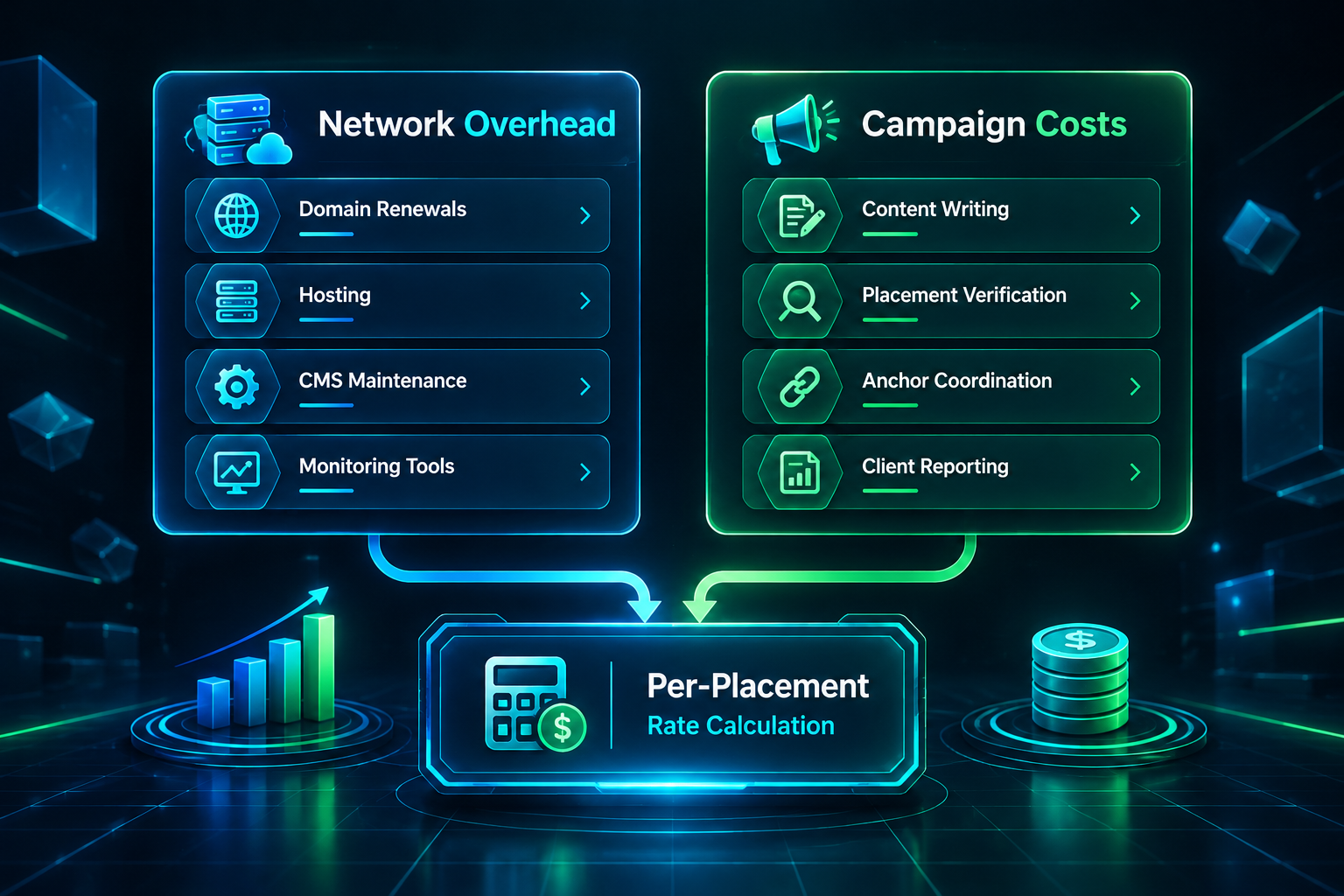
When these two cost layers are tracked separately, it becomes much easier to calculate the true cost per placement for any given client and to identify which parts of the network are generating the most overhead relative to the revenue they produce. An aged domain with a high renewal cost and strong metrics may justify a premium placement rate. A newer domain with lower acquisition and hosting costs may be priced more competitively while still maintaining margin.
Agencies that do not separate these layers often discover that their per-link pricing was set based on intuition rather than actual cost data, which leads to margin erosion as the network scales or as domain renewal costs accumulate. A simple internal cost sheet that lists each domain’s annual costs, estimated placements per year, and required content spend per placement gives a reliable baseline for setting allocation rates.
Handling Domain Acquisition Costs
Expired and aged domain acquisition is often the largest single cost in building or expanding a PBN, and how that cost is allocated across clients has a meaningful impact on pricing accuracy. There are two main approaches: amortizing acquisition costs over the expected useful life of the domain, or treating acquisition as a one-time cost recovered through a premium on the first set of placements made on that domain.
Amortization spreads the acquisition cost across a defined number of placements or a defined time period. If an expired domain was acquired for a specific cost and is expected to host placements for multiple clients over two or three years, dividing the acquisition cost by the expected number of placements gives a per-placement acquisition component that can be added to the ongoing maintenance cost. This approach produces a more stable per-placement cost and avoids front-loading the expense onto the first client to use a new domain.
The alternative — recovering acquisition costs through a premium on early placements — is simpler to administer but can make initial placements on new domains more expensive than placements on fully amortized older domains. Some agencies use this approach deliberately, offering lower rates on established network domains as a way to incentivize clients toward placements that are already generating a return on the acquisition investment.
For agencies purchasing domains specifically to serve a particular client’s niche or topical relevance requirements, it may be appropriate to pass a larger share of the acquisition cost directly to that client, since the domain was sourced to meet their specific campaign needs rather than as a general network asset. This should be agreed upon transparently before the domain is acquired.
Content Production and Placement Costs
Content production is typically the most significant variable cost in a PBN operation, and it is also the cost most directly attributable to individual client placements. Each contextual backlink requires a host article — the page on the PBN site that contains the link — and that article needs to meet a quality standard sufficient to support the placement’s value and avoid obvious footprint signals.
Allocating content costs is straightforward when each placement requires a dedicated article: the cost of producing that article is a direct campaign cost for the client receiving the link. The allocation becomes more complex when a single article contains links for multiple clients, which some networks use to reduce content production costs. In that case, the article cost needs to be split across the clients whose links appear in it, either equally or weighted by the prominence or placement position of each link within the content.
Agencies should also account for content refresh costs when calculating long-term allocation. PBN sites that are maintained as active, topically relevant properties may require periodic content updates to sustain their indexing and authority profile. These refresh costs are part of the ongoing network overhead and should be factored into the per-placement rate rather than treated as unexpected expenses.
Billing Transparency and Client Communication
How cost allocation is communicated to clients affects both trust and retention. Most clients purchasing PBN backlink packages do not need a detailed breakdown of the network’s internal cost structure, but they do benefit from understanding what their investment covers at a high level: the number of placements, the quality tier of the domains being used, the content standard, and any reporting or monitoring included in the service.
Agencies that offer tiered backlink packages — distinguishing between standard placements and premium placements on higher-authority domains — give clients a natural framework for understanding why different placements carry different price points. This tiered structure also makes it easier to upsell clients from entry-level packages to higher-quality placements as their campaigns mature and their link-building goals become more defined.
For clients on retainer arrangements, a clear scope of service document that specifies the number of placements per month, the domain quality parameters, the content length and standard, and the reporting cadence gives both parties a shared reference point for evaluating whether the allocation is working as intended. Periodic reviews — quarterly is a common interval — allow the agency to adjust the retainer if the client’s link volume or domain requirements have changed significantly.
Tracking Profitability by Client and by Domain
Accurate cost allocation is only useful if it feeds into meaningful profitability tracking. Agencies managing PBN campaigns for multiple clients benefit from tracking margin at two levels: by client and by domain or domain tier.
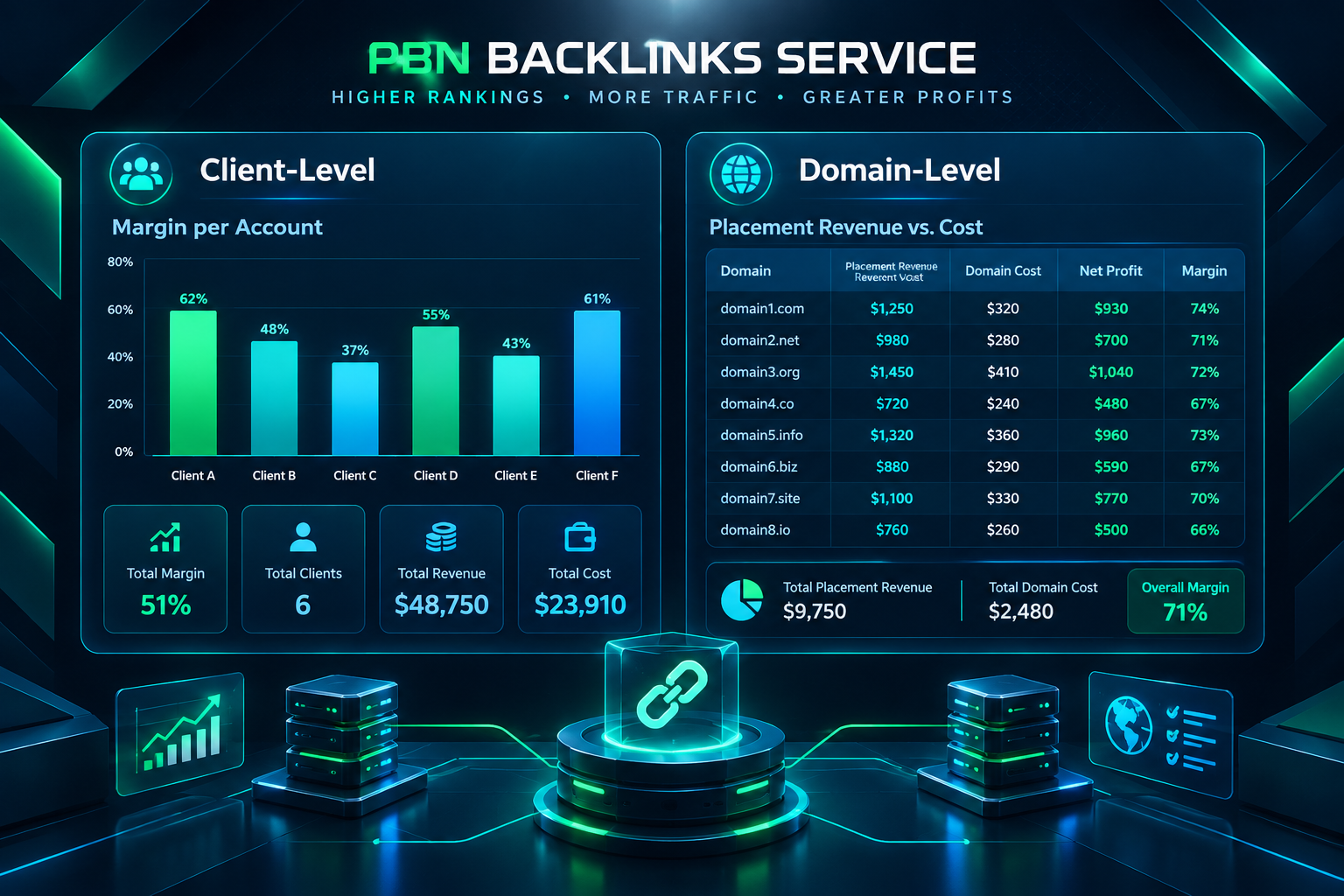
Client-level profitability tracking shows which accounts are generating healthy margins and which may be underpriced relative to the actual cost of serving them. A client requiring frequent anchor text adjustments, detailed reporting, or placements on premium domains may be consuming more resources than a standard per-placement rate recovers. Identifying these accounts allows the agency to reprice, renegotiate, or adjust the service scope before margin erosion becomes significant.
Domain-level profitability tracking shows which sites in the network are generating a return on their acquisition and maintenance costs and which are underperforming. A domain with high renewal costs, low placement frequency, and content refresh requirements may be costing more to maintain than it generates in placement revenue. This analysis can inform decisions about whether to continue renewing a domain, repurpose it, or replace it with a more cost-effective asset.
SEO tools such as Ahrefs, Semrush, or Majestic can support domain-level assessment by providing data on referring domain trends, estimated traffic, and metric changes over time. These data points help the agency monitor whether the network’s assets are maintaining their quality profile and justify the ongoing maintenance investment to clients when relevant.
Frequently Asked Questions
What costs should always be included in a PBN cost allocation model?
At minimum, a PBN cost allocation model should capture domain registration and renewal fees, hosting costs across all providers used by the network, content production costs for placement articles, any SEO tool subscriptions used to monitor the network, and the labor time spent on maintenance, placement verification, and client reporting. Agencies that omit labor costs from their allocation models frequently underestimate the true cost per placement.
How should domain acquisition costs be handled when pricing placements?
Domain acquisition costs are best amortized over the expected useful life of the domain and the anticipated number of placements it will host. Dividing the acquisition cost by the projected placement volume gives a per-placement acquisition component that can be added to ongoing maintenance and content costs. For domains acquired specifically for a single client’s niche, a larger share of the acquisition cost may be passed directly to that client by prior agreement.
Is tiered pricing or flat per-placement pricing better for a multi-client PBN?
Tiered pricing is generally more accurate for networks where domain quality varies significantly, because it aligns the price of each placement with the actual cost and value of the domain hosting it. Flat per-placement pricing is simpler to administer and works well when the network’s domains are relatively uniform in quality and maintenance cost. Many agencies start with flat pricing and move to tiered structures as their networks grow and domain quality becomes more differentiated.
How often should a PBN cost allocation model be reviewed?
A review at least once per year is advisable, and more frequently if the network is growing rapidly, domain renewal costs are changing, or the client mix is shifting. Significant changes in content production costs, hosting provider pricing, or the number of active clients can all affect whether the existing allocation model is recovering costs accurately.
Can a retainer model work for PBN link-building services?
A retainer model works well for clients with predictable monthly link-building needs and for agencies that can accurately forecast the cost of serving a defined placement volume. The retainer rate should be set to cover the client’s proportional share of network overhead plus the direct variable costs of their placements, with a margin that reflects the agency’s service and management time. Retainer agreements benefit from a clear scope of service document and periodic reviews to ensure the rate remains aligned with actual costs.
How should an agency handle a month where fewer clients are active and fixed costs are higher per client?
One practical approach is to set a minimum monthly overhead recovery floor in the pricing model — a base amount that each active client contributes toward fixed network costs regardless of placement volume. This prevents fixed costs from being absorbed entirely by the agency in low-activity periods. Alternatively, agencies can build a slightly higher margin into their standard per-placement rate to create a buffer that absorbs fixed cost fluctuations across the year.
Building a PBN Cost Allocation Model That Scales
A well-structured cost allocation model does more than protect margins on individual client accounts — it gives the agency a reliable foundation for scaling the network, onboarding new clients, and making informed decisions about domain acquisition and content investment. The key is to start with an accurate picture of the full cost structure, separate fixed network overhead from variable campaign costs, and choose an allocation method that reflects how the network actually operates rather than how it is easiest to invoice.
For agencies at an early stage, a straightforward per-placement model with a tiered rate for different domain quality levels is usually sufficient. As the client base grows and the network becomes more complex, moving toward proportional cost sharing for overhead and per-placement billing for variable costs gives a more accurate margin picture. Retainer arrangements work well for established client relationships where link volume is predictable and both parties benefit from billing simplicity.
Periodic profitability reviews at both the client and domain level keep the model calibrated as costs change and the network evolves. Agencies that treat cost allocation as an ongoing management discipline rather than a one-time pricing decision are better positioned to maintain healthy margins, justify their rates to clients, and invest in network quality with confidence. If you are building or expanding a PBN-based link-building service and want to discuss how placement packages and domain quality tiers can be structured to support your client billing model, PBN Backlinks Service can help you assess your options.