

When you purchase PBN backlinks, a replacement guarantee is one of the most commercially significant terms in the agreement. If a placement disappears, the referring domain loses indexing, or the linking page is removed, the guarantee determines whether you receive a comparable replacement or simply lose the value of that link. Assessing these guarantees carefully before committing to a provider can make a meaningful difference to the long-term performance of a link-building campaign.
Key Takeaways
- A PBN link replacement guarantee is only as useful as its specific terms — vague promises of “lifetime replacement” rarely hold up without defined conditions, timelines, and quality standards.
- The most important factors to evaluate are the replacement trigger conditions, the timeframe for delivery, the quality parity of the replacement placement, and how disputes are handled.
- Providers who are transparent about their network maintenance practices and indexing monitoring are generally better positioned to honor replacement commitments reliably.
- Replacement guarantees do not eliminate the need for ongoing backlink monitoring; they complement it by giving you a defined recourse when a placement fails.
- Assessing a guarantee requires reading the actual terms, not just the marketing headline — the gap between the two is where most buyer disappointment originates.
What a PBN Link Replacement Guarantee Actually Covers
A PBN link replacement guarantee is a provider’s commitment to substitute a lost or non-functional placement with a comparable one, typically at no additional cost. The word “guarantee” is used loosely across the industry, so the first step in any assessment is identifying exactly what the provider has committed to replacing and under what circumstances. A guarantee that covers only complete domain deindexation is materially different from one that also covers page-level removal, noindex tags applied to the linking page, or significant drops in the referring domain’s authority metrics.
Common replacement triggers that a well-structured guarantee should address include: the linking page being deleted or returning a 404 error, the referring domain losing its Google index status, a noindex or nofollow attribute being added to the placement after delivery, or the anchor text or target URL being altered without notice. Some providers also include metric-based triggers, such as a referring domain’s Domain Rating or Trust Flow falling below a stated threshold after placement. Each of these scenarios represents a different type of placement failure, and a guarantee that only covers one or two of them leaves meaningful gaps.
It is equally important to understand what a replacement guarantee does not cover. Most providers exclude ranking changes on the buyer’s target website, algorithm updates that affect how a link is weighted, or situations where the buyer’s own website undergoes a significant change. These exclusions are generally reasonable because those outcomes involve factors outside the provider’s direct control. The guarantee should be scoped to the placement itself — its existence, its attributes, and its basic technical integrity — rather than to downstream ranking outcomes.
Evaluating the Replacement Timeframe
The timeframe within which a provider commits to delivering a replacement placement is a practical measure of how seriously the guarantee is structured. A replacement commitment with no stated delivery window is difficult to enforce and creates uncertainty about when, or whether, the substitute link will appear. Providers who specify a clear replacement window — commonly between 14 and 45 days depending on the complexity of sourcing a comparable placement — demonstrate that the guarantee has been operationally planned rather than added as a marketing afterthought.
When assessing the timeframe, consider whether the provider distinguishes between different types of replacement scenarios. Replacing a placement on a domain that has simply had its linking page removed is typically faster than sourcing a new domain when the original referring domain has been deindexed entirely. A provider who applies a single blanket timeframe to all scenarios may be oversimplifying the process. Conversely, a provider who explains the distinction and sets realistic expectations for each scenario is demonstrating operational transparency that tends to correlate with reliable follow-through.
Also consider whether the replacement timeframe begins from the date the issue is reported by the buyer or from the date the provider independently detects it. Providers who actively monitor their network for indexing status, page availability, and link attribute changes are better positioned to initiate replacements proactively. If the burden of detection falls entirely on the buyer, the effective value of the guarantee depends heavily on how diligently the buyer monitors their own backlink profile — which shifts responsibility in a way that is worth understanding before purchase.
Quality Parity: The Most Overlooked Guarantee Condition
A replacement placement is only meaningful if it is broadly comparable to the original in the characteristics that made the original placement valuable. Quality parity is the most frequently overlooked dimension of PBN link replacement guarantees, and it is where the gap between a strong and a weak guarantee is most apparent. A provider who replaces a contextual placement on a topically relevant, well-indexed domain with a sitewide footer link on a low-metric domain has technically honored a replacement commitment while delivering substantially less value.
When assessing quality parity terms, look for explicit commitments on the following characteristics: the topical relevance of the replacement referring domain relative to the buyer’s niche, the minimum authority metric thresholds for the replacement domain (expressed in whatever metric the provider uses, such as Domain Rating, Domain Authority, or Trust Flow), the placement type (contextual within body content versus sidebar or footer), the indexing status of the replacement domain and linking page, and the anchor text and target URL accuracy of the replacement link.
Providers who specify minimum metric thresholds for replacement domains give buyers a measurable standard against which to assess compliance. For example, a guarantee that states replacements will be placed on domains with a Domain Rating of at least 20 and topical relevance to the buyer’s niche is verifiable using tools such as Ahrefs or Semrush. A guarantee that simply promises “a similar domain” without defining similarity is not practically enforceable. The more specific the quality parity terms, the more confidence a buyer can have that the replacement will serve a comparable function in their backlink profile.
How to Verify a Provider’s Network Maintenance Practices
The reliability of a PBN link replacement guarantee depends significantly on how well the provider maintains the underlying network. A provider who actively monitors domain indexing status, content freshness, link attribute integrity, and referring domain health is structurally better positioned to detect placement failures early and fulfill replacements efficiently. Assessing these maintenance practices before purchase is a meaningful due diligence step that goes beyond reading the guarantee terms themselves.
Questions worth asking a provider before committing to a package include: How frequently do you audit the indexing status of domains in your network? Do you use automated monitoring tools to detect page-level removals or attribute changes? What is your process when a domain in your network loses its index status — do you replace the domain or attempt to recover it? How do you handle domains that experience significant metric drops after a placement has been delivered? These questions are not adversarial; they are reasonable operational inquiries that a provider with a well-maintained network should be able to answer with reasonable specificity.
Providers who can describe a defined monitoring and maintenance workflow — even at a general level — are demonstrating that the replacement guarantee is backed by an operational process rather than a reactive one. Providers who are vague or dismissive about network maintenance practices may be operating networks where replacement fulfillment is slower, less consistent, or dependent on sourcing new domains from scratch each time a placement fails. That is not necessarily disqualifying, but it is a meaningful factor in assessing how the guarantee will function in practice.
Reading the Fine Print: Terms That Limit Guarantee Scope
Marketing language around PBN link replacement guarantees often emphasizes breadth — “lifetime guarantee”, “permanent replacement”, “full coverage” — while the actual terms contain conditions that significantly narrow the scope. Reading the fine print carefully before purchase is the most direct way to understand what you are actually being offered.
Common limiting conditions to look for include: a reporting window that requires the buyer to notify the provider of a placement failure within a specified number of days (after which the guarantee lapses), a maximum number of replacements permitted per order or per domain, exclusions for placement failures caused by changes to the buyer’s target website rather than the referring domain, and conditions that void the guarantee if the buyer has used the placement in combination with certain other link-building activities. Some providers also include a clause that limits replacements to a single substitution per original placement, meaning that if the replacement itself subsequently fails, no further recourse is available.
The reporting window condition deserves particular attention. If a guarantee requires the buyer to report a failed placement within 30 days of the failure occurring, and the buyer only monitors their backlink profile quarterly, the guarantee may effectively be void for a significant proportion of placement failures. Understanding this condition in advance allows a buyer to calibrate their monitoring frequency accordingly, or to factor the limitation into their assessment of the guarantee’s practical value.
Lifetime guarantees warrant specific scrutiny. A lifetime guarantee is only as durable as the provider’s business continuity. A provider who offers lifetime replacement but has no stated process for honoring that commitment if the business changes ownership, restructures its network, or discontinues a particular package type is offering a term that may be difficult to enforce over a multi-year campaign. Asking how the provider handles guarantee obligations for legacy orders when their network or service structure changes is a reasonable question for any buyer considering a long-term link-building relationship.
Comparing Guarantee Structures Across Providers
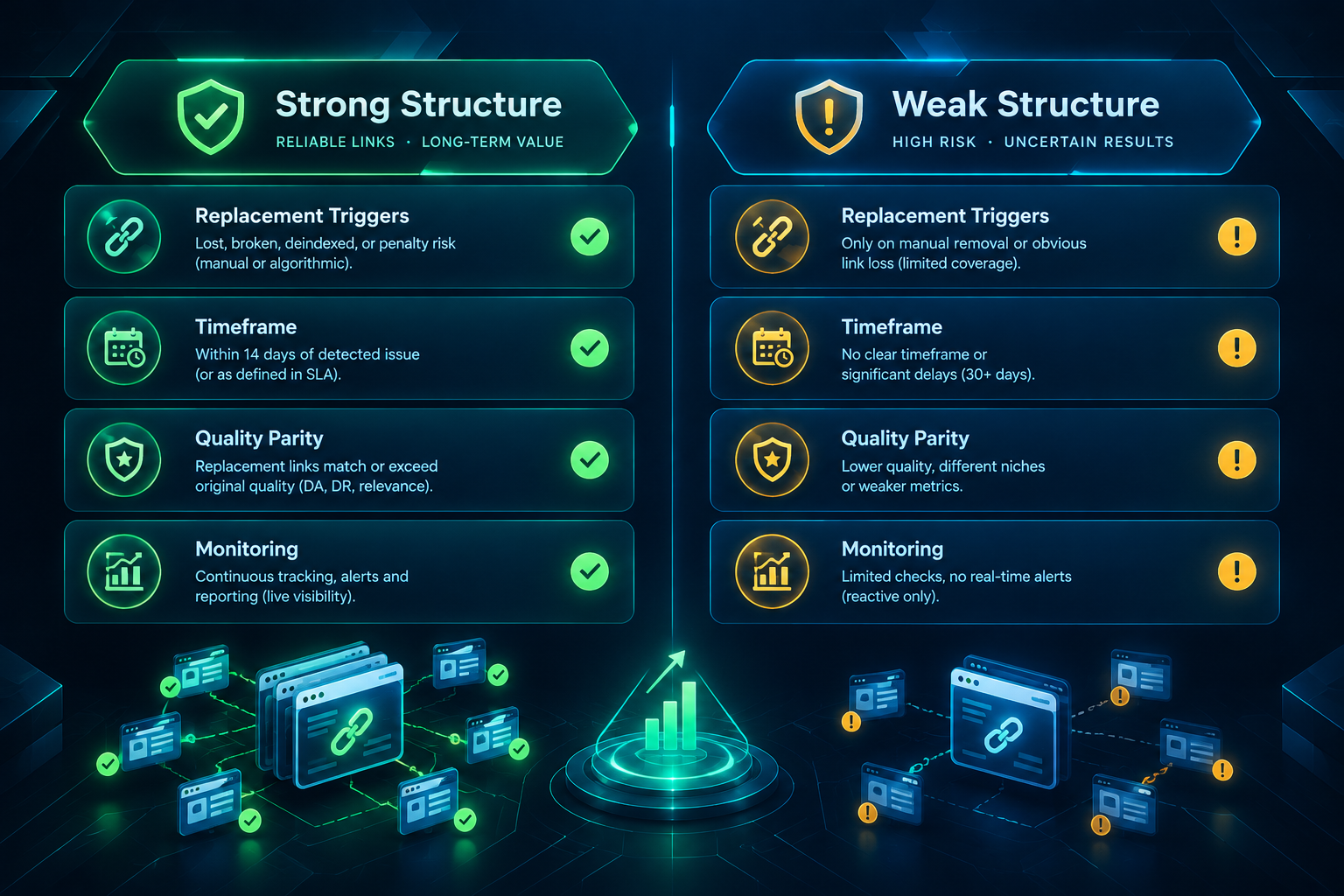
Not all PBN link replacement guarantees are structured the same way, and comparing them across providers requires a consistent framework. The table below outlines the key dimensions to assess when evaluating guarantee terms from different providers.
| Guarantee Dimension | Strong Structure | Weak Structure |
|---|---|---|
| Replacement triggers | Covers deindexation, page removal, noindex, attribute changes, metric drops | Covers only full domain deindexation |
| Replacement timeframe | Specific window stated (e.g., 14–30 days), differentiated by scenario | No timeframe stated or vague “as soon as possible” |
| Quality parity terms | Minimum metric thresholds, topical relevance, placement type specified | “Similar domain” with no measurable definition |
| Reporting window | Generous window (60–90 days) or provider-initiated detection | Short window (14–30 days) with buyer-only detection responsibility |
| Replacement limit | Multiple replacements permitted per placement over the guarantee period | Single replacement only, no further recourse |
| Lifetime guarantee durability | Defined process for legacy orders if network or service changes | No stated process for business continuity scenarios |
| Network monitoring | Provider actively monitors indexing, attributes, and domain health | Buyer responsible for detecting all placement failures |
Using a framework like this when evaluating multiple providers allows for a more objective comparison than relying on headline guarantee language alone. A provider whose terms score consistently in the “strong structure” column across most dimensions is offering a materially more reliable commitment than one whose terms cluster in the “weak structure” column, even if both use similar marketing language.
Monitoring Your Placements to Support Guarantee Claims
A replacement guarantee functions as a recourse mechanism, not a substitute for active backlink monitoring. Buyers who monitor their PBN placements regularly are better positioned to identify placement failures within any reporting window, gather the evidence needed to support a replacement claim, and assess whether a delivered replacement meets the quality parity terms specified in the guarantee.
Practical monitoring for PBN placements typically involves checking the live status of linking pages at intervals appropriate to the campaign scale, verifying that the anchor text and target URL remain accurate, confirming that the referring domain retains its index status using Google Search Console or a crawl-based tool, and tracking any significant changes in the referring domain’s authority metrics using tools such as Ahrefs, Semrush, or Majestic. Screaming Frog can be useful for crawling a set of referring URLs to check for redirect chains, noindex tags, or page-level errors that might affect how a link is processed.
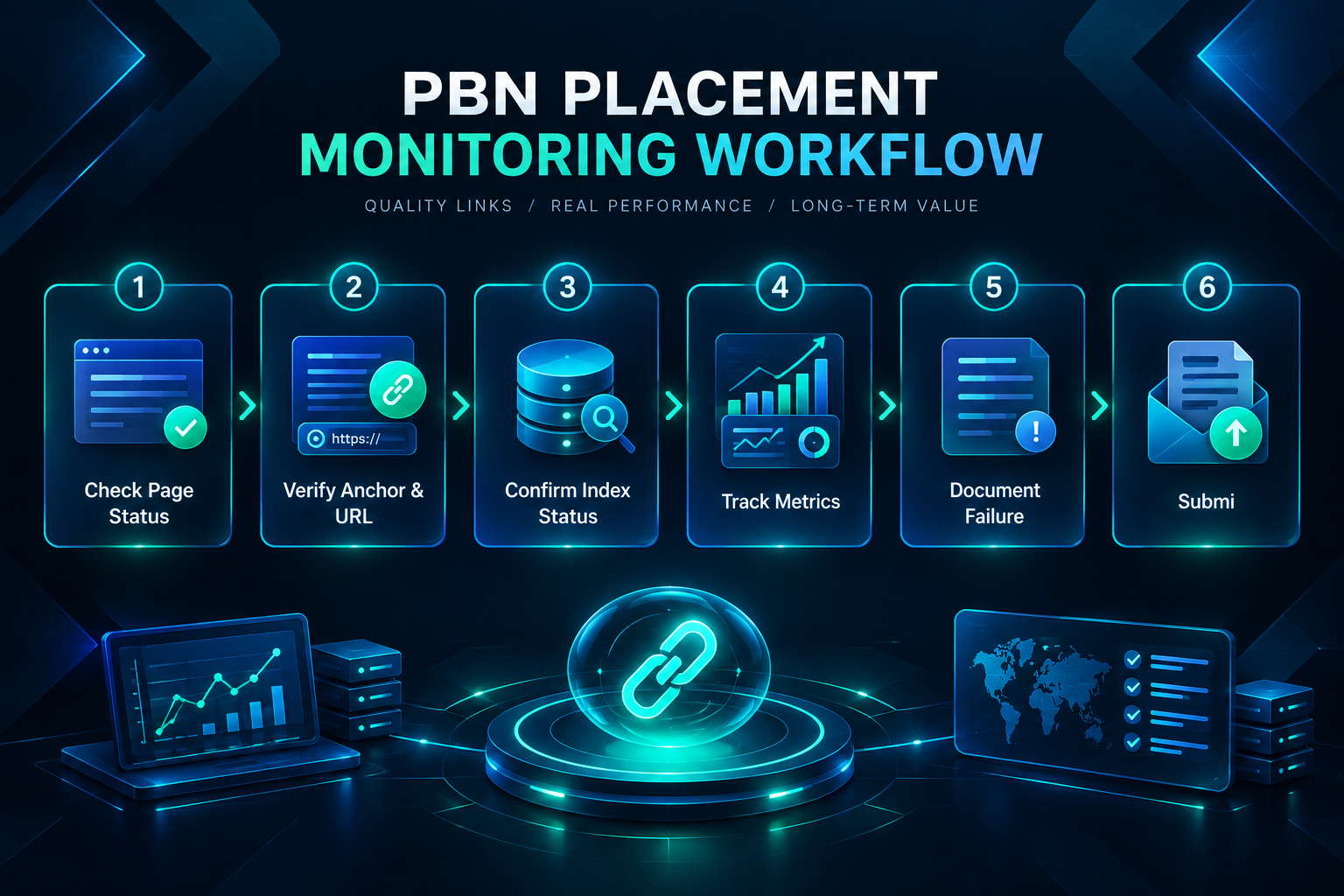
When a placement failure is identified, documenting it clearly before contacting the provider strengthens the replacement claim. Useful documentation includes a screenshot of the linking page showing the absence of the placement or the presence of a disqualifying attribute, a record of the referring domain’s current index status, and the date on which the failure was first detected. Providers with a structured replacement process will typically have a defined submission format for replacement requests; understanding that format in advance reduces friction when a claim needs to be made.
Frequently Asked Questions
What is the difference between a replacement guarantee and a refund policy for PBN links?
A replacement guarantee commits the provider to delivering a substitute placement when the original fails, keeping the link-building value within the campaign. A refund policy returns the purchase price but does not restore the placement. For buyers focused on maintaining a consistent backlink profile, a replacement guarantee is generally more useful than a refund, because the goal is link presence rather than cost recovery.
How long should a PBN link replacement guarantee last?
Guarantee duration varies by provider, but a period of at least six to twelve months is a reasonable baseline for a campaign-level commitment. Lifetime guarantees are offered by some providers and can be valuable, but their practical worth depends on the provider’s business continuity and the specific terms governing how legacy orders are handled if the network or service structure changes over time.
Can I verify that a replacement placement meets the quality parity terms?
Yes, if the guarantee specifies measurable criteria such as minimum Domain Rating, topical relevance, and placement type, you can verify compliance using tools such as Ahrefs, Semrush, or Majestic. Check the replacement referring domain’s authority metrics, confirm the placement is contextual within body content if that was specified, and verify that the anchor text and target URL match the original order. If the replacement does not meet the stated criteria, you have documented grounds to request a further substitution.
What happens if the provider goes out of business before honoring a replacement?
This is a genuine business risk with any service-based guarantee. Providers who have been operating for several years, have a documented track record, and can describe their process for handling legacy orders if their service structure changes present a lower risk in this regard. For long-term campaigns, working with an established provider and maintaining your own backlink monitoring records gives you the best position to manage this scenario if it arises.
Should I rely solely on the provider’s monitoring to detect placement failures?
Relying solely on provider-side monitoring is not advisable, even when a provider actively monitors their network. Maintaining your own monitoring routine using backlink tools and periodic manual checks gives you an independent record of placement status, supports replacement claims with documented evidence, and ensures you can identify failures that may fall outside the provider’s detection scope.
Does a replacement guarantee affect the overall value of a PBN backlink package?
A well-structured replacement guarantee adds meaningful value to a PBN backlink package by reducing the risk of placement attrition over the campaign period. Packages with clearly defined, enforceable replacement terms represent a more durable investment than those with vague or absent guarantees, particularly for campaigns where link longevity is a significant factor in the overall strategy.
Choosing a PBN Provider Based on Guarantee Quality
Assessing PBN link replacement guarantees is ultimately an exercise in evaluating provider reliability and operational transparency. The guarantee terms a provider offers reflect how they think about their network, their buyers, and their long-term service commitments. Providers who have invested in clear, specific, and enforceable replacement terms are generally those who have also invested in the network maintenance practices that make those terms achievable in practice.
Before placing an order, review the replacement trigger conditions, the delivery timeframe, the quality parity criteria, the reporting window, and any conditions that limit or void the guarantee. Ask the provider directly about their network monitoring practices and how they handle replacement requests operationally. Compare the answers against the framework outlined in this article to form a grounded assessment of what the guarantee is actually worth.
If you are evaluating a PBN backlink package and want to understand how replacement guarantees are structured for specific placements or campaign types, PBN Backlinks Service can walk you through the relevant terms and help you assess whether a given package aligns with your campaign requirements and monitoring capacity.