

Counting unique referring domains in a PBN campaign is a more nuanced task than it first appears. A raw backlink count tells you how many individual links point to a page, but the number of unique referring domains tells you how many distinct websites are contributing those links — and that distinction has a direct bearing on how you assess campaign coverage, link diversity, and the overall structure of a backlink profile. Understanding how to calculate this figure accurately, and what it actually means for your SEO strategy, helps you make better decisions about placement volume, domain selection, and campaign progression.
Key Takeaways
- Unique referring domains counts the number of distinct root domains sending at least one link to a target URL or domain — not the total number of backlinks.
- Most professional SEO tools such as Ahrefs, Semrush, and Majestic report referring domain counts, but their crawl coverage and deduplication logic differ, so figures may not match exactly across platforms.
- In a PBN campaign, each PBN site should ideally contribute as a separate referring domain; multiple links from the same PBN domain count as one unique referring domain regardless of how many pages link out.
- Calculating the gap between your current unique referring domain count and a competitor’s count is a practical way to estimate how many additional PBN placements a campaign may need.
- Domain-level deduplication, subdomain handling, and redirect chains can all affect the final count, so understanding how your chosen tool processes these factors is essential for accurate reporting.
What a Unique Referring Domain Actually Means
A referring domain is any website that contains at least one hyperlink pointing to your target URL or domain. A unique referring domain is counted only once regardless of how many individual backlinks originate from that same website. If a single PBN site publishes three separate articles, each containing a link to your money site, that PBN site contributes three backlinks but only one unique referring domain to your count.
This distinction matters because search engines, and the SEO tools that model their behavior, generally treat link diversity — measured partly through the spread of unique referring domains — as a meaningful signal. A backlink profile with 200 links from 10 domains looks structurally different from one with 200 links from 180 domains, even if the raw link count is identical. When planning or auditing a PBN campaign, working with the referring domain count rather than the raw link count gives you a clearer picture of how much domain-level diversity the campaign is actually delivering.
It is also worth distinguishing between referring domains counted at the root domain level and those counted at the subdomain level. Most tools default to root domain deduplication, meaning that blog.example.com and shop.example.com are treated as the same referring domain (example.com). Some tools offer subdomain-level reporting as an alternative view. For PBN campaign planning, root domain counting is typically the more relevant figure because it reflects the number of independent websites contributing links.
Tools Used to Count Unique Referring Domains
Several established SEO platforms provide referring domain data, and each has its own crawl index, update frequency, and deduplication methodology. The most widely used options for this type of analysis include Ahrefs, Semrush, and Majestic.
Ahrefs reports unique referring domains prominently in its Site Explorer tool. The platform distinguishes between referring domains counted at the root domain level and those at the subdomain level, and it updates its index frequently enough that new placements typically appear within days to a couple of weeks of being crawled. Ahrefs also provides a historical referring domain graph, which is useful for tracking how a campaign’s domain count has grown over time.
Semrush offers referring domain data through its Backlink Analytics module. Like Ahrefs, it deduplicates at the root domain level by default and provides trend data. Semrush’s index differs from Ahrefs’ in coverage and crawl depth, so the absolute numbers reported by each tool for the same target site will often differ. Neither figure is definitively correct; they reflect each tool’s crawl sample.
Majestic uses two separate indexes — the Fresh Index and the Historic Index — and reports referring domains through its Site Explorer. The Fresh Index covers recently crawled links, while the Historic Index includes links discovered over a longer period, including some that may no longer be active. For PBN campaign tracking, the Fresh Index is generally more relevant because it reflects currently live placements.
When using any of these tools, it is important to recognize that the referring domain count they display is an estimate based on their crawl coverage, not a complete census of every link on the web. A placement that has not yet been crawled by a tool’s bot will not appear in the count. This is a normal limitation of third-party index tools and does not necessarily indicate a problem with the placement itself.
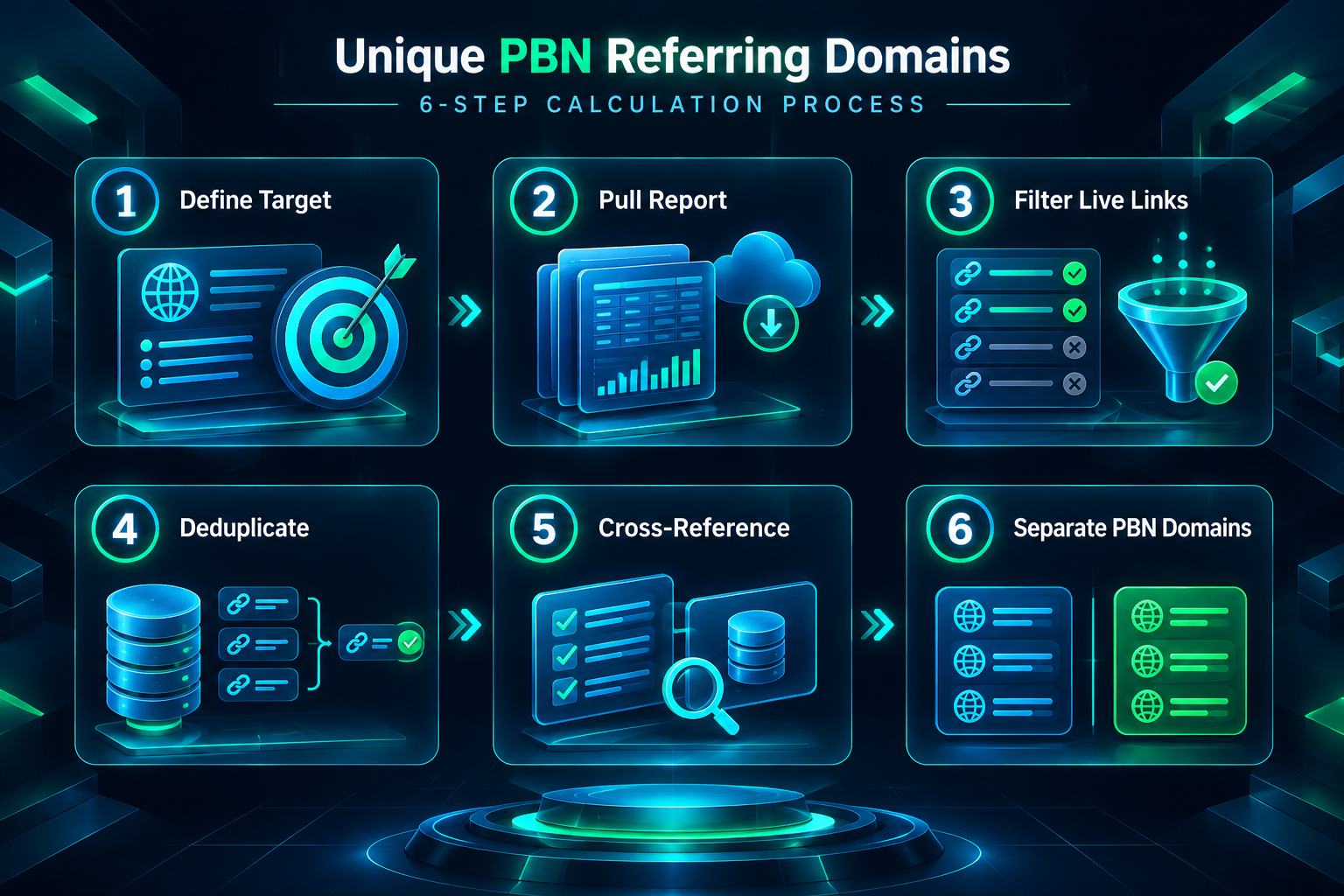
Step-by-Step: How to Calculate Unique PBN Referring Domains
The calculation process involves several distinct steps, each of which affects the accuracy of the final figure. Working through them systematically produces a count that is genuinely useful for campaign planning.
- Define the target. Decide whether you are counting referring domains to a specific URL (a single page, such as a product page or a blog post) or to the entire root domain. PBN placements often target specific pages, so page-level counts are frequently more relevant than domain-level counts when assessing the impact on a particular ranking target.
- Pull the referring domain report. In your chosen tool, enter the target URL or domain and navigate to the referring domains section. Export the full list rather than relying on the summary count, because the export allows you to filter and verify the data.
- Filter for live links. Most tools allow you to filter referring domains by link status — live, lost, or broken. For an accurate count of currently active PBN placements, filter to live links only. Lost or broken links should be tracked separately as they represent placements that are no longer contributing to the count.
- Deduplicate at the root domain level. If you are working from an exported list, use a spreadsheet to extract the root domain from each referring domain entry and remove duplicates. This step is particularly important if your PBN includes sites hosted on subdomains or if any PBN domains have multiple subdomains linking to the same target.
- Cross-reference across tools. Because no single tool has complete crawl coverage, running the same analysis in two tools and combining the unique domain lists can produce a more complete picture. After deduplication across both lists, the combined count represents a broader estimate of your actual referring domain footprint.
- Separate PBN domains from organic referring domains. If your target site also has naturally acquired links or links from other sources, and you want to isolate the PBN contribution specifically, you will need to maintain a separate record of which referring domains in the tool’s report correspond to PBN placements. This is typically done by keeping an internal placement log that records the domain, the linking page URL, the target URL, and the date of placement.
Why the Count Differs Between Tools — and What to Do About It
A common source of confusion when calculating unique referring domains is that Ahrefs, Semrush, and Majestic will often report different numbers for the same target. This is not an error; it reflects genuine differences in how each platform crawls the web, how frequently they update their indexes, and how they handle redirects, canonicals, and link attributes.
Redirect chains are one specific factor that can affect the count. If a PBN domain redirects through an intermediate URL before reaching the target, some tools may attribute the referring domain to the intermediate URL rather than the original source. Checking that placements link directly to the intended target URL, without unnecessary redirect hops, helps ensure that the referring domain is attributed correctly in tool reports.
Nofollow and sponsored link attributes are another consideration. Some tools include nofollow-attributed links in their referring domain counts by default, while others filter them out or report them separately. For PBN placements, which are typically implemented as followed links intended to pass ranking signals, confirming that the link attribute is correct and that the tool is counting followed links is an important verification step.
The practical approach is to choose one primary tool for consistent campaign tracking and use a second tool periodically for cross-validation. Consistency in methodology matters more than achieving an exact absolute number, because the referring domain count is most useful as a relative measure — comparing your count to a competitor’s count, or tracking growth over time — rather than as a precise absolute figure.
Using the Referring Domain Gap to Plan PBN Placement Volume
One of the most practical applications of the unique referring domain count in a PBN campaign is the referring domain gap analysis. This involves comparing the referring domain count of your target page or domain against the referring domain counts of the pages currently ranking in the top positions for your target keyword.
The process is straightforward. Pull the referring domain count for your target URL using your chosen tool. Then pull the same figure for each of the top-ranking competitor pages. Calculate the difference between your count and the median or average count of the top-ranking pages. That gap provides a rough indication of how many additional unique referring domains may be needed to reach a comparable level of domain-level link diversity for that keyword.
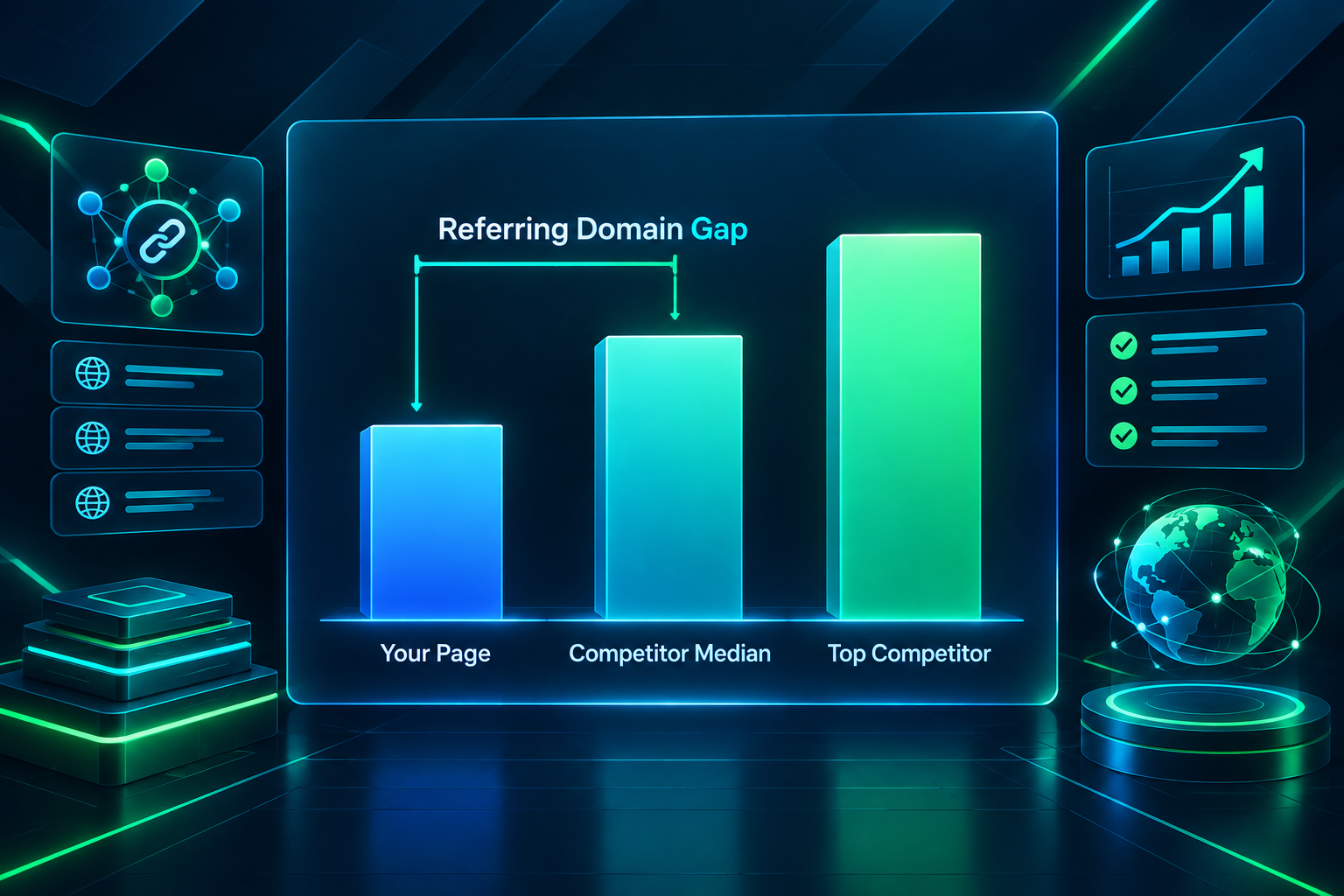
This calculation should be treated as a directional estimate rather than a precise prescription. Referring domain count is one of many factors that influence rankings, and the relationship between domain count and ranking position is not linear or guaranteed. A page with fewer referring domains can outrank a page with more if the linking domains are more topically relevant, if the on-page content is stronger, or if other technical and authority factors favor it. The gap analysis is a useful planning tool, not a formula that produces a guaranteed outcome.
When applying this analysis to PBN campaign planning specifically, it is also worth considering the quality distribution of the competitor’s referring domains. A competitor with 50 referring domains from high-authority, topically relevant sites may be harder to match than a competitor with 80 referring domains from lower-quality sources. Referring domain count and referring domain quality are related but distinct dimensions of a backlink profile.
Tracking Unique Referring Domain Growth Over Time
A single referring domain count at a point in time is useful, but tracking how the count changes over the course of a PBN campaign provides more actionable information. Most SEO tools offer a historical graph of referring domain growth, which allows you to see whether new placements are being indexed and attributed as expected, whether any previously counted domains have dropped out of the index, and whether the overall trajectory of the campaign aligns with the planned placement schedule.
When a new PBN placement is added, it will typically appear in a tool’s referring domain count after the tool’s crawler has visited the linking page. This can take anywhere from a few days to several weeks depending on the tool’s crawl frequency and the crawl priority assigned to the linking domain. A placement that does not appear in the count after a reasonable period may warrant a check to confirm that the linking page is indexed by search engines, that the link is live and correctly formatted, and that the target URL matches the intended destination.
Tracking referring domain counts at regular intervals — for example, monthly — and recording them in a campaign log alongside the placement dates allows you to build a clear picture of campaign velocity and index uptake. If the count is growing more slowly than expected, it may indicate that some placements are on pages with low crawl frequency, that some linking pages are not indexed, or that the tool’s index has not yet captured recent additions. Each of these possibilities has a different practical response, so identifying the specific cause is more useful than simply noting that the count is lower than anticipated.
Subdomain Handling and Edge Cases in PBN Domain Counting
Most PBN setups use standalone root domains as individual network sites, which makes the referring domain count straightforward: each PBN site contributes one unique referring domain. However, there are edge cases worth understanding, particularly if you are auditing an existing campaign or evaluating a provider’s network structure.
If any PBN sites are hosted on subdomains of a shared root domain — for example, site1.networkhost.com and site2.networkhost.com — most tools will count both as referring from the same root domain (networkhost.com), meaning they contribute only one unique referring domain between them rather than two. This is a structural consideration that affects how the campaign’s domain diversity is reported and perceived.
Expired domains that have been repurposed as PBN sites and that carry redirect chains from their previous incarnations can also create counting anomalies. If the expired domain previously redirected to another site and that redirect is still partially active, some tool crawlers may follow the redirect and attribute the link to the destination rather than the PBN domain. Verifying that expired domains used in a PBN are cleanly configured, with no unintended redirects, helps ensure that each domain is counted correctly as a distinct referring domain.
Domains that have been deindexed by search engines present a different issue. A deindexed PBN domain may still appear in a tool’s referring domain count if the tool’s crawler has previously visited the linking page and has not yet updated its index to reflect the deindexation. Conversely, a domain that is indexed but has not been recently crawled by the tool may be absent from the count even though the link is live. These discrepancies are a normal feature of working with third-party index tools and reinforce the value of maintaining an internal placement log as the authoritative record of active PBN placements.
Interpreting the Count in the Context of a Full Backlink Profile
The unique referring domain count from PBN placements should be interpreted alongside the broader backlink profile of the target site, not in isolation. A site that has 30 PBN referring domains and 5 organic referring domains has a very different profile structure from a site that has 30 PBN referring domains alongside 200 organic referring domains from diverse sources. The ratio and distribution of referring domains across different link types is a dimension of profile analysis that goes beyond the raw PBN count.
Anchor text distribution across unique referring domains is another layer of analysis that complements the domain count. Tracking how many of the unique PBN referring domains use exact-match anchor text versus branded, partial-match, or generic anchors gives a more complete picture of the campaign’s anchor profile. This matters because the anchor text signals associated with a referring domain contribute to how the link is interpreted, and a campaign with a large number of unique referring domains but a heavily concentrated anchor text pattern may present a different profile than one with more varied anchor usage.
When presenting referring domain counts to clients or stakeholders, it is useful to report the figure alongside the tool used, the date of the report, whether the count is at the page level or domain level, and whether it includes only followed links or all link types. These contextual details prevent misinterpretation and make the figure more meaningful as a campaign metric.
Frequently Asked Questions
Does every PBN link I buy add a new unique referring domain?
Each PBN placement adds a new unique referring domain only if it comes from a root domain that is not already linking to your target. If you purchase multiple placements from the same PBN site — for example, two articles on the same domain — those placements add to your backlink count but not to your unique referring domain count. For maximum domain diversity, each placement should come from a distinct root domain.
Why does Ahrefs show a different referring domain count than Semrush for the same site?
Ahrefs and Semrush maintain separate crawl indexes with different coverage, crawl frequencies, and deduplication logic. Neither tool has a complete view of every link on the web, so discrepancies between their counts are normal. For consistent campaign tracking, choose one tool as your primary reference and use the other for periodic cross-validation rather than trying to reconcile the two figures exactly.
How long does it take for a new PBN placement to appear in the referring domain count?
The time between a placement going live and it appearing in a tool’s referring domain count depends on how quickly the tool’s crawler visits the linking page. This can range from a few days for frequently crawled domains to several weeks for less prominent sites. If a placement has not appeared after a few weeks, it is worth checking whether the linking page is indexed by search engines and whether the link is correctly formatted and live.
Should I count referring domains at the page level or the domain level for PBN campaign planning?
For most PBN campaigns targeting specific pages — such as a product page, a service page, or a blog post — counting referring domains at the page level is more directly relevant because it reflects the link equity directed at the specific URL you are trying to rank. Domain-level counts are useful for understanding the overall authority profile of the site but may include links that do not directly benefit the target page.
Can I use referring domain count as the sole metric for evaluating a PBN campaign?
Referring domain count is a useful structural metric but should not be used in isolation. The topical relevance of the linking domains, the quality of the content on the linking pages, the anchor text distribution across those domains, and the indexing status of the linking pages all contribute to how the campaign performs. A higher referring domain count from lower-quality or irrelevant sources does not automatically outperform a lower count from well-chosen, topically relevant domains.
What happens to my referring domain count if a PBN domain is deindexed?
If a PBN domain is deindexed by a search engine, the links from that domain may no longer be processed as active ranking signals, though the domain may still appear in third-party tool counts for some time depending on when the tool last crawled the linking page. Monitoring your referring domain count over time and cross-referencing it with your internal placement log helps identify domains that may have dropped out of the active index.
Calculating Unique Referring Domains as an Ongoing Campaign Practice
Counting unique PBN referring domains accurately is not a one-time task — it is an ongoing measurement practice that supports better campaign decisions at every stage. Starting with a clear definition of the target URL, choosing a consistent tool and methodology, maintaining an internal placement log, and running periodic gap analyses against competing pages gives you a structured way to assess whether a campaign is building the domain diversity it was designed to deliver.
The calculation itself is straightforward once the methodology is established: pull the referring domain report for the target URL, filter for live followed links, deduplicate at the root domain level, and cross-reference against your placement log to confirm which domains correspond to active PBN placements. The more complex and valuable work lies in interpreting that count in context — understanding how it compares to competitor profiles, how it is growing relative to the placement schedule, and how it interacts with anchor text distribution and domain quality across the network.
If you are planning a PBN campaign and want to assess how many unique referring domains your target pages currently have, how that compares to the pages you are competing against, and what placement volume may be appropriate for your goals, PBN Backlinks Service can help you work through those figures and structure a campaign accordingly. A review of your existing backlink profile and target keyword landscape is a practical starting point for any placement decision.