

Assigning PBN anchors across landing pages is one of the most consequential decisions in a link-building campaign. The anchor text attached to each PBN placement signals relevance to search engines, and the way those signals are distributed across your target pages shapes how each page competes for its intended keywords. Getting the allocation right requires understanding anchor types, the role each landing page plays in your site architecture, and how the cumulative anchor profile across your entire backlink portfolio reads to a search engine crawler.
Key Takeaways
- Anchor text allocation should be planned at the campaign level, not decided placement by placement, so the cumulative profile across all landing pages remains coherent and varied.
- Each landing page type — commercial, informational, category, or homepage — has a different anchor strategy because each competes for different keyword types and carries different authority expectations.
- Exact-match anchors carry the strongest topical signal but should represent a minority of placements; branded, partial-match, and natural anchors provide the surrounding variation that makes a profile look organic.
- Distributing PBN links across multiple landing pages rather than concentrating them on one URL reduces footprint risk and supports a broader keyword footprint across the site.
- Anchor planning is iterative: monitor how each target page responds after placements index, then adjust future anchor choices based on observed ranking movement and the competitive gap.
Why Anchor Allocation Matters More Than Anchor Choice
Most discussions about PBN anchor text focus on which anchor to use for a single link. The more important question is how anchors are allocated across all the landing pages in a campaign. A single exact-match anchor on one PBN placement is rarely the deciding factor in a ranking outcome. What matters is the pattern that emerges when all placements are indexed and read together. If every PBN link pointing to a commercial landing page uses the same exact-match phrase, the resulting anchor profile can look unnatural compared to the broader backlink landscape in that niche. Conversely, if every anchor is generic or branded, the topical signal those PBN placements were intended to deliver may be diluted.
Anchor allocation is therefore a portfolio decision. Before assigning any anchor to a specific PBN placement, it helps to audit the existing backlink profile of each target page using a tool such as Ahrefs or Semrush. This audit reveals the current anchor distribution — how many links already use exact-match phrases, how many use branded terms, and how many use generic or URL-based anchors. The goal of new PBN placements is to complement that existing distribution, not to replicate it or push it further in one direction.
Understanding the Main Anchor Types
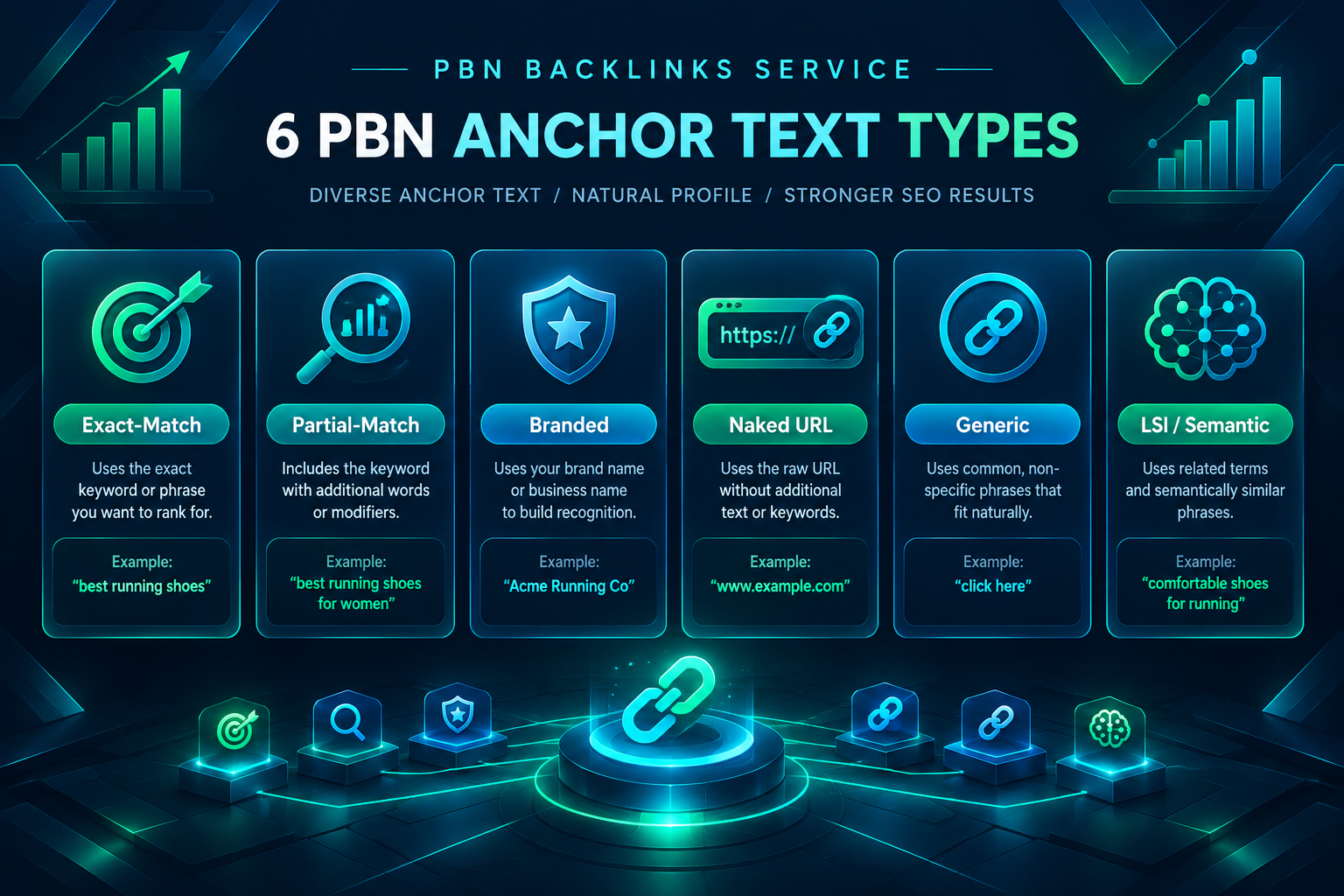
Anchor text in a PBN campaign typically falls into several categories, each serving a different function in the overall link profile.
- Exact-match anchors use the precise keyword phrase the target page is optimized for, such as “project management software” for a page targeting that term. These carry a direct topical signal and are often the primary reason a site owner chooses PBN placements for a specific page.
- Partial-match anchors include the target keyword alongside other words, such as “best project management software for teams” or “affordable project management tools”. These provide topical relevance while appearing more naturally varied than a repeated exact phrase.
- Branded anchors use the company or website name, such as “Acme Software” or “visit Acme”. Branded links are a natural component of any healthy backlink profile and help balance the proportion of keyword-rich anchors.
- Naked URL anchors use the target page address as the anchor, such as “acmesoftware.com/project-management”. These are common in natural link profiles and add variation without contributing a keyword signal.
- Generic anchors use phrases such as “click here”, “read more”, or “this page”. While they carry minimal topical signal, including a small proportion of generic anchors in a PBN campaign contributes to profile naturalness.
- LSI and semantic anchors use related terms or synonyms rather than the exact target phrase, such as “task tracking platform” for a project management page. These support topical relevance without repeating the exact-match phrase and are particularly useful when a page already has several exact-match links.
No fixed percentage governs how many of each type a campaign should contain. The right balance depends on the existing anchor distribution of each target page, the competitive landscape in the niche, and the number of PBN placements being deployed. What is consistent across well-planned campaigns is that exact-match anchors are used selectively rather than as the default choice for every placement.
Mapping Anchor Types to Landing Page Goals
Different landing pages serve different purposes in a site’s architecture, and the anchor strategy for each should reflect those purposes.
Commercial and Product Pages
Commercial landing pages — product pages, service pages, and conversion-focused pages — are typically the primary targets for exact-match and partial-match PBN anchors. These pages compete for transactional or commercial-intent keywords, and a well-placed exact-match anchor from a topically relevant PBN domain can reinforce the page’s relevance signal for that keyword. However, because commercial pages are often the most competitive and the most scrutinized, the anchor profile for these pages should include a meaningful proportion of branded and partial-match anchors alongside any exact-match placements. Concentrating all exact-match anchors on a single commercial page, especially if that page already has a high proportion of keyword-rich links, can create an unnatural-looking profile.
Informational and Blog Pages
Informational pages — guides, how-to articles, comparison posts, and blog content — typically target informational-intent keywords. PBN anchors pointing to these pages often work well as partial-match or LSI anchors that reflect the broader topic rather than a single exact phrase. Informational pages also serve as useful intermediate targets in a tiered link-building approach, where PBN links build authority on a supporting page that then passes relevance to a commercial page through internal links. When using this approach, the anchor text on the PBN link should reflect the informational page’s topic, not the commercial page’s keyword.
Category and Pillar Pages
Category pages and content pillar pages sit above individual posts or product pages in site architecture. PBN links to these pages can distribute authority broadly across the site through internal linking. Anchors for category pages often work best as partial-match or branded phrases that reflect the category topic without over-optimizing for a single keyword. Because category pages typically rank for a range of related terms rather than one exact phrase, a varied anchor set is particularly appropriate here.
Homepage
The homepage is usually the most authoritative page on a domain and often ranks for branded terms and broad head keywords. PBN links to the homepage are commonly assigned branded anchors or partial-match anchors that include the brand name alongside a broad keyword. Exact-match anchors pointing to the homepage can look unnatural unless the homepage is specifically optimized for a single non-branded keyword, which is less common for established sites. Homepage PBN placements are often used to build overall domain authority rather than to target a specific keyword, so anchor variation is especially important here.
Planning Anchor Distribution Across Multiple Landing Pages
When a PBN campaign targets several landing pages simultaneously, anchor allocation requires a campaign-level plan rather than page-by-page decisions. The starting point is a clear list of target pages ranked by priority, with the primary keyword for each page and the current anchor distribution from an existing backlink audit.
A practical approach is to assign a target anchor mix to each landing page before ordering placements. For example, a commercial page with few existing backlinks and a clean anchor profile might receive a higher proportion of exact-match and partial-match anchors in the first campaign phase. A page that already has several exact-match links from previous campaigns might receive primarily branded, partial-match, and LSI anchors in the next phase to balance the profile. This prevents any single anchor type from becoming disproportionately dominant on a specific page.
Spreading PBN placements across multiple landing pages rather than concentrating them on one URL also has a practical benefit beyond anchor diversity. It reduces the concentration of PBN-sourced links on any single page, distributes topical signals across the site, and supports a broader keyword footprint. For sites with several commercial pages competing in the same niche, this approach can produce more balanced ranking improvements across the site rather than a single page gaining most of the benefit.
Sequencing Anchors Over Time
Anchor allocation is not a one-time decision. In a campaign that deploys PBN placements in phases over weeks or months, the anchor choices in each phase should be informed by what was placed in the previous phase and how the target pages have responded.
In an initial phase, it is common to use a mix of branded, partial-match, and a limited number of exact-match anchors to establish a varied foundation. As placements index and ranking data becomes available, subsequent phases can be adjusted. If a target page has moved into a competitive position for its primary keyword but has not yet reached the first page, adding a carefully chosen exact-match or partial-match anchor in the next phase may help close the gap. If a page has already reached a strong position, maintaining it with branded and LSI anchors rather than adding more exact-match links is often the more measured approach.
This iterative process requires monitoring. Tracking ranking positions for each target page’s primary and secondary keywords, alongside the indexed anchor distribution visible in a tool such as Ahrefs or Semrush, gives a clearer picture of how the campaign is progressing and where adjustments are needed. Ranking changes after PBN placements index are one data point, but they should be interpreted alongside other factors such as content updates, competitor activity, and algorithm changes before drawing conclusions about specific placements.
Topical Relevance and Anchor Coherence
The relevance of the PBN domain to the target page’s topic is closely connected to anchor effectiveness. A PBN placement on a domain with a strong history in a related niche, combined with an anchor that reflects the target page’s topic, creates a coherent relevance signal. A topically mismatched domain using an exact-match anchor may deliver a weaker signal because the surrounding content and domain history do not reinforce the anchor’s keyword claim.
When planning anchor allocation, it is worth considering whether the PBN domains available for each target page are topically appropriate. A commercial page about financial services may benefit more from a partial-match anchor on a finance-adjacent PBN domain than from an exact-match anchor on a domain with no thematic connection to the topic. Topical coherence between the PBN domain, the placement page content, the anchor text, and the target landing page strengthens the overall relevance signal and makes the placement more useful.
Common Anchor Allocation Mistakes
Several patterns in PBN anchor allocation tend to produce suboptimal results or create profiles that look unusual compared to naturally acquired backlink sets.
- Repeating the same exact-match anchor across every PBN placement for a single landing page creates an anchor profile that is heavily skewed toward one phrase. Even if each individual placement is on a high-quality domain, the cumulative pattern can look inconsistent with how links to that page type are typically distributed in the niche.
- Ignoring the existing anchor profile before ordering new placements means new links may push an already over-optimized profile further in the same direction rather than balancing it.
- Using the same anchor set for every landing page regardless of page type or keyword intent misses the opportunity to tailor the relevance signal to each page’s specific competitive situation.
- Concentrating all placements on one landing page while leaving other target pages without support limits the campaign’s overall impact and may create an uneven link distribution across the site.
- Failing to update the anchor plan as the campaign progresses means early decisions made without ranking data continue to drive placements even after the competitive situation has changed.
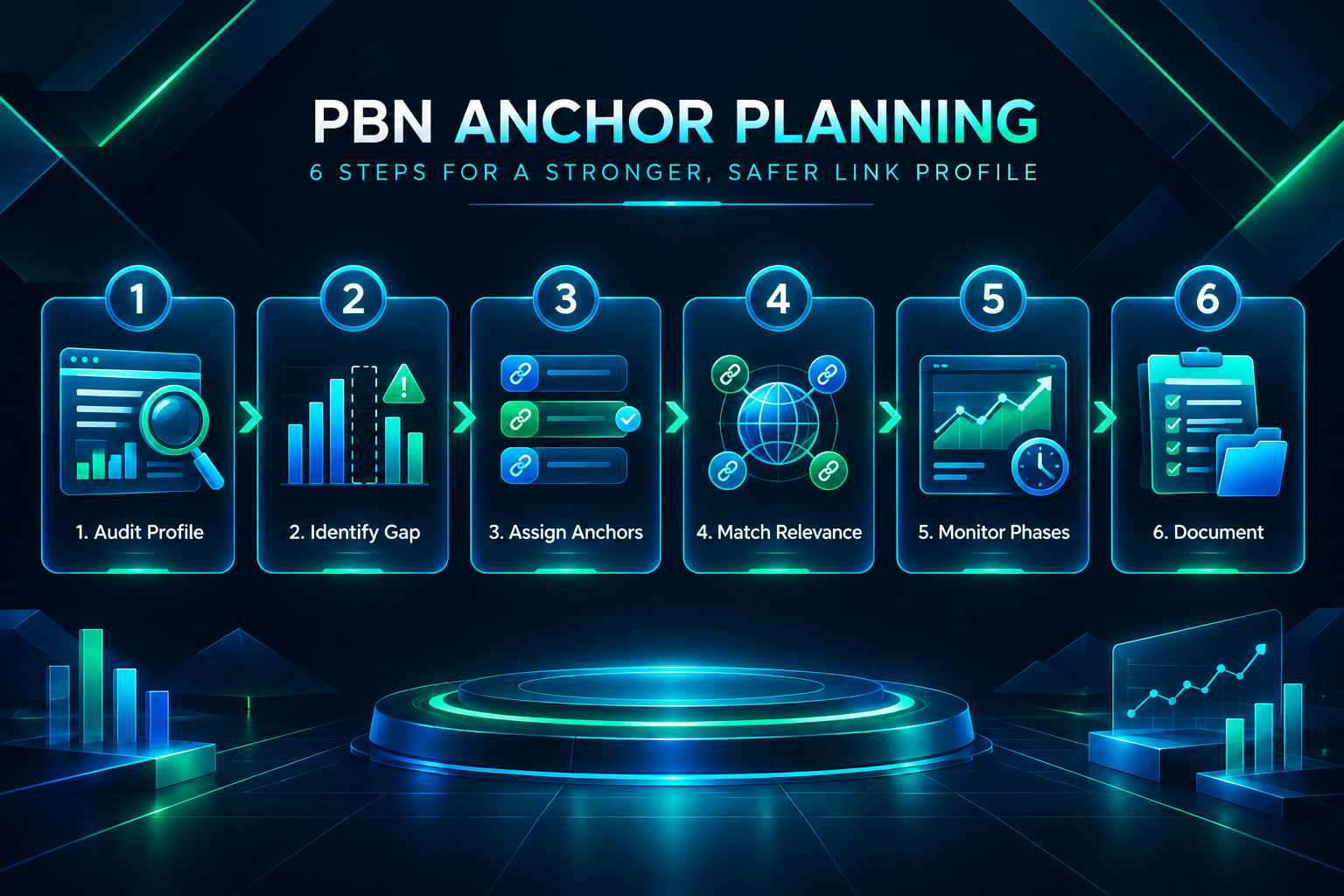
Practical Steps for Assigning Anchors Before Ordering Placements
- Audit each target page’s existing backlink profile. Use Ahrefs, Semrush, or Majestic to export the current anchor distribution for each landing page. Note the proportion of exact-match, partial-match, branded, naked URL, and generic anchors already present.
- Identify the anchor gap for each page. Compare the current distribution to what a natural profile in the niche looks like. If exact-match anchors are already well-represented, the gap may be in branded or partial-match anchors. If the profile is mostly branded, there may be room for carefully placed partial-match or LSI anchors.
- Assign a target anchor type and specific phrase to each planned placement. Do this at the campaign planning stage rather than at the point of ordering, so the full set of placements can be reviewed for coherence before any links are placed.
- Match anchor choices to PBN domain relevance. Confirm that the PBN domain being used for each placement has topical relevance to the target page’s niche before finalizing the anchor assignment.
- Stagger placements and monitor after each phase. Allow time for placements to be crawled and indexed before assessing ranking movement. Use the data from each phase to inform anchor choices in the next phase.
- Document every placement. Record the target URL, PBN domain, anchor text used, placement date, and indexing status. This record makes it possible to review the cumulative anchor profile accurately and plan future phases without guessing.
Frequently Asked Questions
How many PBN placements should use exact-match anchors for a single landing page?
There is no universally correct number or percentage. The appropriate proportion depends on the page’s existing anchor distribution, the competitiveness of the target keyword, and how the niche’s natural link profiles look. Reviewing the anchor profiles of pages already ranking in the top positions for the target keyword gives a useful reference point. Exact-match anchors are generally used selectively rather than as the majority of placements for any single page.
Should every landing page in a campaign receive PBN links?
Not necessarily. Priority should be given to pages where the ranking gap is most significant and where PBN placements are most likely to contribute meaningfully. Some pages may already have sufficient link equity from other sources. Spreading placements too thinly across many pages can reduce the impact on any individual page, so focusing on a defined set of priority targets is usually more effective than distributing links across every page on the site.
Can the same anchor text be used on multiple PBN placements pointing to the same page?
Using the same anchor on multiple placements pointing to one page is not automatically problematic, but it does increase the concentration of that anchor in the page’s profile. If the anchor is an exact-match phrase and several placements already use it, adding more of the same anchor may push the profile toward an unusual distribution. Varying the anchor across placements — even with small differences such as adding or removing a modifier word — is generally a more measured approach.
How does internal linking interact with PBN anchor allocation?
Internal links from high-authority pages on the same site can pass relevance and authority to target landing pages without requiring additional external placements. When planning PBN anchor allocation, it is worth considering whether some target pages can be supported through improved internal linking from pages that already have strong external link equity. This can reduce the number of external PBN placements needed for secondary pages while concentrating external link budget on primary targets.
How long after PBN placements index should I wait before assessing anchor effectiveness?
Ranking responses to new backlinks vary considerably depending on the site, the niche, the competitiveness of the keyword, and how quickly search engines process the new signals. Observing meaningful ranking movement typically requires several weeks after confirmed indexing, and in competitive niches it may take longer. Assessing anchor effectiveness too soon — before placements have been fully processed — can lead to premature adjustments that disrupt a campaign that was on track.
Building an Anchor Plan That Serves Each Landing Page
Effective PBN anchor allocation is a planning discipline as much as a technical one. The decisions made before a single placement is ordered — which pages to target, which anchor types to assign, how to sequence placements across phases, and how to monitor the results — determine whether the campaign produces a coherent, useful backlink profile or an uneven one that delivers less than it could.
The core principle is that anchor text should be assigned to serve each landing page’s specific competitive situation rather than applied uniformly across all placements. Commercial pages, informational pages, category pages, and the homepage each have different anchor needs, different existing profiles, and different keyword targets. A campaign plan that accounts for these differences, and that is updated as ranking data becomes available, is more likely to produce measurable progress than one that treats every placement as an isolated decision.
If you are planning a PBN campaign and want to review anchor allocation strategy, target page selection, or placement quality before ordering, PBN Backlinks Service can help you assess your requirements and structure a campaign that fits your site’s current profile and goals.