

PBN case studies circulate widely in SEO communities, but the gap between a published result and a reproducible outcome can be significant. Before using a case study to justify a link-building decision, it is worth understanding what the study actually measured, which variables were controlled, and whether the conditions that produced the result are likely to apply to your own website. This article explains a structured approach to assessing PBN case study reproducibility, covering methodology review, variable identification, quality benchmarks, and the practical limits of transferring one site’s results to another.
Key Takeaways
- Reproducibility depends on how closely your website’s conditions match those described in the case study, including niche, competition level, existing backlink profile, and on-page quality.
- A credible PBN case study should document the network’s domain quality, placement context, anchor text strategy, and the timeline between link acquisition and measurable ranking changes.
- Correlation between link acquisition and ranking improvement is not the same as demonstrated causation; other concurrent SEO activities can confound results.
- Methodology transparency, including baseline metrics, control variables, and measurement intervals, is the most reliable indicator of whether a case study result is transferable.
- Even a well-documented case study describes one outcome under specific conditions; your own campaign requires a site-specific assessment rather than a direct replication of another site’s link profile.
Why PBN Case Study Reproducibility Is Worth Examining
A PBN case study is only as useful as its methodology. When a study reports that a website moved from position 18 to position 4 after acquiring a set of PBN backlinks, that result is meaningful only if the reader can identify what was done, under what conditions, and whether those conditions are comparable to their own situation. Without that information, the result is anecdotal rather than instructive. Reproducibility assessment is the process of determining whether the documented outcome is likely to occur again under similar conditions, or whether it reflects a unique combination of factors that cannot be reliably replicated.
The SEO industry produces a large volume of case studies with varying levels of rigor. Some document methodology carefully, including baseline rankings, link acquisition dates, anchor text choices, domain metrics, and competing activities during the test period. Others report only the before-and-after ranking change without explaining the mechanism. The difference matters considerably when you are trying to decide whether a particular link-building approach is appropriate for your own website and goals.
Step One: Evaluate the Methodology Before the Result
The first question to ask about any PBN case study is not “what result did they get?” but “how did they measure it?” A reproducible result requires a documented baseline, a defined intervention, a clear measurement interval, and an honest account of what else changed during the study period. If any of these elements are missing, the result cannot be reliably assessed for transferability.
Look for the following methodological markers when reviewing a case study:
- Baseline documentation: Were pre-campaign rankings, organic traffic, and domain authority metrics recorded before any links were acquired? A study that begins with “we started building links in March” without recording the site’s position at that point cannot demonstrate what the links actually changed.
- Defined intervention: Does the study specify exactly how many PBN placements were acquired, over what period, to which target pages, and with what anchor text distribution? Vague descriptions such as “we built some PBN links” make it impossible to replicate the approach.
- Measurement interval: Rankings can fluctuate significantly week to week. A credible study tracks positions over a meaningful period, typically several weeks to months, rather than capturing a single favorable data point.
- Confounding activity disclosure: Did the site also publish new content, acquire other backlinks, improve technical SEO, or change its internal linking structure during the same period? Any of these activities can influence rankings independently of PBN link acquisition, and a study that does not account for them cannot attribute the result to the links alone.
The absence of these elements does not mean the result is fabricated, but it does mean the result cannot be treated as evidence that the same approach will produce the same outcome for a different website.
Step Two: Identify the Key Variables That Affect Transferability
Even a methodologically sound PBN case study describes one outcome under a specific set of conditions. Transferability depends on how closely your situation matches those conditions. The following variables have the greatest influence on whether a documented result is likely to recur.
Niche and Competitive Landscape
A ranking improvement achieved in a low-competition niche with few authoritative referring domains may not transfer to a competitive vertical where the top-ranking pages carry substantially stronger backlink profiles. The case study should specify the niche and, ideally, the approximate competition level for the target keywords. If it does not, you can assess this independently by examining the backlink profiles of the pages that currently rank for the same or similar terms.
Existing Backlink Profile of the Target Site
A site with a thin or new backlink profile may respond differently to a set of PBN placements than a site with an established profile of diverse referring domains. The case study should describe the target site’s pre-campaign link profile, including the approximate number of referring domains, their topical relevance, and any notable characteristics such as a high proportion of exact-match anchors or a history of link-building campaigns. Without this context, it is difficult to assess whether the documented result reflects the PBN links specifically or the site’s overall link-building trajectory.
Domain Quality of the PBN Placements
Not all PBN domains carry equivalent link equity. The quality of a PBN placement depends on factors including the referring domain’s historical topical relevance, the quality and diversity of its own backlink profile, its indexing history, and the relevance of the placement page to the target site’s content. A case study that reports results from placements on domains with strong historical authority in a relevant niche describes a different intervention than one using recently registered or repurposed domains with thin content. Look for domain-level metrics such as referring domain counts, topical relevance indicators, and indexing status in the case study documentation.
Anchor Text Strategy
The distribution of anchor text across PBN placements can influence both the ranking signal and the risk profile of a campaign. A case study that used a varied anchor text strategy, combining branded, partial-match, and generic anchors, describes a different approach than one that relied heavily on exact-match anchors. The study should document the anchor text choices made and, where possible, explain the rationale. If the anchor strategy is not described, you cannot replicate the intervention accurately, and you cannot assess whether the anchor distribution contributed to or detracted from the result.
Placement Context and Content Quality
A contextual PBN backlink placed within a well-written, topically relevant article on a domain with genuine content history is a different placement type than a link inserted into a thin page with no thematic connection to the target site. The case study should describe the placement context, including the type of content surrounding the link, the relevance of the placement page to the target keyword, and whether the linking page itself had any existing authority or traffic. Placement context is one of the factors that distinguishes higher-quality PBN networks from lower-quality ones, and it directly affects the likely ranking contribution of each link.
Step Three: Assess the Measurement Tools and Data Sources
Reproducibility assessment also requires scrutiny of how results were measured. Ranking data from different tools can vary meaningfully, and a result reported using one tool may not be directly comparable to measurements taken with another. When reviewing a PBN case study, check which ranking tracker was used, whether the rankings were measured at a consistent location and device type, and whether organic traffic data from Google Search Console or a comparable source was used to corroborate the ranking improvement.
Third-party domain metrics such as Domain Rating from Ahrefs, Domain Authority from Moz, or Trust Flow from Majestic are useful for assessing relative link quality, but they are proprietary scores rather than Google ranking signals. A case study that reports PBN domain quality exclusively through one of these metrics is providing a useful reference point, but not a direct measure of the ranking value Google assigns to those links. When a study uses multiple data sources, including ranking trackers, Search Console data, and backlink analysis tools, the result is generally more credible than one relying on a single metric.
Step Four: Look for Documented Timeline Between Link Acquisition and Ranking Change
The timeline between PBN link acquisition and a measurable ranking change is an important reproducibility variable. Links must first be crawled and indexed before they can contribute to ranking signals, and the time required for that process varies depending on the crawl frequency of the linking domain, the indexing status of the placement page, and the overall crawl budget of the network. A case study that documents the specific dates of link acquisition, indexing confirmation, and ranking movement provides a more useful reference than one that reports only a before-and-after snapshot without a timeline.
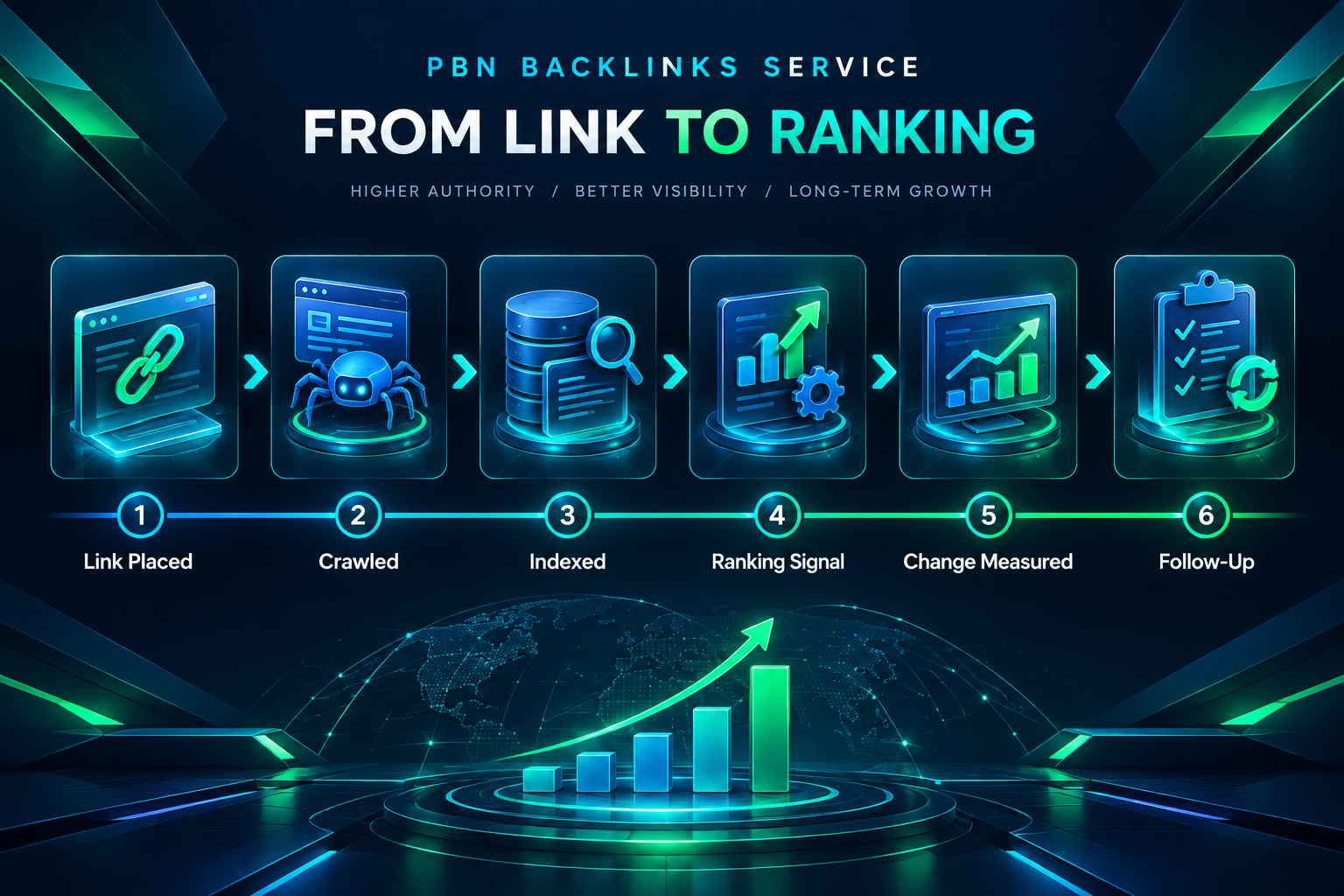
Ranking changes following link acquisition can also reflect factors unrelated to the new links, including algorithm updates, seasonal search volume shifts, or changes in competitor behavior. A study conducted during a period of significant algorithm activity should acknowledge that possibility rather than attributing all ranking movement to the PBN placements. If the study period overlaps with a known algorithm update and the study does not address this, the result is less reliable as a predictor of what PBN links alone might achieve.
Step Five: Check Whether the Study Accounts for Link Longevity
Some PBN case studies report ranking improvements measured shortly after link acquisition without following up to assess whether those improvements were sustained. A ranking gain that persists for six months or more under stable conditions is a more meaningful result than one measured at a single point shortly after the links were indexed. When evaluating a case study for reproducibility, check whether the study includes a follow-up measurement and, if so, how long after the initial result it was taken.
Link longevity is also relevant to the practical value of a PBN placement. If the linking domain is deindexed, loses its own backlink profile, or is repurposed after the study period, the ranking contribution of that placement may change. A study that does not address the ongoing status of the PBN domains used cannot confirm that the result reflects a durable link-building outcome rather than a temporary signal.
Step Six: Compare the Study Conditions to Your Own Website
After reviewing the methodology, variables, measurement approach, and timeline, the final step is a direct comparison between the study conditions and your own website’s situation. This comparison should cover the following areas:
- Niche match: Is your target niche similar in competition level and topical structure to the one described in the study?
- Backlink profile similarity: Does your site’s current referring domain count, anchor text distribution, and link quality profile resemble the target site’s pre-campaign profile?
- Target page type: Was the study conducted on a page type similar to yours, such as a commercial landing page, an informational article, or a category page?
- Domain quality alignment: Are the PBN domains described in the study comparable in quality to those available through the provider you are evaluating?
- Anchor text strategy compatibility: Is the anchor text approach documented in the study appropriate for your current backlink profile and keyword targets?
A close match across most of these dimensions increases the likelihood that the documented result is informative for your own planning. A significant mismatch in any one dimension, particularly niche competition or existing backlink profile, reduces the transferability of the result and suggests that your campaign may produce a different outcome.
Red Flags That Reduce a Case Study’s Credibility
Certain characteristics in a PBN case study should prompt additional scrutiny before the result is used to inform a link-building decision. These include:
- No baseline metrics recorded before link acquisition began
- Results measured over a very short window, such as one to two weeks after indexing
- No disclosure of other SEO activities conducted during the study period
- Domain quality described only through a single proprietary metric without supporting detail
- Anchor text strategy not documented or described only vaguely
- No follow-up measurement to confirm that ranking improvements were sustained
- Results presented as universally applicable without acknowledging site-specific variables
- Ranking data sourced from a single tool without corroboration from Search Console or traffic data
None of these issues automatically invalidates a case study, but each one reduces the confidence with which the result can be treated as a reproducible benchmark. A study with several of these characteristics is better treated as a directional indicator than as a reliable predictor of what a similar campaign will achieve for your website.
What a Credible PBN Case Study Should Include
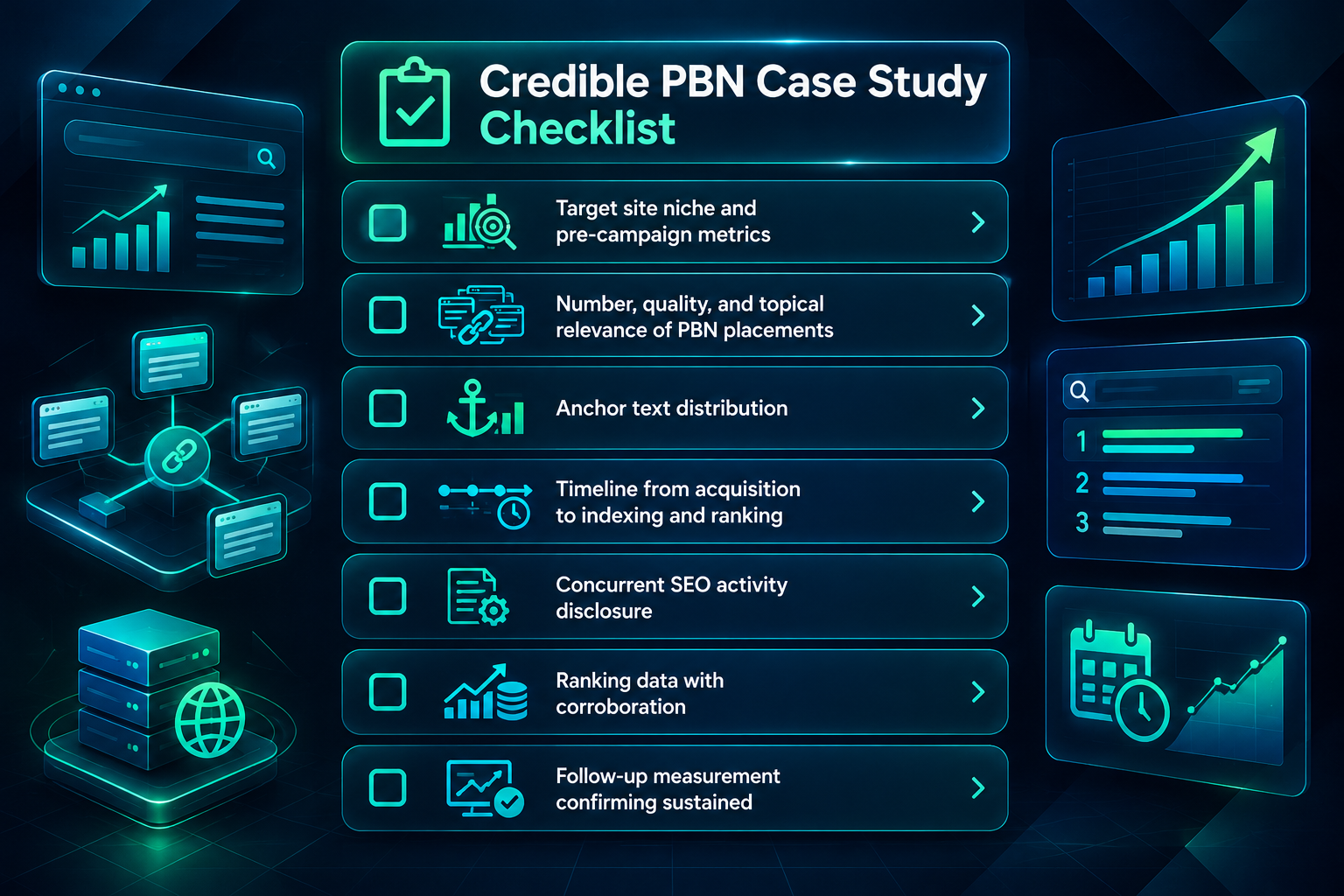
For reference, a well-documented PBN case study that supports reproducibility assessment should contain the following elements: a clear description of the target site’s niche and pre-campaign metrics; the number, quality, and topical relevance of PBN placements acquired; the anchor text distribution used; the timeline from link acquisition to indexing and ranking measurement; disclosure of any concurrent SEO activities; ranking data from at least one primary tool with corroboration where possible; and a follow-up measurement confirming whether the result was sustained. Studies that include most of these elements provide a substantially more useful basis for planning than those that report only a before-and-after ranking change.
Frequently Asked Questions
Can a PBN case study ever be fully reproducible?
Full reproducibility is rarely achievable in SEO because no two websites, backlink profiles, or competitive environments are identical. A well-documented case study can provide a useful directional reference, but it should be treated as one data point rather than a guaranteed template. The closer your site’s conditions match those described in the study, the more informative the result is likely to be for your own planning.
How many PBN case studies should I review before making a decision?
Reviewing multiple case studies from different sources and niches gives a broader picture of the range of outcomes that PBN placements have produced under different conditions. A single case study, even a well-documented one, reflects one outcome. Patterns that appear consistently across several studies with different methodologies carry more weight than a single impressive result.
Does a high Domain Rating on a PBN domain guarantee a ranking improvement?
Domain Rating is a proprietary metric from Ahrefs that estimates the strength of a domain’s backlink profile relative to other domains in the tool’s index. It is not a Google ranking signal and does not guarantee any specific ranking outcome. A high DR can indicate that a domain has a strong historical backlink profile, which may contribute to the link equity it passes, but placement context, topical relevance, and indexing status also affect the practical value of a PBN link.
What is the difference between a ranking correlation and a demonstrated causal result in a PBN case study?
A correlation means that a ranking improvement occurred around the same time as PBN link acquisition. A causal result would require evidence that the links specifically caused the improvement, ruling out other explanations such as algorithm changes, new content, technical improvements, or natural link acquisition. Most PBN case studies demonstrate correlation rather than causation, which is why methodology transparency and confounding variable disclosure are important for assessing how much weight to give the result.
Should I ask a PBN provider for case study documentation before ordering?
Requesting documentation of past results, including the methodology used and the conditions under which those results were achieved, is a reasonable part of evaluating any link-building provider. A provider that can describe the quality characteristics of their network, the types of placements they offer, and the general outcomes observed across different campaign types is in a better position to help you assess whether their service is appropriate for your specific goals than one that offers only unverified ranking claims.
How long should I wait before measuring results after PBN link acquisition?
The time between link acquisition and a measurable ranking change varies depending on how quickly the linking pages are crawled and indexed, the competitiveness of the target keywords, and the overall authority of the target site. Measuring results too soon, such as within the first week or two, risks capturing normal ranking fluctuations rather than a genuine signal from the new links. Most practitioners allow several weeks to a few months before drawing conclusions, and a follow-up measurement at a later point helps confirm whether any improvement is sustained.
Assessing PBN Case Studies for Your Own Campaign Decisions
Reproducibility assessment is not about finding a case study that promises a specific ranking outcome and then replicating it exactly. It is about developing a realistic understanding of what conditions produced a documented result and whether those conditions are sufficiently similar to your own situation to make the result informative. A case study that scores well on methodology transparency, variable documentation, measurement rigor, and timeline disclosure gives you a more reliable basis for planning than one that reports only a headline ranking improvement.
When evaluating PBN placements for your own website, the most useful approach combines case study review with a site-specific assessment of your existing backlink profile, target keyword competition, and the quality characteristics of the placements being considered. Domain quality, topical relevance, placement context, and anchor text strategy all influence the likely contribution of a PBN link to your rankings, and these factors should be evaluated in relation to your specific goals rather than assumed to match those described in a published study.
If you are assessing whether a PBN backlink campaign is appropriate for your website, PBN Backlinks Service can help you review placement quality, discuss campaign fit, and evaluate the domain and contextual characteristics of available placements in relation to your link-building objectives.