

Topical Trust Flow is one of the most practically useful metrics available when assessing the quality of a PBN backlink. Unlike raw authority scores that treat all links equally, Topical Trust Flow attempts to measure how closely a domain’s link profile aligns with a specific subject area, making it a relevant signal when you want a PBN placement to reinforce the topical relevance of your target page. Understanding how to read and apply this metric correctly can meaningfully improve the quality of your link selection decisions.
Key Takeaways
- Topical Trust Flow (TTF) is a proprietary Majestic metric that scores a domain’s thematic alignment with one or more topic categories based on its backlink profile, not a Google ranking signal.
- For PBN backlink assessment, TTF helps identify whether a donor domain’s historical link profile is genuinely relevant to your niche, which is a meaningful quality indicator beyond raw authority numbers.
- A high TTF score in a matching category is a positive quality signal, but it should be evaluated alongside Citation Flow, Trust Flow, referring domain quality, content relevance, and indexing status.
- TTF can be inflated, misread, or misapplied; understanding its limitations prevents over-reliance on a single metric when vetting PBN placements.
- Combining TTF with a manual review of the domain’s content, anchor text distribution, and placement context gives a more complete picture of a PBN link’s likely value.
What Topical Trust Flow Actually Measures
Topical Trust Flow is a proprietary metric developed by Majestic SEO. It extends the company’s Trust Flow score by categorizing a domain’s backlink profile into approximately 800 topic categories arranged in a hierarchical taxonomy. Rather than assigning a single authority number, TTF identifies which subject areas the sites linking to a domain belong to, then scores the domain’s alignment with each of those categories. A domain that has accumulated backlinks predominantly from health-related websites will show a high TTF score in the Health category, while a domain linked to primarily from finance sites will score higher in Business and Finance.
The practical implication for PBN backlink assessment is straightforward: a PBN domain with a strong TTF score in a category that matches your target niche carries a more coherent topical signal than a domain with a high generic Trust Flow but scattered or unrelated category scores. Topical coherence is a quality factor that many experienced link builders consider when selecting placements, because a contextually relevant link is generally thought to carry more meaningful weight than a link from a domain with no thematic connection to the target page’s subject matter.
It is important to understand that TTF is a Majestic proprietary metric, not a Google ranking factor or a direct measure of how any search engine values a link. Majestic calculates TTF from its own crawl data, which may differ from Google’s index. A high TTF score in a relevant category is a useful quality indicator, but it does not guarantee that a link will produce a specific ranking outcome.
Why Topical Relevance Matters in PBN Link Assessment
When evaluating a PBN backlink, topical relevance operates at two levels: the relevance of the donor domain’s overall subject matter and the relevance of the specific page where the link will be placed. TTF primarily addresses the first level by reflecting the thematic character of the domain’s historical link profile. A domain that was previously a legitimate resource in a specific niche will typically carry a TTF profile that reflects that history, even after it has expired and been repurposed as a PBN property.
This historical topical alignment is one reason why expired domains with strong TTF scores in a matching category are considered more valuable for PBN construction than domains with high raw metrics but no clear thematic identity. The domain’s link profile has been shaped by years of editorial decisions made by other webmasters, and that accumulated topical signal is part of what a PBN operator is preserving when they acquire and maintain such a domain carefully.
For the SEO buyer assessing a PBN placement, a matching TTF category means the donor domain’s backlink history is coherent with the niche of the target page. This coherence is a meaningful quality signal, though it is one factor among several rather than a standalone guarantee of link value.
How to Read Topical Trust Flow Scores in Practice
Majestic displays TTF as a list of topic categories, each with a numerical score. The scores are not percentages; they are relative values on a scale that reflects the strength of the domain’s association with each category. A domain may appear in multiple categories, but the primary category with the highest score is the most meaningful signal for relevance assessment.
When evaluating a PBN domain for a specific niche, the practical steps are as follows. First, identify the primary TTF category and compare it to the niche of your target page. If you are building links to a personal finance comparison page, a PBN domain with a primary TTF category of Business and Finance or a relevant subcategory such as Financial Planning is a stronger candidate than one whose primary category is Arts and Entertainment. Second, check whether the TTF score in the relevant category is meaningfully higher than scores in unrelated categories. A domain with a TTF of 25 in Finance and a TTF of 24 in Sports is not genuinely topically focused; it has a scattered profile that reduces the value of the topical signal. Third, compare the TTF score to the domain’s Citation Flow. The ratio of Trust Flow to Citation Flow, sometimes called the TF:CF ratio, gives a rough indication of link quality relative to link quantity. A domain with a high Citation Flow but a low Trust Flow in any category may have accumulated many low-quality links, which dilutes the topical signal.
Majestic’s category taxonomy is hierarchical, so a domain may score in a broad parent category such as Health and also in a narrower subcategory such as Health and Alternative Medicine. When your target page is in a specific sub-niche, a strong score in the matching subcategory is a more precise relevance signal than a high score only in the broad parent category.
Limitations of Topical Trust Flow as a PBN Assessment Tool
Topical Trust Flow is a useful starting point, but it has limitations that matter when assessing PBN placements specifically. Understanding these limitations prevents over-reliance on a single metric and helps you build a more complete quality assessment.
First, TTF reflects the domain’s historical backlink profile, not its current content. A PBN domain may have a strong TTF score in a relevant category because of its previous life as a legitimate website, but if the current content on that domain is thin, off-topic, or poorly maintained, the placement context may undermine the value of the link regardless of the metric score. Always review the actual content of the page where your link will appear, not just the domain-level TTF.
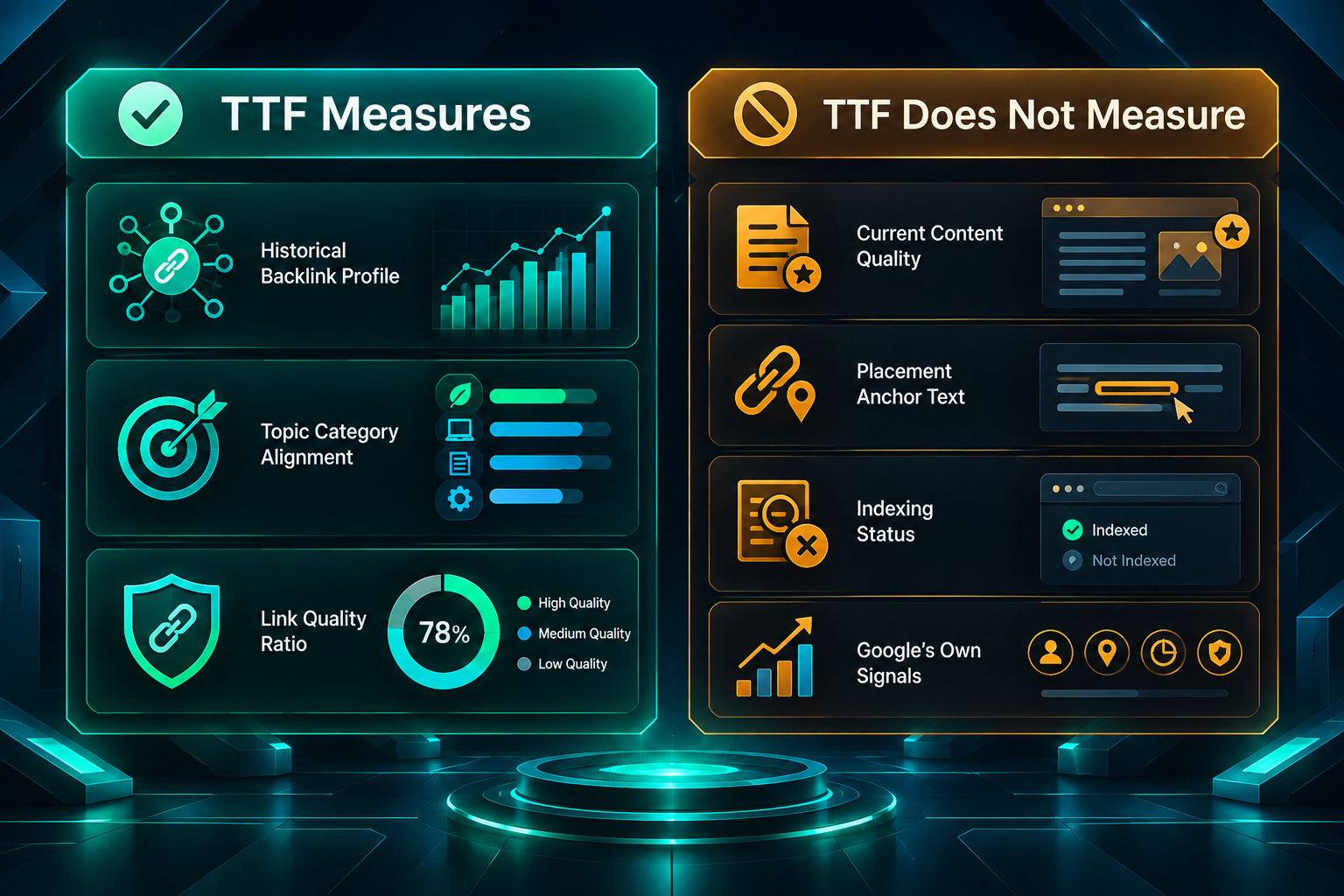
Second, Majestic’s crawl data is not identical to Google’s index. Majestic may have indexed links that Google has not, or vice versa. A TTF score is only as reliable as the completeness and recency of Majestic’s crawl of the domain’s referring pages. For domains with a long history or a large backlink profile, Majestic’s data is generally more comprehensive, but for newer or smaller domains, the TTF score may be based on a limited sample.
Third, TTF scores can be manipulated. A domain’s TTF profile can be influenced by the links pointing to it, which means a PBN operator could theoretically build links from topically relevant sources to inflate a domain’s TTF in a target category. This is not common practice among quality-focused providers, but it is a reason to treat TTF as one signal rather than a definitive quality certificate. Cross-referencing with Ahrefs Domain Rating, Moz Domain Authority, and a manual review of the referring domains in Majestic’s backlink explorer provides a more robust picture.
Fourth, TTF does not measure the quality of the placement page itself, the anchor text used, the surrounding content, or the internal linking structure of the PBN site. These placement-level factors are important for assessing how a specific link will function, and they require manual review rather than metric-based assessment alone.
Building a Multi-Metric Assessment Framework for PBN Backlinks
Experienced link builders typically use TTF as one component of a broader quality assessment rather than as the sole criterion for accepting or rejecting a PBN placement. A practical multi-metric framework for evaluating PBN backlinks might include the following checks.
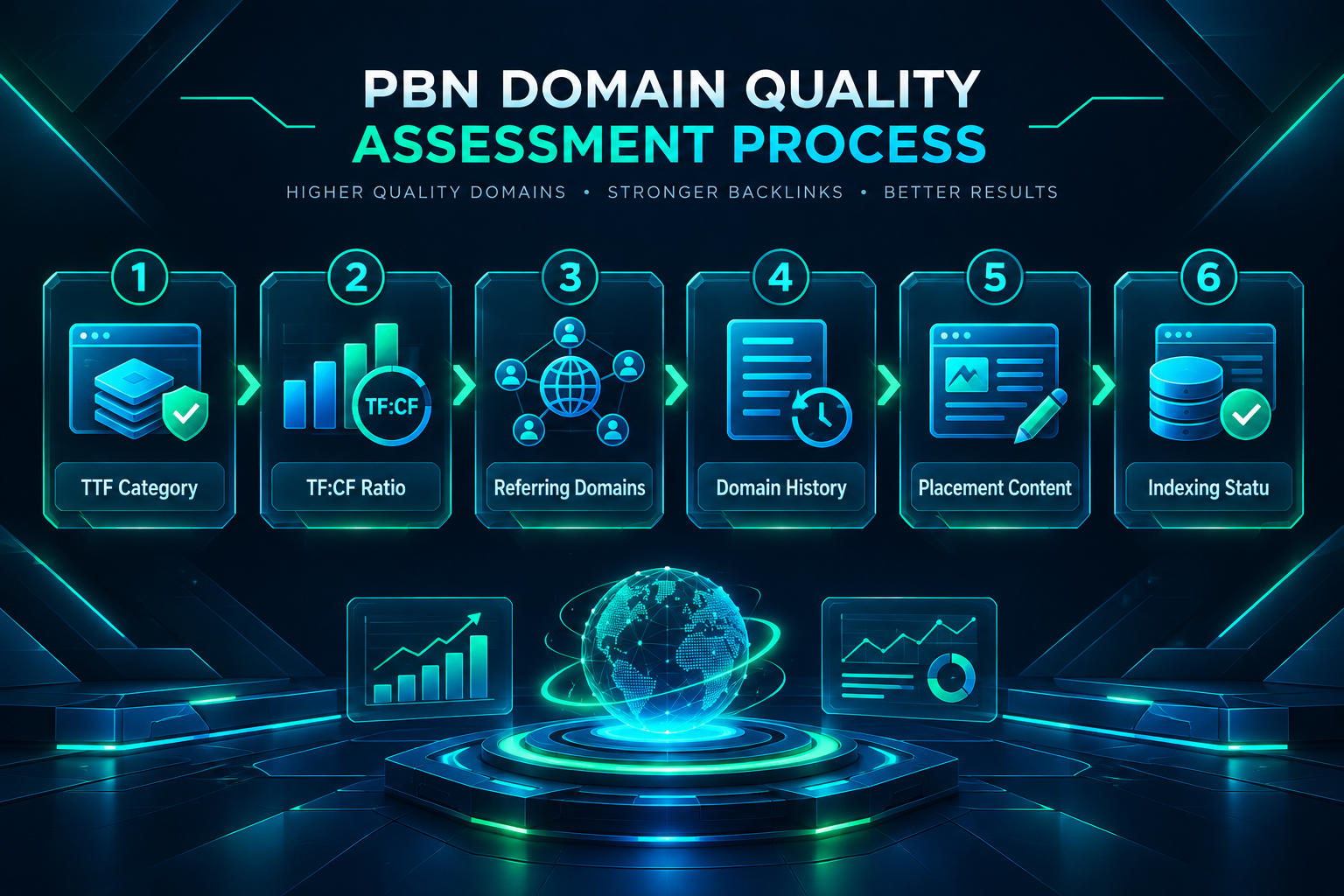
- Topical Trust Flow category and score: Confirm the primary TTF category matches the niche of your target page and that the score in that category is meaningfully higher than scores in unrelated categories.
- Trust Flow and Citation Flow: Review the overall TF score and the TF:CF ratio. A ratio closer to 1:1 or above suggests a cleaner, more editorially earned link profile. A very low ratio may indicate a high volume of low-quality links.
- Referring domain quality: Use Majestic’s backlink explorer or Ahrefs to review the actual domains linking to the PBN property. A strong TTF score built on a small number of high-quality referring domains is more credible than one built on hundreds of low-authority links.
- Domain history and content continuity: Check the Wayback Machine to confirm the domain’s previous use was genuinely relevant to the claimed niche. A domain that was previously a legitimate industry resource is more likely to carry a coherent topical signal than one with a fragmented or unrelated history.
- Current content quality: Review the live content on the PBN domain and the specific placement page. The content should be substantive, relevant to the domain’s stated niche, and contextually appropriate for the link being placed.
- Indexing status: Confirm the domain and the placement page are indexed in Google. A link on a page that is not indexed provides no direct ranking signal, regardless of the domain’s TTF score.
- Anchor text distribution: Review the existing anchor text profile of the PBN domain and consider how your planned anchor text fits within that distribution. Heavily exact-match anchor profiles on the donor domain may be a quality concern independent of TTF.
Applying TTF Assessment When Selecting PBN Placements
When you are reviewing a PBN backlink package or selecting individual placements, TTF assessment fits naturally into the pre-purchase evaluation stage. Most reputable PBN providers will supply domain metrics including Majestic TTF data alongside Ahrefs DR and other standard indicators. If a provider does not supply TTF data, you can look up any domain directly in Majestic’s free or paid interface using the domain’s root URL.
For niche-specific campaigns, prioritize placements where the donor domain’s primary TTF category aligns with the subject matter of your target page. For broader authority-building campaigns where topical diversity is acceptable, a range of TTF categories may be appropriate, but each domain should still show a coherent topical profile rather than a scattered or unclassified one. Domains that appear in Majestic’s data with no meaningful TTF category, or with very low scores across all categories, may indicate a thin or low-quality backlink history that limits the domain’s value as a PBN property.
It is also worth noting that TTF assessment is particularly relevant when evaluating expired domains for PBN construction. An expired domain’s TTF profile reflects the topical character of the links it accumulated during its active life. Acquiring a domain with a strong, coherent TTF score in a target niche and maintaining that topical identity through relevant content is a recognized approach to preserving the domain’s historical link equity.
TTF in the Context of Anchor Text Strategy
Topical Trust Flow assessment and anchor text strategy are complementary rather than independent considerations. A PBN domain with a strong TTF score in a relevant category provides a topically coherent context for the link, but the anchor text used for the placement determines how that link is associated with a specific keyword or topic in the search engine’s interpretation of the page being linked to.
When a donor domain has a high TTF score in a category that matches your target page’s niche, using a contextually relevant anchor text that reflects the subject matter of both the donor page and the target page reinforces the topical signal. Conversely, placing an exact-match commercial anchor on a donor domain whose TTF profile is unrelated to the target page’s niche creates a mismatch between the topical context and the anchor signal, which may reduce the coherence of the link from an assessment perspective.
Anchor text diversity across a PBN campaign remains an important consideration regardless of TTF scores. A mix of branded, partial-match, and contextual anchors distributed across placements with coherent TTF profiles is generally a more considered approach than concentrating exact-match anchors on a small number of high-TTF domains.
Questions to Ask Your PBN Provider About Topical Trust Flow
If you are purchasing PBN backlinks from a provider rather than building your own network, asking the right questions about TTF and topical relevance helps you assess placement quality before committing to a campaign.
- What is the primary Majestic TTF category for each domain in the proposed placement list, and does it align with my target niche?
- Can you provide the full TTF category breakdown, not just the top category, so I can assess topical focus versus scatter?
- What is the Trust Flow and Citation Flow for each domain, and what is the TF:CF ratio?
- How many referring domains contribute to the TTF score, and can I review a sample of those referring domains?
- Has the domain’s content been maintained in a way that is consistent with its historical TTF category?
- Is the specific placement page indexed in Google, and can I verify this before the link goes live?
- What anchor text options are available, and how does the provider approach anchor text diversity across placements?
Frequently Asked Questions
Is Topical Trust Flow a Google metric?
No. Topical Trust Flow is a proprietary metric created by Majestic SEO. It is calculated from Majestic’s own crawl data and reflects the thematic character of a domain’s backlink profile as Majestic categorizes it. Google does not use TTF as a ranking signal, and a high TTF score does not guarantee any specific outcome in Google Search. TTF is useful as a third-party quality indicator, not as a direct measure of how Google values a link.
What TTF score should I look for in a PBN domain?
There is no universally correct TTF threshold. The relevance of the primary category to your niche matters more than the absolute score. A domain with a TTF of 15 in a precisely matching subcategory may be more useful for a specific campaign than a domain with a TTF of 35 in a broad, loosely related category. Focus on category alignment, score concentration in the relevant category relative to other categories, and the quality of the referring domains that contribute to the score.
Can a PBN domain have a high TTF but still be a poor placement?
Yes. TTF reflects the domain’s historical backlink profile, not the current quality of its content, the relevance of the specific placement page, or the indexing status of that page. A domain with a strong TTF score may still be a weak placement if the current content is thin, the placement page is not indexed, or the surrounding content is unrelated to the link’s target. TTF should always be combined with a manual review of the placement context.
How does TTF differ from Domain Authority or Domain Rating?
Domain Authority (DA) is a Moz metric and Domain Rating (DR) is an Ahrefs metric. Both are general authority scores that reflect the overall strength of a domain’s backlink profile without categorizing it by topic. Topical Trust Flow adds a thematic dimension by identifying which subject areas the domain’s linking sites belong to. For niche-specific PBN assessment, TTF provides a relevance signal that DA and DR do not, which is why using multiple metrics together gives a more complete picture than relying on any single score.
Does a scattered TTF profile mean a domain is unsuitable for a PBN?
Not necessarily, but it is a consideration. A domain with TTF scores spread thinly across many unrelated categories has a less coherent topical identity than one with a concentrated score in a specific niche. For campaigns where topical relevance to a specific subject area is important, a focused TTF profile is preferable. For general authority-building campaigns, a domain with moderate scores across several categories may still provide useful link equity, provided the other quality indicators are satisfactory.
Should I check TTF for every PBN placement I consider?
Checking TTF for every domain in a proposed placement list is a reasonable part of a quality review process, particularly for niche-specific campaigns. It takes only a few minutes per domain using Majestic’s interface and provides a useful topical relevance signal that complements other metrics. For large placement lists, prioritizing domains where the primary TTF category clearly matches your niche and deprioritizing those with no meaningful category alignment is a practical approach to quality filtering.
Assessing Topical Trust Flow as Part of a Considered PBN Strategy
Topical Trust Flow gives you a structured way to evaluate whether a PBN domain’s historical link profile is genuinely relevant to the niche you are targeting. Used correctly, it moves the assessment process beyond raw authority numbers and toward a more nuanced understanding of what a domain’s backlink history actually represents. A domain with a coherent, high TTF score in a category that matches your target page’s subject matter is a meaningfully stronger candidate for a quality PBN placement than one with equivalent generic metrics but no clear topical identity.
At the same time, TTF is a third-party metric with real limitations. It reflects Majestic’s crawl data, not Google’s index. It measures the domain’s historical link profile, not the current quality of its content or the relevance of the specific placement page. And like any metric, it can be misread or over-weighted if it is treated as a standalone quality certificate rather than one component of a broader assessment framework. The most reliable PBN placement evaluations combine TTF with Trust Flow, Citation Flow, referring domain quality, domain history, current content review, and indexing verification.
If you are working with a PBN provider and want to ensure that topical relevance is built into your placement selection, PBN Backlinks Service can help you review domain metrics, assess category alignment for your niche, and structure a placement approach that reflects the quality factors that matter for your specific campaign. Discussing your target pages, niche, and existing backlink profile before selecting placements is the most effective way to make TTF assessment work in practice.