

When a PBN link provider closes its doors, the backlinks pointing to your site do not automatically disappear overnight, but the situation does require a clear-headed response. Understanding which links are still live, which have gone dark, and how to assess the impact on your rankings gives you the information needed to make practical decisions rather than reactive ones. This guide walks through the full process of auditing your existing PBN placements, evaluating what you still have, and planning a continuity strategy that keeps your link profile stable.
Key Takeaways
- A provider shutdown does not instantly remove all your PBN backlinks; many placements may remain live on domains that continue to exist under new or lapsed management.
- The first priority after a provider closes is a full backlink audit to identify which links are still indexed, which domains have dropped, and which placements have gone dark.
- Ranking changes following a provider shutdown are not always caused by link loss; isolating the variable requires comparing link status against ranking movement over time.
- Replacing lost placements with quality PBN links from a reliable provider is a practical continuity step, but the replacement domains and placement context should be evaluated carefully before ordering.
- Maintaining a diversified set of providers reduces single-point-of-failure risk in any link-building campaign that relies on PBN placements.
What Actually Happens to Your Links When a PBN Provider Shuts Down
The immediate effect of a provider shutdown depends on what happens to the underlying domains in the network. In many cases, the domains continue to resolve and serve content for weeks or months after the provider stops operating, because domain registrations and hosting contracts do not expire the moment a business closes. During that window, the backlinks pointing to your site remain live, continue to be crawled by search engines, and may still pass whatever ranking signal they were contributing. The practical risk is not instant link loss but gradual decay as domains expire, hosting lapses, or content is taken offline.
Some providers sell their networks to other operators when closing, which can mean your placements transfer to a new owner with minimal disruption. Others simply let domains lapse, at which point the domains may be picked up by domain investors, parked, redirected, or left unresolved. A parked or unresolved domain stops serving the page that contained your link, which effectively removes that placement from your active backlink profile. A domain that is redirected to an unrelated site may pass a different signal or none at all, depending on how search engines evaluate the redirect context.
The key point is that a provider closure is a process, not a single event. Monitoring your backlinks in the weeks following a shutdown gives you a much clearer picture than assuming everything is lost immediately.
Running a Backlink Audit After a Provider Closes
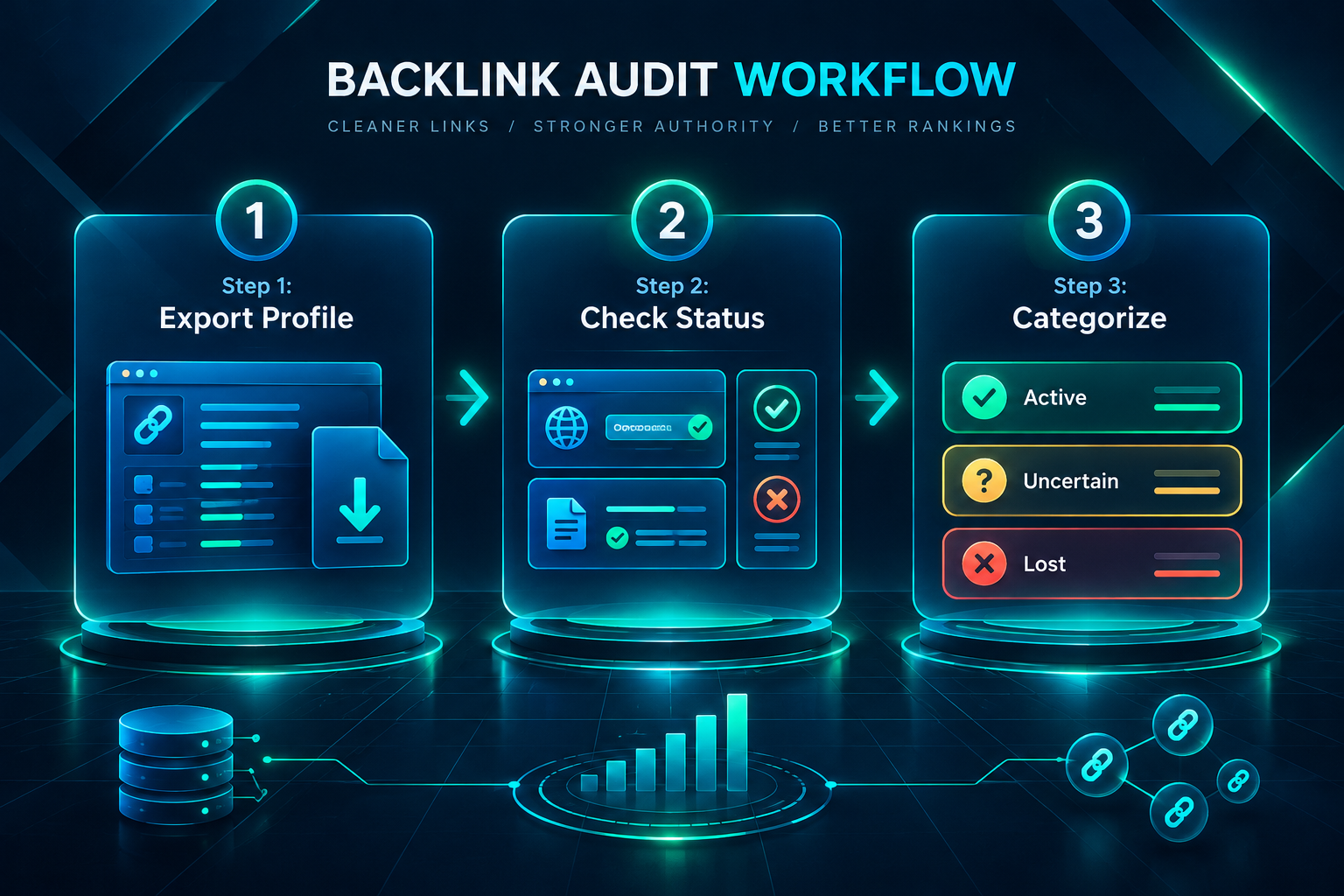
A structured backlink audit is the most important step you can take after learning that a PBN provider has shut down. The goal is to produce a clear inventory of which placements are still active, which have gone offline, and which domains are showing signs of instability such as parking pages, redirect loops, or deindexation.
Start by pulling your full backlink profile from a tool such as Ahrefs, Semrush, or Majestic. Export the referring domains and filter for the specific domains you know were part of the provider’s network. If you kept records of your placements when you ordered them, cross-reference those records against the current data. If you did not keep records, look for clusters of domains with similar acquisition dates, similar metrics, or similar content patterns that match what you received from the provider.
For each domain in the cluster, check the following:
- Is the domain still resolving? A domain that returns a 404, a parking page, or a hosting error is no longer serving your link.
- Is the specific page still live? Even if the domain resolves, the individual page containing your link may have been deleted or redirected.
- Is the page still indexed? Use a site-specific search query or Google Search Console data to check whether the linking page is still in the index. A deindexed page is unlikely to contribute meaningful ranking signal.
- Has the domain’s backlink profile changed significantly? A sudden drop in referring domains to the PBN site itself, or a spike in low-quality links pointing to it, may indicate the domain has been repurposed or sold to a different operator.
- What is the current content on the page? If the content has been replaced with unrelated material or thin placeholder text, the topical relevance of the placement has changed.
Document the status of each placement in a simple spreadsheet. Categorize each link as active and stable, active but uncertain, or lost. This inventory becomes the foundation for your continuity plan.
Assessing the Ranking Impact of Lost PBN Links
Not every lost PBN placement will produce a measurable ranking change, and not every ranking change that follows a provider shutdown is caused by link loss. Isolating the actual impact requires comparing your ranking data against your link status data over the same time period.
Pull ranking data for the target pages that received the PBN placements. Look at position history for the primary keywords those pages were targeting. If rankings were stable before the provider closed and began declining around the time specific domains went offline, there is a reasonable correlation worth investigating. However, correlation is not causation. Algorithm updates, competitor link-building activity, content changes, and technical SEO issues can all produce ranking movement that coincides with a provider shutdown without being caused by it.
A useful approach is to compare the pages that lost placements against pages on the same site that did not receive links from the closed provider. If the pages with lost links declined while other pages held steady, the link loss is a more plausible contributing factor. If the entire site moved in the same direction, a broader cause such as an algorithm update is more likely.
Google Search Console can help here. Check for any manual action notifications in the Manual Actions report. A manual action targeting specific links or the site as a whole would be a documented event with a clear explanation, which is different from an algorithmic ranking change. These are distinct outcomes and should not be treated as the same thing. If no manual action is present and rankings have shifted, the change is more likely algorithmic or competitive rather than a direct enforcement response to the lost links.
Deciding Which Lost Placements Are Worth Replacing
Once you have a clear picture of which PBN placements are gone and which target pages have been affected, the next decision is which lost links are worth replacing. Not every placement needs to be replaced immediately, and not every lost link was contributing meaningfully to your rankings in the first place.
Prioritize replacement for placements that met the following criteria when they were active:
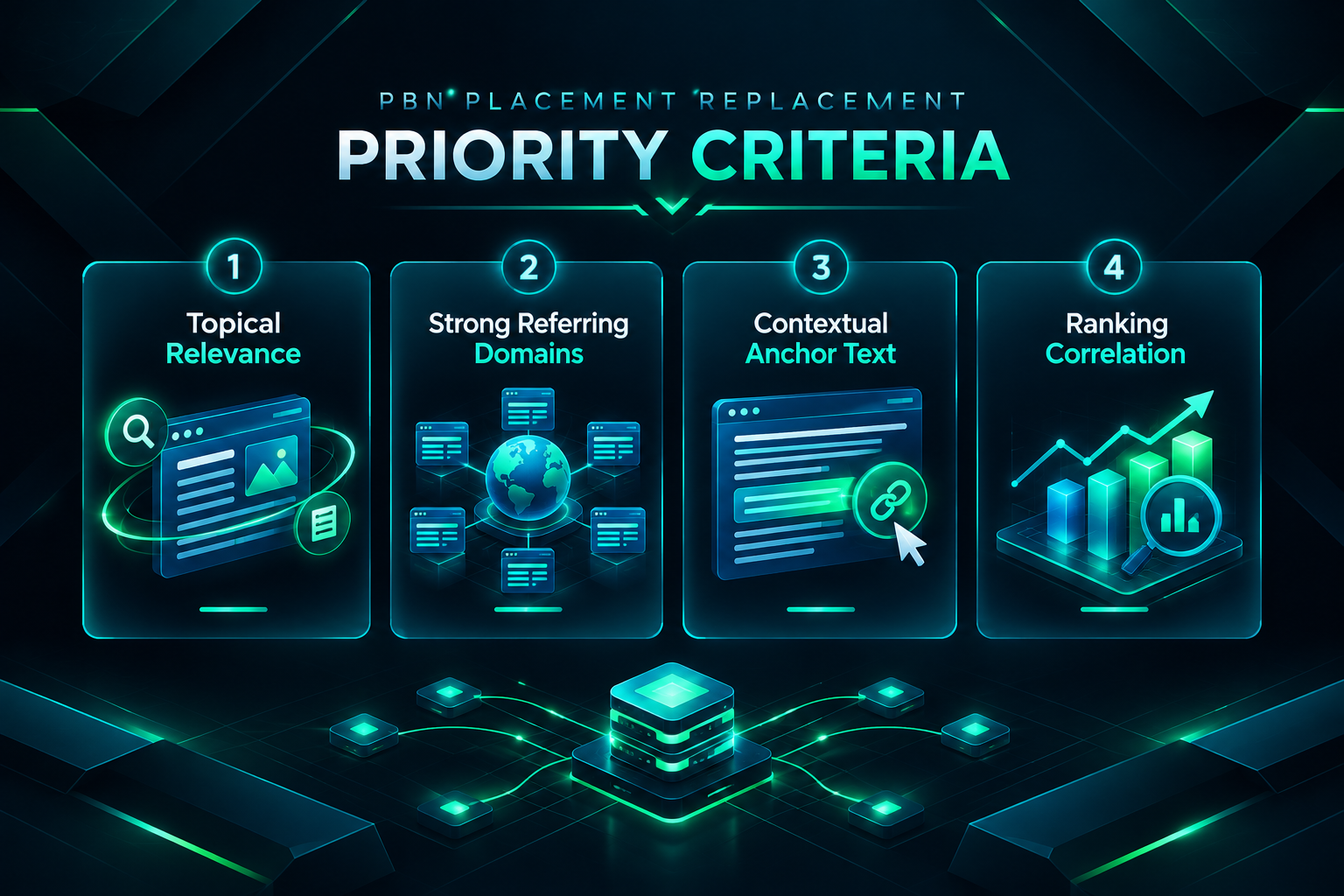
- The linking domain had a strong and relevant backlink profile of its own, with referring domains from topically related sites rather than generic or unrelated sources.
- The placement was on a page with content that was contextually relevant to your target page’s topic.
- The anchor text used was appropriate for the target keyword and consistent with your broader anchor text strategy.
- The target page showed measurable ranking improvement or stability that correlated with the placement being active.
Placements that came from domains with thin content, weak or irrelevant backlink profiles, or that were placed on pages with no topical connection to your site are lower priority. Replacing a low-quality placement with a higher-quality one from a reliable provider may actually improve your link profile rather than simply restoring it to its previous state.
When evaluating replacement options, look at the domain’s history using tools like Ahrefs or Majestic to check referring domain quality, anchor text distribution, and whether the domain has a clean indexing history. Topical relevance between the PBN site’s content and your target page remains one of the most important placement quality factors, regardless of which provider you use.
How to Vet a New PBN Provider After a Shutdown
A provider shutdown is a useful prompt to review how you select and work with PBN link providers going forward. The closure of one provider does not reflect on the quality of PBN link-building as a strategy, but it does highlight the importance of provider stability, transparency, and the quality of the underlying network.
When evaluating a new provider, consider asking the following questions before placing an order:
- How long has the provider been operating? Established providers with a track record are generally more stable than newer entrants, though longevity alone is not a guarantee of quality.
- What happens to placements if the provider closes or a domain expires? A provider that has a clear policy on domain renewal and placement continuity is more transparent about the risks involved.
- Can you verify the domains in the network before ordering? Being able to check domain history, content quality, and backlink profiles independently gives you more confidence in the placement quality.
- What is the content quality on the PBN sites? Placements on sites with substantive, topically relevant content are more likely to maintain their value over time than placements on thin or templated pages.
- Does the provider offer any form of link monitoring or replacement guarantee? Some providers offer replacement links if a domain goes offline within a defined period, which reduces the continuity risk.
- How does the provider handle anchor text? A provider that allows you to specify anchor text and advises on distribution is more likely to support a coherent anchor text strategy rather than defaulting to exact-match anchors across all placements.
Spreading placements across more than one provider is a practical way to reduce the impact of any single provider closing in the future. If one network goes offline, the placements from other providers remain active, limiting the disruption to your link profile.
Rebuilding Link Profile Continuity After a Shutdown
Rebuilding after a provider shutdown is not simply a matter of replacing lost links one-for-one. It is an opportunity to reassess the overall structure of your backlink profile and make deliberate decisions about placement quality, topical relevance, anchor text distribution, and provider diversity.
Start with the pages that showed the clearest ranking correlation with the lost placements. For each of those pages, review the current backlink profile to understand what remains active and what the anchor text distribution looks like. If the lost placements used exact-match anchors, replacing them with a mix of partial-match, branded, and natural anchors may produce a more sustainable profile than replicating the original anchor pattern exactly.
When ordering replacement PBN placements, consider the following factors for each domain being used:
- Domain history and topical relevance: A domain with a history in your niche and a backlink profile from relevant sites is more likely to contribute meaningful signal to your target page.
- Placement page context: The page on the PBN site that contains your link should have content that is genuinely related to your target page’s topic, not just a generic article with your link inserted.
- Link velocity: Adding a large number of replacement links in a short period can create an unusual pattern in your backlink profile. Spacing placements over several weeks is generally a more measured approach.
- Target page selection: Confirm that the pages receiving new placements are the ones that most need the additional link equity, based on your current ranking data and competitive analysis.
Monitoring your rankings and backlink profile during the rebuilding phase gives you data to assess whether the replacement placements are having the intended effect. Ranking changes from new PBN placements typically take several weeks to become measurable, as the linking pages need to be crawled and indexed before any signal is passed.
Keeping Records to Protect Against Future Disruptions
One of the most practical lessons from a provider shutdown is the value of maintaining detailed records of every PBN placement you have ordered. Without records, auditing your backlink profile after a closure is significantly more time-consuming, because you have to reconstruct which domains were part of the provider’s network from backlink data alone.
For each placement, record the following at the time of ordering:
- The domain name of the PBN site
- The specific URL of the page containing your link
- The target URL on your site
- The anchor text used
- The date the placement was ordered and confirmed live
- The provider name and any order reference
- The domain metrics at the time of placement, such as DR, TF, or DA, for reference
Storing this information in a shared spreadsheet or a project management tool makes it straightforward to run a status check at any point. Setting up a backlink monitoring alert through a tool like Ahrefs or Semrush can also notify you when referring domains are lost, giving you early warning of any placement going offline rather than discovering it weeks later during a manual audit.
Frequently Asked Questions
Do PBN links disappear immediately when a provider closes?
Not necessarily. The domains in a PBN network continue to exist until their registrations expire or hosting lapses. Many placements remain live for weeks or months after a provider stops operating. The rate at which links go offline depends on how the provider manages or abandons the underlying domains after closing.
Will losing PBN links definitely cause a ranking drop?
Not automatically. Whether a ranking change follows link loss depends on how much signal those specific placements were contributing, the strength of your remaining backlink profile, and whether other factors such as algorithm updates or competitor activity are influencing rankings at the same time. Some pages hold their positions after losing PBN placements; others decline. Monitoring ranking data alongside link status gives you the clearest picture.
Should I disavow links from a closed provider’s domains?
Disavowal is generally relevant when there is a documented manual action targeting specific links, or when there is clear evidence that particular links are causing harm. Losing links because a provider closed is a different situation from having harmful links in your profile. If the placements were on reasonable-quality domains and there is no manual action present, disavowal is unlikely to be necessary. Review your specific situation before taking any action.
How long does it take for replacement PBN links to show an effect?
Replacement PBN placements need to be crawled and indexed before any ranking signal is passed. Depending on the crawl frequency of the linking domain and the competitiveness of your target keywords, measurable ranking changes may take several weeks to become visible. Results vary by site, niche, and the quality of the replacement placements.
How many replacement links do I need to order?
There is no fixed number that applies to every site. The appropriate volume depends on how many placements were lost, how much ranking movement followed the loss, the competitiveness of your target keywords, and the current state of your backlink profile. A review of your rankings and remaining link profile is the most reliable basis for deciding how many replacements to prioritize.
Can I find out which domains were in a closed provider’s network?
If you kept records of your placements, you already have the domain list. If not, you can cross-reference your backlink profile data from tools like Ahrefs or Semrush against the dates when links were acquired and look for clusters of domains with similar characteristics. This is more time-consuming but workable for most backlink profiles.
Planning Your Next Steps After a Provider Shutdown
A PBN provider closing is a disruption, but it is a manageable one when approached methodically. The most important actions are auditing your current placements to establish what is still live, monitoring your rankings to identify which pages may have been affected, and making deliberate decisions about which lost placements are worth replacing based on their historical contribution to your link profile.
The quality of replacement placements matters more than speed. Ordering links from a provider whose network you can evaluate independently, whose domains have relevant histories and substantive content, and whose placement process allows you to specify anchor text and target pages gives you a stronger foundation than simply replicating the volume of what was lost. Spreading future placements across more than one provider reduces the risk of a single closure creating the same disruption again.
If you are assessing your current backlink profile after a provider shutdown and want to evaluate replacement PBN placements or discuss a continuity strategy, PBN Backlinks Service can help you review your requirements and identify placement options suited to your target pages and campaign goals.