

Merging two websites is one of the more complex SEO operations a site owner can undertake, and the challenge becomes significantly more layered when both properties carry PBN backlinks. The core question is straightforward: how do you handle PBN links after merging two websites without losing the ranking signals those placements were built to deliver? The answer depends on which domain survives the merger, how the redirects are structured, where each PBN link currently points, and whether the placements can be updated to reflect the new URL architecture. This article walks through each stage of that process so you can make informed decisions before, during, and after the migration.
Key Takeaways
- PBN backlinks pointing to a domain that is being redirected or retired will pass some link equity through a 301 redirect, but updating the target URL directly on the PBN placement is generally the more reliable approach for preserving ranking value.
- Before the merger goes live, audit every PBN placement on both domains so you know exactly which URLs are receiving links and which pages those links are meant to support.
- The surviving domain’s URL structure, content consolidation plan, and internal linking all affect how much value migrated PBN links ultimately contribute.
- PBN links pointing to pages that are merged, removed, or redirected to irrelevant destinations may lose much of their intended effect; updating placements to the correct destination page is worth prioritising.
- Post-merger monitoring of crawl status, indexing, and ranking movement across both former domains helps identify which placements are working and which may need attention.
Why Website Mergers Create PBN Link Management Challenges
When two websites merge, the URL landscape changes fundamentally. Pages that previously existed as standalone destinations are either consolidated, redirected, or retired. PBN backlinks are placed on specific pages within a network and point to specific target URLs. If those target URLs change without any corresponding update to the placement, the link either follows a redirect chain or points to a page that no longer exists. Both outcomes can reduce the practical value of the placement compared to a direct link to a live, relevant page.
The challenge is compounded when both websites being merged carry their own PBN backlink profiles. You may have placements pointing to the primary domain, placements pointing to the secondary domain, and in some cases placements pointing to specific inner pages on each. A merger without a clear PBN link management plan risks fragmenting that accumulated link equity across redirect chains, orphaned pages, and mismatched anchor text targets.
There is also a footprint consideration. PBN placements are typically built with a specific target page and anchor text strategy in mind. If the merger changes the content structure of the surviving domain significantly, some placements may end up pointing to pages whose topical relevance no longer matches the original intent. This does not automatically neutralise the link, but it can reduce how effectively the placement supports the target page’s ranking for its intended terms.
Step One: Audit All PBN Placements Before the Migration
The most important action you can take before a website merger is a complete audit of every PBN placement across both domains. This means documenting the PBN domain, the specific page on the PBN where the link appears, the anchor text used, and the exact target URL on your website. Without this inventory, you cannot make informed decisions about which placements need updating, which can rely on redirects, and which may need to be renegotiated with your provider.
Use a backlink analysis tool such as Ahrefs or Semrush to pull the full referring domain list for both websites. Cross-reference this against any placement records you hold from your PBN provider or your own network management. The goal is a complete map of inbound link placements before a single redirect goes live. Doing this after the migration is significantly harder because you are then working backwards from a changed URL structure.
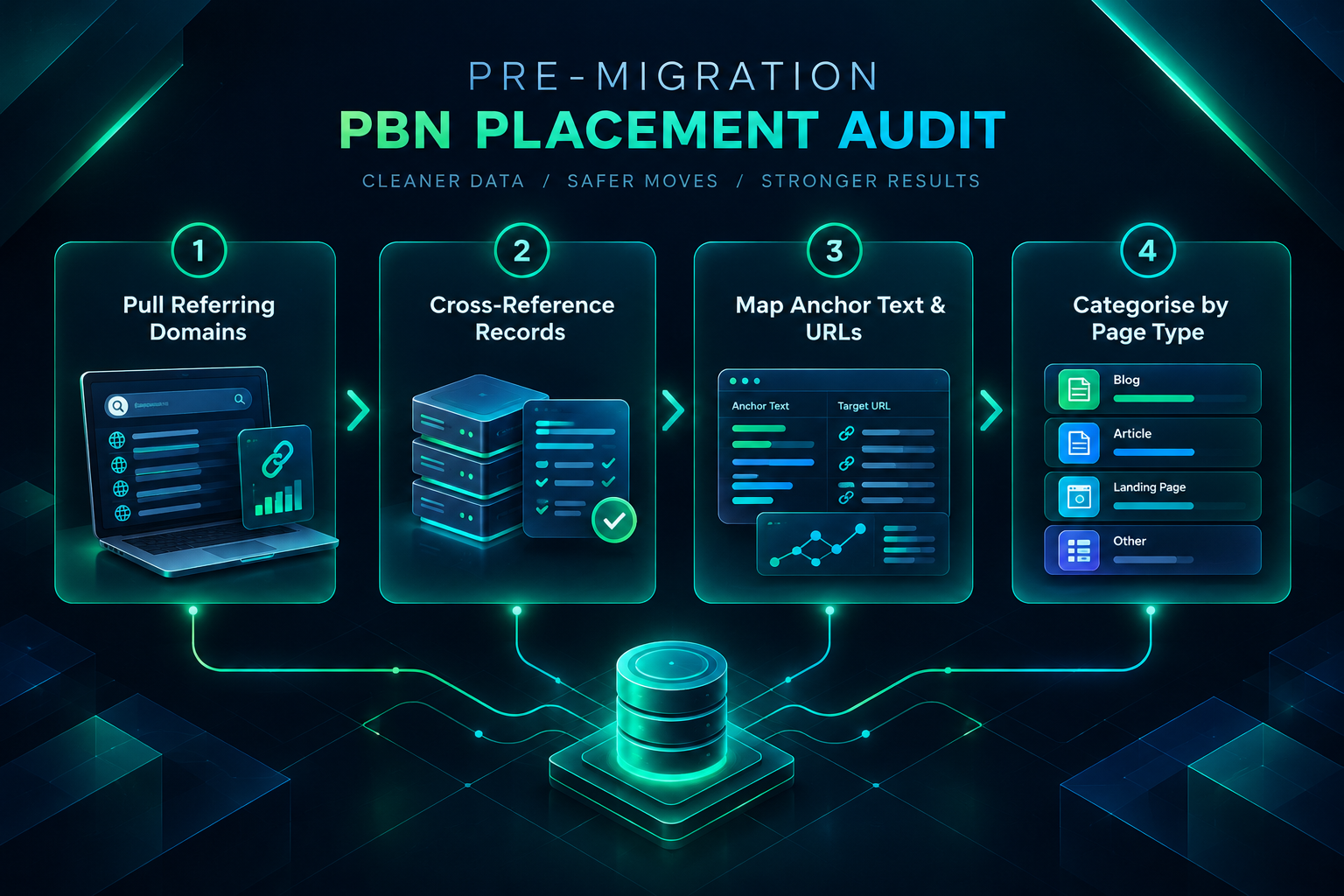
During the audit, categorise each placement by the type of page it targets. Placements pointing to the homepage of the retiring domain are relatively straightforward to handle. Placements pointing to specific category pages, product pages, or blog posts require more careful planning because those pages may be merged with equivalent content on the surviving domain, redirected to a different section, or removed entirely. Each scenario calls for a different response.
Understanding How 301 Redirects Affect PBN Link Equity
A 301 redirect signals to search engines that a URL has permanently moved to a new location. Google has stated that 301 redirects pass PageRank, and the general SEO industry understanding is that a well-implemented 301 redirect preserves a meaningful portion of the link equity from the original URL. This means that PBN backlinks pointing to a retired domain or a redirected page are not automatically wasted after a merger.
However, the practical effect of a redirect on PBN link equity involves some uncertainty. Redirect chains, where a URL redirects to another URL that itself redirects, can dilute the signal further. A PBN link pointing to a page on the retiring domain that then redirects through two or three hops before reaching the surviving domain’s equivalent page is less efficient than a direct link to the live destination. Where possible, ensure that redirects from the retiring domain go directly to the most relevant equivalent page on the surviving domain rather than defaulting everything to the homepage.
It is also worth noting that Google does not publish a precise formula for how much equity passes through a redirect, and the effect may vary depending on the age of the redirect, the crawl frequency of the PBN page, and the overall authority of the linking domain. Treating redirects as a complete substitute for direct placement updates is therefore a pragmatic compromise rather than an equivalent outcome.
Updating PBN Placements to the New Target URLs
Where your PBN provider or your own network allows it, updating the target URL on existing placements is the most direct way to preserve the intended link equity after a merger. Rather than relying on a redirect to carry the signal, a direct link to the correct live page on the surviving domain removes the redirect dependency entirely and ensures the placement is pointing to the most relevant destination.
When requesting placement updates, provide your provider with a clear mapping document: the old target URL, the new target URL, and confirmation that the anchor text remains appropriate for the new destination. If the merger has changed the content focus of the target page, this is also the right moment to review whether the existing anchor text still reflects the page’s primary topic. Mismatched anchor text, where the anchor describes content that no longer exists at the destination, can reduce the relevance signal the placement delivers.
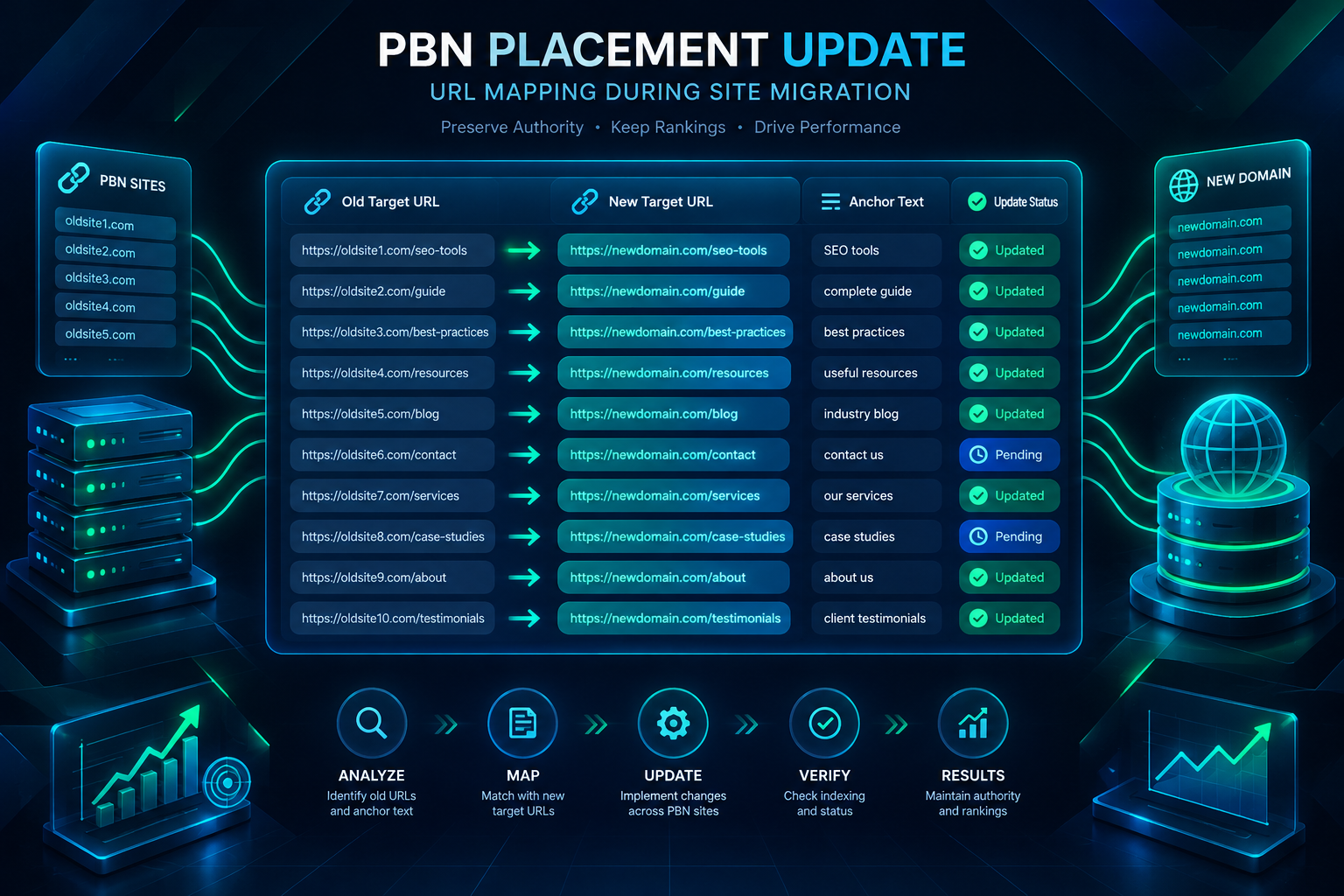
Not every PBN provider will offer free URL updates as part of an existing placement agreement. Some treat URL changes as a new placement requirement. Clarify this with your provider early in the merger planning process so you can budget for any update costs and factor them into the overall migration timeline. If you manage your own private blog network, updating the target URLs is a straightforward editorial change on each PBN site, though it still requires systematic tracking to ensure every placement is updated correctly.
Handling PBN Links on the Retiring Domain
When one domain is being retired entirely and all traffic is being redirected to the surviving domain, the PBN backlinks pointing to the retiring domain face a specific challenge. If the retiring domain’s DNS and hosting remain active and the 301 redirects are properly configured, those links will continue to pass equity through the redirect for as long as the domain remains live and the redirects are maintained. The practical risk arises if the retiring domain is eventually allowed to expire or its hosting is discontinued, at which point the redirect infrastructure disappears and those PBN links effectively point to a dead destination.
For PBN placements on the retiring domain that represent meaningful link equity, the preferred approach is to update the target URL to the surviving domain’s equivalent page before the retiring domain is wound down. This removes the dependency on redirect infrastructure that may not be maintained indefinitely. If the retiring domain is being kept live purely to maintain redirect continuity, factor in the ongoing hosting and domain registration costs against the value of the placements that depend on it.
In some merger scenarios, the retiring domain itself has strong backlink metrics and may be worth retaining as a PBN asset rather than simply redirecting and abandoning it. This is a separate strategic decision that depends on the domain’s history, its existing content, and whether it can be repurposed within a private blog network structure. If the domain has a clean history, relevant topical authority, and a solid referring domain profile, it may have value beyond its role as a redirect vehicle.
Managing Anchor Text Strategy Across the Merged Domain
A website merger effectively combines two anchor text profiles into one. The surviving domain will now carry the anchor text distribution from its own PBN placements plus whatever anchor text profile the retiring domain’s links bring through the redirect. This combined profile may look different from what either domain carried individually, and it is worth reviewing the aggregate anchor text distribution after the merger to understand the new baseline.
Anchor text strategy for PBN placements on the surviving domain should be reviewed in light of the merged profile. If the retiring domain’s links were built with a heavy exact-match anchor approach and the surviving domain’s placements used a more varied distribution, the combined profile will shift. Conversely, if both domains used similar anchor strategies targeting the same or related terms, the merger may concentrate anchor text in a way that warrants attention when planning future placements.
When commissioning new PBN placements after the merger, use the combined anchor text profile as your baseline rather than treating the surviving domain as a fresh start. The merged domain carries the history of both properties, and new placements should complement that combined profile rather than being planned in isolation from it.
Monitoring Rankings and Crawl Status After the Merger
Post-merger monitoring is essential for understanding how the PBN link management decisions you made during the migration are performing in practice. Track ranking positions for the key pages on the surviving domain that were supported by PBN placements on either the surviving or retiring domain. Ranking movement in the weeks following a merger can reflect many factors, including the redirect implementation, content consolidation, internal linking changes, and how search engines are processing the combined backlink profile.
Use Google Search Console to monitor crawl coverage and indexing status on the surviving domain. Check that the pages receiving PBN link equity are being indexed correctly and that no crawl errors are preventing search engines from accessing those destinations. If a target page is returning a 404 or is blocked by robots.txt, any PBN link pointing to it is not delivering its intended value regardless of how well the placement itself is configured.
For the retiring domain, monitor how quickly search engines are processing the 301 redirects and updating their index to reflect the new destination URLs. This process can take weeks to months depending on the crawl frequency of the retiring domain and the PBN pages linking to it. During this period, some ranking fluctuation is normal and does not necessarily indicate a problem with the PBN placements themselves.
Backlink monitoring tools such as Ahrefs or Semrush can help you track whether PBN placements are being crawled and whether the links are appearing in the tool’s index. Keep in mind that third-party tool coverage of PBN links varies and that a link not appearing in a tool’s index does not confirm it is not being processed by search engines. Use these tools as a monitoring aid rather than a definitive measure of placement status.
Content Consolidation and Its Effect on PBN Placement Relevance
Website mergers typically involve consolidating overlapping content from both domains into a single, stronger page on the surviving domain. When this happens, the target pages that PBN links were originally built to support may change in scope, focus, or URL. A PBN placement that was built to support a specific product comparison page on the retiring domain may now need to point to a consolidated version of that page on the surviving domain that covers a broader topic.
Topical relevance between the PBN placement page and the target page is a meaningful quality factor for contextual link placements. When content consolidation changes the focus of a target page significantly, review whether the existing PBN placements pointing to that page still make contextual sense. A placement on a PBN site covering home improvement that links to a page now focused on a different product category is less contextually aligned than it was originally. Where the mismatch is significant, updating the placement target or the anchor text may be worth discussing with your provider.
Content consolidation also affects internal linking on the surviving domain. Strong internal linking from the surviving domain’s existing pages to the consolidated pages that are receiving PBN link equity helps distribute that equity further through the site and supports the target pages’ relevance signals. Internal linking is a controllable on-site factor that complements the external link work done through PBN placements.
Frequently Asked Questions
Do PBN links automatically transfer when I redirect a domain?
A 301 redirect from the retiring domain to the surviving domain will pass some link equity from PBN placements pointing to the retiring domain, but the transfer is not automatic in the sense of being instant or guaranteed to be complete. The redirect needs to be correctly implemented, the retiring domain needs to remain live, and search engines need to crawl and process the redirect. Directly updating the target URL on each placement is a more reliable approach where it is available.
Should I tell my PBN provider about the merger before it happens?
Yes. Informing your provider before the migration allows them to prepare for URL update requests and advise on any placement agreement terms that may affect how updates are handled. Waiting until after the merger means you may be managing redirect dependencies for longer than necessary while waiting for updates to be processed.
What happens to PBN links if the retiring domain expires?
If the retiring domain expires and its DNS and hosting are discontinued, the 301 redirects that were passing equity from PBN placements on that domain will stop functioning. Any PBN link still pointing to the expired domain will effectively point to a dead destination. This is why updating placements to the surviving domain’s URLs before winding down the retiring domain is the preferred approach for preserving link equity.
How long does it take for search engines to process redirects from PBN placements?
The timeline varies depending on how frequently search engines crawl the PBN pages and the retiring domain. For well-crawled pages, the redirect may be processed within days to a few weeks. For less frequently crawled pages, it can take considerably longer. There is no fixed public timeline, and ranking changes during this period may reflect the processing lag rather than a permanent outcome.
Can I use the retiring domain as a PBN site after the merger?
This depends on the domain’s history, content, and backlink profile. If the retiring domain has a clean history, relevant topical authority, and a solid referring domain profile, it may be worth evaluating as a PBN asset rather than simply redirecting and abandoning it. This is a separate strategic decision from the merger itself and should be assessed based on the domain’s specific characteristics.
Do I need to rebuild my anchor text strategy after a merger?
Not necessarily rebuild, but review. The merger combines two anchor text profiles, and the aggregate distribution on the surviving domain will differ from either domain individually. Use the combined profile as your baseline when planning new PBN placements rather than treating the surviving domain as starting from scratch.
Planning PBN Link Management as Part of Your Merger Strategy
Handling PBN links after merging two websites is a manageable process when it is planned systematically rather than addressed as an afterthought. The core steps are consistent: audit all placements before the migration, implement clean 301 redirects from the retiring domain to the most relevant equivalent pages on the surviving domain, update placement target URLs directly where possible, review the combined anchor text profile, and monitor crawl status and ranking movement after the merger goes live.
The degree of effort required scales with the number of placements across both domains, the complexity of the content consolidation, and whether your PBN provider supports URL updates under existing placement agreements. For larger migrations with significant PBN link profiles on both domains, treating link management as a dedicated workstream within the broader merger project is a practical approach that reduces the risk of losing placement value through avoidable redirect dependencies or mismatched targets.
If you are planning a website merger and want to assess how your existing PBN placements should be handled during the migration, PBN Backlinks Service can help you review your current placement structure and discuss the most effective approach for preserving and continuing your link-building strategy on the surviving domain.