

Trademark complaints involving PBN domains are a practical legal and operational concern that domain owners and SEO practitioners occasionally face, particularly when building or acquiring private blog networks using expired or aged domains. A complaint can arrive through a registrar, a UDRP (Uniform Domain-Name Dispute-Resolution Policy) filing, or a direct cease-and-desist letter, and each route carries different timelines, consequences, and response options. Understanding how these complaints work, what triggers them, and how to respond appropriately can help you protect your domain assets and keep your network operational.
Key Takeaways
- Trademark complaints on PBN domains most commonly arise when a domain name contains a registered trademark, when the domain was previously associated with a brand, or when the current content appears to trade on a third-party brand’s reputation.
- Complaints can arrive through three main channels: registrar abuse reports, UDRP or URS arbitration proceedings, and direct legal correspondence such as cease-and-desist letters.
- Each channel has a different process, timeline, and set of possible outcomes, ranging from a domain transfer or cancellation to a negotiated resolution or a successful defense.
- Conducting due diligence on a domain’s name, historical content, and backlink profile before acquisition significantly reduces the likelihood of encountering a trademark dispute.
- If a complaint is received, the appropriate response depends on the specific claim, the domain’s history, and whether the use genuinely conflicts with the complainant’s trademark rights.
Why Trademark Complaints Arise on PBN Domains
Private blog networks frequently rely on expired or auction domains because those domains carry existing backlink profiles, topical history, and indexing signals that can support link-building campaigns. However, expired domains sometimes carry names that include or closely resemble registered trademarks. A domain may have originally been operated by a legitimate business that later let the registration lapse, or it may have been registered speculatively. When a new owner acquires such a domain and publishes content on it, the trademark holder may take notice and file a complaint, particularly if the domain name itself contains their brand term or if the site’s content appears to reference their products or services.
Trademark complaints are not limited to domains whose names contain obvious brand terms. A complaint can also arise when a domain’s archived content, inbound anchor text, or backlink profile is strongly associated with a specific brand, and the new owner’s use of the domain appears to exploit that association. Registrars and arbitration panels consider the overall context of use, not just the domain name string itself. For PBN operators, this means that a domain acquired for its link equity may carry reputational or legal baggage that was not immediately visible during the acquisition process.
It is also worth noting that trademark rights vary by jurisdiction and by the goods or services covered by the registration. A domain name that incorporates a term trademarked in one country or one industry sector may not infringe a trademark in another jurisdiction or sector. This jurisdictional complexity does not eliminate the risk of a complaint, but it does affect how a complaint is evaluated and what defenses may be available.
The Three Main Complaint Channels
Registrar Abuse Reports
A trademark holder or their legal representative can file an abuse report directly with the domain’s registrar, alleging that the domain registration or its use violates the registrar’s acceptable use policy. Registrars are not trademark adjudicators, and most will not unilaterally transfer or cancel a domain based solely on a trademark claim without a formal legal process. However, if the registrar determines that the domain is being used in a way that clearly violates its terms of service, such as phishing, impersonation, or malicious brand abuse, it may place the domain on hold or suspend it while the matter is investigated.
For PBN domains, a registrar abuse report is less likely to result in immediate domain loss than a formal UDRP proceeding, but it can disrupt operations by triggering a hold that prevents the domain from resolving. Responding promptly and professionally to a registrar inquiry, explaining the legitimate purpose of the domain and providing evidence that the use does not constitute abuse, is generally the appropriate first step. Registrars typically give the domain owner an opportunity to respond before taking action.
UDRP and URS Proceedings
The Uniform Domain-Name Dispute-Resolution Policy, administered by accredited providers such as WIPO (World Intellectual Property Organization) and the Forum (formerly NAF), is the primary formal mechanism through which trademark holders challenge domain registrations. A complainant must establish three elements to succeed in a UDRP proceeding: that the domain name is identical or confusingly similar to a trademark in which the complainant has rights; that the domain owner has no legitimate rights or interests in the domain name; and that the domain was registered and is being used in bad faith.
All three elements must be proven. A complainant who can demonstrate trademark similarity but cannot show bad faith registration and use will not prevail. For PBN operators, the bad faith element is often the most contested. Registering a domain that previously belonged to a legitimate business, and then using it to host content unrelated to that business while benefiting from its historical link equity, may be characterized as bad faith use by a UDRP panel, particularly if the domain name itself is a brand term. However, if the domain was acquired through a legitimate expired domain marketplace, the name is a common dictionary word or phrase, and the content is genuinely topically relevant rather than brand-mimicking, a defense may be available.
The URS (Uniform Rapid Suspension) is a faster and cheaper alternative to UDRP, available for clear-cut cases of infringement. A successful URS complaint results in suspension of the domain rather than transfer, and the standard of proof is higher than UDRP. URS is less commonly used for PBN-related disputes but may be employed when the trademark infringement is considered obvious.
UDRP proceedings typically conclude within approximately 60 days of the complaint being filed. The domain owner is notified of the complaint and given a deadline, usually 20 calendar days, to submit a response. Failing to respond does not automatically mean the complainant wins, but panels do consider a non-response as a factor, and default decisions frequently favor the complainant in clear-cut cases.
Cease-and-Desist Letters
A cease-and-desist letter is a direct communication from a trademark holder or their legal counsel demanding that the domain owner stop using the domain in a way that allegedly infringes the trademark. Unlike a UDRP filing, a cease-and-desist letter has no formal enforcement mechanism on its own. It is a precursor to potential legal action or a UDRP filing, and it gives the domain owner an opportunity to resolve the matter without formal proceedings.
Receiving a cease-and-desist letter does not mean the complainant’s position is legally correct. The letter represents the trademark holder’s interpretation of the situation. Before responding, it is advisable to assess the strength of the trademark claim, the domain’s history, and whether the current use of the domain genuinely conflicts with the trademark. A measured, factual response prepared with legal input is generally more productive than either ignoring the letter or immediately surrendering the domain.
Assessing the Strength of a Trademark Complaint
Not every trademark complaint is well-founded, and not every domain that receives a complaint will ultimately be transferred or cancelled. Before deciding how to respond, it is useful to assess several factors that affect the likely outcome of a formal proceeding or negotiation.
- Does the domain name contain the trademark? A domain name that is identical to a registered trademark is at significantly higher risk than one that merely contains a common word that happens to be trademarked in a specific industry.
- Is the trademark registered, and in which jurisdictions and classes? A trademark registered only in one country or one product category may not support a complaint against a domain used in a different context.
- What was the domain’s history before acquisition? If the domain was previously operated by the trademark holder or a licensee, a panel may view the acquisition more skeptically. If the domain has a long history unrelated to the trademark, that history may support a defense.
- What content is currently published on the domain? Content that references the trademark holder’s products, mimics their branding, or appears designed to divert their customers is more likely to be characterized as bad faith use than genuinely topical content unrelated to the brand.
- What does the inbound anchor text and backlink profile suggest? If a significant portion of the domain’s inbound links use the trademark as anchor text, a panel may infer that the domain was associated with the brand, which can complicate a defense.
Reviewing these factors honestly before responding to a complaint helps identify whether a defense is realistic or whether a negotiated resolution is the more practical path. In some cases, the domain may be worth contesting; in others, releasing the domain or negotiating a transfer may be the more efficient outcome.
How to Respond to a Trademark Complaint on a PBN Domain
Step One: Gather Documentation
Before taking any action, collect all relevant documentation about the domain. This includes the acquisition record showing when and how the domain was purchased, the purchase price, the registrar’s confirmation, and any due diligence records from the acquisition process. Archive the current state of the domain’s content and backlink profile using tools such as Ahrefs or Majestic, and retrieve the domain’s historical content from the Wayback Machine. This documentation establishes a factual record of the domain’s history and your use of it, which is essential for any formal response.
Step Two: Seek Legal Advice
Trademark law and domain dispute proceedings involve specialized legal concepts that vary by jurisdiction. Consulting a lawyer with experience in intellectual property and domain disputes before responding to a UDRP complaint or a cease-and-desist letter is strongly advisable. A legal professional can assess the strength of the complaint, identify available defenses, and help draft a response that accurately represents your position without inadvertently conceding points that could be used against you.
Step Three: Evaluate the Domain’s Strategic Value
Consider whether the domain is sufficiently valuable to your PBN or link-building campaign to justify the time, cost, and uncertainty of contesting a complaint. A domain that provides significant link equity to important target pages may warrant a formal defense. A domain that is one of many in a diversified network, or one whose metrics are not exceptional, may not justify the resources required for a UDRP response. This is a practical business decision, not a legal one, and it should be made with a clear understanding of the domain’s actual contribution to your campaign.
Step Four: Respond Within the Deadline
In a UDRP proceeding, the response deadline is fixed and strictly enforced. Missing the deadline does not automatically result in a decision against you, but it significantly reduces your ability to present a defense. If you decide to contest the complaint, submit a complete, factual response that addresses each of the three UDRP elements, provides evidence of your legitimate use, and explains why the bad faith standard has not been met. If you decide not to contest, you may still communicate with the complainant directly to negotiate a resolution, such as a domain transfer in exchange for a release of further claims.
Step Five: Adjust Your Domain Acquisition Process
A trademark complaint is also an opportunity to review and strengthen the due diligence process used when acquiring domains for a private blog network. Incorporating trademark screening into the acquisition workflow reduces the likelihood of future disputes and protects the stability of the network over time.
Due Diligence to Reduce Trademark Risk Before Acquisition
The most effective way to handle trademark complaints on PBN domains is to reduce the likelihood of acquiring domains that are vulnerable to them in the first place. A structured pre-acquisition review should include the following checks.
- Trademark database searches: Search the USPTO (United States Patent and Trademark Office), EUIPO (European Union Intellectual Property Office), and WIPO’s Global Brand Database for the domain name and its component terms before completing a purchase. Many registrars and domain marketplaces do not perform this check on your behalf.
- Wayback Machine review: Examine the domain’s archived content to understand what the domain was previously used for and whether it was associated with a specific brand or business. A domain that previously hosted a branded business’s website carries a higher trademark risk than one with a history of generic topical content.
- Anchor text and backlink profile analysis: Use tools such as Ahrefs, Majestic, or Semrush to review the domain’s inbound anchor text distribution. A high proportion of branded anchor text pointing to the domain may indicate that the domain was closely associated with a specific brand, which increases the risk of a complaint if that brand is still active.
- WHOIS and ownership history: Review the domain’s ownership history where available. Domains that changed hands multiple times in a short period, or that were previously held by a known brand, may carry additional risk.
- Content relevance assessment: Ensure that the content you plan to publish on the domain is genuinely topically relevant to the domain’s history and does not reference or mimic any brand associated with the domain’s previous use.
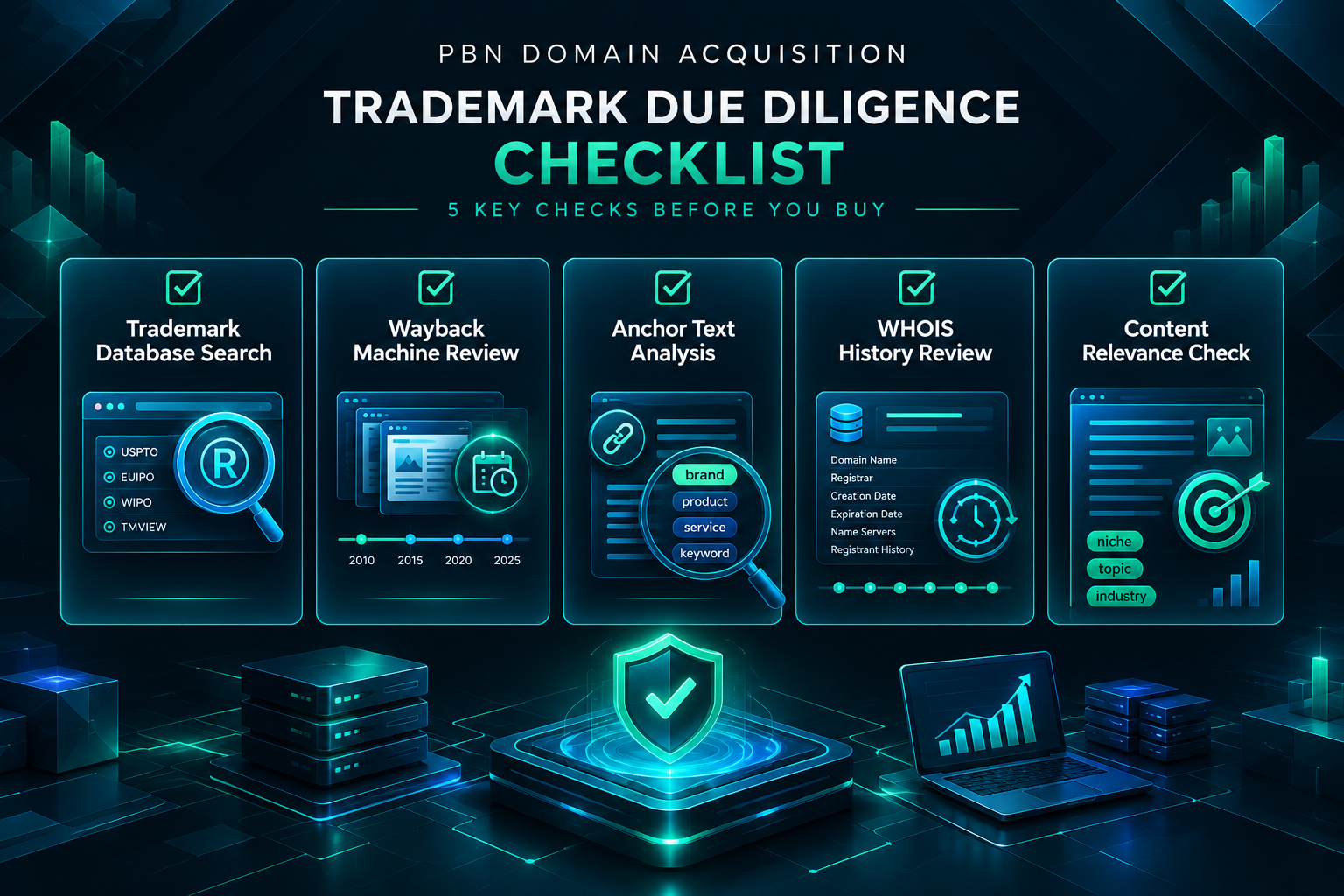
Incorporating these checks into a standard acquisition workflow adds a modest amount of time to the process but significantly reduces the operational and legal risk associated with trademark disputes. For operators managing larger networks, a systematic screening process is more efficient than addressing complaints reactively after acquisition.
What Happens to a PBN Domain After a Complaint Is Filed
The practical consequences of a trademark complaint depend on the channel through which it is filed and the outcome of the process. In a UDRP proceeding, the possible outcomes are transfer of the domain to the complainant, cancellation of the domain registration, or denial of the complaint. There is no financial penalty imposed on the domain owner through UDRP itself, though legal costs may be incurred if professional representation is used. A domain that is transferred or cancelled is no longer available to the network, and any links pointing from that domain to target pages will cease to function once the domain stops resolving.
If a registrar places a domain on hold during an investigation, the domain will stop resolving in the interim, which interrupts any link-passing function the domain was serving. The duration of a hold varies by registrar and by the nature of the complaint. Maintaining records of the domain’s legitimate use and responding promptly to registrar inquiries can help resolve a hold more quickly.
For a cease-and-desist letter that does not escalate to formal proceedings, the domain owner retains control of the domain unless they choose to transfer or release it. Monitoring whether a complainant follows through with a formal filing after sending a cease-and-desist letter is a reasonable approach, particularly when the legal basis for the complaint appears weak.
Frequently Asked Questions
Can a trademark holder force me to give up a PBN domain through UDRP?
A UDRP panel can order the transfer or cancellation of a domain, but only if the complainant proves all three required elements: trademark similarity, lack of legitimate rights or interests on the part of the domain owner, and bad faith registration and use. A complaint that fails to establish any one of these elements will be denied. The outcome depends on the specific facts of each case, not on the mere existence of a trademark.
Does acquiring a domain through an expired domain marketplace protect me from trademark complaints?
Acquiring a domain through a legitimate marketplace establishes that you purchased it in good faith, which is a relevant factor in a UDRP proceeding. However, it does not automatically prevent a complaint from being filed or guarantee a successful defense. The domain’s name, history, and your use of it remain the primary factors in any dispute assessment.
What if the trademark was registered after I acquired the domain?
UDRP panels generally consider whether the trademark was in existence at the time the domain was registered. If you registered or acquired the domain before the trademark was filed, this is a significant factor in your favor, though it does not automatically resolve the dispute. Documenting the acquisition date and the trademark’s registration date is important in this scenario.
Should I remove the domain from my PBN while a complaint is pending?
This is a decision that depends on the specific circumstances and is best made with legal advice. Removing the domain from active use during a dispute may reduce the appearance of ongoing bad faith use, but it does not resolve the underlying complaint. Consult a legal professional before making changes to the domain’s content or configuration during a formal proceeding.
How does a trademark complaint affect the other domains in my PBN?
A trademark complaint is specific to the domain named in the complaint. It does not automatically affect other domains in your network unless those domains also contain the trademark or are otherwise implicated in the complaint. Maintaining clear separation between domains in a network is a standard operational practice that also limits the scope of any individual dispute.
Can I sell a domain that has received a trademark complaint?
Transferring a domain while a UDRP proceeding is pending is generally not permitted under ICANN rules, which require the registrar to lock the domain during the proceeding. Outside of a formal proceeding, a domain that has received a cease-and-desist letter can technically be transferred, but the new owner would inherit the dispute. Disclosing the complaint to a prospective buyer is the appropriate course of action.
Protecting Your PBN Domain Assets from Trademark Disputes
Trademark complaints on PBN domains are manageable when approached methodically. The most important factors are understanding which channel the complaint is coming through, assessing the factual strength of the claim against the domain’s actual history and use, and responding within the applicable deadlines with accurate documentation. Pre-acquisition due diligence that includes trademark screening, Wayback Machine review, and anchor text analysis reduces the frequency of disputes and protects the long-term stability of a private blog network.
For domain owners and SEO practitioners who build or manage PBNs using expired and aged domains, the trademark dimension of domain selection deserves the same attention as domain authority metrics, topical relevance, and backlink profile quality. A domain that passes all standard SEO quality checks but carries a trademark risk can create operational disruption that outweighs its link-building value. Integrating trademark awareness into the domain selection process is a practical step that supports a more durable and defensible network over time.
If you are evaluating domains for a private blog network or reviewing the composition of an existing backlink campaign, PBN Backlinks Service can assist with assessing domain quality and placement suitability as part of a broader link-building strategy discussion.