

Unsolicited PBN backlinks — links from private blog network sites that you never requested or paid for — occasionally appear in website backlink profiles, and the right response depends heavily on context rather than a blanket rule. Understanding what these links are, how to assess their actual significance, and when action is genuinely warranted will help you make a measured, evidence-based decision rather than reacting to every unfamiliar link with alarm.
Key Takeaways
- Not every unsolicited backlink from a PBN-style site requires immediate action; the appropriate response depends on the link’s characteristics, your backlink profile, and any observable ranking changes.
- Identifying whether a link is genuinely from a private blog network requires reviewing domain history, content quality, topical relevance, and backlink profile patterns rather than relying on a single metric.
- Google’s documented link spam policies address paid links intended to manipulate rankings; the enforcement outcome for any individual unsolicited link is not publicly specified and varies by context.
- Monitoring tools such as Google Search Console, Ahrefs, or Semrush can help you track new referring domains and spot unusual link patterns before they accumulate.
- Disavowal is one available option, but it is not universally required for every unfamiliar or low-quality link; a site-specific assessment is necessary before deciding.
What Are Unsolicited PBN Backlinks?
A private blog network (PBN) is a collection of websites, often built on expired or aged domains with existing link equity, used to place backlinks pointing to a target site. When those links are placed intentionally by a site owner or SEO practitioner, they are a deliberate link-building strategy. Unsolicited PBN backlinks are different: they appear in your backlink profile without your knowledge or instruction, placed by a third party for reasons that may include competitive manipulation, link spam campaigns, or simply automated link-building tools operating without targeting precision.
The term “negative SEO” is sometimes used to describe deliberate attempts to harm a competitor’s rankings by pointing low-quality or manipulative links at their site. Unsolicited PBN links may or may not be part of such a campaign. In many cases, they are simply the byproduct of indiscriminate link-building tools or low-quality directories that scrape and republish content with embedded links. Distinguishing between these scenarios matters because the appropriate response differs.
How to Identify Whether a Backlink Comes from a PBN
No single signal definitively identifies a site as part of a private blog network, and it is important not to conflate “unfamiliar domain” with “PBN.” A thorough assessment involves several overlapping indicators rather than one definitive test.
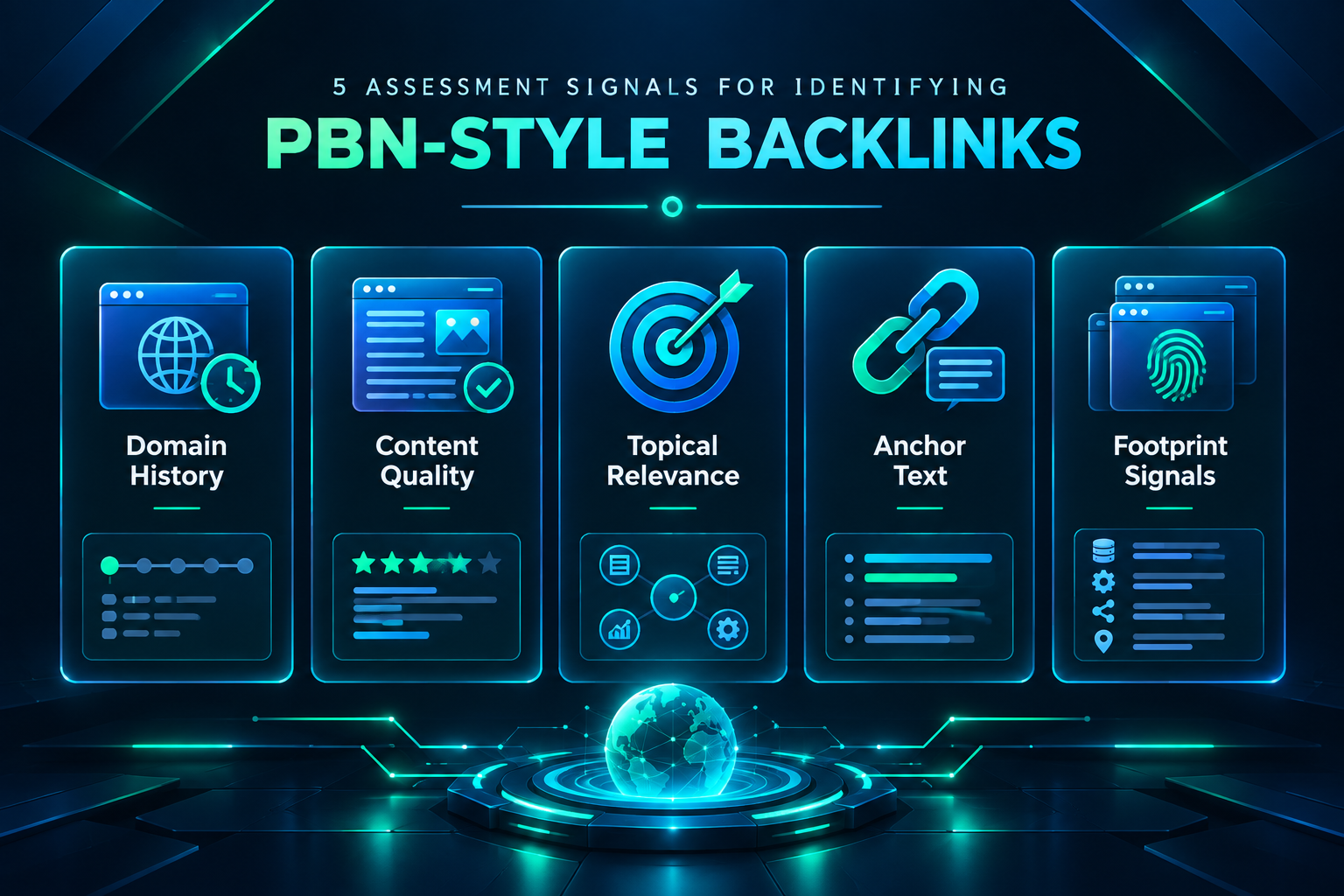
Domain History and Backlink Profile
Check the referring domain’s history using a tool such as Ahrefs, Semrush, or Majestic. A domain that was previously active in an unrelated niche, dropped, and then relaunched with new content may have characteristics associated with expired-domain PBN setups. Look at the domain’s referring domain count over time: a sharp drop followed by a rebuild can indicate a domain that changed hands. Majestic’s Trust Flow and Citation Flow metrics, Ahrefs’ Domain Rating, and Moz’s Domain Authority are proprietary scores that can provide a rough sense of link profile quality, but none of these metrics is a Google ranking signal or a definitive PBN detector.
Content Quality and Topical Relevance
Visit the linking page directly. Thin content, templated layouts, minimal author information, and topics that bear no relationship to your site’s niche are characteristics sometimes associated with lower-quality link networks. However, these are also characteristics of many ordinary low-quality websites that are not PBNs. Topical irrelevance combined with an unusual domain history and a backlink profile consisting almost entirely of outbound links to unrelated commercial sites is a stronger combined signal worth noting.
Anchor Text and Placement Context
Review the anchor text used in the link. Exact-match commercial anchor text pointing to a money page, placed within thin content on a topically unrelated domain, is a pattern that may attract search-engine scrutiny regardless of whether the site is technically a PBN. Contextual placement within genuinely relevant content is a different situation. The anchor text distribution across your entire backlink profile matters more than any single instance.
Footprint Signals
Some PBN setups share hosting infrastructure, use identical CMS configurations, or display other technical patterns that link analysis tools can sometimes surface. These footprint signals are not publicly documented by Google as enforcement triggers, and their presence in a single referring domain does not confirm that a link will be treated as manipulative. They are useful as part of a broader assessment, not as standalone proof.
Assessing the Actual Risk to Your Site
The central question when you discover unsolicited PBN-style backlinks is whether they pose a meaningful risk to your site’s search performance. The honest answer is that the risk level is genuinely uncertain and site-specific. Google’s link spam systems are designed to identify and neutralize links that appear to manipulate rankings, but the documented outcome for any individual link or cluster of links is not publicly specified.
Google has stated publicly that its systems are generally able to ignore low-quality links rather than penalizing the recipient site for links it did not request. This is a meaningful distinction: a link being ignored or devalued is not the same as a manual action or an algorithmic ranking penalty. Manual actions for unnatural links are documented in Google Search Console and require a human reviewer’s assessment; they are not automatic consequences of any particular link type appearing in a backlink profile.
The risk calculus changes if unsolicited links arrive in large volumes, use aggressive exact-match anchor text targeting competitive keywords, or coincide with a measurable ranking decline. In those circumstances, a more careful review is warranted. A single unfamiliar link from a site that happens to resemble a PBN is a different situation from a coordinated campaign of hundreds of links with manipulative anchor text patterns.
Separating Policy from Enforcement Behavior
Google’s spam policies address paid links intended to pass PageRank as a violation of its guidelines. Those policies are authoritative for what Google considers a guideline violation. They do not specify a detection threshold, a link count, an anchor percentage, or a hosting pattern that automatically triggers a page-level or sitewide action. The distinction between a documented policy and an observed enforcement behavior is important: SEO practitioners observe correlations between link patterns and ranking changes, but the precise mechanism and threshold remain unpublished. Treat industry observations as useful context rather than confirmed enforcement rules.
Monitoring Your Backlink Profile for Unusual Activity
Regular backlink monitoring is a practical baseline for any website with an active SEO strategy, regardless of whether unsolicited links are currently a concern. Google Search Console’s Links report shows the external sites linking to your pages and can be exported for analysis. Third-party tools such as Ahrefs, Semrush, and Majestic provide more granular data including referring domain history, anchor text distribution, and new or lost link alerts.
Setting up new referring domain alerts in a tool like Ahrefs allows you to review unfamiliar links as they appear rather than discovering a large accumulation later. When reviewing new links, prioritize patterns over individual instances. A single unusual link rarely warrants immediate action. A sudden cluster of links from topically unrelated domains with identical anchor text pointing to the same page is a pattern worth investigating more carefully.
What to Record During a Review
When you identify a link that warrants closer attention, document the referring domain, the specific linking page URL, the anchor text used, the target page on your site, the date the link was first detected, and any observable domain history signals. This record is useful if you later decide to submit a disavowal file or if you need to demonstrate to a search engine that you did not solicit the links during a reconsideration request process.
Response Options: What You Can Actually Do
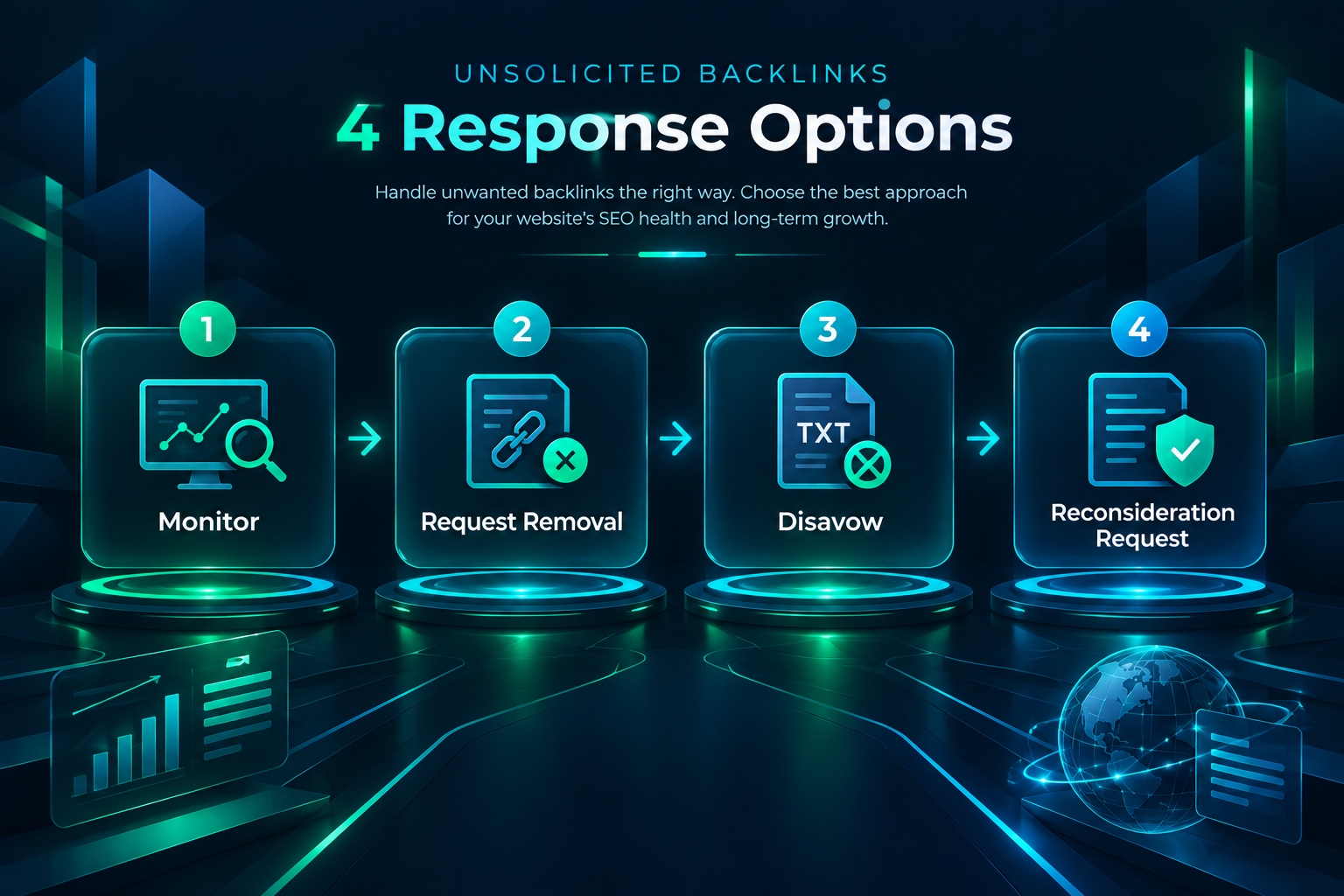
Once you have assessed the links and their potential significance, you have several practical options. The right choice depends on the volume of links, their characteristics, any ranking changes you can observe, and whether you have received a manual action notification in Google Search Console.
Take No Immediate Action
For a small number of unfamiliar links from low-authority sites with no observable impact on rankings, doing nothing while continuing to monitor is a reasonable response. Google’s systems are designed to handle low-quality links at scale, and many such links are simply ignored rather than counted against the recipient site. Reacting to every unfamiliar link with a disavowal submission can introduce unnecessary complexity and, in some interpretations, may signal to Google that you are concerned about links that it would otherwise have disregarded.
Contact the Linking Site
If you can identify a contact method for the site hosting the link, you may request removal. This is more practical for links on ordinary websites than for sites that appear to be part of an automated network, where contact information is often absent or unresponsive. Keep a record of any removal requests sent, including the date and method, in case documentation is needed later.
Use Google’s Disavowal Tool
Google’s disavowal tool, accessible through Google Search Console, allows you to submit a file listing domains or specific URLs that you want Google to ignore when assessing your site’s backlink profile. Google’s own guidance on the disavowal tool notes that it is intended for situations where you have a significant number of spammy, artificial, or low-quality links pointing to your site and you are concerned they may be causing issues, or where you have received a manual action for unnatural links.
Disavowal is not a universal requirement for every unfamiliar link. Submitting a disavowal file for links that Google’s systems would have ignored anyway has no confirmed benefit and introduces the possibility of accidentally disavowing links that are providing ranking value. If you do decide to disavow, be precise: disavow at the domain level only when you are confident that no links from that domain are beneficial, and disavow at the URL level when only specific pages are problematic.
Submit a Reconsideration Request
A reconsideration request is only relevant if your site has received a manual action notification in Google Search Console specifically related to unnatural inbound links. If no manual action is present, a reconsideration request is not applicable. If a manual action has been issued, Google’s documented process involves demonstrating that you have taken steps to address the identified links — through removal requests and, where removal was not possible, disavowal — before submitting the request. Document your efforts thoroughly.
Negative SEO: When Unsolicited Links Are Deliberate
Negative SEO refers to deliberate attempts by a third party to harm a competitor’s search rankings, sometimes by pointing large volumes of low-quality or manipulative links at their site. Whether PBN-style links can reliably cause ranking harm to a recipient site that did not request them is a subject of ongoing debate in the SEO community. Google has stated that its systems are designed to prevent negative SEO from being effective, though the company acknowledges that in some cases manual review may be necessary.
If you suspect a coordinated negative SEO campaign — characterized by a sudden, large-scale influx of links with manipulative anchor text patterns and a coincident ranking decline — the appropriate steps include documenting the pattern thoroughly, attempting link removal where possible, preparing a disavowal file for the identified domains, and monitoring Search Console for any manual action notifications. Contacting Google’s Search Central support channels to report a suspected negative SEO attack is also an option, though response outcomes vary.
It is worth maintaining perspective: genuine, large-scale negative SEO campaigns are less common than the SEO community’s discussion of them might suggest. Many apparent negative SEO situations turn out to be unrelated to the unfamiliar links when investigated carefully. Correlation between new links and a ranking change does not establish causation without ruling out other factors such as algorithm updates, technical issues, or competitor improvements.
When Unsolicited PBN Links Are Not a Concern
Not every link from a site that resembles a PBN warrants a response. If the referring domain has reasonable topical relevance to your site, the linking page contains substantive content, the anchor text is natural and non-commercial, and the link appears alongside other ordinary outbound links rather than in a pattern of mass commercial placements, the link may simply be a low-authority backlink with limited positive or negative impact. Many websites accumulate a range of link types over time, and a diverse backlink profile that includes some lower-authority links is normal.
The threshold for concern is meaningfully higher than “this link looks unusual.” Focus your attention on patterns, volume, anchor text manipulation, and any observable correlation with ranking changes rather than treating every unfamiliar domain as a threat requiring immediate remediation.
Frequently Asked Questions
Can unsolicited PBN backlinks cause a Google penalty?
Google’s systems are designed to ignore or neutralize low-quality links rather than automatically penalizing the recipient site. A manual action for unnatural inbound links is possible in some circumstances, but it requires a human reviewer’s assessment and is not an automatic consequence of any PBN-style link appearing in your profile. If no manual action appears in Google Search Console, no penalty in the formal sense has been issued.
Should I disavow every link from a site that looks like a PBN?
Not necessarily. Disavowal is most appropriate when you have a significant volume of links that you believe are causing harm, or when you have received a manual action. Disavowing links that Google’s systems would have ignored anyway provides no confirmed benefit and risks removing links that may be contributing positively. Assess the pattern and volume before deciding.
How do I know if a link is genuinely from a PBN or just a low-quality site?
There is no single definitive test. A combination of signals — unusual domain history, thin or templated content, topical irrelevance, a backlink profile dominated by outbound commercial links, and exact-match anchor text — provides a stronger basis for assessment than any one factor alone. Third-party tools such as Ahrefs, Semrush, and Majestic can assist with domain history and link profile analysis.
What is the difference between a manual action and algorithmic devaluation?
A manual action is a documented enforcement decision made by a human reviewer at Google and is visible in Google Search Console under the Manual Actions report. Algorithmic devaluation refers to Google’s automated systems choosing to discount or ignore a link’s contribution to rankings without issuing a formal penalty. These are distinct outcomes with different implications and different response processes. Do not treat them as interchangeable.
Does contacting the linking site always work?
Removal requests are often unsuccessful when the linking site is part of an automated network, has no active owner, or has no accessible contact information. Keep records of your attempts regardless of the outcome, as documentation of good-faith removal efforts is relevant if you later need to submit a reconsideration request following a manual action.
How often should I audit my backlink profile for unsolicited links?
For most websites, a monthly review of new referring domains using Google Search Console or a third-party tool is sufficient to catch unusual patterns early. Sites in competitive niches or those that have previously experienced negative SEO activity may benefit from more frequent monitoring or automated alerts for new referring domains.
Deciding on the Right Response for Your Site
Handling unsolicited PBN backlinks effectively comes down to proportionate assessment rather than reflexive action. The presence of unfamiliar or low-quality links in a backlink profile is common across websites of all sizes, and the appropriate response ranges from continued monitoring to targeted disavowal depending on the volume, pattern, anchor text characteristics, and any observable impact on search performance.
Begin with a structured review of the links in question using available tools, document your findings, and assess whether the pattern represents a meaningful risk given your site’s overall backlink profile and current rankings. If no manual action is present in Google Search Console and no significant ranking decline coincides with the appearance of the links, a watchful monitoring approach is often the most measured starting point. Reserve disavowal for situations where the evidence supports a genuine concern rather than applying it as a precautionary measure for every unfamiliar link.
If you are managing a broader link-building strategy alongside this assessment and want to understand how intentional PBN placements, backlink packages, or domain selection fit into your overall approach, PBN Backlinks Service can help you review your requirements and evaluate options suited to your site’s goals and competitive context.