

PBN case studies frequently produce contradictory results, and that contradiction is one of the most common sources of confusion for website owners and SEO practitioners evaluating link-building strategies. One study reports significant ranking improvements after adding PBN backlinks; another reports minimal movement or a decline. Understanding why these outcomes differ — and how to assess which findings are most relevant to your own situation — is more useful than accepting any single result at face value.
Key Takeaways
- Conflicting PBN case study results are usually explained by differences in methodology, website context, niche competition, domain quality, and the time frame measured — not by a single universal truth about PBN effectiveness.
- A case study’s value depends on how clearly it documents variables such as domain metrics, anchor text distribution, placement context, link velocity, and the baseline state of the target site.
- Outcome differences between studies are often attributable to variation in PBN quality, not to PBN backlinks as a category.
- Separating documented search-engine policy from observed SEO behavior and industry speculation is essential when evaluating any case study’s conclusions.
- No published case study can substitute for a website-specific assessment, because ranking outcomes depend on factors that vary significantly between sites and campaigns.
Why PBN Case Studies Produce Contradictory Results
The most important thing to understand about conflicting PBN case studies is that contradiction is expected, not anomalous. Link-building outcomes are influenced by a large number of interacting variables, and most published case studies control for very few of them. When two studies appear to reach opposite conclusions, the most likely explanation is that they are measuring different things under different conditions — not that one is simply wrong and the other is right.
Several structural reasons explain why PBN case study results diverge so frequently. First, the quality of the private blog network itself varies enormously between studies. A network built on carefully selected expired domains with strong topical relevance, diverse hosting, and well-written contextual content will behave differently from a network built on low-metric domains with thin, templated pages. When a study reports poor results, it may be documenting the performance of a low-quality implementation rather than the performance of PBN backlinks as a method. Conversely, a study reporting strong results may reflect a high-quality network that is not representative of every provider or self-built setup.
Second, the target website’s existing backlink profile, domain history, content quality, and technical SEO baseline all influence how much impact any new link acquisition will have. A site with a weak existing profile and strong on-page fundamentals may respond differently to PBN placements than a site that already has hundreds of referring domains or one that has previously received a manual action. These baseline differences are rarely disclosed in full in published case studies.
Third, niche competition levels vary significantly. A PBN campaign targeting a low-competition local keyword may produce measurable ranking movement within weeks, while the same campaign targeting a highly competitive national keyword in a saturated vertical may show little measurable effect over the same period. Studies that do not specify competition level make it difficult to generalize their findings.
Evaluating Methodology Before Accepting a Finding
Before drawing any conclusion from a PBN case study, the first step is to assess the quality of its methodology. A finding is only as reliable as the process used to produce it, and many published SEO case studies — including those about PBN backlinks — have significant methodological limitations that are not always acknowledged by the author.
The most important methodological questions to ask are whether the study isolates PBN links as the variable being tested, or whether other link-building activity, content changes, technical SEO work, or algorithm updates occurred during the same period. If multiple changes happened simultaneously, attributing a ranking change specifically to PBN backlinks is not possible without a controlled comparison. Many case studies do not isolate variables in this way, which means their conclusions about causation are speculative even when the correlation they report is genuine.
A well-structured case study should document the following at minimum: the number and type of PBN placements added, the domain authority or trust metrics of the linking domains, the anchor text distribution used, the target pages receiving the links, the time frame of the campaign, the baseline ranking position before links were added, and whether any other SEO activity occurred during the measurement period. Studies that omit several of these details make it difficult to assess whether their results are transferable to a different website or campaign.
It is also worth noting whether the study was conducted by the service provider whose network was used, by an independent SEO practitioner, or by a third party with no commercial interest in the outcome. Provider-conducted studies are not automatically unreliable, but they carry a higher risk of selection bias — for example, reporting only campaigns that produced positive results while not publishing campaigns where results were neutral or negative. Independent studies may have their own limitations, including smaller sample sizes and less access to network-level data.
Key Variables That Explain Outcome Differences
When two PBN case studies reach different conclusions, a structured comparison of their key variables usually explains the divergence. The following factors are among the most significant sources of outcome variation across published studies.
Domain Quality and Topical Relevance
The quality of the expired or aged domains used to build a private blog network has a substantial effect on the ranking value those domains can pass through backlinks. Domains with a strong historical backlink profile, consistent topical relevance to the target niche, clean indexing history, and no prior spam or repurposing are generally considered more likely to contribute ranking value than domains selected primarily on the basis of a single metric such as Domain Rating or Domain Authority. A case study using high-quality, topically relevant PBN domains is measuring a different input than one using domains selected only by metric score, and comparing their results directly is not meaningful without acknowledging that difference.
Anchor Text Distribution
Anchor text strategy affects how a backlink profile is interpreted by search engines. Case studies that use a high proportion of exact-match anchor text across PBN placements are testing a different approach than those using a varied distribution of branded, partial-match, and generic anchors. Outcome differences between studies may partly reflect the anchor text choices made rather than the PBN placements themselves. A study that reports a ranking decline after PBN link building may have used an aggressive anchor text pattern that would be notable regardless of the link source.
Link Velocity and Placement Timing
The rate at which PBN backlinks are added to a target site’s profile can influence how those links are processed. A study that adds a large number of placements in a short period is testing a different scenario than one that spaces placements over several months. Comparing results across studies without accounting for link velocity differences can lead to incorrect conclusions about what caused a particular outcome.
Measurement Time Frame
Ranking changes following link acquisition do not always appear immediately. Crawling, indexing, and the subsequent processing of new backlinks by search engine algorithms takes time, and the period over which a study measures results significantly affects what it can report. A study measuring results over four weeks may miss ranking movements that only become visible after three months. Conversely, a study measuring over a longer period may attribute ranking changes to PBN links that were actually caused by later algorithm updates or other link-building activity. When comparing case studies, check whether the measurement windows are comparable before treating their results as equivalent.
Target Page Type and Existing Authority
Whether PBN backlinks point to a homepage, a category page, a product page, or a blog post affects the likely outcome. The existing authority of the target page, its internal linking structure, and the relevance of its content to the target keyword all interact with the incoming links. A case study targeting a well-optimized page on a site with strong technical SEO is not directly comparable to one targeting a thin page on a new domain.
Separating Policy Statements from Observed Behavior
A recurring source of confusion in PBN case study interpretation is the conflation of search-engine policy statements with observed ranking behavior. These are distinct categories of information, and treating them as equivalent leads to analytical errors in both directions.
Search engines publish guidelines that describe the types of links they consider to be outside their quality standards. These guidelines are authoritative statements of the search engine’s stated policy. They are not, however, empirical evidence of how every individual PBN link is processed, weighted, or acted upon in practice. A case study that cites policy documentation as proof that PBN links cannot produce ranking value is making an inferential leap that the documentation itself does not support. Equally, a case study that dismisses policy considerations entirely because it observed positive ranking results is ignoring a genuine risk factor that may affect outcomes over longer time frames or under different enforcement conditions.
When evaluating a case study’s conclusions, it is useful to ask whether the author distinguishes between what a search engine’s documentation states, what can reasonably be inferred from that documentation, and what the study’s own data actually shows. Studies that conflate these three categories — treating policy statements as performance data, or treating observed correlations as proof of causation — are less reliable guides to decision-making than those that keep these distinctions clear.
It is also worth noting that search engine enforcement behavior is not fully public. Thresholds for manual actions, the conditions under which algorithmic link devaluation occurs, and the distinction between page-level and sitewide enforcement are not published in detail. Any case study that claims to have identified a specific trigger point — a particular number of PBN links, a specific anchor text percentage, or a defined footprint pattern — that reliably causes or prevents a penalty is making a claim that goes beyond what is publicly documented. Such claims should be treated with appropriate skepticism regardless of whether they are framed positively or negatively.
How to Compare Multiple Case Studies Systematically
Rather than accepting or rejecting individual case studies based on their conclusions, a more reliable approach is to compare multiple studies systematically and look for patterns that hold across different methodologies, niches, and time frames. This approach reduces the influence of any single study’s limitations and helps identify which findings are more likely to reflect genuine, transferable insights.
A practical framework for comparing PBN case studies involves grouping them by their key variables and then examining whether outcome patterns correlate with those variables. For example, if studies using topically relevant, high-metric PBN domains consistently report more positive outcomes than studies using lower-quality domains, that pattern is more informative than any individual result. Similarly, if studies measuring results over longer time frames show different patterns than those measuring over short windows, that difference is worth noting when assessing what a campaign might realistically achieve.
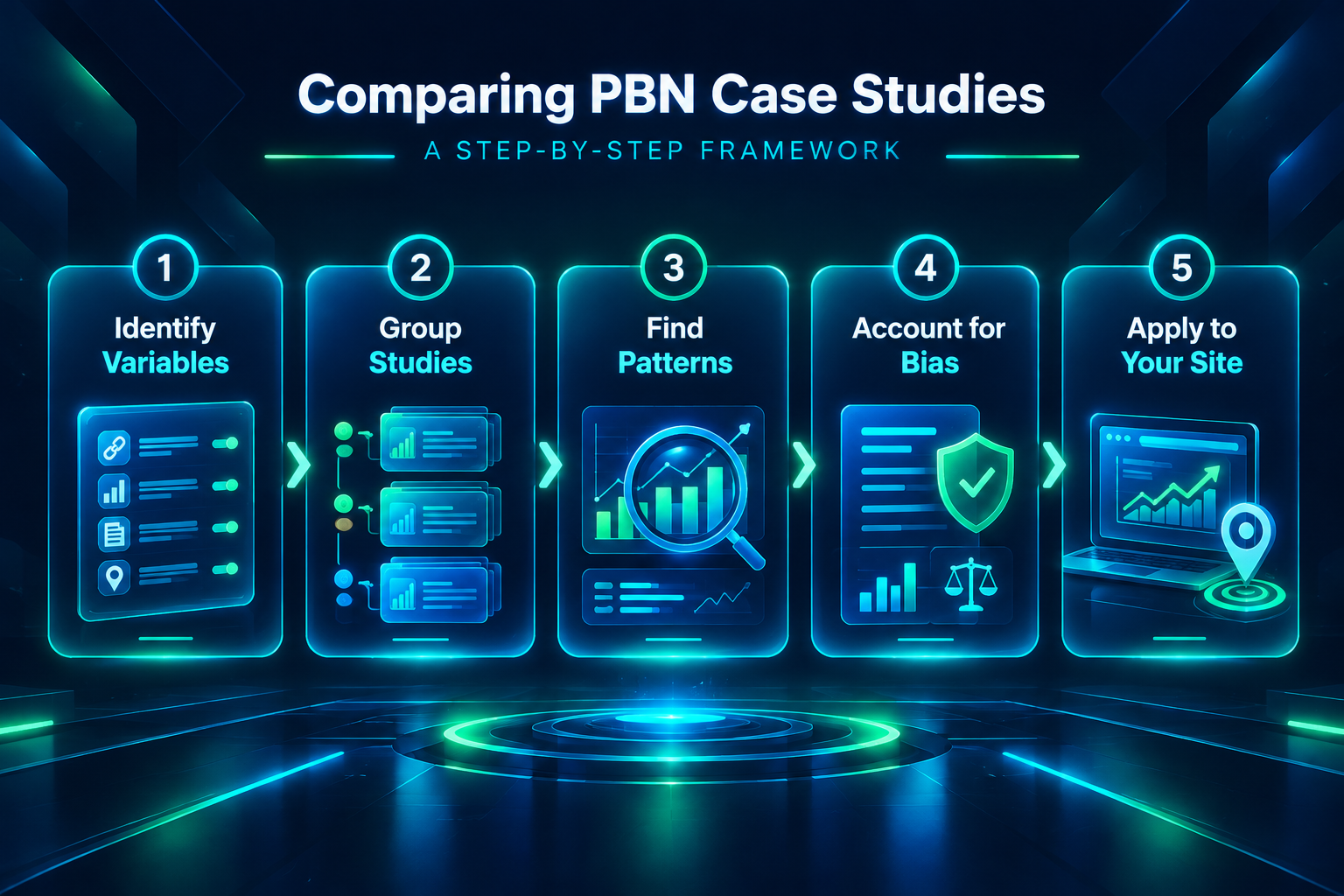
When grouping studies, consider the following dimensions: network quality indicators, target site baseline, niche and competition level, anchor text approach, link velocity, measurement period, and whether the study was conducted by an independent party or a service provider. Studies that share similar characteristics across several of these dimensions are more directly comparable than those that differ on multiple variables simultaneously.
It is also useful to note what case studies do not report. Publication bias — the tendency for positive results to be shared more widely than neutral or negative ones — is a recognized issue in SEO case study literature. A set of published studies showing predominantly positive PBN outcomes may not represent the full distribution of results across all campaigns. Accounting for this possibility does not mean dismissing positive findings, but it does mean treating them as evidence of what is achievable under favorable conditions rather than as a guarantee of what any campaign will produce.
Red Flags in PBN Case Study Reporting
Certain patterns in case study reporting should prompt additional scrutiny before a finding is used to inform a link-building decision. These are not automatic disqualifiers, but they indicate that a study’s conclusions may be less reliable than they appear.
- No baseline data: A study that does not report the target site’s ranking position, backlink profile, or traffic before the campaign began makes it impossible to assess how much change actually occurred or whether the change was meaningful.
- Single-site results presented as universal: A finding from one website in one niche over one time period is not evidence of what will happen across different sites, niches, and campaigns. Studies that present single-site results as broadly applicable conclusions are overstating their evidence.
- Correlation presented as causation: A ranking improvement that coincides with PBN link acquisition is not proof that the links caused the improvement. Algorithm updates, seasonal search volume changes, competitor movements, and other factors can produce ranking changes independently.
- No disclosure of concurrent SEO activity: If content was updated, technical issues were fixed, or other links were acquired during the same period, those factors need to be disclosed and accounted for before attributing results to PBN placements.
- Unverifiable network claims: Studies that describe the PBN used in vague terms — without any information about domain quality, content standards, or hosting diversity — make it impossible to assess whether the network used is representative of what a reader might access through a provider.
- Short measurement windows for competitive keywords: Reporting results after two or three weeks for competitive keywords may capture early fluctuations rather than stable ranking changes. Longer measurement periods generally produce more reliable conclusions for competitive niches.
Applying Case Study Insights to Your Own Campaign
Even well-conducted PBN case studies cannot substitute for a website-specific assessment, because the variables that determine ranking outcomes differ between sites. The most useful way to apply case study insights is to treat them as evidence of what is possible under defined conditions, and then assess how closely your own situation matches those conditions.
If a case study reports positive results using topically relevant PBN placements on a site with a clean backlink history in a moderately competitive niche, and your own site shares those characteristics, the study’s findings are more relevant to your decision than a study conducted in a different niche with a different baseline. Conversely, if your site has a complex backlink history, has previously received a manual action, or operates in a highly competitive vertical, you should look for case studies that more closely match those conditions before drawing conclusions.
It is also worth considering what a case study cannot tell you. Published studies rarely report on the long-term stability of ranking gains, the effect of subsequent algorithm updates on sites that received PBN links, or the cumulative impact of ongoing placements over multi-year campaigns. These are genuine evidence gaps, and acknowledging them is part of making an informed decision rather than a reason to dismiss the available evidence entirely.
When evaluating a PBN backlinks provider or planning a campaign, asking for transparency about the network’s domain selection criteria, content standards, hosting diversity, and placement context is a reasonable step. Providers who can explain these factors clearly make it easier to assess whether their network’s characteristics match the conditions under which positive case study results have been observed.
Frequently Asked Questions
Why do some PBN case studies show ranking gains while others show no effect?
The most common explanation is variation in network quality, target site baseline, niche competition, anchor text strategy, and measurement time frame. These variables interact in ways that produce genuinely different outcomes, so divergent results across studies are expected rather than contradictory in a meaningful sense. Comparing studies that share similar conditions is more informative than averaging across all available results.
Can a single PBN case study be used to predict what will happen on my site?
Not reliably. A single case study reflects the outcome for one site under one set of conditions. Its findings are most relevant when your site’s baseline, niche, and campaign parameters closely match those described in the study. Treating any single study as a universal predictor overstates its evidence.
How do I know if a case study’s results were caused by PBN links specifically?
Look for whether the study isolates PBN links as the only significant change during the measurement period. If content updates, technical fixes, or other link acquisition occurred simultaneously, the study cannot reliably attribute the outcome to PBN placements alone. Studies that acknowledge this limitation are generally more credible than those that do not.
Should I trust case studies published by PBN service providers?
Provider-published case studies can contain useful information about network characteristics and campaign structure, but they carry a higher risk of selection bias — reporting successful campaigns more frequently than neutral or unsuccessful ones. They are worth reading alongside independent studies and should be evaluated using the same methodological criteria as any other source.
What does it mean when a case study reports a ranking decline after PBN link building?
A reported decline may reflect a low-quality network, an aggressive anchor text pattern, a site that was already under algorithmic scrutiny, or a coincidental algorithm update during the measurement period. It does not automatically mean that PBN backlinks caused the decline, and it does not mean that every PBN campaign will produce the same result. Assessing the study’s methodology and the specific conditions involved is necessary before drawing a conclusion.
How long should a PBN case study measure results before its findings are reliable?
There is no universally agreed minimum, but studies measuring results over at least three to six months are generally more informative for competitive keywords than those measuring over a few weeks. Short measurement windows may capture early ranking fluctuations rather than stable changes, and they may miss the full processing time required for new backlinks to influence rankings.
Making Sense of PBN Evidence for Your Link-Building Decisions
Conflicting PBN case studies are a feature of an environment where outcomes depend on many interacting variables and where controlled experimentation is difficult to conduct at scale. The contradiction between studies is not evidence that PBN backlinks are universally effective or universally ineffective — it is evidence that results depend heavily on implementation quality, site context, and campaign design.
The most reliable approach to interpreting this body of evidence is to evaluate each study on its methodological merits, compare findings across studies with similar conditions, distinguish documented search-engine policy from observed behavior and industry inference, and apply findings only to situations that genuinely resemble the conditions under which they were produced. Studies that clearly document their variables, acknowledge their limitations, and separate correlation from causation are more useful guides than those that present a single result as a universal conclusion.
If you are assessing whether a PBN backlink campaign may be appropriate for your website, reviewing the available case study evidence alongside a specific assessment of your site’s baseline, niche, and goals will produce a more informed decision than relying on any single study’s conclusion. PBN Backlinks Service can help you evaluate placement quality, domain characteristics, and campaign fit based on your specific situation — providing the context that published case studies alone cannot supply.