

When a PBN backlink campaign is running alongside other SEO activity, two distinct effects can appear in your analytics at the same time: direct referral visits arriving through the PBN links themselves, and organic ranking improvements driven by the authority those links pass to your target pages. Treating these two signals as the same thing leads to inaccurate campaign evaluation, misattributed results, and poor decisions about where to invest next. Separating them requires a structured approach to traffic segmentation, ranking data, and timing analysis — and this article walks through exactly how to do that.
Key Takeaways
- PBN referral traffic and SEO ranking gains are two separate effects that require different data sources to measure accurately.
- Referral traffic from PBN placements appears in your analytics under the referring domain; organic ranking improvements appear in Google Search Console and rank-tracking tools as position changes for target keywords.
- Timing is a critical separator: referral visits can appear within hours of a link going live, while ranking changes typically take weeks to become measurable.
- Isolating ranking effects requires controlling for other concurrent SEO activity, seasonal patterns, and algorithm updates during the measurement window.
- Accurate attribution helps you evaluate placement quality, justify campaign spend, and make informed decisions about scaling or adjusting your link-building strategy.
Why the Distinction Matters for Campaign Evaluation
PBN backlinks can produce two measurable outcomes that are easy to conflate. The first is referral traffic: actual visits that arrive at your site because a user clicked the link on the PBN page. The second is an organic ranking effect: an improvement in your target page’s position in search results, which then drives more organic visitors. Both outcomes can increase your overall traffic numbers, but they reflect entirely different mechanisms and have different implications for how you assess a placement’s value.
If you attribute all traffic growth to ranking improvement when some of it is referral-driven, you may overestimate how much authority a placement is passing. Conversely, if you dismiss a placement because organic rankings have not visibly shifted, you may be overlooking genuine referral value that the link is already delivering. Accurate separation gives you a clearer picture of what each placement is actually doing, which is the foundation of any evidence-based link-building evaluation.
This distinction also matters when you are comparing placements across different PBN sites. A placement on a high-traffic PBN page may generate meaningful referral visits even if its ranking effect is modest. A placement on a lower-traffic but topically authoritative page may produce little referral traffic but contribute more meaningfully to ranking movement over time. Without separating the two signals, you cannot make that comparison reliably.
Understanding Referral Traffic from PBN Placements
Referral traffic from a PBN link is recorded in your web analytics platform when a visitor clicks the link on the PBN page and arrives at your site. Most analytics platforms, including Google Analytics 4, record the source of that session as the referring domain. This means you can identify PBN-driven referral visits by filtering your traffic reports to show sessions where the source matches the domain of the PBN site that hosts your link.
The volume of referral traffic a PBN placement generates depends primarily on how much organic or direct traffic the PBN page itself receives. Many PBN pages carry little to no active readership, which means referral traffic from those placements may be negligible or zero. In that case, the placement’s value is almost entirely a function of the link equity it passes rather than the direct visits it sends. Recognizing this early prevents you from judging a placement’s effectiveness by referral volume alone when the intended benefit is ranking improvement.
To monitor referral traffic from a specific PBN placement, create a custom segment or filter in your analytics platform that isolates sessions from that referring domain. Track this segment over a rolling 30-day window after the link goes live. If referral sessions appear consistently, the PBN page has some active audience. If referral sessions are absent or negligible, the placement’s contribution will need to be evaluated through ranking data instead.
Understanding Organic Ranking Gains and How They Differ
Organic ranking gains are changes in your target page’s position in search engine results pages for specific keywords. These changes are driven by how search engines evaluate the authority, relevance, and trustworthiness of your page relative to competing pages. When a PBN backlink contributes to a ranking improvement, it does so by passing link equity to your target page, which may strengthen its position for relevant queries over time.
The key difference from referral traffic is that ranking gains are not directly visible in your analytics as a traffic source. They appear indirectly as an increase in organic sessions, but that increase is attributed to the search engine — typically shown as organic traffic from Google or Bing — rather than to the PBN domain. To connect a ranking improvement to a specific PBN campaign, you need to cross-reference your analytics data with keyword position data from a rank-tracking tool or Google Search Console.
Google Search Console’s Performance report shows average position, impressions, and clicks for specific queries over time. By filtering for the target keywords associated with your PBN campaign and comparing position data before and after the campaign period, you can identify whether a ranking shift occurred. This is the most direct way to observe a potential ranking effect, though it does not by itself prove causation — other factors may have contributed simultaneously.
Setting Up a Measurement Framework Before the Campaign
Accurate separation of referral traffic and ranking effects depends heavily on establishing a clean baseline before any PBN links go live. Without a pre-campaign baseline, it becomes very difficult to determine whether a traffic or ranking change is attributable to the campaign or to unrelated factors such as seasonal demand, a competitor’s ranking drop, or a broad algorithm update.
Before placing PBN backlinks, record the following data points for each target page and its associated keywords. First, capture the current average position for each target keyword in Google Search Console, using at least a 28-day average to smooth out daily fluctuations. Second, record the current monthly organic sessions to each target page, segmented from other traffic sources. Third, note the current referral traffic from any existing backlinks to establish a baseline referral rate. Fourth, document any other SEO activity planned during the measurement window, such as content updates, internal linking changes, or technical fixes, so these can be accounted for when interpreting results.
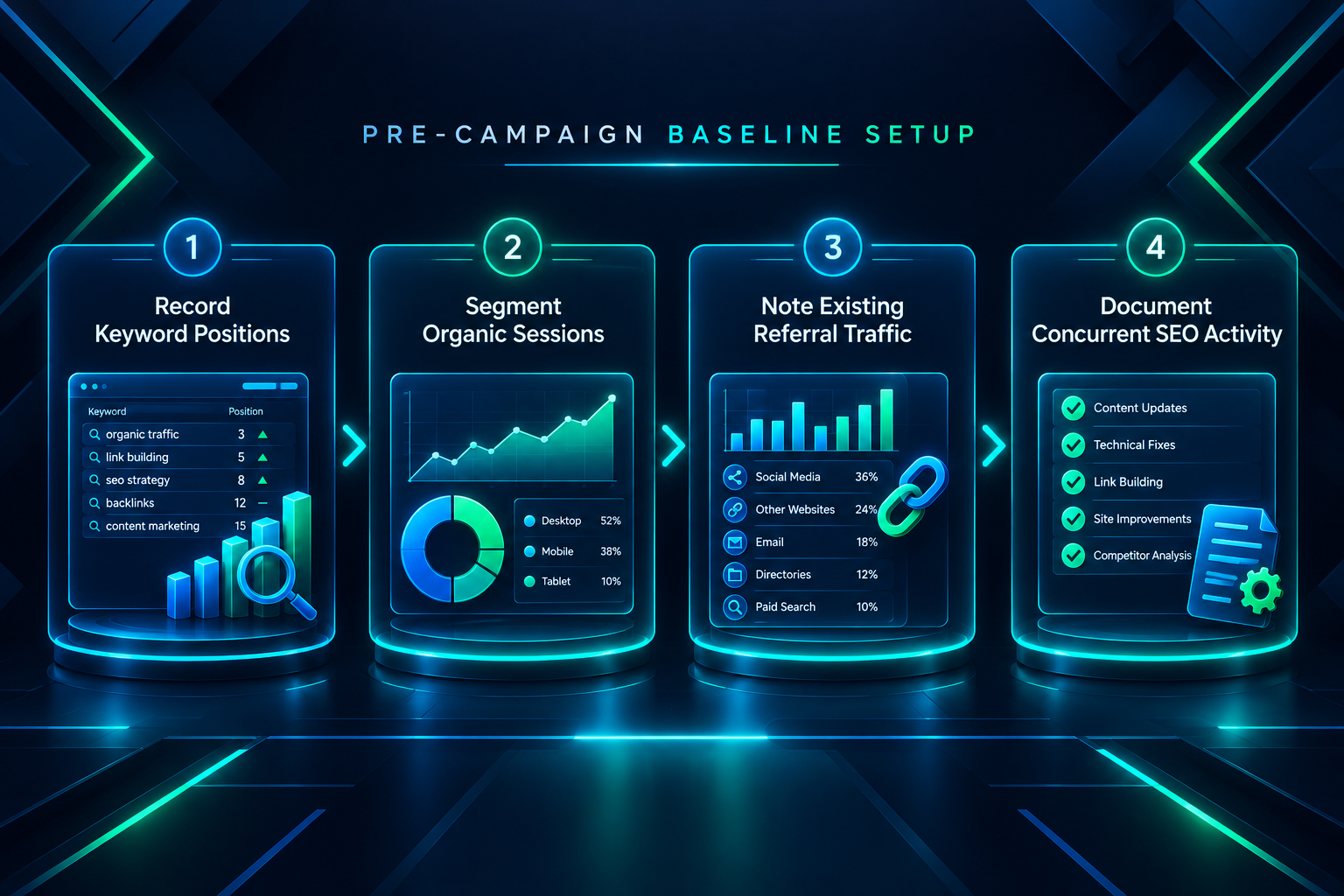
This pre-campaign snapshot becomes your control point. Any changes observed after the campaign launches can then be compared against this baseline rather than against an undefined prior state. The measurement window for ranking effects should typically extend at least 60 to 90 days after the links are placed, since ranking changes driven by new backlinks often take several weeks to become measurable in position data.
Using Google Search Console to Isolate Ranking Effects
Google Search Console is the most reliable free tool for observing keyword-level ranking changes associated with a PBN campaign. The Performance report allows you to filter by specific pages and queries, compare date ranges, and observe trends in average position, impressions, and click-through rate over time.
To use Search Console effectively for this purpose, set up a date comparison that places your pre-campaign baseline period alongside the post-campaign measurement period. Filter the report to show only the target page receiving the PBN links and the specific keywords you are targeting. An improvement in average position for those queries during the post-campaign period is a signal worth investigating further, though it should be interpreted alongside other data rather than in isolation.
One important limitation of Search Console data is that it reflects aggregate position across all searches for a query, which can mask day-to-day volatility. Supplementing Search Console with a dedicated rank-tracking tool — such as Semrush, Ahrefs, or a similar platform — gives you daily position data for specific keywords, which makes it easier to identify the timing of a ranking shift and correlate it with when your PBN links were indexed. If a position improvement begins shortly after your links are confirmed as indexed, that timing correlation strengthens the case that the campaign contributed to the change, though it does not eliminate other possible explanations.
Separating the Two Signals in Your Analytics Platform
In Google Analytics 4, traffic is attributed to channels based on the session source and medium. Referral traffic from a PBN placement will typically appear under the Referral channel with the PBN domain as the source. Organic traffic driven by ranking improvements will appear under the Organic Search channel with the search engine as the source. These two channels are reported separately by default, which means a basic channel report already provides a first-level separation.
For more granular analysis, create a custom exploration in GA4 that shows sessions broken down by both channel and landing page. This allows you to see whether an increase in organic sessions to your target page is occurring at the same time as referral sessions from the PBN domain. If organic sessions to the target page are growing while referral sessions from the PBN domain remain low or zero, the organic growth is more likely driven by a ranking effect rather than by users clicking through from the PBN page itself.
A useful cross-check is to compare the landing page data in GA4 with the query data in Search Console. If organic sessions to your target page are increasing and Search Console shows improving positions for your target keywords during the same period, the two data sources are corroborating each other. This convergence of signals — rising organic sessions in GA4 and improving keyword positions in Search Console — provides stronger evidence of a ranking effect than either data source alone.
Accounting for Confounding Factors
Isolating the effect of a PBN campaign is complicated by the fact that search rankings are influenced by many factors simultaneously. Algorithm updates, competitor activity, seasonal search demand, content changes on your own site, and other link-building activity can all affect rankings during the same window in which your PBN links are active. Failing to account for these factors can lead to either over-crediting or under-crediting the campaign.
To reduce the impact of confounding factors, keep a log of any significant events during the measurement window. Note the dates of any Google algorithm updates, any changes made to the target page’s content or internal linking, any new backlinks acquired through other channels, and any significant changes in competitor rankings for the same keywords. Tools such as Semrush’s Sensor or MozCast can help you identify periods of elevated ranking volatility that may indicate a broad algorithm update rather than a campaign-specific effect.
If a ranking improvement coincides with a period of high industry-wide volatility, attribute it cautiously. Conversely, if rankings improve during a stable period shortly after your PBN links are indexed, the timing correlation is more meaningful. Neither scenario provides definitive proof of causation, but the quality of your attribution improves significantly when you document and account for these external variables rather than ignoring them.
Evaluating Placement Quality Through Attribution Data
Once you have separated referral traffic from ranking effects, the combined data gives you a more complete picture of each placement’s contribution. A placement that generates both measurable referral traffic and a correlated ranking improvement is delivering value through two channels simultaneously. A placement that generates referral traffic but no observable ranking movement may be on a page with active readership but limited link equity. A placement that shows no referral traffic but correlates with a ranking improvement is likely passing link equity from a page that search engines value but that receives little direct human traffic.
This analysis is particularly useful when evaluating PBN placements across different sites in a network. Comparing the referral and ranking data for each placement helps you identify which types of pages and domains are contributing most effectively to your campaign goals. Over time, this data can inform decisions about where to concentrate future placements, which domains to prioritize, and whether the overall campaign is producing the ranking movement needed to justify continued investment.
When discussing placement performance with a link-building provider, having this segmented data available allows for a more specific and productive conversation. Rather than reporting only that overall traffic increased or decreased, you can identify which placements are generating referral visits, which correlate with ranking shifts, and which appear to have had no measurable effect in either dimension. This level of specificity supports better campaign decisions and more accurate evaluation of provider performance.
Timing as a Diagnostic Tool
The timing of each effect is one of the most practical tools for separating referral traffic from ranking gains. Referral traffic from a PBN link can appear within hours or days of the link going live, as soon as a user visits the PBN page and clicks through. Ranking effects, by contrast, typically require the link to be crawled and indexed by search engines first, and then for the ranking algorithm to process the new link signal — a process that can take anywhere from a few weeks to several months depending on the crawl frequency of the PBN domain and the competitiveness of the target keywords.
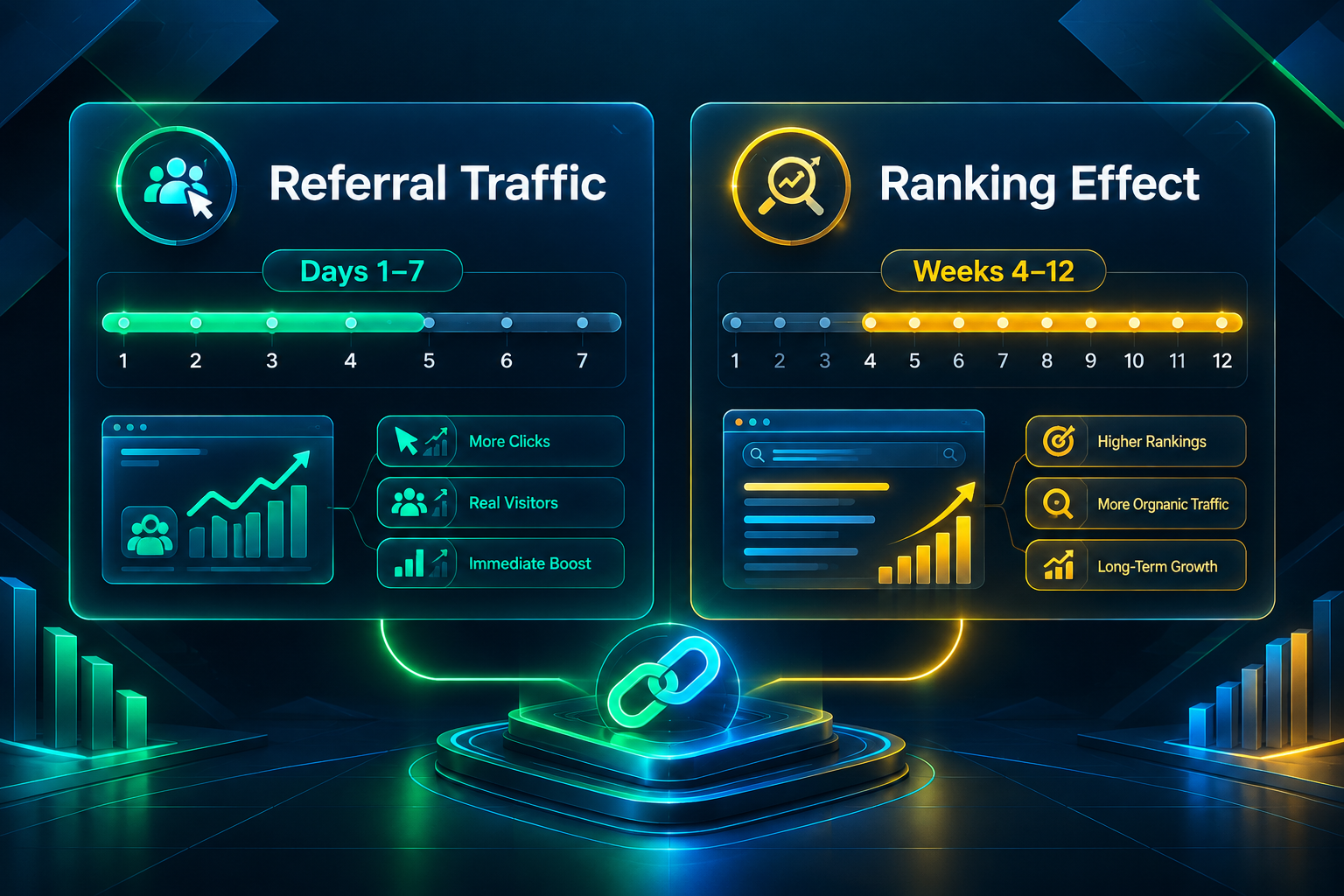
By monitoring your analytics and rank-tracking data on a weekly basis after a campaign launches, you can observe the sequence of events. If referral sessions from the PBN domain appear in the first week but keyword positions do not begin shifting until four to eight weeks later, that timing pattern is consistent with the expected behavior of each effect. If both referral traffic and ranking improvements appear simultaneously in the first week, it is more likely that the ranking change is attributable to a different factor, since link equity rarely influences rankings that quickly.
Documenting the indexing date of each PBN link — which you can verify by searching for the URL in Google or using a crawl tool — gives you a precise anchor point for timing analysis. The gap between the indexing date and the first observable ranking movement is a useful data point for understanding how quickly a particular domain’s links are being processed by the ranking algorithm.
Practical Monitoring Setup for Ongoing Campaigns
For campaigns involving multiple PBN placements over time, a structured monitoring setup prevents data from becoming unmanageable. Create a simple tracking document that records the following for each placement: the PBN domain, the target page URL, the target keywords, the date the link went live, the confirmed indexing date, the pre-campaign keyword positions, and weekly position updates for at least 90 days after indexing. Alongside this, record the monthly referral sessions from each PBN domain in your analytics platform.
Review this data at regular intervals — monthly is usually sufficient for ranking data, while referral traffic can be checked more frequently if needed. Look for patterns across placements: are certain types of PBN pages consistently generating referral traffic? Are placements on domains with particular characteristics more likely to correlate with ranking improvements? These patterns, observed over multiple campaigns, build a practical understanding of which placement attributes tend to produce which outcomes for your specific site and niche.
If you are working with PBN Backlinks Service or a similar provider, sharing this monitoring framework with them allows for more informed discussions about campaign performance and placement selection. Providers who understand how you are measuring results can offer more relevant guidance about domain selection, placement context, and campaign pacing that aligns with your measurement approach.
Frequently Asked Questions
Can referral traffic from a PBN link affect my organic rankings directly?
Referral traffic itself does not directly influence organic rankings. Search engines rank pages based on signals such as link equity, content relevance, and page authority — not on the volume of referral visits a page receives. However, if referral visitors engage meaningfully with your content, that engagement may contribute to behavioral signals that some SEO practitioners believe can influence rankings indirectly, though the extent of this effect is not publicly documented by search engines.
How long should I wait before evaluating ranking effects from a PBN campaign?
A minimum of 60 days after confirmed link indexing is a reasonable starting point for evaluating ranking effects, with 90 days providing a more reliable picture for competitive keywords. Ranking changes driven by new backlinks often emerge gradually rather than immediately, and short measurement windows can produce misleading conclusions about whether a campaign is working.
What if my organic traffic increases but my keyword positions don’t change noticeably?
This can happen when ranking improvements occur for long-tail or lower-volume queries that are not individually tracked in your rank-monitoring setup. Check Google Search Console’s full query list for your target page to see whether impressions and clicks are growing across a broader set of queries, even if your primary tracked keywords have not shifted significantly. It can also indicate that referral traffic is contributing to the overall organic-looking traffic increase through a different attribution path.
Is it possible for a PBN link to generate referral traffic but no ranking improvement?
Yes. A PBN page with active readership but limited link equity — for example, a page with few inbound links of its own — may send referral visitors without meaningfully improving the target page’s ranking. Conversely, a page with strong topical authority and a well-established backlink profile may pass significant link equity with minimal referral traffic. The two outcomes are related to different characteristics of the PBN page and should be evaluated separately.
How do I verify that a PBN link has been indexed by Google?
You can check whether a specific URL has been indexed by entering the full URL into Google Search using the site: operator or by pasting the URL directly into the search bar and looking for a cached result. Some SEO tools also provide indexing status checks. Keep in mind that a URL appearing in search results confirms it has been crawled and indexed, but does not confirm that the link on that page has been processed for ranking purposes — that processing may take additional time.
Should I use UTM parameters to track PBN referral traffic?
UTM parameters can be added to the destination URL in a PBN link to create a more specific traffic source label in your analytics platform. However, this approach has a practical limitation: UTM-tagged URLs are visible in the link itself, which may create a footprint if the PBN page is reviewed. Whether to use UTM tracking for PBN placements is a decision that depends on your specific monitoring needs and how you manage your link-building documentation.
Separating the Signals: Making Your Campaign Data Work Harder
Distinguishing PBN referral traffic from organic ranking gains is not a complex technical exercise, but it does require a deliberate measurement setup and consistent data review. The core principle is straightforward: referral traffic is visible in your analytics as sessions from the PBN domain, while ranking effects are visible in Search Console and rank-tracking tools as position changes for target keywords. These two data streams need to be read together, not merged into a single traffic number.
The practical value of this separation extends beyond campaign evaluation. When you can demonstrate which placements are contributing to ranking movement and which are generating referral visits, you have a much clearer basis for deciding how to allocate future link-building budget, which domains to prioritize, and how to pace a campaign relative to your ranking goals. It also gives you a more honest picture of what a PBN campaign is delivering — which is the starting point for any informed decision about whether to continue, adjust, or expand it.
If you are planning a PBN backlink campaign and want to ensure your measurement approach is set up correctly from the start, PBN Backlinks Service can help you assess placement options, domain quality, and campaign structure in a way that supports clear attribution. Reviewing your target pages, existing backlink profile, and ranking goals before placements go live makes the subsequent data far easier to interpret.