

Distributing PBN backlinks across multiple money pages is one of the most consequential decisions in a private blog network campaign. Point too many links at a single page and you risk an unnatural-looking profile; spread them too thinly and no individual page accumulates enough link equity to move rankings. Getting the balance right requires a clear understanding of page priority, anchor text strategy, link velocity, and how internal linking can amplify the value of every external placement you secure.
Key Takeaways
- Prioritize money pages by commercial value and current ranking gap before allocating PBN placements, rather than distributing links evenly across all target URLs.
- Anchor text variation should be planned at the campaign level, not page by page, so that the overall backlink profile reflects a natural mix of branded, generic, and keyword-rich anchors.
- Internal linking from a well-linked supporting page can pass equity to money pages that receive fewer direct PBN placements, extending the reach of your campaign budget.
- Link velocity — the rate at which new placements appear — should reflect the age, authority, and existing backlink profile of each target page to avoid sudden, unnatural spikes.
- Regular monitoring of indexed placements, ranking movement, and crawl data helps you adjust distribution as the campaign progresses rather than committing to a fixed plan that may not suit changing conditions.
Why Distribution Strategy Matters for PBN Campaigns
A private blog network placement delivers link equity from the PBN domain to the target URL. When a campaign targets several money pages — product pages, service landing pages, affiliate review pages, or category pages — the question of how to allocate placements across those URLs becomes a strategic one. Each money page competes in its own keyword landscape, carries its own existing backlink profile, and may be at a different stage of its ranking trajectory. Treating every page identically ignores those differences and typically produces weaker results than a distribution plan built around actual page-level data.
The distribution decision also affects how the overall backlink profile of the root domain appears to search engines. A site that receives all its new links pointing to one URL in a short window looks different from a site where link acquisition is spread across multiple pages over time. Neither pattern is inherently problematic, but the former can attract more scrutiny if the velocity is unusually high relative to the site’s history. A thoughtful distribution plan accounts for both the page-level goal and the domain-level profile.
Mapping Your Money Pages Before Allocating Links
Before assigning any PBN placements, compile a clear inventory of every money page you want to support. For each page, record the target keyword, current ranking position, estimated monthly search volume, and the number and quality of backlinks the page already has. Tools such as Ahrefs, Semrush, or Majestic can provide referring domain counts, approximate domain authority metrics, and anchor text breakdowns for each URL. This data gives you a factual basis for prioritization rather than guesswork.
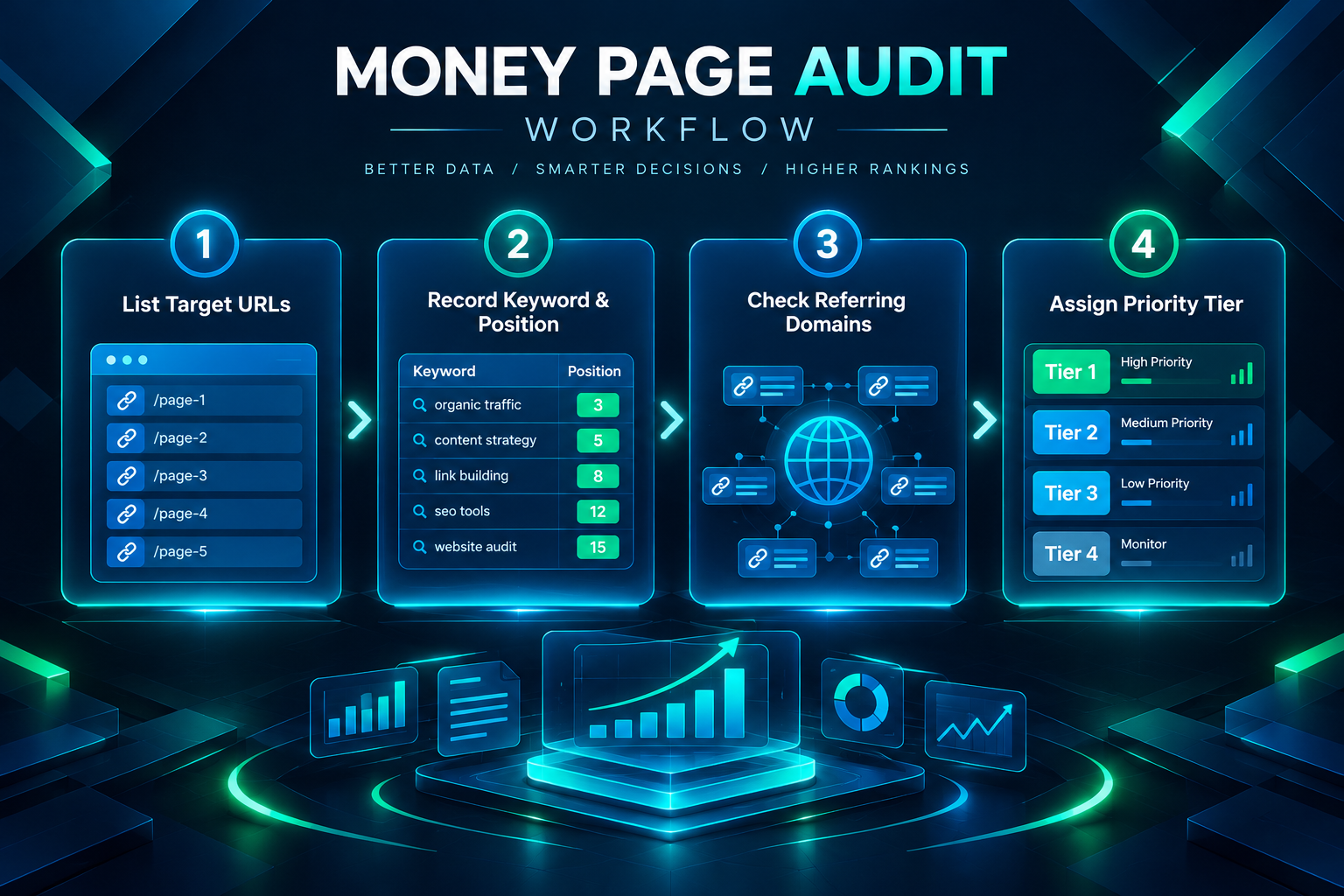
Once you have that inventory, group your money pages into tiers based on two factors: commercial importance and ranking opportunity. A page that ranks on page two for a high-volume transactional keyword represents a strong ranking opportunity — a modest increase in link equity could push it onto page one where traffic gains are substantial. A page that already ranks in position three for a competitive term may need fewer new placements to maintain its position than a page that is not yet in the top thirty. Conversely, a page with high commercial value but a very weak existing backlink profile may need a sustained series of placements before movement becomes measurable.
This tiered mapping exercise prevents the common mistake of distributing PBN links equally across ten pages when three of those pages are responsible for the majority of potential revenue. Concentration on high-priority targets, supported by a smaller allocation to secondary pages, generally produces more measurable outcomes than a flat distribution.
Prioritization Frameworks for Multi-Page Campaigns
Several practical frameworks can guide how you weight placements across money pages. The simplest is a ranking-gap model: calculate how many positions each page needs to gain to reach a target ranking, then allocate more placements to pages with the largest gap relative to their commercial value. A page sitting in position fifteen for a term with strong buyer intent typically deserves more immediate attention than a page already in position five for a lower-volume informational keyword.
A second approach is a competition-adjusted model. Examine the backlink profiles of the pages currently ranking in the top three for each of your target keywords. If the top-ranking competitors for a given term have significantly more referring domains than your money page, that page will likely need a larger and more sustained allocation of PBN placements to close the gap. Pages where the competition is thinner can often respond to a smaller number of well-placed links.
A third consideration is page readiness. A money page with thin content, slow load times, or poor internal linking may not convert additional link equity into ranking gains as efficiently as a well-optimized page. Before committing a large share of your PBN budget to a page, confirm that the page itself is technically sound and that its content matches the search intent of the target keyword. PBN placements support on-page quality; they do not substitute for it.
Anchor Text Strategy Across Multiple Target Pages
Anchor text planning becomes more complex when multiple money pages are involved because each page has its own target keyword, and the anchors used across all placements collectively shape the domain-level anchor text profile. A common mistake is to plan anchor text independently for each page without considering how the combined profile will look across the entire site.
A practical approach is to plan anchor text at the campaign level first. Decide on the overall ratio of exact-match keyword anchors, partial-match anchors, branded anchors, and generic anchors across all planned placements. Industry observation suggests that a heavily exact-match anchor profile — where a large proportion of links use the precise target keyword — can appear unnatural for sites that have not earned links organically at scale. The appropriate ratio varies by niche, competition level, and the existing anchor distribution of the site, so there is no universally correct percentage. What matters is that the combined anchor profile across all money pages does not look artificially constructed.
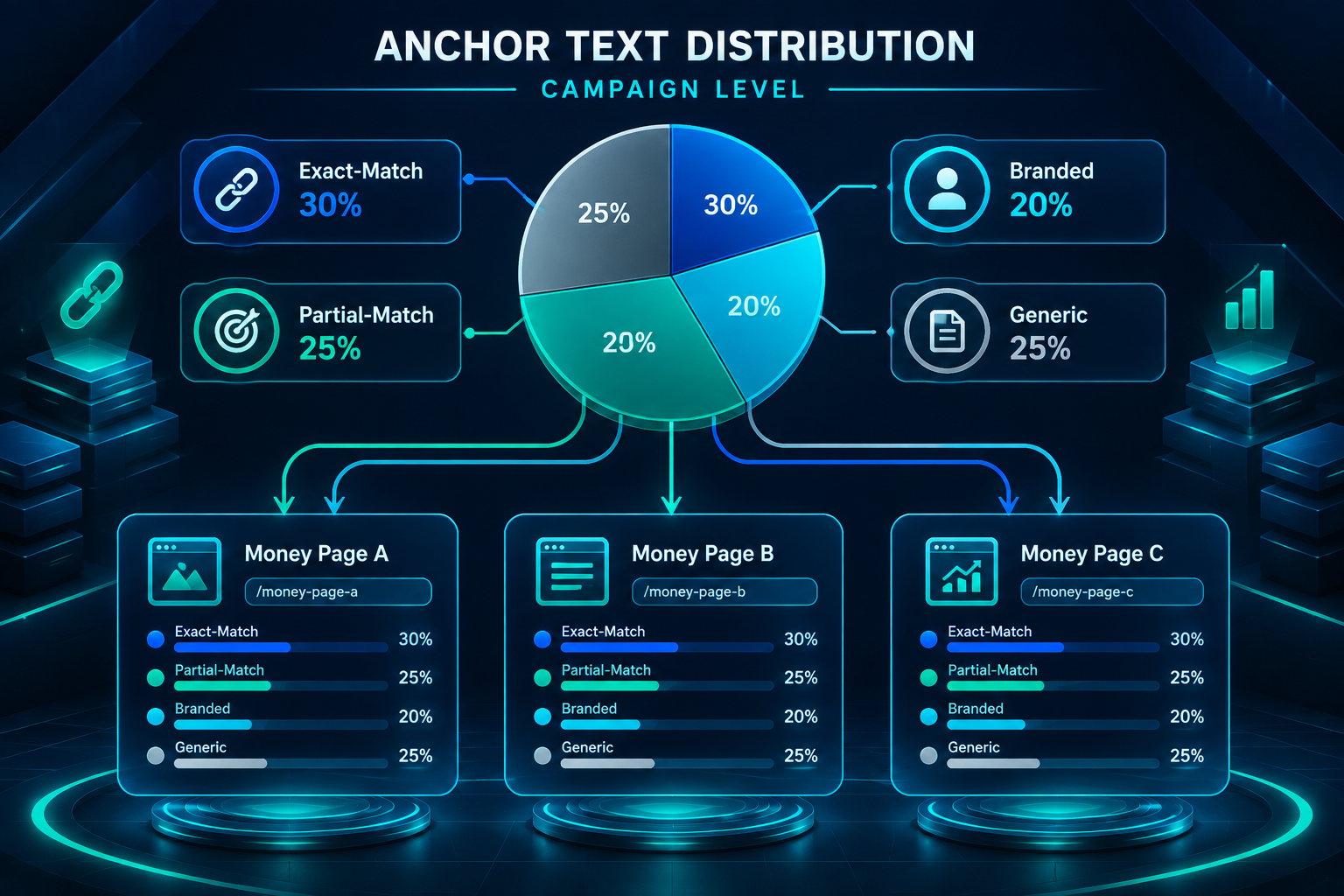
Within that overall framework, assign anchor text to individual placements based on each page’s current anchor distribution. If a money page already has several exact-match anchors from previous campaigns, new placements to that page should lean toward partial-match, branded, or generic anchors to add variety. If a page has almost no keyword-rich anchors, a carefully placed exact-match or partial-match anchor may be appropriate. The goal is a profile that reflects the kind of natural variation seen in sites that attract links from multiple independent sources.
When using PBN placements from PBN Backlinks Service, discussing your anchor text plan with the provider before placements go live allows you to coordinate anchors across the full set of target pages rather than optimizing each placement in isolation.
Using Internal Links to Extend PBN Link Equity
Not every money page needs to receive a direct PBN placement to benefit from a PBN campaign. Internal linking allows link equity to flow from pages that receive external placements to pages that do not. This is particularly useful when a campaign budget limits the total number of placements available, or when a money page is too new or too thin to be a credible direct target for multiple external links.
A common approach is to direct some PBN placements toward a strong supporting page — a detailed informational article, a category hub, or a resource page — that is internally linked to one or more money pages. The supporting page absorbs the external link equity and passes a portion of it through internal links to the money pages. This technique can make a modest number of PBN placements work harder across a larger set of target URLs.
For this to work effectively, the internal links from the supporting page to the money pages should use descriptive anchor text that reflects the money page’s target keyword, and the supporting page itself should be genuinely relevant to the money pages it links to. A loosely related supporting page with a forced internal link is less likely to pass meaningful equity than a page that naturally leads a reader toward the money page topic.
Link Velocity and Timing Across Pages
Link velocity refers to the rate at which new backlinks appear pointing to a given URL or domain. When distributing PBN placements across multiple money pages, velocity decisions apply at both the page level and the domain level. A sudden spike in new referring domains pointing to a single page — particularly a page with a previously thin backlink profile — can look unusual relative to the site’s historical link acquisition pattern.
A more measured approach is to stagger placements across pages over weeks or months rather than deploying all links simultaneously. This allows each page’s backlink profile to grow at a pace that is more consistent with organic link acquisition in that niche. The appropriate velocity depends on the site’s age, its existing backlink profile, the competitiveness of the niche, and how quickly competitors in the same space tend to acquire links. There is no published threshold from any major search engine that defines what velocity triggers a review, so decisions here are based on observed SEO practice and provider experience rather than documented rules.
Staggering placements also gives you the opportunity to monitor ranking responses after each batch of links is indexed. If a page responds positively to an initial set of placements, you can decide whether to continue with the planned allocation or redirect some future placements to a page that has not yet responded. This iterative approach is more flexible than committing the entire campaign budget upfront without any feedback from ranking data.
Balancing Direct Placements and Tiered Link Building
Some PBN campaigns use a tiered structure in which PBN links point not directly to money pages but to intermediate pages — often called Tier 2 — that themselves link to the money pages. This approach can be used to add distance between the PBN network and the primary target site, or to amplify the authority of the Tier 2 pages before that equity flows onward.
In a multi-money-page campaign, a tiered structure adds another layer of distribution decisions. You need to decide which Tier 2 pages receive PBN placements, how many placements each Tier 2 page receives, and how the Tier 2 pages link to the money pages. The benefit of this approach is that it can make the money page’s direct backlink profile look more diverse, since the money page receives links from the Tier 2 pages rather than directly from PBN domains. The trade-off is that some link equity is absorbed at each tier, so the equity reaching the money page may be lower than with a direct placement.
Whether a tiered structure is appropriate depends on the campaign’s goals, the risk tolerance of the site owner, and the quality of the Tier 2 pages being used. For campaigns where the money pages are already well-established and the primary goal is incremental ranking improvement, direct placements to the money pages are often the more straightforward choice. For newer sites or campaigns where profile diversity is a priority, a tiered approach may be worth considering.
Monitoring and Adjusting Distribution Over Time
A PBN link distribution plan should be treated as a working document rather than a fixed commitment. Ranking data, indexing status, and backlink profile changes all provide signals that may warrant adjustments to the original allocation.
After each batch of placements is live, verify that the PBN pages hosting your links have been indexed by the search engine. An unindexed placement does not pass link equity to the target page, so monitoring indexing status is a basic quality check. Tools such as Google Search Console can show whether your money pages are receiving new referring domains over time, though they do not identify the specific source of each link.
Track ranking positions for each money page’s target keyword at regular intervals — weekly or bi-weekly is common for active campaigns. If a page that received placements shows no movement after a reasonable period, consider whether the issue is link-related (insufficient placements, poor anchor text, low-quality PBN domains) or on-page (content quality, technical issues, internal linking gaps). Attributing a lack of movement solely to the PBN placements without ruling out on-page factors leads to misdiagnosis and wasted budget.
If a money page responds strongly to an initial set of placements, it may not need the full allocation originally planned. Redirecting those remaining placements to a page that has not yet responded can improve the overall campaign efficiency. Conversely, if a high-priority page is not moving despite several placements, it may need a review of the page itself before additional links are added.
Quality Factors That Affect Distribution Decisions
The quality of the PBN domains used in a campaign influences how many placements a money page may need to achieve a measurable ranking response. A placement on a PBN domain with a strong historical backlink profile, genuine topical relevance to the money page, and well-written contextual content surrounding the link is generally considered more valuable than a placement on a domain with a thin history and no topical connection to the target page.
When planning distribution across multiple money pages, factor in the quality variation within your available PBN placements. Higher-quality placements — those on domains with stronger metrics, better topical alignment, and more authoritative referring domain profiles — are best directed at your highest-priority money pages. Lower-priority pages or supporting pages in a tiered structure can receive placements from domains with more modest metrics.
Topical relevance between the PBN domain and the money page is a meaningful quality factor. A PBN domain with a history in the health and wellness space is likely to pass more relevant equity to a health-related money page than a domain with a general or unrelated history. When working with a provider such as PBN Backlinks Service, discussing the topical profile of available domains before finalizing your distribution plan can help you match the strongest placements to the pages where they will have the most impact.
Frequently Asked Questions
How many PBN links should each money page receive?
There is no universal answer. The appropriate number depends on the page’s current backlink profile, the competitiveness of its target keyword, the quality of the PBN domains being used, and how the page responds to initial placements. A page competing in a low-competition niche may respond to a handful of well-placed links, while a page targeting a highly competitive term may need a sustained series of placements over several months. Reviewing competitor backlink profiles for each target keyword gives a practical benchmark for the scale of effort required.
Should all money pages receive links at the same time?
Staggering placements across pages and over time is generally a more measured approach than deploying all links simultaneously. Staggering allows you to monitor ranking responses page by page and adjust the distribution based on actual data rather than committing the full budget before any feedback is available. It also avoids a sudden spike in new referring domains across the entire site, which can look unusual relative to the site’s historical link acquisition pattern.
Can I use the same PBN domain to link to multiple money pages?
A single PBN domain can technically link to multiple pages on the same target site, but doing so repeatedly from the same domain reduces the incremental value of each additional link from that source. Most SEO practitioners prefer to use a variety of PBN domains, each linking to a different money page or linking once to the same page, to maintain diversity in the referring domain profile. Repeated links from the same domain to the same site also increase the visibility of the relationship between the PBN and the target site.
How does internal linking interact with PBN placements?
Internal links allow link equity received by one page to flow to other pages on the same site. Directing PBN placements to a strong supporting page that internally links to your money pages can extend the reach of a limited placement budget. For this to work effectively, the internal links should use descriptive anchor text and the supporting page should be genuinely relevant to the money pages it links to.
How long does it take to see ranking movement after PBN placements?
The timeline varies depending on how quickly the PBN pages are indexed, how competitive the target keyword is, the quality of the PBN domains, and the existing strength of the money page. Some pages show movement within a few weeks of placements being indexed; others may take several months, particularly in competitive niches. Indexing the PBN placement is a prerequisite for any ranking effect, so verifying that placements are indexed is the first monitoring step after links go live.
What anchor text should I use when linking to different money pages?
Plan anchor text at the campaign level across all money pages rather than optimizing each placement independently. The combined anchor profile across all target URLs should reflect a natural mix of exact-match, partial-match, branded, and generic anchors. For each individual money page, the anchor text of new placements should complement the page’s existing anchor distribution rather than duplicating whatever anchors are already most common in that page’s backlink profile.
Building a Distribution Plan That Works for Your Campaign
Distributing PBN backlinks across multiple money pages is a planning exercise as much as a link-building one. The most effective campaigns start with a clear inventory of target pages, a prioritization framework based on commercial value and ranking opportunity, and an anchor text plan that accounts for the combined profile across all target URLs. From there, placements are allocated to pages in proportion to their priority, staggered over time to maintain a measured velocity, and monitored regularly so that the distribution can be adjusted as ranking data comes in.
Internal linking and tiered structures can extend the reach of a fixed placement budget, but they add complexity that needs to be managed deliberately. Quality factors — particularly the topical relevance and domain history of the PBN sites used — influence how many placements each money page needs and which pages should receive the strongest available domains.
If you are planning a multi-page PBN campaign and want to discuss how to structure placements across your target URLs, PBN Backlinks Service can help you assess your money pages, review available domain quality, and build a distribution plan suited to your niche and ranking goals.