

Labeling paid links on PBN sites sits at the intersection of search engine policy, technical implementation, and practical SEO decision-making. Whether you manage a private blog network, operate individual niche sites that carry paid placements, or are evaluating a link-building campaign, understanding what disclosure means in this context, what search engines actually document, and what the real-world implications are helps you make more informed choices about how your network or placements are structured.
Key Takeaways
- Google’s link spam policies document that paid links intended to pass PageRank should be qualified with a
rel="nofollow",rel="sponsored", orrel="ugc"attribute; therel="sponsored"attribute is the most semantically specific option for commercial placements. - Applying a qualifying link attribute tells Google’s crawlers to treat the link differently from an editorially earned link, which affects how the link may pass ranking signals rather than triggering an automatic penalty.
- PBN operators and site owners face a practical tension: the purpose of a PBN placement is typically to pass link equity, and adding a nofollow or sponsored attribute reduces or eliminates that signal transfer according to Google’s documented behavior.
- Search engine policy documentation describes what Google states it wants; it does not publish a detection formula, enforcement threshold, or guaranteed outcome for every individual link or network.
- The decision about how to handle link attributes on PBN placements involves weighing policy compliance, link equity goals, network footprint considerations, and the specific campaign context.
What Paid Link Disclosure Actually Means
Paid link disclosure, in the context of search engine policy, refers to the practice of adding a machine-readable signal to a hyperlink that tells a crawler the link was placed for commercial reasons rather than earned through independent editorial judgment. Google introduced the rel="nofollow" attribute in 2005 as a way for publishers to indicate that a link should not be treated as an editorial endorsement. In September 2019, Google expanded this system by introducing two additional link attributes: rel="sponsored" for links that are paid or part of an advertising arrangement, and rel="ugc" for user-generated content such as forum posts and comments.
From Google’s documented perspective, a link that passes PageRank in exchange for payment, goods, or services without a qualifying attribute violates its link spam policies. The policy applies broadly to any link intended to manipulate rankings, not only to links on sites that are explicitly identified as PBNs. The distinction Google draws is between a link that reflects genuine editorial choice and a link that was placed because money or value changed hands.
For PBN placements specifically, the relevant question is whether the link carries a qualifying attribute. A rel="sponsored" link on a PBN site is technically compliant with Google’s stated disclosure requirement for paid links. A dofollow link on the same site, with no qualifying attribute, is what Google’s policy describes as a violation when that link was placed for payment.
The Three Link Attribute Options and What They Signal
Understanding the three available qualifying attributes helps clarify the practical choices available to PBN operators and site owners who carry paid placements.
rel=”nofollow”
The rel="nofollow" attribute was the original mechanism for telling Google not to follow or pass ranking credit through a link. Google updated its treatment of nofollow in 2019, reclassifying it as a hint rather than a directive, meaning Google may choose to crawl and index the linked page but will generally not pass PageRank through a nofollow link. For paid placements, nofollow remains an acceptable qualifying attribute under Google’s policy, though rel="sponsored" is now the more semantically precise option.
rel=”sponsored”
The rel="sponsored" attribute was introduced specifically to identify links that are part of paid arrangements, advertisements, or sponsorships. Google describes this as the preferred attribute for commercial link placements. Applying rel="sponsored" to a paid link on a PBN site satisfies the disclosure requirement in Google’s link spam policy. The practical consequence is that the link is unlikely to pass PageRank in the way a dofollow link would, which directly affects the link equity goal that most PBN placements are designed to achieve.
rel=”ugc”
The rel="ugc" attribute is intended for links within user-generated content. It is not the appropriate attribute for a paid editorial placement on a PBN site and is not relevant to the disclosure question for most PBN operators.
The Core Tension for PBN Placements
The practical tension for anyone operating a PBN or purchasing placements on one is straightforward: the primary purpose of a PBN backlink is to transfer link equity to a target page. Google’s documented position is that a paid link carrying a qualifying attribute such as rel="sponsored" or rel="nofollow" should not pass PageRank. If that documented behavior holds in practice, then a fully disclosed, properly labeled paid link on a PBN site would not deliver the ranking signal the placement was intended to provide.
This creates a genuine decision point rather than a simple compliance checklist. A PBN operator who labels every paid placement with rel="sponsored" is technically following Google’s stated disclosure requirement for paid links, but is also reducing or eliminating the link equity transfer that makes the placement commercially valuable. A PBN operator who uses dofollow links without qualifying attributes is pursuing the link equity goal but is not following Google’s stated policy for paid link disclosure.
It is important to separate what Google documents as its policy from what Google can detect, enforce, or act upon in every individual case. Google does not publish a detection formula for PBN links, a threshold for enforcement actions, or a guaranteed outcome for any specific link or network configuration. The SEO industry has observed that many PBN links appear to function without triggering documented enforcement actions, but this observation does not constitute evidence that Google approves of the practice or that enforcement is impossible.
What Google’s Link Spam Policy Actually Documents
Google’s link spam policy, as documented in its Search Central guidelines, identifies several link types that it considers violations when they are intended to manipulate PageRank or rankings. These include buying or selling links that pass PageRank, exchanging links excessively, using automated programs to create links, and requiring links as part of a terms of service arrangement. The policy specifically states that paid links should use a qualifying attribute to indicate they are not editorially placed.
What the policy does not document is a specific detection method, a minimum number of links that triggers a review, a percentage of a backlink profile that constitutes a violation, or a guaranteed enforcement outcome. The distinction between a manual action, an algorithmic adjustment, a link being neutralized without a site-level consequence, and a sitewide penalty is meaningful and these outcomes are not interchangeable. Google’s documentation describes manual actions as a specific enforcement step taken by a human reviewer, distinct from algorithmic signals that may adjust how links are weighted without any formal action being recorded in Google Search Console.
When evaluating how to handle paid link labeling on PBN sites, it is worth distinguishing between what Google explicitly states in its documentation and what SEO practitioners infer from observed ranking behavior, correlation studies, or anecdotal reports. These are different categories of evidence with different levels of reliability.
Practical Implementation: How Link Attributes Are Applied
Applying a qualifying link attribute to a paid placement on a PBN site is technically straightforward. In HTML, a standard dofollow link looks like this: <a href="https://example.com">anchor text</a>. Adding a sponsored attribute changes it to: <a href="https://example.com" rel="sponsored">anchor text</a>. In WordPress, link attributes can be added manually in the HTML editor or through plugins that allow custom link attributes to be set when inserting links in the visual editor.
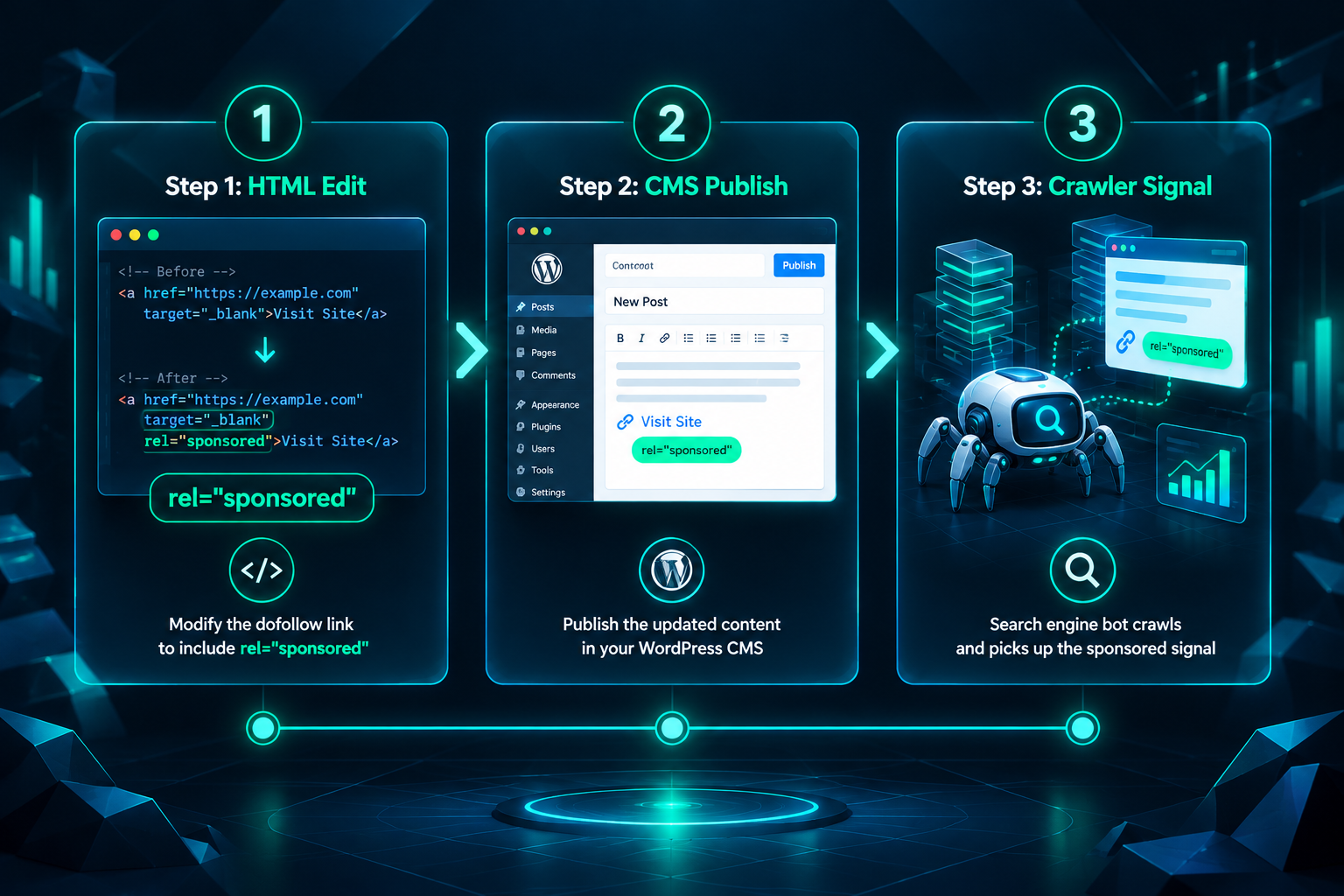
Multiple attributes can be combined if needed. For example, rel="nofollow sponsored" is valid HTML and signals both that the link is paid and that it should not pass PageRank. Google’s documentation indicates it treats these as hints, so combining attributes does not create a conflict.
For PBN operators managing multiple sites, implementing consistent link attribute policies across the network requires either manual attention to each placement or a systematic approach using CMS settings, custom fields, or editorial workflows that specify the required attribute for each link type. There is no single plugin or tool that automatically identifies paid links and applies the correct attribute; the decision about which attribute to use remains an editorial and strategic one.
Footprint Considerations and Network-Level Decisions
Beyond the individual link attribute question, PBN operators sometimes consider whether the pattern of link attributes across a network creates a detectable footprint. A network where every paid placement uses a consistent attribute pattern, identical anchor text structures, or uniform content templates may present different footprint characteristics than a network where placements vary in format, context, and attribute usage.
Footprint analysis in the context of PBNs refers to the set of signals that might allow a search engine or third-party tool to identify that a group of sites is operated by the same entity or serves a common link-building purpose. Link attributes are one potential signal among many, which also include hosting patterns, WHOIS data, content similarity, internal linking structures, domain registration timing, and the overlap of outbound link targets.
The relationship between any individual footprint signal and a specific enforcement outcome is not publicly documented by Google. SEO practitioners have proposed various theories about which footprint signals carry the most weight, but these remain industry hypotheses rather than confirmed enforcement rules. A PBN operator making decisions about link attribute usage should treat footprint considerations as one factor in a broader network quality and management assessment rather than as a guaranteed detection or protection mechanism.
Anchor Text Strategy and Disclosure
Anchor text strategy for PBN placements is a separate consideration from link attribute disclosure, but the two interact in practice. The anchor text used in a paid placement affects how the link may be interpreted by search engines as a relevance signal, while the link attribute affects whether the link is treated as passing PageRank at all.
A paid placement with a rel="sponsored" attribute and an exact-match commercial anchor text is technically disclosed as paid, but the anchor text itself carries no additional ranking signal if the link is not passing PageRank. Conversely, a dofollow paid placement with a varied anchor text strategy may be pursuing link equity transfer while attempting to avoid patterns that look unnatural in the backlink profile of the target site.
Anchor text distribution across a PBN campaign is a quality and strategy consideration that affects how the target site’s backlink profile appears to search engines and third-party tools. Concentrating too many exact-match commercial anchors in paid placements, regardless of the link attribute used, can create patterns that appear in backlink analysis tools such as Ahrefs, Semrush, or Majestic and may attract attention during a manual review. Varying anchor text across branded, partial-match, topical, and natural phrase anchors is a commonly recommended practice in PBN link-building to maintain a more natural-looking profile.
What This Means for Buyers of PBN Placements
If you are purchasing PBN placements rather than operating a network yourself, the link attribute question is still relevant to your campaign. A placement that uses a qualifying attribute such as rel="nofollow" or rel="sponsored" may not deliver the link equity transfer you are paying for, depending on how Google treats that attribute in practice. Before ordering placements, it is reasonable to ask a provider whether links are placed as dofollow or with qualifying attributes, and to understand what that means for the expected outcome of the campaign.
Providers who are transparent about their placement practices, the attributes used, the content quality on placement sites, and the domain history of their network sites give buyers more information to make an informed decision. A provider who cannot or will not clarify whether placements are dofollow or attributed, or who cannot describe the content and domain quality standards of their network, leaves buyers with less ability to assess what they are purchasing.
The link attribute is one quality signal among several. Domain authority metrics from tools like Ahrefs (DR), Moz (DA), or Majestic (TF/CF) are proprietary scores that reflect different aspects of a domain’s backlink profile. These metrics are not Google ranking scores and should not be treated as guarantees of link equity transfer or ranking improvement. Topical relevance between the placement site and the target page, the quality and depth of content surrounding the link, the placement site’s own indexing status, and the overall health of the target site’s backlink profile are all factors that affect how a placement may perform.
Frequently Asked Questions
Does adding rel=”sponsored” to a PBN link make it safe from a Google penalty?
Adding rel="sponsored" to a paid link satisfies Google’s stated disclosure requirement for paid links, but it does not guarantee immunity from any enforcement action. Google’s policies address the intent and nature of link schemes broadly, and a network of sites built primarily to host paid links may attract scrutiny regardless of the attributes used. The attribute affects how the link is treated as a ranking signal, not whether the underlying network structure is consistent with Google’s guidelines.
If I use rel=”sponsored” on PBN placements, will the links still pass ranking value?
According to Google’s documented behavior, links with qualifying attributes such as rel="sponsored" or rel="nofollow" are treated as hints and are generally not used to pass PageRank. In practice, this means a properly disclosed paid link is unlikely to deliver the same link equity transfer as a dofollow placement. This is the core trade-off between policy compliance and link equity goals for PBN placements.
Is there a legal requirement to disclose paid links on websites?
In some jurisdictions, advertising disclosure requirements from consumer protection or trade regulation bodies may apply to certain types of paid content, including sponsored posts. These requirements vary by country and context and are separate from search engine technical policies. If your PBN sites carry paid editorial content, it may be worth reviewing the applicable advertising disclosure rules in the relevant jurisdiction, particularly if the content could be interpreted as a consumer recommendation.
Can I use both rel=”nofollow” and rel=”sponsored” on the same link?
Yes, combining attributes such as rel="nofollow sponsored" is valid HTML. Google’s documentation indicates it accepts combined attributes and treats them as hints. Using both does not create a technical conflict, though for most paid placements, rel="sponsored" alone is the more semantically precise choice.
Does the link attribute affect how third-party tools like Ahrefs or Semrush report the link?
Yes. Tools such as Ahrefs, Semrush, and Majestic typically distinguish between dofollow and nofollow links in their backlink reports. A link with a rel="nofollow" or rel="sponsored" attribute will generally be reported as a nofollow link in these tools, which affects how the link appears in a backlink profile analysis. This is a relevant consideration when evaluating the reported link profile of a target site or a PBN placement site.
What should I ask a PBN provider about link attributes before ordering?
Useful questions include: Are placements delivered as dofollow links or with qualifying attributes? What is the content quality standard for placement pages? Are placement sites indexed in Google? What is the domain history and topical focus of the network sites? How is anchor text handled across placements? A provider who can answer these questions clearly gives you a better basis for assessing whether the placements are likely to meet your campaign goals.
Making an Informed Decision About Paid Link Labeling on PBN Sites
The question of how to label paid links on PBN sites does not have a single universal answer that applies to every network, campaign, or business goal. What it does have is a clear policy framework from Google, a documented set of technical options, and a genuine strategic tension between compliance and link equity transfer that every PBN operator and placement buyer needs to understand.
Google’s documentation is clear that paid links intended to pass PageRank should carry a qualifying attribute. The rel="sponsored" attribute is the most semantically appropriate choice for commercial placements. Applying it satisfies the disclosure requirement but reduces the link equity signal the placement delivers. Using dofollow links without qualifying attributes pursues the link equity goal but does not follow Google’s stated policy for paid links. Neither choice eliminates all considerations; both involve trade-offs that depend on the specific network, the target site, the campaign goals, and the operator’s assessment of risk and benefit.
What is not publicly known is the precise detection methodology Google uses to identify PBN links, the threshold at which a network or campaign attracts a manual review, or the exact conditions under which a link is neutralized versus triggering a broader enforcement action. These are meaningful uncertainties that affect how any individual operator or buyer should weigh their options, and they should be assessed in the context of the specific network quality, domain history, content standards, and campaign structure rather than through generalized assumptions.
If you are evaluating PBN placements and want to understand how link attributes, domain quality, topical relevance, and anchor text strategy interact in a specific campaign context, reviewing your requirements with an experienced provider who can speak to the specifics of their network and placement practices is a practical starting point. PBN Backlinks Service can help you assess placement options and campaign fit based on your target pages, niche, and link-building goals.