

Localizing PBN content for another country involves more than translating text. Effective international PBN placements require matching the language, cultural context, topical relevance, hosting signals, and anchor text strategy to the target market — so that each placement reads naturally to local audiences and aligns with the search signals relevant to that country’s search engine results pages. This guide covers the practical steps, decision factors, and quality considerations involved in building or sourcing country-specific PBN content that supports an international link-building campaign.
Key Takeaways
- Localizing PBN content means adapting language, cultural references, topical relevance, and hosting signals to the target country — not just running text through a translation tool.
- Country-specific domain extensions (ccTLDs), locally relevant referring domains, and geo-targeted hosting can strengthen the geographic signals of a PBN placement.
- Anchor text strategy must reflect the natural language patterns of the target market, including local keyword variants, search volume differences, and regional phrasing.
- Topical relevance between the PBN site and the target page remains important regardless of the country being targeted; a locally relevant but off-topic placement is unlikely to deliver the intended value.
- Quality checks for international PBN domains should include reviewing the domain’s historical content language, archived pages, and referring domain geography to confirm genuine local authority.
Why Country-Specific Localization Matters for PBN Placements
A PBN placement designed for a UK audience will not automatically serve a German or Brazilian campaign. Search engines evaluate contextual signals at the page and domain level, and a placement that reads as foreign-language content on an otherwise English-language site, or that uses awkward machine-translated text, may not carry the same contextual weight as a placement that reads naturally within its local publishing environment. Beyond search engine signals, the practical goal of a PBN placement is to appear as a credible, contextually appropriate link within a relevant piece of content — and that goal is harder to achieve when the content does not match the expectations of the local market.
International SEO campaigns targeting specific countries — whether through country-code top-level domains (ccTLDs), subdirectories, or subdomains — benefit from backlink profiles that include locally relevant referring domains. A German-language PBN site with a .de domain and a backlink profile drawn from German-language sources sends different geographic signals than a generic English-language PBN site with a .com extension. For campaigns targeting competitive local SERPs, these distinctions can influence how placements are evaluated in the context of the broader link profile.
Language Accuracy and Cultural Adaptation
The most visible element of PBN content localization is language quality. Content written in the target language must be accurate, idiomatic, and free from the patterns that identify machine translation — unusual sentence structures, literal translations of idioms, inconsistent register, or vocabulary that does not match local usage. For high-priority placements, native-speaker writing or editing is the most reliable way to achieve this standard. For markets where native-speaker content is harder to source, professional translation with local editorial review is a practical alternative.
Cultural adaptation goes beyond grammar. A placement targeting a French audience should reference locally relevant examples, use date and number formats consistent with French conventions, and avoid cultural references that would read as foreign or out of place. Similarly, content targeting Brazilian Portuguese differs meaningfully from content targeting European Portuguese in vocabulary, spelling conventions, and idiomatic expression. Treating these as interchangeable markets is a common localization error that reduces the natural quality of the placement.
For markets that use non-Latin scripts — Arabic, Chinese, Japanese, Korean, Cyrillic — the localization requirement extends to character encoding, font rendering, and right-to-left layout where applicable. PBN sites targeting these markets need to be technically configured to display the target language correctly, not just to contain translated text.
Domain Selection for International PBN Campaigns
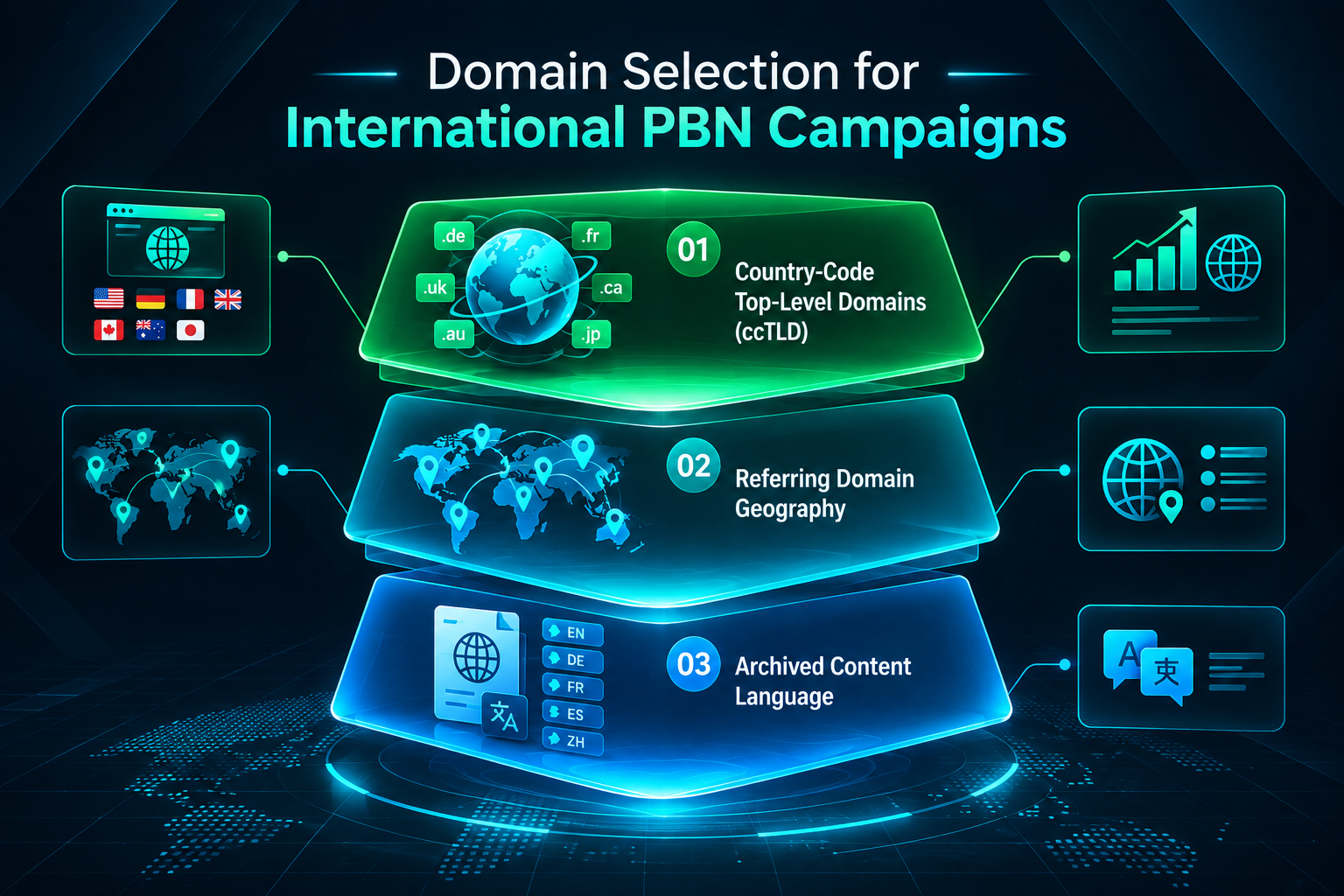
Domain selection is one of the most consequential decisions in building or sourcing international PBN placements. The domain’s history, extension, and backlink profile all contribute to the geographic and topical signals it carries.
Country-Code Top-Level Domains
A ccTLD such as .de, .fr, .es, .com.au, or .co.uk carries an explicit geographic signal that a generic .com domain does not. For campaigns targeting a specific country, PBN domains with the relevant ccTLD can reinforce the local relevance of the placement. When evaluating expired or aged ccTLD domains for a PBN, it is worth checking that the domain’s historical content was genuinely in the target language and relevant to the target market — a .fr domain that previously hosted English-language content, or that was used for an unrelated international purpose, may not carry the local authority that the extension implies.
Referring Domain Geography
The geographic distribution of a PBN domain’s existing backlink profile is a useful quality signal for international campaigns. A domain with a substantial proportion of referring domains from the target country — particularly from locally relevant sources — is more likely to carry meaningful local authority than a domain whose backlinks come predominantly from unrelated international sources. Tools such as Ahrefs and Semrush allow you to filter referring domains by country, which makes this check practical during domain evaluation.
Archived Content Language
Before acquiring an expired domain for an international PBN, reviewing the archived content through the Wayback Machine or similar tools helps confirm that the domain’s historical content was in the target language and relevant to the intended niche. A domain that previously hosted locally relevant content in the target language is a stronger foundation for a localized PBN site than one that was repurposed or used for unrelated purposes before expiry.
Hosting and Technical Signals for Country Targeting
Hosting location is one of several technical signals that can contribute to the geographic relevance of a PBN site. Hosting a PBN site on a server physically located in the target country, or using an IP address associated with that country, can reinforce the local signals of the domain. This is not a mandatory requirement — many legitimate websites are hosted outside their primary market — but for international PBN campaigns where geographic relevance is a priority, locally hosted or locally IP-addressed sites are a reasonable quality consideration.
Content delivery networks (CDNs) such as Cloudflare can complicate IP-based geographic signals because they route traffic through distributed servers. If IP-level geographic targeting is a deliberate part of the PBN strategy, it is worth understanding how the chosen hosting and CDN configuration affects the apparent server location. For most international PBN campaigns, the combination of ccTLD, local-language content, and locally relevant referring domains is likely to be more significant than hosting location alone, but the technical setup should be consistent with the overall localization strategy.
Hreflang tags are relevant for websites that serve multiple language or country versions of the same content, but they are a signal for the target site rather than the PBN site itself. If the campaign goal is to build links to a multilingual or multi-country target site, ensuring that the target site’s hreflang implementation is correct is a separate but related technical consideration.
Anchor Text Strategy for International Markets
Anchor text localization is an area where international PBN campaigns frequently require specific attention. The keywords that perform well in one language or market are not always direct translations of the keywords that perform well in another. Search volume, keyword competition, and natural phrasing vary by country and language, and an anchor text strategy built on English-language keyword research will not automatically transfer to a French, Spanish, or Japanese campaign.
Effective anchor text localization for international PBN placements involves conducting keyword research in the target language and market, identifying the natural phrasing that local searchers use, and building anchor text variation around those local terms. Exact-match anchors in the target language should reflect genuine local search demand rather than literal translations of English-language target keywords. Branded anchors, partial-match anchors, and natural-language anchors should also reflect local naming conventions — a brand name may be rendered differently in different markets, and local audiences may use different shorthand or colloquial references.
The distribution of anchor text across a set of international PBN placements should aim for variety that mirrors the natural linking patterns of the target market. Over-reliance on exact-match anchors in any language can create an unnatural pattern in the backlink profile, and this consideration applies equally to international campaigns as it does to domestic ones.
Topical Relevance in Localized PBN Content
Topical relevance between the PBN site and the target page remains a core quality factor regardless of the country being targeted. A localized PBN site covering local finance topics is a more contextually appropriate source for a link to a local financial services page than a localized PBN site covering unrelated lifestyle content. The localization effort should not come at the expense of topical alignment — both dimensions matter.
Building topical relevance into a localized PBN site means populating it with content that genuinely covers the subject area in the target language, not just translating a generic content template. For niche-specific international campaigns, this may involve sourcing content from writers with subject-matter knowledge in the target language, or at minimum ensuring that the content accurately reflects the terminology and conventions of the niche as it exists in the target market. Legal, medical, financial, and technical niches in particular use terminology that varies significantly between countries and languages.
The placement article itself — the piece of content on the PBN site that contains the link — should be written to a standard that makes the link appear contextually natural. A well-written, locally relevant article that references the target page in a meaningful way is more likely to deliver placement value than a thin or generic piece of content that happens to be in the target language.
Content Volume and Site Depth for International PBN Sites
A localized PBN site that consists of a single placement article and little else is unlikely to present as a credible local publishing source. Building some depth of locally relevant content around the placement — covering related topics in the target language, maintaining a consistent publishing schedule, and ensuring that the site’s overall content profile reflects a genuine local focus — contributes to the site’s credibility as a local source.
The volume of supporting content required will vary depending on the niche, the competition level in the target market, and the overall quality standard of the PBN network. For competitive international markets, a higher standard of site depth and content quality is generally appropriate. For less competitive local niches, a smaller content footprint may be sufficient, but the content that is present should still meet a reasonable quality standard in the target language.
Maintaining a localized PBN site over time involves updating content to keep it current, ensuring that the site remains indexed, and monitoring the placement link to confirm it remains live and accessible. These maintenance considerations apply to all PBN sites but are worth planning for explicitly when managing sites across multiple languages and markets, since the editorial and technical overhead is higher than for a single-language network.
Practical Steps for Localizing PBN Content
- Define the target market precisely. Identify the specific country, language variant, and niche before beginning domain selection or content production. Distinguish between markets that share a language but differ in vocabulary, spelling, and cultural context — such as Spain and Mexico, or the UK and Australia.
- Conduct local keyword research. Use keyword research tools to identify search volume, competition, and natural phrasing in the target language and country. Build the anchor text strategy and placement content brief around local search data rather than translated English-language keywords.
- Evaluate domains for local signals. When selecting expired or aged domains for a localized PBN, check the ccTLD, archived content language, referring domain geography, and historical topical relevance. Prioritize domains with a genuine local history in the target market.
- Source native or professionally translated content. Commission placement articles and supporting site content from native speakers or professional translators with subject-matter knowledge. Review content for idiomatic accuracy, cultural appropriateness, and niche terminology before publishing.
- Configure hosting and technical settings for the target market. Consider hosting location, IP geography, and site language settings. Ensure that the site’s technical configuration — including character encoding, language tags, and layout — is appropriate for the target language.
- Apply localized anchor text variation. Use a mix of exact-match, partial-match, branded, and natural-language anchors drawn from local keyword research. Avoid over-reliance on any single anchor type or phrase.
- Monitor placements and indexing. After publication, confirm that the placement article is indexed and that the link remains live. Use tools such as Google Search Console (for the target site) and backlink monitoring tools to track the placement’s status over time.

Quality Checks Before Publishing International Placements
Before a localized PBN placement goes live, a structured quality review helps confirm that the content meets the standard required for the target market. Key checks include: confirming that the article reads naturally to a native speaker of the target language; verifying that the anchor text matches a genuine local keyword target; checking that the PBN site’s overall content profile is consistent with the niche and market; and confirming that the domain’s technical configuration correctly serves the target language. For campaigns involving multiple languages or markets, a consistent review checklist reduces the risk of quality inconsistencies across placements.
It is also worth reviewing the target page’s existing backlink profile before adding international PBN placements. If the target page already has a strong set of locally relevant referring domains, the incremental value of additional PBN placements in the same market may be different from a situation where local-language links are underrepresented in the profile. Understanding the existing profile helps prioritize where localized placements are likely to be most useful.
Frequently Asked Questions
Do I need a separate PBN site for each country I am targeting?
Not necessarily, but a PBN site that is clearly associated with one country and language is generally a stronger local signal than a multilingual site covering multiple markets. For campaigns targeting several countries, a network of country-specific sites — each with the relevant ccTLD, local-language content, and locally relevant referring domains — is a more coherent approach than a single site attempting to serve multiple markets simultaneously.
Is machine translation acceptable for localizing PBN content?
Machine translation tools have improved significantly, but content produced by machine translation alone often retains patterns that identify it as non-native — unusual phrasing, literal idiom translation, and inconsistent register. For placements where content quality is a priority, native-speaker writing or professional translation with editorial review produces more natural results. Machine-translated content may be acceptable as a starting point if it is thoroughly edited by a native speaker before publication.
How important is the ccTLD for international PBN placements?
A ccTLD is a useful geographic signal but not the only one. A .de domain with locally relevant content, a German-language backlink profile, and German-market hosting sends a coherent set of local signals. A .com domain with the same content and backlink characteristics can also carry local relevance, though the ccTLD adds an explicit geographic indicator. For campaigns where local authority is a priority, ccTLD domains with a genuine local history are worth prioritizing during domain selection.
Should the PBN site’s content niche match the target page’s niche in the local market?
Yes. Topical relevance between the PBN site and the target page is a quality factor that applies regardless of the country being targeted. A locally relevant PBN site that covers a different niche from the target page is less contextually appropriate than one that shares topical alignment. Both localization and topical relevance should be addressed together rather than treating them as separate considerations.
How do I find expired domains with genuine local authority for international PBN campaigns?
Domain research tools such as Ahrefs and Semrush allow you to filter referring domains by country and language, which helps identify domains with locally relevant backlink profiles. Combining this with Wayback Machine checks to review archived content language and topical history gives a practical basis for evaluating whether a domain has genuine local authority rather than just a local extension.
Can I use the same placement article translated into multiple languages across different PBN sites?
Using the same article structure across multiple language versions is a common efficiency approach, but each version should be adapted — not just translated — to reflect the local market’s terminology, cultural references, and natural phrasing. Identical article structures across multiple sites in different languages may also create a recognizable pattern, so varying the content approach across placements is generally preferable for maintaining a natural-looking network.
Planning Your International PBN Strategy
Localizing PBN content for another country is a multi-dimensional process that combines language quality, domain selection, hosting configuration, anchor text strategy, and topical relevance into a coherent approach for each target market. The effort required is higher than for a domestic campaign, but the specificity of a well-localized placement — one that reads naturally in the target language, sits on a domain with genuine local authority, and uses anchor text drawn from local keyword research — is also more targeted to the competitive environment of the local SERP.
The practical starting point for any international PBN campaign is a clear definition of the target market, followed by local keyword research and domain evaluation before content production begins. Skipping these steps and relying on translated domestic content or generic domains with local extensions is likely to produce placements that fall short of the quality standard needed to be useful in competitive local markets.
If you are planning an international link-building campaign and want to assess which placements, domains, or content approaches are appropriate for your target markets, PBN Backlinks Service can help you review your requirements and identify a strategy suited to your specific goals and competitive landscape.