

Redirect chains in PBN backlink paths are one of the more overlooked technical issues that can quietly reduce the ranking value a link delivers. When a PBN placement points to a URL that redirects to another URL, which then redirects again before reaching your target page, each hop in that chain dilutes the link equity passing through. Fixing these chains — or preventing them from forming in the first place — is a practical maintenance task that applies to any link-building campaign relying on PBN placements.
Key Takeaways
- A redirect chain occurs when a backlink passes through two or more sequential redirects before reaching the final destination URL, reducing the link equity delivered at each step.
- PBN backlinks are particularly vulnerable to redirect chains when target pages are restructured, when domains change, or when tracking parameters are added between the placement and the destination.
- The most effective fix is replacing the redirecting URL in the anchor with a direct link to the canonical destination, eliminating intermediate hops entirely.
- Detection requires crawling the backlink path, not just checking the placement URL — tools such as Screaming Frog, Ahrefs, or a redirect-path checker can reveal the full chain.
- Ongoing monitoring of PBN placements is necessary because redirect chains can develop after a link goes live, particularly when target-site URLs change without updating the source anchor.
What a Redirect Chain Is and Why It Matters for PBN Links
A redirect chain is a sequence of HTTP redirects where a browser or crawler following a URL is sent through multiple intermediate locations before arriving at the final page. A single 301 redirect from an old URL to a new one is a normal and generally well-handled situation. A chain — where URL A redirects to URL B, which redirects to URL C, which finally resolves to the target — introduces compounding issues. Each redirect step requires an additional HTTP request, adds latency, and, according to widely cited SEO industry analysis, may reduce the proportion of link equity that passes through to the final destination. Google has not published a precise formula for how much equity is lost per redirect hop, but the general SEO consensus is that chains are worth resolving, particularly when the links involved are intended to carry meaningful ranking signals.
For PBN backlinks specifically, redirect chains matter because the entire purpose of a PBN placement is to pass link equity from a domain with an established backlink profile to a target page. If the anchor URL in the placement is not pointing directly to the canonical destination, some of that equity may be absorbed or lost in transit. A PBN link that passes through a chain of two or three redirects before reaching the money site is delivering less value than a direct link to the same page — even if the placement itself is contextually strong and the PBN domain carries solid referring domain metrics.
How Redirect Chains Form in PBN Backlink Paths
Redirect chains in PBN link paths typically develop through a small number of predictable scenarios. Understanding the cause makes it easier to both fix existing chains and prevent new ones from forming.
Target-Site URL Changes After Placement
The most common cause is a change on the target site after the PBN link has already been placed. If a money-site page is moved, the URL structure is updated during a site migration, or HTTPS is implemented after the link was built to an HTTP URL, the original anchor URL in the PBN placement now points to a redirecting address rather than the live canonical page. If the target site then makes a further structural change — for example, adding a trailing slash or changing a subfolder — a second redirect is introduced, creating a chain. The PBN placement itself has not changed, but the path it follows has become longer.
Tracking Parameters and Redirect Wrappers
Some campaign setups route outbound links through tracking scripts or redirect wrappers to measure click traffic. If a PBN placement is built using a tracked URL rather than the direct canonical URL, the link path already includes at least one redirect before reaching the destination. If the destination URL then changes, a second hop is added. Tracking wrappers are rarely necessary for PBN placements and are generally worth removing from the anchor URL before the link goes live.
PBN Domain or CMS Changes
Changes on the PBN domain itself can also introduce redirect issues. If a PBN site migrates from HTTP to HTTPS, changes its permalink structure, or moves content between URLs, internal links within the PBN post may begin redirecting before the outbound link to the target site is even reached. In this scenario, the redirect chain starts within the PBN domain rather than at the target site. Crawling the full path from the PBN post URL through to the money-site destination is the only reliable way to detect this type of chain.
Expired Domain Forwarding
When a PBN is built on an expired or aged domain, the domain’s previous owner may have set up forwarding rules that were not fully cleared before the new site was built. Residual redirect rules at the server or registrar level can intercept requests and add an unintended hop. This is less common but worth checking during the initial domain setup and again if redirect issues are detected later.
How to Detect Redirect Chains in Your PBN Backlink Paths
Detecting redirect chains requires following the full HTTP path from the PBN placement URL to the final destination, not just checking whether the placement page is live. Several approaches are practical depending on the scale of the campaign.
Using a Redirect Path Checker
A dedicated redirect path checker — available as a standalone browser extension or as a feature within tools such as Screaming Frog SEO Spider — will show every HTTP status code and URL in the chain from the starting address to the final resolved destination. To use this for a PBN backlink, input the exact URL that appears in the anchor of the PBN placement, not the PBN domain’s homepage. The tool will display whether the path resolves directly with a 200 status, passes through a single 301, or involves a chain of multiple redirects. Any path showing more than one redirect step before reaching the canonical target page is a chain worth resolving.
Crawling with Screaming Frog
Screaming Frog SEO Spider can be configured to crawl a list of URLs and report on redirect chains. For a PBN campaign with multiple placements, export the list of anchor URLs from your placement records and run them through a crawl. Screaming Frog’s redirect chain report will flag any URL that passes through more than one redirect, making it straightforward to identify which placements need attention. The tool also distinguishes between 301 permanent redirects, 302 temporary redirects, and other status codes, which is useful context when deciding how to fix the issue.
Checking via Ahrefs or Backlink Audit Tools
Ahrefs and similar backlink analysis platforms report the URL that a linking page points to, but they do not always follow the full redirect chain to the final destination. These tools are useful for identifying which PBN placements exist and what anchor URLs are in use, but a separate redirect-path check is still needed to confirm whether a chain is present. Use Ahrefs to pull the list of PBN placement URLs and anchor targets, then verify each path with a redirect checker or crawler.
Manual Browser Inspection
For a small number of placements, opening the anchor URL in a browser with the developer tools network tab active will show every redirect hop in sequence. This is practical for spot-checking individual links but becomes time-consuming at scale. It is most useful for confirming a suspected chain after a tool has flagged it.
How to Fix Redirect Chains in PBN Backlinks
The most direct and effective fix for a redirect chain in a PBN backlink path is to update the anchor URL in the PBN placement so that it points directly to the current canonical destination URL, bypassing all intermediate redirects. This eliminates the chain entirely rather than managing it at the redirect level.
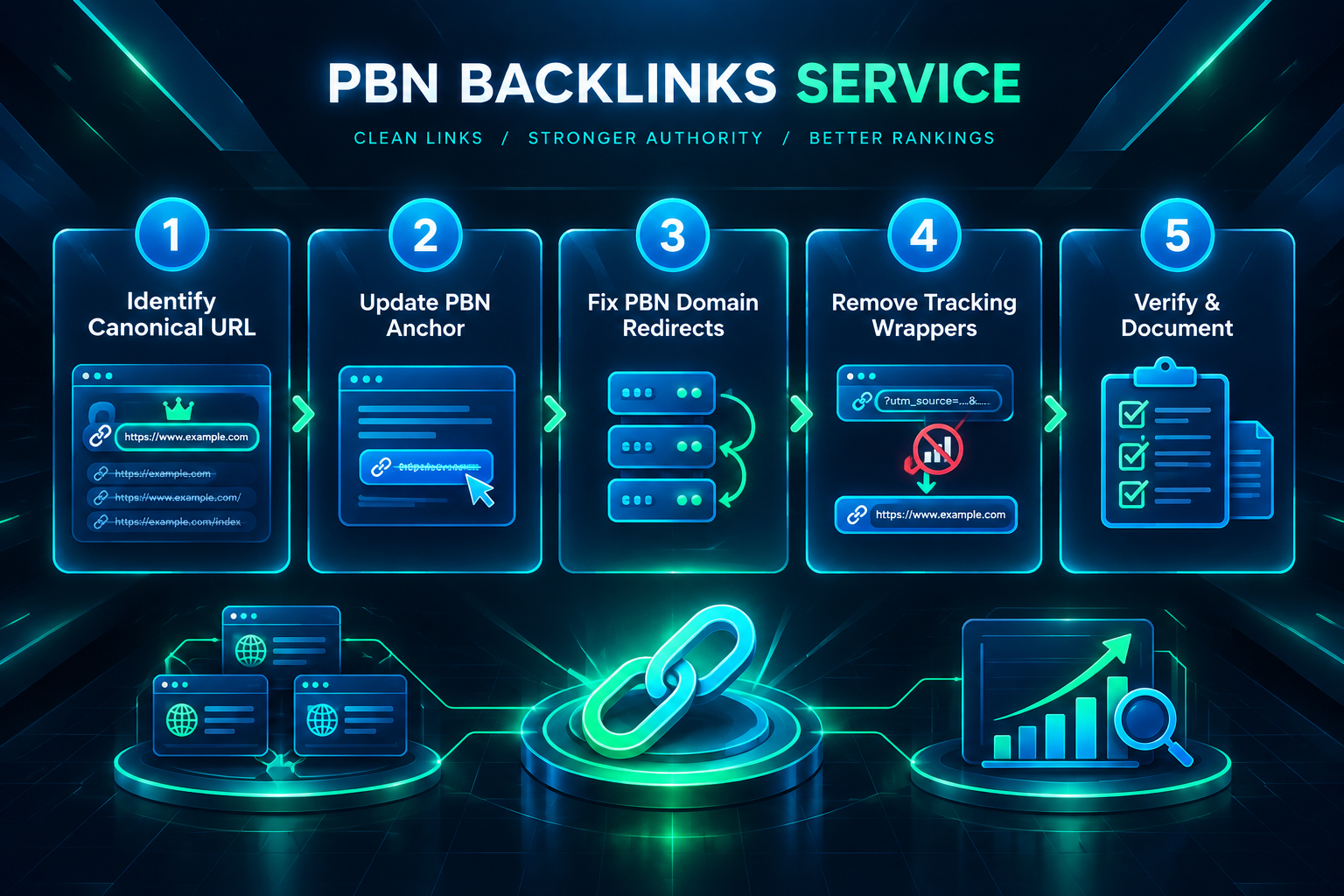
Step 1: Identify the Final Canonical Destination
Before editing any PBN placement, confirm the exact canonical URL of the target page. This is the URL that returns a 200 HTTP status code with no further redirects. Check the target page’s canonical tag in the HTML source to confirm the intended canonical URL, particularly if the site uses HTTPS, www versus non-www variations, or trailing slashes inconsistently. Updating the PBN anchor to a URL that is itself non-canonical will recreate the problem.
Step 2: Update the Anchor URL in the PBN Placement
Access the PBN site’s content management system and locate the post or page containing the backlink. Edit the hyperlink in the anchor text so that it points directly to the canonical destination URL identified in Step 1. Save and publish the change. After updating, use a redirect path checker to confirm that the new anchor URL resolves directly to the target page with a single 200 response and no intermediate hops. This direct-link repair is the cleanest solution because it removes the dependency on any redirect infrastructure that could change again in the future.
Step 3: Resolve Any Redirect Issues on the PBN Domain Itself
If the redirect chain begins within the PBN domain — for example, because the PBN post URL itself redirects before the outbound link is followed — the PBN site’s internal redirect structure needs to be corrected first. Update the PBN site’s permalink settings, fix any internal redirect rules in the .htaccess file or server configuration, and confirm that the post URL resolves directly before checking the outbound link path. A PBN placement on a page that itself redirects is delivering reduced value regardless of what the outbound anchor points to.
Step 4: Remove Tracking Wrappers from Anchor URLs
If the original placement was built using a tracked or wrapped URL, replace it with the direct canonical URL of the target page. Tracking wrappers add at least one redirect hop and provide no SEO benefit for a PBN placement. The direct canonical URL is always preferable for a link intended to pass equity.
Step 5: Verify the Fix and Document the Change
After updating each placement, run the new anchor URL through a redirect path checker to confirm a clean direct resolution. Document the change in your placement records, noting the original redirecting URL, the updated canonical URL, and the date of the fix. This record is useful for future audits and helps identify whether the same target page causes recurring redirect issues as the money site evolves.
Preventing Redirect Chains from Forming in Future PBN Placements
Prevention is more efficient than repair, particularly for campaigns with a large number of placements. Several practices reduce the likelihood of redirect chains developing after a PBN link goes live.
- Always use the canonical URL as the anchor target. Before placing a link, verify that the target URL returns a 200 status directly and matches the page’s canonical tag. Do not use a URL that already redirects, even if the redirect is a single clean 301.
- Coordinate with target-site URL changes. When the money site undergoes a migration, permalink restructure, or HTTPS implementation, audit all existing PBN placements and update anchor URLs before or immediately after the change. A site migration that is not followed by a placement audit will create redirect chains across every existing PBN link pointing to the affected pages.
- Avoid tracking parameters in PBN anchor URLs. Use direct canonical URLs in all PBN placements. If click tracking is needed for campaign reporting, use server-side logging on the PBN domain rather than redirect-based tracking in the anchor URL.
- Audit PBN domain redirect rules after any CMS or hosting change. When a PBN site is migrated, updated, or restructured, check that the post URLs resolve directly and that no residual redirect rules are intercepting requests.
- Schedule periodic redirect-path audits. Even well-maintained placements can develop redirect issues over time as target sites evolve. A quarterly check of anchor URL paths across active PBN placements is a practical maintenance interval for most campaigns.
Link Equity, Redirect Types, and What the Evidence Suggests
The SEO industry’s general position is that 301 permanent redirects pass the majority of link equity to the destination URL, but that each additional redirect hop in a chain introduces further dilution. Google has acknowledged that redirect chains can slow crawling and may affect how PageRank flows through a chain, though the company has not published a precise equity-loss figure per hop. The practical implication is that a PBN backlink passing through a two- or three-step redirect chain is likely delivering less ranking signal than a direct link from the same placement, even if the difference is not always measurable in isolation.
The distinction between a 301 and a 302 redirect is also relevant in this context. A 301 signals a permanent move and is generally treated by search engines as passing link equity to the destination. A 302 signals a temporary redirect and may be treated differently, with some interpretations suggesting that equity is retained at the source URL rather than passed to the destination. If a redirect chain in a PBN backlink path includes a 302 hop, the equity-passing behavior is less predictable. Replacing the chain with a direct link to the canonical destination removes this uncertainty entirely.
It is worth noting that the impact of a redirect chain on any individual PBN placement will vary depending on the overall backlink profile of the target page, the authority metrics of the PBN domain, the length of the chain, and the redirect types involved. A single redirect chain on one placement in a large campaign may have a negligible measurable effect. However, if redirect chains are present across multiple placements pointing to the same target page, the cumulative reduction in equity delivery becomes more significant and is worth addressing systematically.
Monitoring PBN Placements for Redirect Issues Over Time
Redirect chains are not always present at the time a PBN link is placed. They frequently develop later, as the target site evolves or as the PBN domain undergoes changes. A monitoring process that checks placement health periodically is more reliable than a one-time audit at campaign launch.
A practical monitoring setup for PBN placements includes tracking the HTTP status of each anchor URL on a scheduled basis. This can be done by maintaining a spreadsheet of placement URLs and running them through a redirect checker or crawler at regular intervals — monthly or quarterly depending on campaign size. Any URL that returns a redirect status rather than a direct 200 should be flagged for investigation and repair. Combining this with a check of the PBN post URL itself — to confirm the placement page is still live and indexed — gives a more complete picture of placement health.
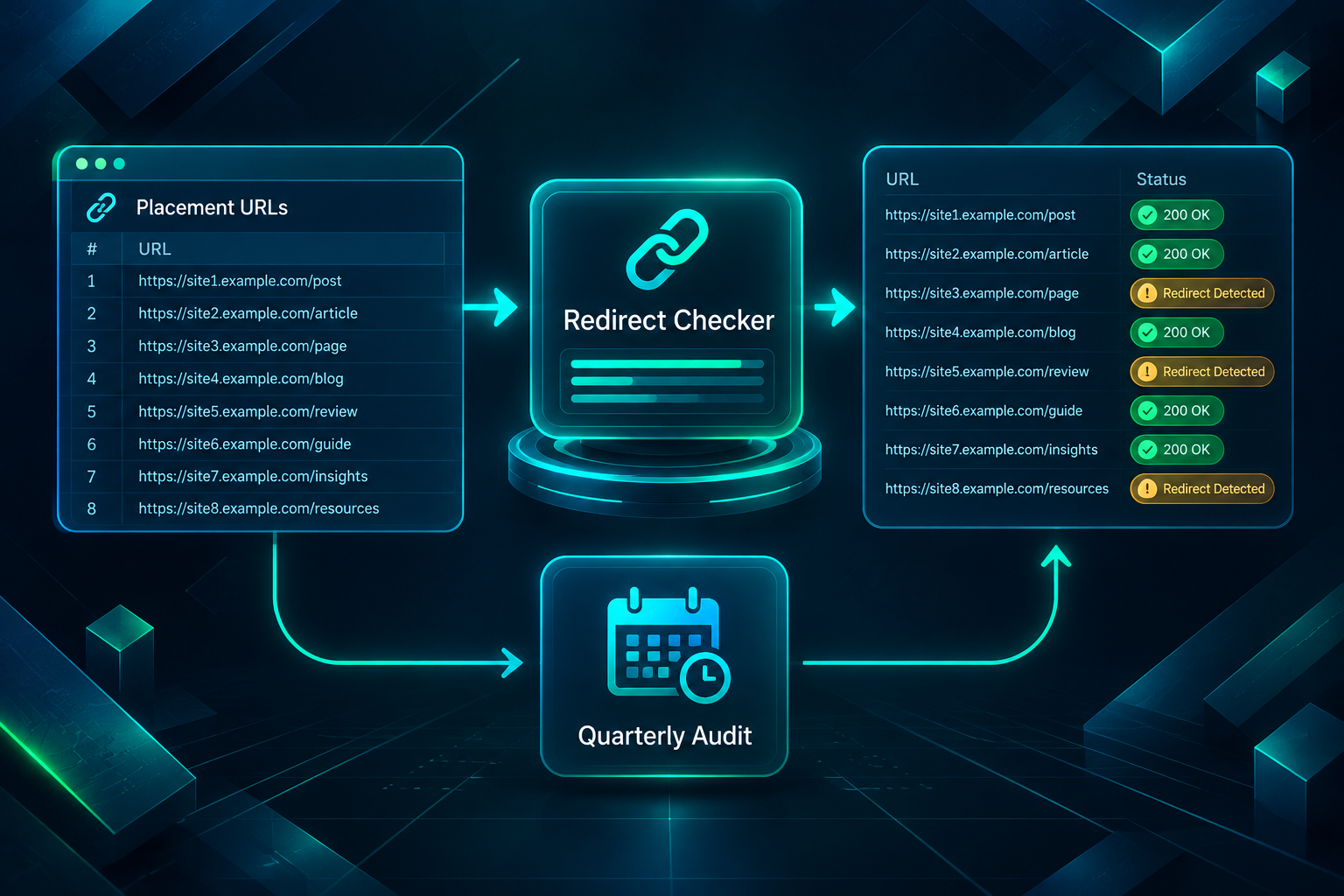
Backlink monitoring tools such as Ahrefs can alert you when a previously detected backlink disappears from their index, which may indicate that the PBN post has been removed or that the PBN domain has been deindexed. However, these tools do not reliably detect redirect chains in the anchor path, so a separate redirect-path check remains necessary for that specific issue.
Frequently Asked Questions
Does a single 301 redirect in a PBN backlink path need to be fixed?
A single clean 301 redirect is generally considered to pass the majority of link equity to the destination and is a lower priority than a multi-hop chain. However, replacing a single-redirect anchor with a direct link to the canonical URL is still the cleaner setup and removes any uncertainty about equity transfer. If the redirect is stable and unlikely to change, the practical impact of leaving a single 301 in place is usually small. A chain of two or more redirects is a higher priority for repair.
How do I know if a redirect chain is affecting my rankings?
Isolating the ranking impact of a redirect chain on a specific PBN placement is difficult without controlled testing, because many variables affect ranking simultaneously. The more practical approach is to treat redirect chains as a link-health issue worth fixing regardless of whether a measurable ranking change is visible. Resolving chains ensures that the equity from each placement is delivered as efficiently as possible, which is the intended purpose of the link.
Can I fix a redirect chain by updating the redirect on the target site instead of editing the PBN placement?
If the chain is caused by a redirect on the target site, updating the target site’s redirect rules to point directly to the canonical URL will shorten the chain. However, the cleanest fix is still to update the PBN placement anchor to point directly to the canonical destination, because this removes the dependency on the redirect infrastructure entirely. If the target site’s redirect changes again in the future, a placement pointing to the canonical URL will not be affected, whereas a placement pointing to a redirecting URL will develop a new chain.
What if I cannot access the PBN placement to update the anchor URL?
If the PBN placement is managed by a provider and you do not have direct CMS access, contact the provider and request that the anchor URL be updated to the current canonical destination. A reputable PBN provider should be able to make this change as part of standard placement maintenance. If a provider is unable or unwilling to update anchor URLs when redirect chains are identified, that is a relevant factor when evaluating the ongoing value of placements from that network.
Do redirect chains affect how quickly a PBN backlink is crawled and indexed?
Redirect chains add HTTP request overhead, which can slow the crawl path from the PBN placement to the target page. For Googlebot and other crawlers operating under crawl budget constraints, a chain of redirects may reduce the frequency with which the full path is followed. Resolving the chain to a direct link reduces this overhead and may support more consistent crawling of the link path, though crawl behavior is influenced by many factors beyond redirect structure.
Should I disavow PBN links that have redirect chains?
Disavowal is not an appropriate response to a redirect chain. A redirect chain is a technical link-health issue, not a signal that the link itself is harmful. The correct response is to fix the chain by updating the anchor URL to point directly to the canonical destination. Disavowal removes the link’s equity contribution entirely, which is the opposite of the intended outcome when the goal is to restore efficient equity delivery.
Keeping PBN Backlink Paths Clean and Efficient
Redirect chains in PBN backlink paths are a solvable technical problem. The fix — updating the anchor URL in the PBN placement to point directly to the current canonical destination — is straightforward once the chain has been detected. The more demanding part of the process is systematic detection and ongoing monitoring, because chains frequently develop after a link is placed rather than being present from the start.
For campaigns with multiple PBN placements pointing to the same target pages, a periodic redirect-path audit is a practical maintenance step that protects the equity contribution of each placement. Combining this with a clear process for updating placements when the target site’s URL structure changes — particularly during site migrations or HTTPS implementations — prevents the most common causes of chain formation.
If you are evaluating PBN placements or managing an existing campaign and want to assess the technical health of your backlink paths, PBN Backlinks Service can help you review placement quality, anchor URL accuracy, and link equity delivery as part of a broader campaign assessment. Clean, direct link paths are a basic quality standard for any PBN placement intended to contribute meaningful ranking signal.