

Retiring a PBN site without a plan can quietly erode the link equity your money site depends on. Whether you are consolidating a network, letting a domain lapse, or restructuring your private blog network after a content or hosting audit, the steps you take before taking a site offline determine how much of that ranking signal survives. This guide walks through the practical options for link preservation during PBN site retirement, explains the mechanisms behind each approach, and helps you decide which method fits your situation.
Key Takeaways
- Link equity from a retiring PBN site can often be preserved through a well-configured 301 redirect, but the amount of signal passed depends on the quality of the retiring domain and the relevance of the redirect destination.
- Crawling and indexing the redirect before decommissioning the site gives search engines time to process the change and reduces the risk of abrupt link loss.
- Migrating the linking page’s content to a new PBN property is an alternative to redirecting the whole domain, and it keeps the link placement active rather than relying on redirect signal transfer.
- Monitoring your money site’s backlink profile and rankings before, during, and after retirement helps you detect signal loss early and respond before it compounds.
- The domain itself may retain value after retirement if its backlink profile is still intact, making it a candidate for reuse within the network or for sale as an aged domain asset.
Why Link Preservation Matters When Retiring a PBN Site
A PBN site functions as a controlled link source pointing to a target page, typically a money site or an intermediate tier. The ranking contribution of that link depends on the domain’s authority metrics, the topical relevance of the linking page, the anchor text used, and how consistently search engine crawlers have indexed the placement. When the PBN site goes offline without any transition plan, the link disappears from the crawlable web. Search engines that previously indexed the placement will eventually recrawl the URL, receive a non-200 response, and begin discounting the link from their link graph. The speed at which this happens varies, but the outcome is the same: the money site loses a link signal it was previously receiving.
The practical consequence depends on how much of the money site’s backlink profile that single PBN placement represented. For a site with a diverse link portfolio, losing one placement may produce no measurable ranking change. For a site that relied heavily on a small number of PBN links, the loss can be more noticeable. Either way, a structured retirement process costs relatively little effort compared to rebuilding lost link equity from scratch.
Assessing the Retiring Domain Before Taking Action
Before choosing a preservation method, audit the retiring PBN site to understand what you are working with. Pull the domain’s referring domain count and backlink profile using a tool such as Ahrefs or Majestic. Check whether the domain’s own inbound links are still live and indexed, since a domain that has already lost most of its referring domains will pass less signal regardless of how the retirement is handled. Review the Trust Flow, Citation Flow, or Domain Rating depending on which tool you use, keeping in mind that these are proprietary metrics and not direct Google ranking scores.
Also check the domain’s current indexing status. If the PBN site’s pages are already deindexed or have been flagged, the link equity being passed may already be limited. Confirming the indexing status before investing time in a redirect or migration prevents wasted effort. A quick site: query in Google or a crawl using Screaming Frog can give you a baseline picture of how many pages are currently indexed and whether the linking page itself is accessible.
Finally, identify every outbound link the retiring site carries. If the site links to multiple money sites or tier-two properties, each of those link relationships needs to be accounted for in the retirement plan. Retiring the domain without mapping its outbound links risks disrupting multiple campaigns simultaneously.
Option 1: 301 Redirect the Retiring Domain
A 301 permanent redirect is the most commonly used method for passing link equity from a retiring domain to a destination URL. When configured correctly, a 301 redirect signals to search engines that the resource has permanently moved, and crawlers are expected to transfer a portion of the link signal from the old URL to the redirect destination. In practice, the amount of equity transferred through a 301 redirect is not publicly quantified by Google, and the actual effect on rankings varies depending on the quality of the redirecting domain, the relevance of the destination, and how the redirect is implemented.
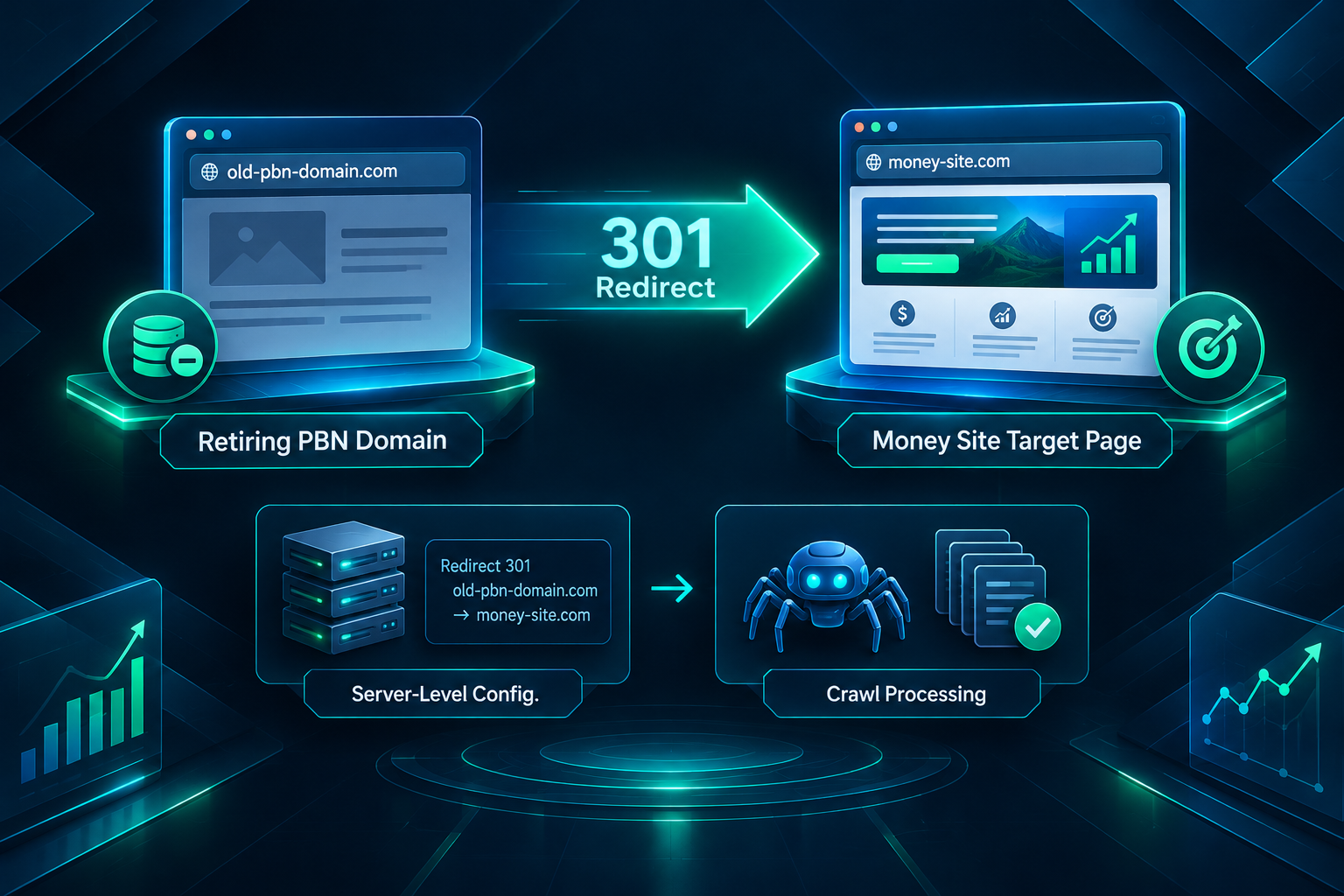
For a PBN retirement scenario, the redirect destination is typically the money site’s target page or a relevant inner page. Redirecting the entire retiring domain to a single destination URL is the simplest implementation. If the retiring PBN site had multiple pages linking to different target pages, you can configure page-level 301 redirects so that each linking URL points to its most relevant destination, rather than funneling everything through the homepage.
The redirect should be implemented at the server level, either through the hosting control panel, an .htaccess file on Apache servers, or an equivalent configuration on Nginx. WordPress-based PBN sites can use a redirect plugin, but server-level redirects are generally more reliable and faster to execute. Once the redirect is live, allow several weeks for major search engine crawlers to process the change before decommissioning the hosting. Pulling the hosting immediately after setting the redirect at the registrar level, without keeping the server response active, means crawlers may encounter errors before they have processed the 301, which reduces the effectiveness of the transition.
One practical consideration: if the retiring domain’s registration is about to lapse, renew it for at least one additional year before setting up the redirect. A domain that expires mid-redirect will drop the redirect entirely, and any equity transfer in progress will be interrupted. The cost of a one-year renewal is typically small relative to the value of the link equity being preserved.
Option 2: Migrate the Linking Page to a New PBN Property
Rather than redirecting the retiring domain, you can migrate the specific page that carries the outbound link to a new or existing PBN site. This approach keeps the link placement active rather than relying on redirect signal transfer, which means the money site continues to receive a live contextual link rather than a redirected one. The migration involves recreating the linking page’s content on the new PBN property, updating the outbound link to point to the correct target URL, and then either redirecting the old page URL to the new one or simply allowing the old placement to expire while the new one is indexed.
Content migration works best when the new PBN property is topically relevant to the content being moved. A page about home improvement products linking to a money site in that niche should ideally move to a PBN domain with a related content profile, not to an unrelated domain. Topical relevance affects how search engines interpret the context of the link, and a mismatch between the linking page’s topic and the hosting domain’s overall theme can reduce the placement’s effectiveness.
If you are migrating content to an existing PBN site that already has its own content and link profile, check that the new page does not create a footprint issue by duplicating content that exists elsewhere. Rewriting the migrated content to fit the new site’s voice and topic cluster is a straightforward way to avoid this. The goal is a live, indexed, contextually relevant link on a functioning PBN property, not a copy-paste of the retiring site’s content.
Option 3: Update the Link Placement Before Retirement
If the retiring PBN site will remain online for a defined transition period before being taken down, use that window to update the link placement itself. This means editing the outbound link on the retiring page to point to a different URL if the original target page has changed, or adjusting the anchor text if the money site’s anchor text strategy has evolved since the placement was first created. This is also a good time to review whether the placement’s surrounding content still reads naturally and whether the page has any technical issues such as broken internal links or missing meta tags that might affect how the page is crawled.
Updating the placement before retirement does not preserve the link after the site goes offline, but it ensures that the link is in its best possible state during the transition period and that any redirect or migration you implement afterward starts from a clean, well-configured placement rather than an outdated one.
Crawl and Indexing Considerations During Retirement
The timing of crawl and indexing events matters during a PBN site retirement. Search engine crawlers do not visit every page on a continuous schedule; crawl frequency depends on the site’s crawl budget, the frequency of content updates, and the domain’s overall authority. A PBN site that has not been updated recently may be crawled infrequently, which means a redirect or content change may take longer to be processed than you expect.
To encourage faster crawl processing during the transition, submit the retiring domain’s sitemap or key URLs through any available webmaster tools account associated with the domain, if one exists. Alternatively, linking to the redirect destination from an already-indexed page can help crawlers discover the change more quickly. These steps are not guaranteed to accelerate indexing, but they reduce the window during which the retiring site’s link is in an ambiguous state between live placement and processed redirect.
After the redirect is live and the hosting is maintained, monitor the money site’s backlink profile in Ahrefs or a similar tool to confirm that the retiring domain’s link is still being reported. A link that disappears from the backlink report entirely before the redirect has been processed may indicate a crawl issue with the redirect configuration. Check that the redirect returns a genuine 301 status code rather than a 302 or a meta refresh, since these response types are treated differently by search engine crawlers and may not transfer link equity as effectively.
Preserving the Domain as a Network Asset
Retiring a PBN site does not necessarily mean abandoning the domain. If the domain still carries a meaningful backlink profile and its metrics remain intact, it may be worth retaining the registration and repurposing the domain within the network at a later date. Aged domains with established link histories can be valuable for building new PBN properties, particularly when the domain’s historical topical relevance aligns with a future campaign’s niche.
Before deciding to let a domain lapse, check whether its referring domain count has held steady or declined significantly. A domain that has retained most of its inbound links since acquisition is a stronger candidate for reuse than one whose referring domains have dropped substantially. Tools such as Ahrefs’ domain history view or Majestic’s historic index can help you assess how the domain’s link profile has changed over time.
If the domain is no longer useful to your network but still carries authority metrics, it may be worth listing as an aged domain asset rather than allowing it to expire and re-enter the open market. Domains with documented link histories and relevant topical profiles are sought after by other network operators, and selling or transferring the domain can recover some of the original acquisition cost.
Monitoring Your Money Site After PBN Site Retirement
Link preservation is not a one-time action; it requires monitoring to confirm that the transition has worked as intended. After retiring a PBN site and implementing your chosen preservation method, track the money site’s rankings for the target keywords associated with the retired placement. A ranking decline in the weeks following retirement may indicate that the link signal was not successfully transferred, though it is important to account for other variables such as algorithm updates, competitor activity, and seasonal traffic patterns before attributing a ranking change to the retired link.
Check the money site’s backlink profile at regular intervals using Ahrefs, Majestic, or Semrush to confirm that the redirected domain or the new placement is being reported as a live referring domain. If the retired domain’s link disappears from the profile and rankings decline simultaneously, that correlation warrants a closer look at the redirect configuration or the new placement’s indexing status.
Keep a record of the retirement process, including the date the redirect was implemented, the destination URL, the anchor text of the original placement, and the domain metrics at the time of retirement. This documentation is useful if you need to troubleshoot a ranking issue later or if you are managing multiple PBN sites and need to track which retirements have been completed and which are still in progress.
Common Mistakes to Avoid During PBN Site Retirement
Several avoidable errors can undermine an otherwise well-planned retirement. Allowing the domain registration to expire before the redirect has been crawled and processed is one of the most common. Once a domain expires and is released, the redirect configuration is lost, and any equity transfer that was in progress is interrupted. Set a calendar reminder to renew the domain before expiry if the retirement timeline extends beyond the current registration period.
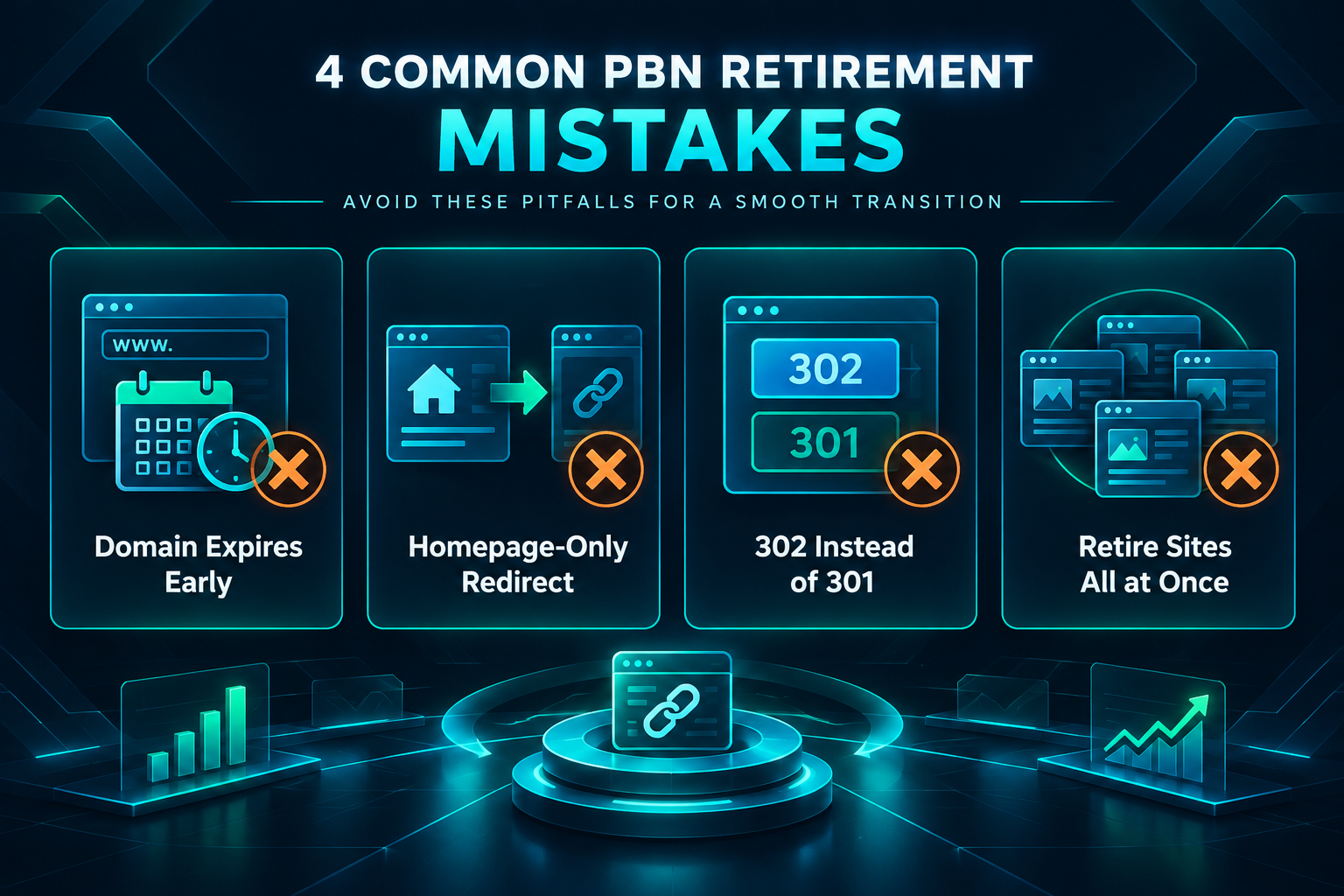
Another frequent mistake is redirecting the retiring domain to the money site’s homepage rather than to the specific page the original link was pointing to. A page-level redirect to the most relevant destination is generally more effective than a blanket domain-level redirect to a homepage, particularly when the retiring site’s content was topically specific. Match the redirect destination to the content context of the original placement where possible.
Failing to verify the redirect’s HTTP status code is also a common oversight. A misconfigured redirect that returns a 302 temporary redirect instead of a 301 permanent redirect may not transfer link equity as intended. Use a tool such as Screaming Frog or an online HTTP header checker to confirm the status code before considering the retirement complete.
Finally, do not retire multiple PBN sites simultaneously without staggering the process. Retiring several link sources at once can create a sudden drop in the money site’s referring domain count, which may be more noticeable in rankings than a gradual, managed transition. Spacing retirements over several weeks gives search engines time to process each change and reduces the cumulative impact on the money site’s link profile.
Frequently Asked Questions
How long does it take for a 301 redirect to transfer link equity after a PBN site is retired?
There is no fixed timeline. Search engine crawlers need to recrawl the retiring domain’s URLs and process the redirect before any signal transfer occurs. This can take anywhere from a few days to several weeks depending on the domain’s crawl frequency and the crawler’s schedule. Keeping the hosting active during this period ensures the redirect remains accessible throughout the transition.
Will a 301 redirect from a retired PBN domain pass the same amount of link equity as the original live link?
Not necessarily. Google has indicated that 301 redirects can pass link signals, but the exact amount is not publicly quantified and may vary depending on the quality of the redirecting domain, the relevance of the destination, and the number of redirect hops involved. A direct live link on an indexed page is generally considered more straightforward than a redirected signal, which is why migrating the placement to a new PBN property is sometimes preferred over a redirect-only approach.
Should I disavow the retiring PBN domain’s link before taking the site offline?
Disavowing a link from your own PBN site is not a standard step in a retirement process and would actively remove the link signal you are trying to preserve. Disavowal is a tool for addressing unwanted inbound links to your money site, not for managing links you control. There is no general requirement to disavow PBN links during retirement.
Can I reuse a retired PBN domain for a new site in the same network?
Yes, if the domain’s backlink profile and authority metrics are still intact after retirement, it can be repurposed as the foundation for a new PBN property. The domain’s historical topical relevance and link history are the key factors to assess before rebuilding on it. A domain that has retained its referring domains and has a clean indexing history is generally a stronger candidate for reuse than one that has lost most of its links or has been deindexed.
What happens to the money site’s rankings if I retire a PBN site without any preservation steps?
The outcome depends on how significant that link was to the money site’s overall backlink profile and how competitive the target keyword is. For sites with diverse link portfolios, the impact may be minimal. For sites that relied heavily on a small number of PBN placements, an unmanaged retirement can contribute to a measurable ranking decline over time as search engines stop counting the lost link. The degree and speed of any change varies and cannot be predicted with certainty without knowing the specific site and competitive landscape.
Is it worth keeping a retired PBN domain registered if I am not planning to use it again?
If the domain still carries a meaningful backlink profile and its metrics are intact, retaining the registration for at least one additional year while you decide on its future use is generally worthwhile. The cost of renewal is typically low relative to the potential value of the domain as a network asset or as an aged domain for sale. If the domain’s link profile has deteriorated significantly, the case for renewal is weaker.
Planning Your PBN Site Retirement to Protect Link Equity
Retiring a PBN site is a routine part of managing a private blog network over time. Domains age, hosting arrangements change, content strategies evolve, and network consolidation is sometimes necessary. The difference between a retirement that preserves link equity and one that wastes it comes down to preparation: auditing the domain before taking action, choosing the right preservation method for the situation, implementing redirects or content migrations correctly, and monitoring the money site’s backlink profile and rankings through the transition.
A 301 redirect is the most practical option for most retirements, provided the domain’s registration is maintained long enough for crawlers to process the change and the redirect is configured to return the correct HTTP status code. Content migration to a new PBN property is a stronger option when you want to keep a live contextual link rather than rely on redirect signal transfer. In either case, the retiring domain itself may retain value as a network asset, and the decision to let it lapse or repurpose it deserves the same consideration as the original acquisition decision.
If you are managing a network of PBN sites and want to assess the quality of your current placements, review domain metrics before retirement, or plan a link migration that protects your money site’s rankings, PBN Backlinks Service can help you evaluate your options and structure a transition that minimizes unnecessary link loss.