

Managing a private blog network for a single website is straightforward enough, but scaling that operation across multiple clients introduces a distinct set of organisational, technical, and strategic challenges. Agencies, freelance SEO specialists, and in-house teams running PBN campaigns for several clients simultaneously need clear systems for separating assets, tracking placements, controlling footprint exposure, and reporting results without letting one client’s campaign bleed into another’s. This guide covers the practical frameworks and decision factors that make multi-client PBN management workable at scale.
Key Takeaways
- Strict asset separation between clients is the foundation of sustainable multi-client PBN management, covering hosting, domains, content, and link records.
- A centralised placement tracking system prevents duplicate link assignments, anchor text conflicts, and reporting errors across campaigns.
- Footprint control becomes more complex when one network serves multiple clients; deliberate variation in hosting, CMS configuration, and content style reduces shared signals.
- Client reporting should distinguish placement delivery, indexing status, and observable ranking changes as separate milestones rather than treating publication as a guaranteed outcome.
- Scaling a PBN operation requires documented workflows and regular domain health audits to maintain network quality as the number of active campaigns grows.
Why Multi-Client PBN Management Requires a Dedicated System
A private blog network used for a single project can be managed informally, with placements tracked in a basic spreadsheet and domains reviewed on an ad hoc basis. Once the same network serves three, five, or ten clients, informal management creates compounding problems. Duplicate placements on the same PBN domain for competing clients, inconsistent anchor text ratios, missed indexing checks, and unclear ownership of each domain’s link history all become realistic failure points. A dedicated management system is not optional at this scale; it is the mechanism that keeps individual campaigns coherent and prevents one client’s link strategy from interfering with another’s.
The core requirement is separation. Each client’s campaign should have its own clearly defined pool of PBN domains, its own placement log, its own anchor text record, and its own reporting cadence. This separation applies even when the underlying network infrastructure is shared, because the link strategy for a local service business differs substantially from the strategy for a national e-commerce site or an affiliate publisher. Mixing placement records or reusing domains across competing clients in the same niche creates both strategic conflicts and footprint risks that are difficult to unwind later.
Organising the Network: Domain Pools and Client Assignment
The most practical starting point for multi-client PBN management is a domain pool structure. Rather than assigning every available PBN domain to a single client, the network is divided into logical groups based on topical relevance, domain authority metrics, and niche alignment. A domain with a strong backlink history in the health and wellness space is a better fit for a client in that vertical than for a client running a SaaS comparison site, regardless of raw domain rating or trust flow scores.
Domain assignment should be documented before any placement is made. A master domain registry that records each PBN domain’s topical category, current assigned client or clients, number of outbound links, anchor text already used, and last indexing check date gives the campaign manager a single reference point for every placement decision. This registry prevents the common error of placing a second link to a different client on a domain that has already reached a sensible outbound link threshold, and it makes it straightforward to audit which domains are underutilised and which are carrying too many placements.
When a PBN domain is genuinely topically neutral, it may be suitable for placements across multiple clients in unrelated niches, provided the outbound link count remains reasonable and the content surrounding each placement is contextually appropriate. Placing links to a legal services client and a fitness supplement client on the same PBN page is unlikely to serve either campaign well from a topical relevance standpoint, even if the domain’s authority metrics are strong. Keeping placements contextually coherent on each PBN page is a quality consideration that applies regardless of how many clients the network serves.
Footprint Control Across a Shared Network
Footprint management is one of the more technically demanding aspects of running a PBN for multiple clients. A footprint, in this context, refers to any pattern of shared signals across PBN domains that could allow a search engine or a competitor’s analysis to identify the sites as part of a coordinated network. Common footprint signals include shared hosting IP ranges, identical CMS themes or plugin configurations, similar WHOIS registration patterns, and content that follows an obvious template across multiple domains.
When a network serves only one client, footprint exposure primarily affects that client’s campaign. When the same network serves multiple clients, a footprint that becomes visible through competitor analysis or search engine evaluation potentially affects every campaign simultaneously. This raises the stakes for footprint control and makes deliberate variation more important, not less, as the network scales.
Practical footprint reduction for a multi-client network typically involves distributing domains across different hosting providers and IP ranges, using varied CMS configurations and themes rather than a single template, ensuring that content on each PBN site reflects the domain’s historical topic rather than a generic article format, and staggering domain registration and renewal patterns where possible. None of these measures eliminates the underlying policy consideration that search engines have stated positions on link schemes, but they do reduce the likelihood that a single shared signal connects all client campaigns to the same infrastructure.
It is worth being precise about what footprint control achieves and what it does not. Reducing obvious shared signals improves the independence of each PBN domain as an asset, but no configuration choice makes a paid link placement equivalent to an independently earned editorial link in terms of search engine policy. The goal of footprint management in a multi-client context is operational quality and campaign independence, not a claim of policy compliance.
Anchor Text Strategy Across Multiple Campaigns
Anchor text management becomes significantly more complex when one network supports multiple clients. Each client’s target site has its own existing backlink profile, its own branded anchor distribution, and its own competitive context. The anchor text choices made for one client’s PBN placements should be driven by that client’s profile, not by a generic ratio applied uniformly across all campaigns.
A centralised anchor text log for each client is essential. This log should record every PBN placement made to that client’s site, the anchor text used, the target URL, the PBN domain used, and the date of placement. Over time, this record allows the campaign manager to assess whether the client’s PBN-derived anchor distribution is becoming over-concentrated in exact-match terms, whether branded and partial-match anchors are being used in appropriate proportion, and whether any single target page is receiving a disproportionate share of placements.
A common error in multi-client PBN management is applying the same anchor text template to every campaign because it simplifies the workflow. Clients in competitive niches with thin existing backlink profiles require a different anchor approach than clients with established authority sites and diverse existing link profiles. The anchor text strategy should be set per client based on a review of that client’s current profile, the target page’s existing anchor distribution, and the competitive landscape for the target keywords.
Placement Tracking and Campaign Reporting
Accurate placement tracking is the operational backbone of multi-client PBN management. Without a reliable record of which PBN domains have been used for which clients, at which URLs, with which anchors, and on which dates, it becomes impossible to manage anchor ratios, avoid duplicate placements, or produce credible client reports.
A placement tracking system for a multi-client operation should capture at minimum: the client name, the target URL receiving the link, the PBN domain providing the link, the anchor text used, the publication date, the indexing status of the PBN page, and the last date the link was verified as live. Many agencies use a combination of a structured spreadsheet and a backlink monitoring tool such as Ahrefs or Majestic to cross-reference placement records against what is actually crawlable and indexed.
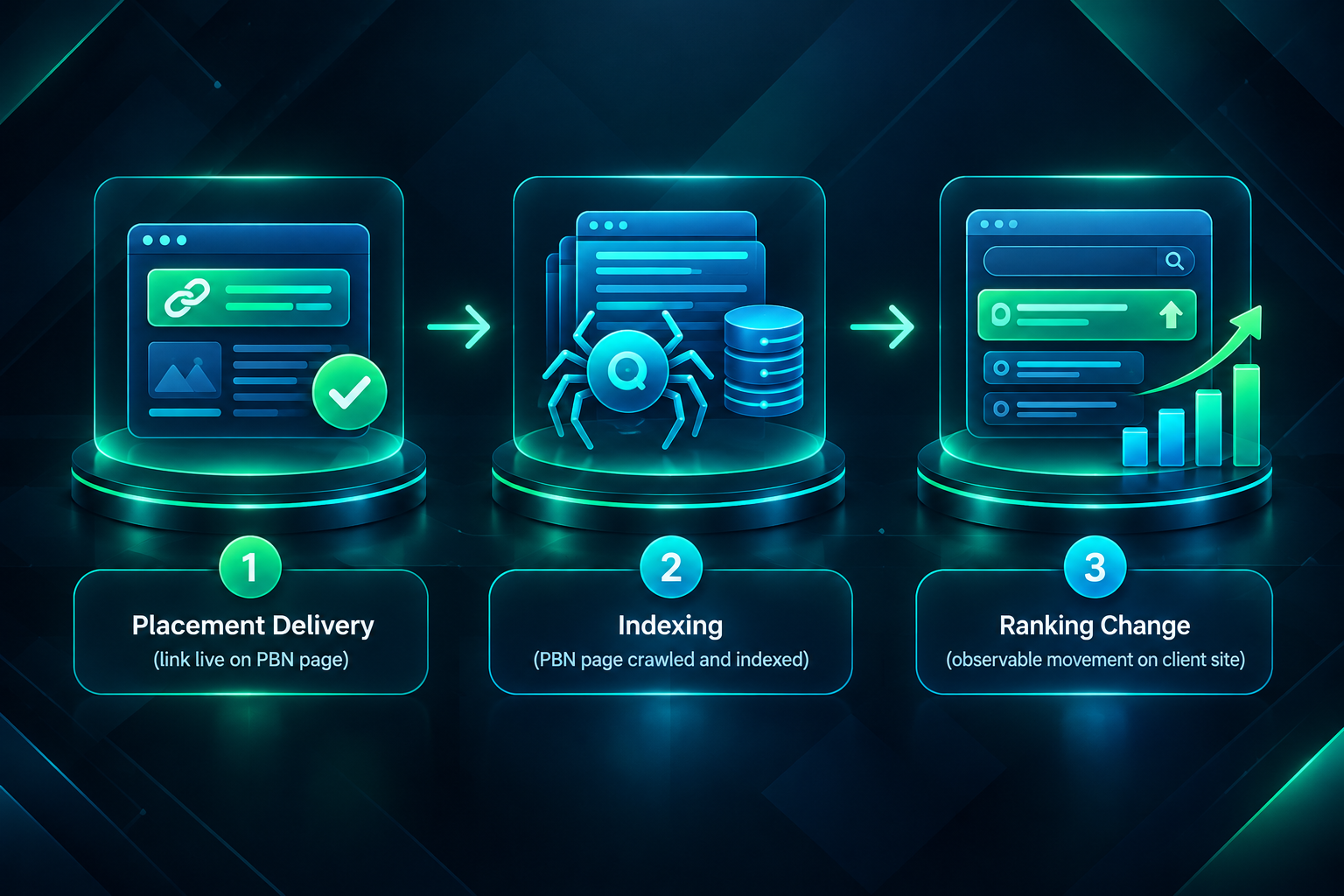
Client reporting should be structured to distinguish between three separate milestones: placement delivery, meaning the link is live on the PBN page; indexing, meaning the PBN page containing the link has been crawled and indexed by the search engine; and observable ranking or traffic changes on the client’s target site. These are distinct events with different timelines, and conflating them creates unrealistic client expectations. A link that is live but not yet indexed has not yet had the opportunity to influence rankings. A link that is indexed may take additional weeks before any ranking movement becomes measurable, and the degree of movement will depend on the client’s overall SEO situation, not solely on the PBN placement.
Domain Health Audits and Network Maintenance
A PBN domain that was a strong asset when it was acquired can deteriorate over time if its referring domains drop, if the domain loses indexed pages, or if the content on the site becomes stale or technically problematic. In a multi-client network, a deteriorating domain affects every client whose campaign includes a placement on that domain. Regular domain health audits are therefore a maintenance requirement, not an optional quality check.
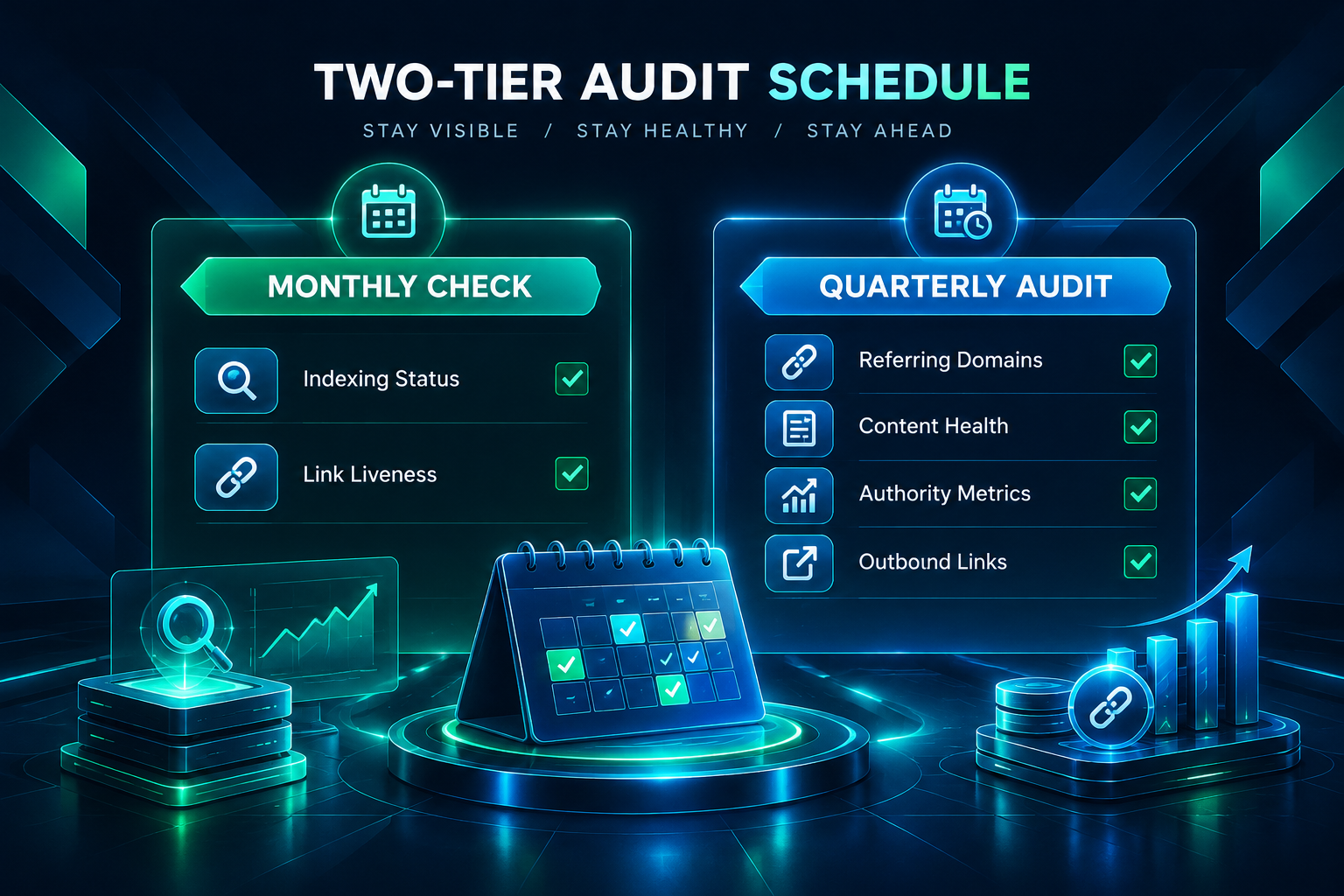
A domain health audit for a PBN site in a multi-client network should review: whether the domain’s key referring domains are still active and indexed; whether the domain itself remains indexed in the search engine; whether the content on the domain is still accessible and rendering correctly; whether the outbound links from the domain, including client placements, are still live; and whether the domain’s third-party authority metrics such as domain rating in Ahrefs or trust flow in Majestic have changed materially since the last review.
Audit frequency depends on the size of the network and the number of active campaigns. A practical approach for a network serving multiple clients is to conduct a full domain audit on a quarterly basis, with a lighter monthly check focused on indexing status and link liveness. Domains that show significant metric decline, loss of referring domains, or indexing problems should be flagged for review before new placements are made on them, and clients with existing placements on those domains should be informed if the domain’s status changes materially.
Workflow Documentation and Team Coordination
As a multi-client PBN operation grows, the management workload typically exceeds what one person can handle reliably without documented processes. Workflow documentation serves two purposes: it ensures consistency across campaigns regardless of who is executing a given task, and it creates an audit trail that makes quality control and error correction straightforward.
Core workflows that benefit from documentation in a multi-client PBN operation include: the domain acquisition and vetting process, covering the criteria used to assess a domain’s suitability before it is added to the network; the client onboarding process, covering how a new client’s target URLs, anchor preferences, and campaign goals are recorded; the placement process, covering how a domain is selected for a given client, how content is created or sourced, and how the placement is recorded; the indexing verification process, covering how and when PBN pages are checked for indexing after publication; and the reporting process, covering how placement data is compiled and communicated to the client.
When a team of writers, outreach coordinators, or technical staff is involved, role-specific documentation prevents the situation where a writer publishes content on a PBN domain without knowing that the domain has already reached its outbound link threshold for a given client, or where a coordinator assigns a domain to a new client without checking the existing placement log. Clear role boundaries and a shared reference system reduce these errors significantly.
Scaling Considerations: When to Expand the Network
A network that was adequate for three clients may become strained when it is asked to serve eight or ten. The signs that a multi-client PBN network needs expansion include: domains approaching their practical outbound link limits, a shortage of topically relevant domains for new client niches, difficulty maintaining content quality across all active PBN sites, and anchor text conflicts where the same domain has already been used for a competing client in the same niche.
Expanding the network through additional domain acquisitions requires the same vetting process applied to the original domains. Expired domains acquired for PBN use should be assessed for historical topical relevance, the quality and diversity of their referring domain profiles, their indexing history, and any signs of previous spam use or manual action history. A domain with strong authority metrics but a history of thin content, aggressive exact-match anchor profiles, or previous repurposing as a link farm is a poor addition to a network serving multiple clients, regardless of its current metric scores.
The decision to expand the network should also account for the ongoing maintenance cost of each additional domain. Every domain added to a multi-client network requires hosting, content, regular health audits, and indexing monitoring. Adding domains faster than the team can maintain them degrades the overall network quality and creates the same operational problems that a structured management system is designed to prevent.
Client Communication and Expectation Management
Clients commissioning PBN placements as part of a broader SEO campaign benefit from clear communication about what the placements are designed to achieve, what the realistic timeline for measurable results looks like, and what factors outside the PBN campaign influence whether rankings improve. This is particularly important in a multi-client context, where the campaign manager is balancing competing priorities and cannot always respond to client inquiries with the same immediacy as a single-client engagement.
A practical approach is to establish a standard reporting cadence for each client at the outset of the campaign, covering placement delivery confirmations, monthly indexing status updates, and quarterly reviews of ranking and traffic data. This structure sets expectations, reduces ad hoc reporting requests, and gives the campaign manager a predictable workflow that scales across multiple clients without requiring constant manual intervention.
Clients should understand that PBN placements are one component of an SEO strategy, and that the ranking impact of any individual placement depends on the client’s overall backlink profile, the competitiveness of the target keywords, the technical health of the client’s site, and the quality of the content on the target pages. Presenting PBN placements as a standalone ranking solution, rather than as a link-building component within a broader strategy, creates expectations that are difficult to meet and that complicate the client relationship when results take longer than anticipated.
Frequently Asked Questions
How many PBN domains should be assigned to each client?
The appropriate number of PBN domains per client depends on the client’s target keyword competitiveness, the existing strength of their backlink profile, and the campaign goals. There is no universal figure. A new site targeting moderately competitive keywords may benefit from a modest initial placement set, while an established site competing in a high-authority niche may require a larger and more sustained placement programme. A review of the client’s current profile and competitive landscape should inform the placement volume rather than a fixed formula.
Can the same PBN domain be used for two different clients?
A single PBN domain can carry links to more than one client site, provided the clients are in unrelated niches, the outbound link count on the domain remains reasonable, and the content surrounding each placement is contextually appropriate. Using the same domain for two clients competing in the same niche or targeting the same keywords is generally inadvisable, as it creates a direct connection between competing campaigns and reduces the topical relevance of each placement.
How should indexing problems on PBN pages be handled in a multi-client context?
If a PBN page containing a client placement is not indexed within a reasonable period after publication, the first step is to verify that the page is technically accessible and that the domain itself remains indexed. Common causes of indexing delays include thin content, crawl budget issues on the PBN domain, or a recently acquired domain that has not yet been fully recrawled. If the domain remains unindexed after standard troubleshooting, the placement should be flagged in the tracking system and the client informed. A replacement placement on a different domain may be appropriate depending on the campaign agreement.
What is the best way to track anchor text across multiple client campaigns?
A per-client anchor text log maintained alongside the placement tracking system is the most reliable approach. Each entry should record the anchor text used, the target URL, the PBN domain, and the date. Periodically cross-referencing this log against a backlink analysis tool such as Ahrefs or Majestic allows the campaign manager to verify that the recorded placements match what is actually indexed and to assess whether the anchor distribution for each client remains within a sensible range given their existing profile.
How often should PBN domain health be audited in a multi-client network?
A quarterly full audit combined with a monthly lighter check of indexing status and link liveness is a practical cadence for most multi-client networks. Networks with a large number of active domains or clients in competitive niches may benefit from more frequent checks. The priority is to identify domain deterioration before it affects active client campaigns, so that placements can be replaced or supplemented before ranking impact becomes visible.
Should clients be told their links are coming from a PBN?
This is a business and contractual decision rather than a purely technical one. Some agencies operate transparently with clients about the link-building methods used, while others provide placements as part of a broader service without specifying the source network. The important consideration is that the campaign agreement accurately reflects what is being delivered, and that clients have a realistic understanding of the link-building approach being used on their behalf. Misrepresenting PBN placements as independently earned editorial links creates both ethical and contractual problems that are separate from the SEO considerations.
Building a Scalable Multi-Client PBN Operation
Managing PBN sites for multiple clients is fundamentally an organisational challenge as much as a technical one. The quality of the individual domains, the relevance of each placement, and the coherence of each client’s anchor text strategy all matter, but they only produce consistent results when supported by documented workflows, reliable tracking systems, and regular maintenance routines. Without these operational foundations, even a network built on strong expired domains with well-researched content will produce inconsistent outcomes as the number of active campaigns grows.
The practical priorities for any agency or specialist looking to scale a multi-client PBN operation are clear domain pool organisation with per-client assignment records, a centralised placement and anchor text tracking system, deliberate footprint variation across the network, regular domain health audits, and a client reporting structure that accurately represents what has been delivered and what results are realistically measurable. These are not one-time setup tasks; they are ongoing operational requirements that determine whether the network remains a reliable asset or becomes an increasingly difficult liability to manage.
If you are evaluating how PBN placements might fit into a multi-client link-building programme, or if you need a structured approach to domain selection and placement quality for your campaigns, PBN Backlinks Service can help you assess the options and identify a workable strategy for your specific client mix and campaign goals.