

A lapsed PBN domain can unravel months of link-building work in a matter of days. When a domain expires and drops, the backlinks it carries disappear, any accumulated authority metrics reset, and the domain becomes available for anyone to register — including competitors or domain investors who may repurpose it in ways that conflict with your SEO goals. Preventing missed renewals is therefore one of the most operationally important aspects of managing a private blog network, yet it is often treated as an afterthought until something goes wrong.
Key Takeaways
- Missed PBN domain renewals cause immediate link loss, authority metric resets, and potential domain hijacking by third parties.
- Centralizing domain registration across as few registrars as practical and enabling auto-renewal with a reliable payment method is the most effective baseline protection.
- A dedicated renewal calendar with layered alerts — at 90, 60, 30, and 7 days before expiry — reduces the risk of a domain lapsing due to overlooked notifications.
- Registrar-level expiry monitoring tools and third-party domain management platforms can automate much of the tracking workload for larger PBN portfolios.
- Recovering a dropped PBN domain through a redemption period or aftermarket auction is possible but costly and not guaranteed, making prevention significantly more practical than recovery.
Why Domain Expiry Is a Serious Risk for PBN Operators
PBN domains are not interchangeable assets. Each domain in a private blog network typically carries a specific backlink profile, topical history, and authority metric profile that took time and money to acquire — whether through an expired domain auction, a direct purchase, or a manual outreach process. When that domain lapses, the links it hosts to your target pages stop passing any value, and the domain itself enters a grace period before becoming publicly available again. The practical consequence is that a single missed renewal can eliminate a meaningful portion of a carefully constructed link profile.
Beyond the immediate link loss, a dropped PBN domain creates a secondary risk: domain hijacking. Once a domain clears its redemption period and re-enters the open market, it can be registered by anyone. If a competitor, a domain investor, or a spam operator picks it up, the domain’s future content and link profile become entirely outside your control. In some cases, a re-registered domain may be used in ways that could create an unwanted association with your target site’s backlink history, depending on how crawlers and indexing systems process the transition.
For SEO agencies and affiliate publishers managing PBN portfolios at scale, the cumulative risk multiplies with every domain added to the network. A portfolio of twenty or thirty domains spread across multiple registrars, with varying registration dates and renewal cycles, creates a genuinely complex tracking problem if managed manually.
The Most Common Causes of Missed Renewals
Understanding why renewals get missed is the first step toward building a system that prevents them. The causes tend to cluster around a few recurring patterns rather than isolated incidents.
Fragmented registrar accounts are one of the most frequent contributors. PBN operators often acquire domains opportunistically — from auctions, expired domain marketplaces, and direct registrations — which means domains end up spread across GoDaddy, Namecheap, Dynadot, NameSilo, Porkbun, and other registrars simultaneously. Each registrar sends renewal notices to a different email address, uses a different interface, and applies different grace period rules. Without a consolidated view, it is easy for a renewal notice to be filtered as spam, sent to an outdated email address, or simply overlooked in a busy inbox.
Payment method failures are the second most common cause. Auto-renewal is only as reliable as the payment method attached to the account. An expired credit card, a declined transaction due to a billing address mismatch, or a PayPal account with insufficient funds can silently disable auto-renewal without triggering an obvious alert. Many registrars send a payment failure notice, but if that notice goes to an unmonitored inbox, the domain can lapse before the problem is identified.
Outdated contact information compounds both problems. If the email address registered with a domain registrar account is no longer actively monitored — because a team member left, an agency email alias was retired, or a personal address was changed — renewal notices simply disappear. This is particularly common in agencies where domain portfolios are managed by individuals who later move on.
Irregular renewal cycles create additional complexity. Domains registered for one year, two years, or five years have different expiry dates, and a domain registered in a burst of acquisitions may have a cluster of renewals falling in the same month, making it easy to miss one in the group.
Building a Reliable Renewal Management System
Preventing missed PBN domain renewals requires a layered system rather than a single safeguard. No individual measure is completely reliable on its own, but combining several overlapping controls reduces the probability of a lapse to near zero for most portfolios.
Consolidate Domains Across Fewer Registrars
Reducing the number of registrars in use is the single most impactful structural change for most PBN operators. Managing renewals across two or three registrar accounts is substantially easier than managing them across eight or ten. When acquiring new domains, prioritize registrars that offer bulk renewal management, clear expiry dashboards, and reliable auto-renewal systems. Migrating existing domains through a transfer process takes time and incurs a transfer fee, but the operational simplification is often worth the cost for portfolios above fifteen to twenty domains.
It is worth noting that PBN footprint considerations sometimes lead operators to distribute domains across multiple registrars deliberately, on the assumption that a single registrar creates a detectable ownership pattern. If registrar diversity is part of your network management strategy, the consolidation approach needs to be balanced against that consideration. In practice, a middle ground — using three to five registrars with clear account management for each — tends to be workable for most network sizes.
Enable Auto-Renewal With a Dedicated Payment Method
Auto-renewal should be enabled for every domain in the portfolio as a baseline setting, not an optional feature. The critical supporting step is attaching a dedicated, reliable payment method to each registrar account — ideally a credit card used exclusively for domain renewals, with a high enough limit to cover a full year’s renewals in a single billing cycle. Using a dedicated card makes it straightforward to monitor for declined transactions and eliminates the risk of a shared card being cancelled or replaced without the domain account being updated.
Set a calendar reminder to verify the payment method on each registrar account at least once per quarter. This takes a few minutes per account and catches expiring cards before they cause a renewal failure. Some registrars also allow you to add a backup payment method, which provides an additional layer of protection if the primary card is declined.
Create a Centralized Domain Expiry Calendar
A centralized expiry calendar is the operational backbone of renewal management for any PBN portfolio. This can be as simple as a shared spreadsheet with columns for domain name, registrar, registration date, expiry date, auto-renewal status, payment method attached, and a notes field for any domain-specific considerations. The spreadsheet should be updated whenever a domain is acquired, transferred, or renewed.
From this master list, create calendar alerts at four intervals: 90 days before expiry, 60 days before expiry, 30 days before expiry, and 7 days before expiry. The 90-day alert is an early warning that gives time to resolve any payment or account issues without urgency. The 7-day alert is a final check to confirm that auto-renewal has processed or that a manual renewal has been completed. For portfolios managed by a team, assign a named person responsible for acting on each alert level.
Use Domain Portfolio Management Tools
Several third-party platforms are designed specifically to aggregate domain information across multiple registrars and provide centralized expiry monitoring. Tools in this category typically connect to registrar accounts via API or manual import and display all domains, their expiry dates, and renewal status in a single dashboard. Some also send consolidated renewal alerts, which reduces inbox fragmentation compared to receiving separate notices from each registrar.
For larger PBN portfolios — generally above thirty to fifty domains — a dedicated domain management platform can save meaningful time and reduce the cognitive load of tracking renewals manually. Evaluate platforms based on the registrars they support, the reliability of their alert systems, and whether they offer bulk renewal functionality. As with any third-party tool, verify that connecting registrar accounts via API does not create access or security concerns relevant to your network management approach.
Monitor Registrar Notification Emails Actively
Even with auto-renewal enabled, registrar notification emails serve as an important secondary signal. Create a dedicated email address or alias used exclusively for domain registrar accounts, and check it at least weekly. Using a shared team inbox rather than an individual’s personal address reduces the risk of notifications being lost when a team member is unavailable or leaves the organization.
Set up email filters to flag messages from each registrar as high priority, and periodically review the spam or junk folder for that address to catch any misdirected notices. Some registrars send renewal confirmations as well as expiry warnings; reviewing these confirmations provides positive confirmation that auto-renewal has processed successfully rather than relying on the absence of a failure notice.
Handling Domains That Have Already Lapsed
Despite the best systems, a domain occasionally slips through. Understanding the recovery options and their limitations helps you respond quickly if a lapse occurs.
Most registrars provide a grace period of between 0 and 45 days after the expiry date during which the domain can be renewed at the standard renewal price. The grace period length varies by registrar and by the domain’s top-level domain (TLD). During this window, the domain is typically suspended — meaning the website goes offline and links stop resolving — but the domain has not yet been released to the public. Renewing during the grace period restores the domain and its associated content, though there may be a brief period of downtime that affects crawling and indexing.
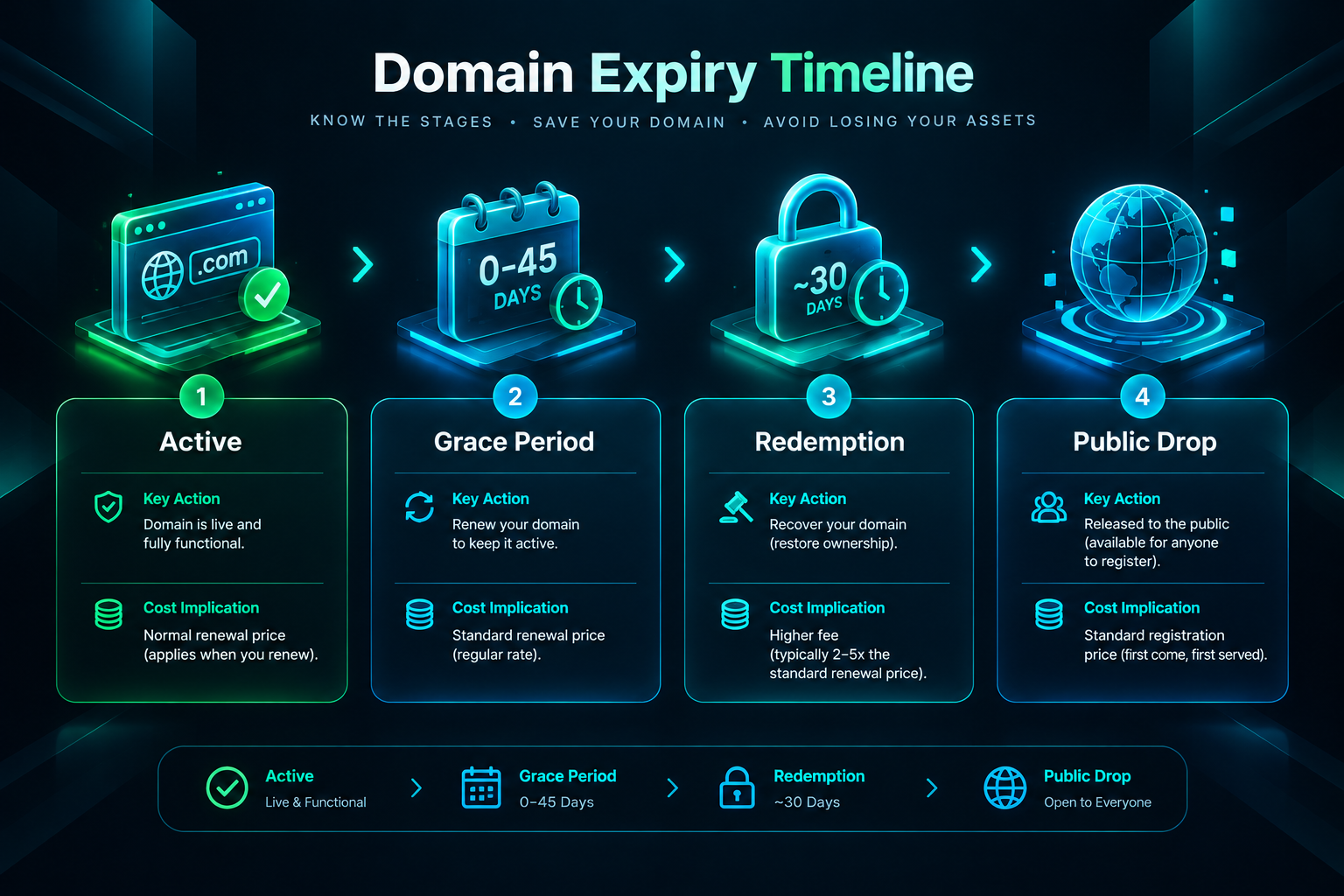
After the grace period, many registrars move the domain into a redemption period, which typically lasts 30 days. During redemption, the domain can still be recovered by the original registrant, but the cost is substantially higher — often between $80 and $200 or more depending on the registrar and TLD — because the registrar charges a redemption fee on top of the standard renewal price. If the domain is not recovered during redemption, it is released for general registration, at which point anyone can register it.
If a domain has already dropped and been re-registered by a third party, recovery becomes significantly more difficult. Options include contacting the new registrant to negotiate a purchase, monitoring the domain for future expiry through a backorder service, or accepting the loss and replacing the domain with a comparable alternative. None of these options is as straightforward or cost-effective as preventing the lapse in the first place.
Protecting Domain Value During Renewal Management
Renewal management is not only about preventing expiry — it is also about maintaining the conditions that make a PBN domain valuable over time. Several practices support this broader goal alongside the renewal tracking system.
Keep WHOIS and registrant contact information current. Outdated registrant details can complicate domain recovery if a dispute arises, and some registrars use the registrant email address as a fallback for renewal notices. Review and update contact information annually as part of the renewal management process.
Document the domain’s SEO profile at acquisition. Recording the referring domain count, topical relevance, anchor text distribution, and key authority metrics at the time of purchase gives you a baseline for monitoring changes over time. If a domain’s backlink profile degrades significantly between renewals — due to referring domains dropping their links or the domain being deindexed — that information is relevant to the renewal decision. Not every domain in a portfolio will remain equally valuable indefinitely, and renewal management should include a periodic review of whether each domain continues to justify its renewal cost.
Stagger multi-year registrations strategically. Registering domains for two or three years at a time reduces the frequency of renewal events and lowers the risk of a lapse due to an overlooked annual cycle. It also locks in the current registration price, which can be a modest cost saving if registrar pricing increases. The trade-off is a larger upfront cost and a longer commitment to domains that may later prove less useful to the network.
Renewal Management for Agencies and Multi-Client PBN Portfolios
SEO agencies managing PBN domains on behalf of multiple clients face an additional layer of complexity: domains may be registered under different account holders, billed to different payment methods, and subject to different client renewal approval processes. A missed renewal in this context can affect a client’s campaign without the agency being immediately aware of the problem.
Agencies benefit from establishing a standardized onboarding process for every new domain that includes: registering the domain under a centralized agency account where possible, enabling auto-renewal immediately, adding the domain to the master expiry calendar, and documenting the client association and campaign context. A monthly renewal audit — reviewing all domains expiring in the next 90 days — provides a structured opportunity to catch any gaps before they become urgent.
For client-owned domains where the agency manages the SEO but does not control the registrar account, establish a clear communication protocol with the client for renewal approvals. This might include a quarterly renewal report listing all upcoming expiry dates and the actions required, with a defined lead time for client approval before auto-renewal or manual renewal is processed.
Frequently Asked Questions
What happens to PBN backlinks when a domain expires?
When a PBN domain expires and its hosting lapses, the website goes offline and the links it hosts stop resolving. Search engine crawlers that attempt to follow those links will encounter errors rather than live pages, and over time the links will be treated as broken or removed from the crawled link graph. The practical effect is that any ranking contribution those links were providing to target pages may diminish as the links are no longer accessible. Renewing the domain and restoring the site during the grace period can restore the links, though there may be a temporary crawling gap during the downtime.
How long is the grace period after a domain expires?
Grace period length varies by registrar and by the domain’s top-level domain. For most generic TLDs such as .com, .net, and .org, the grace period is typically between 0 and 45 days, during which the domain can be renewed at the standard price. After the grace period, a redemption period of approximately 30 days may apply, during which recovery is possible but at a significantly higher cost. These timelines are not universal — some registrars have shorter grace periods, and some TLDs have different rules — so checking the specific terms for each registrar and TLD in your portfolio is advisable.
Is it worth paying the redemption fee to recover a lapsed PBN domain?
Whether the redemption fee is justified depends on the domain’s value to the network. A domain with a strong, topically relevant backlink profile, a clean history, and meaningful authority metrics may well be worth a redemption fee of $100 to $200 if replacing it with a comparable domain would cost more in acquisition time and price. A domain with a weaker profile or one that has already been partially deindexed may not justify the cost. Evaluate the domain’s current referring domain count, the quality of those referring domains, and its role in the network before committing to a redemption payment.
Should PBN domains be registered under the same registrar account?
Centralizing domains under fewer registrar accounts simplifies renewal management significantly, but some PBN operators prefer to distribute domains across multiple registrars to reduce ownership footprint concentration. The practical approach for most portfolios is to use a small number of registrars — enough to provide some distribution — while keeping the total number of accounts manageable. The renewal management system should be designed around whichever registrar structure you use, with clear account documentation and consistent auto-renewal settings across all accounts.
How often should I audit my PBN domain renewal calendar?
A monthly audit of domains expiring in the next 90 days is a practical cadence for most portfolios. This gives enough lead time to resolve payment issues, update contact information, or make renewal decisions for domains whose value may have changed. For very large portfolios, a weekly review of the 30-day expiry window provides an additional safety check. The audit should confirm that auto-renewal is active, the attached payment method is valid, and the domain’s hosting and content are functioning correctly.
Can I use a domain backorder service as a safety net for PBN domains?
Domain backorder services allow you to place a request to register a domain the moment it becomes available after dropping. This can serve as a last-resort safety net if a domain lapse is discovered after the redemption period has ended. However, backorder services are not guaranteed — if multiple parties have placed backorders on the same domain, the outcome may be determined by an auction — and the domain may be registered by another party before your backorder is processed. Backorders are a useful contingency but should not replace a proactive renewal management system.
Building a Renewal System That Protects Your PBN Investment
Preventing missed PBN domain renewals is fundamentally a systems problem, not a technical one. The domains themselves do not require complex maintenance — they require consistent, organized attention at predictable intervals. The operators who lose domains to expiry are almost always those who rely on a single safeguard, such as registrar email notifications alone, rather than a layered system that catches failures at multiple points.
The practical foundation is straightforward: consolidate registrar accounts where your network management approach allows, enable auto-renewal with a dedicated and monitored payment method, maintain a centralized expiry calendar with alerts at multiple intervals, and conduct a monthly audit of upcoming renewals. For agencies and larger portfolios, adding a domain management platform and a standardized client communication protocol extends this foundation to cover the additional complexity of multi-account and multi-client environments.
The cost of a missed renewal — in lost links, recovery fees, or permanent domain loss — is almost always higher than the time investment required to maintain a reliable renewal system. Treating domain renewal management as a core operational discipline, rather than an administrative afterthought, is one of the most straightforward ways to protect the value of a PBN portfolio over the long term. If you are building or expanding a private blog network and want to discuss domain acquisition, portfolio structure, or backlink strategy, the team at PBN Backlinks Service can help you assess your requirements and identify domains suited to your campaign goals.