

Managing XML sitemaps across a private blog network requires a different approach than managing a single website. Each PBN site operates as a standalone property, which means sitemap generation, submission, and ongoing maintenance must be handled individually while following a consistent process across the network. Getting this right helps search engine crawlers discover and index your PBN content efficiently, which is a prerequisite for any link placement to be crawled and potentially pass value to your target pages.
Key Takeaways
- Each PBN website needs its own XML sitemap generated, submitted, and monitored independently through its respective webmaster tools account.
- Sitemap plugins such as Yoast SEO or Rank Math can automate sitemap generation on WordPress-based PBN sites, but default settings often need adjustment to exclude low-value or duplicate URLs.
- Submitting sitemaps through Google Search Console and Bing Webmaster Tools helps crawlers discover new content and link placements faster than relying on passive crawl discovery alone.
- Sitemap management is one component of PBN indexing strategy; internal linking, crawl budget, and content quality also affect whether pages containing link placements get indexed.
- Periodic sitemap audits help identify orphaned pages, excluded URLs, and crawl errors that may prevent link placement pages from being indexed.
Why XML Sitemaps Matter for PBN Sites
An XML sitemap is a structured file that lists the URLs on a website and provides metadata such as last modification date and update frequency. Search engine crawlers use sitemaps as a discovery signal, not a crawl guarantee, but submitting an accurate sitemap can meaningfully reduce the time between content publication and indexing. For a PBN site, this matters because a link placement on a page that has not been indexed contributes nothing to the target URL until the crawler has processed it.
PBN websites often have relatively modest link profiles and lower crawl frequency compared to established authority sites. This makes sitemap submission more valuable, not less, because passive crawl discovery through backlinks may be slower. A well-structured sitemap signals to the crawler which pages exist, which have been recently updated, and which are the most important, helping allocate crawl budget toward the pages that contain your link placements.
Sitemap management also plays a role in footprint reduction. A PBN site with a poorly configured sitemap that exposes every staging URL, duplicate page, or thin archive may draw unnecessary crawler attention to low-quality content. Configuring sitemaps to include only canonical, indexable, content-rich pages is a practical step toward maintaining a cleaner crawl profile for each network site.
Generating XML Sitemaps on WordPress PBN Sites
Most PBN sites run on WordPress, which makes sitemap generation straightforward using widely available plugins. Yoast SEO, Rank Math, and All in One SEO each generate XML sitemaps automatically and update them when new content is published. The default configuration of these plugins typically includes all public post types, categories, tags, and author pages, which is often more than you need for a PBN site focused on a specific niche.
A practical starting configuration for a PBN WordPress site includes the following adjustments. First, disable sitemap entries for tag archives, author pages, and date-based archives unless those pages contain substantive content. These archive pages are often thin or near-duplicate, and including them in the sitemap can dilute crawl budget without adding indexing value. Second, ensure that the sitemap only includes URLs that return a 200 HTTP status and are set to index in the page’s meta robots settings. Third, if the site uses a noindex directive on certain pages such as privacy policies or contact forms, confirm that those URLs are excluded from the sitemap automatically, which most plugins handle correctly by default.
For non-WordPress PBN sites, sitemap generation can be handled through tools such as Screaming Frog, which can crawl the site and export a sitemap file, or through server-side scripts if the site uses a custom CMS. The resulting sitemap file should be placed at the root of the domain, typically at yourdomain.com/sitemap.xml, and referenced in the site’s robots.txt file with a Sitemap: directive so crawlers can locate it without a manual submission.
Submitting Sitemaps Through Webmaster Tools
Generating a sitemap file is only the first step. Submitting it through Google Search Console and Bing Webmaster Tools gives crawlers a direct signal about the sitemap’s location and prompts faster processing. For a PBN network, this means setting up a separate Search Console property for each domain and submitting the sitemap URL individually.
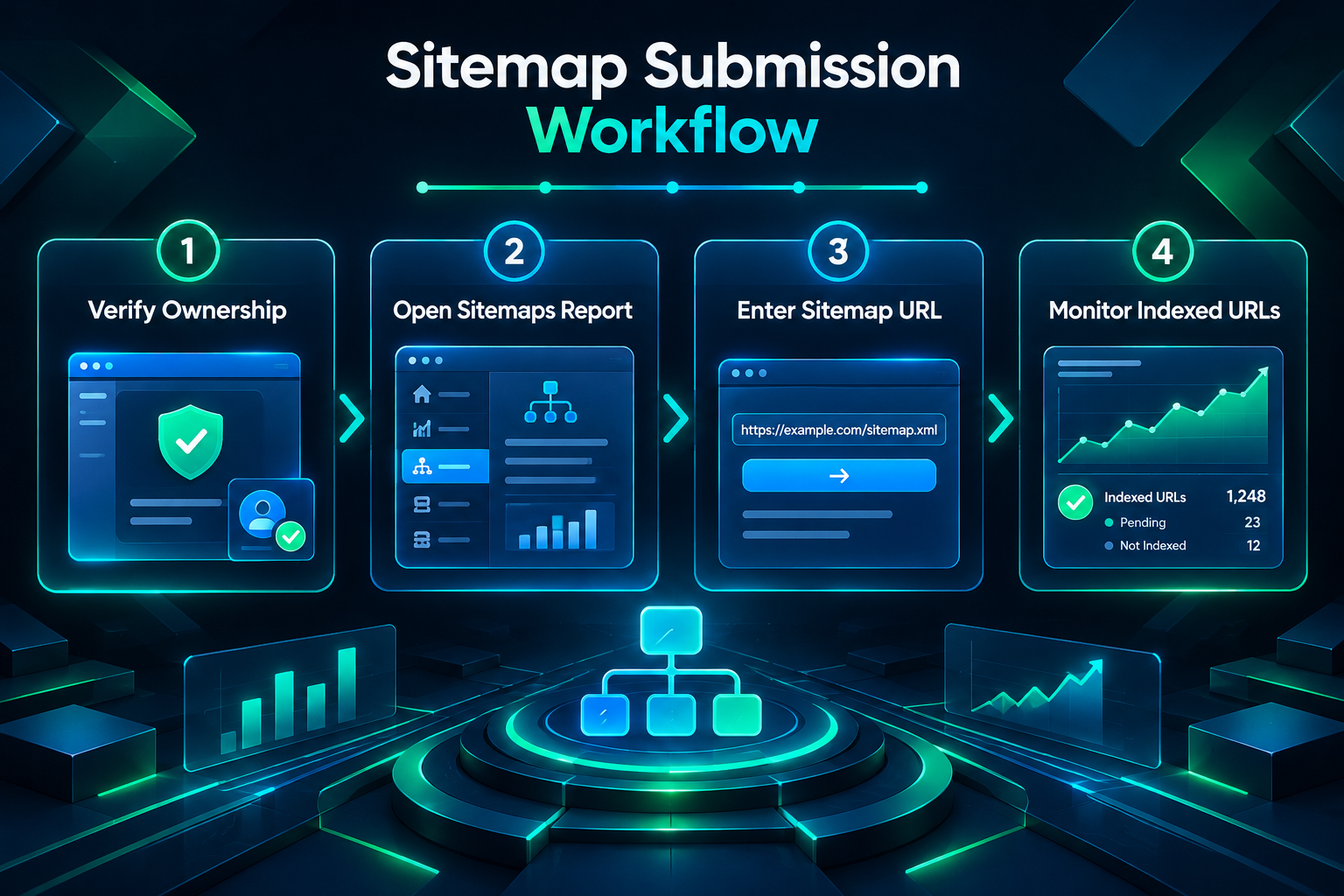
In Google Search Console, sitemap submission is handled through the Sitemaps report within the property. After verifying ownership of the domain, navigate to the Sitemaps section, enter the sitemap URL, and submit. Search Console will then report the number of URLs submitted versus the number indexed, which is a useful diagnostic for identifying pages that are being excluded from the index. Note that Search Console’s interface and available reports may change over time, so refer to current Google documentation for the most accurate navigation steps.
Bing Webmaster Tools offers a similar submission process and is worth including because Bing’s crawler also indexes content that can contribute to overall crawl activity on a domain. Some SEO practitioners find that Bing indexes content faster than Google in certain cases, which can be useful for confirming that a page is accessible before Google processes it.
One practical consideration for PBN network management is the overhead of maintaining separate webmaster tools accounts for each domain. Using a single Google account to manage multiple Search Console properties is possible, but it creates an association between domains that some network operators prefer to avoid. Using separate accounts or delegating access carefully is a network management decision that depends on your operational preferences and footprint considerations.
Sitemap Structure and URL Prioritization
XML sitemaps support optional attributes including lastmod (last modification date), changefreq (how often the page changes), and priority (relative importance within the site). Google has stated publicly that it uses the lastmod attribute when it is accurate and consistent, but largely ignores changefreq and priority as reliable signals. Bing’s treatment of these attributes may differ.
For PBN sites, the most useful attribute to maintain accurately is lastmod. When a page containing a link placement is updated, for example when a new contextual paragraph is added or the surrounding content is refreshed, updating the lastmod value signals to the crawler that the page has changed and may prompt a recrawl. Most WordPress sitemap plugins update this value automatically when a post is edited and saved.
Sitemap index files are useful when a PBN site has a large number of URLs across multiple content types. A sitemap index file references multiple individual sitemap files, each covering a specific content type such as posts, pages, or custom post types. For most PBN sites with a focused content strategy, a single sitemap file is sufficient. Splitting into a sitemap index becomes relevant when the total URL count approaches or exceeds 50,000 URLs, which is the standard per-file limit, or when you want to submit and monitor different content types separately in Search Console.
Crawl Budget and Sitemap Efficiency
Crawl budget refers to the number of URLs a search engine crawler will process on a given site within a specific time period. For smaller PBN sites, crawl budget is rarely a limiting factor, but it becomes relevant when a site has a large number of low-value pages competing for crawler attention with the pages that contain link placements.
Keeping the sitemap lean and accurate is one way to guide crawl budget toward high-value pages. Exclude paginated archive pages beyond the first page, exclude search result pages if they are accessible to crawlers, and exclude any URL that uses a noindex directive. If the PBN site has a significant number of tag or category pages with minimal unique content, excluding those from the sitemap reduces the number of low-value URLs the crawler encounters during a sitemap-guided crawl.
Internal linking also affects crawl efficiency. Pages that are linked from the sitemap but have no internal links pointing to them may be crawled less frequently than pages that are both in the sitemap and linked from other pages on the site. Ensuring that pages containing link placements are linked from the site’s navigation, related posts sections, or other internal anchor points supports more consistent crawl coverage.
Monitoring Sitemap Health Across a PBN Network
Ongoing sitemap monitoring is where many PBN operators fall short. Generating and submitting a sitemap once is not sufficient if the goal is to maintain consistent indexing across the network over time. Pages can fall out of the index due to crawl errors, server issues, accidental noindex directives, or content changes that trigger quality filters. Regular monitoring helps identify these issues before they affect the value of link placements.
The primary monitoring tool for each PBN site is its Search Console property. The Coverage or Indexing report shows which submitted URLs are indexed, which are excluded, and which have errors. Common exclusion reasons include pages marked as noindex, pages with canonical tags pointing elsewhere, pages returning server errors, and pages that Google has chosen not to index despite being crawlable. Reviewing this report periodically, at minimum monthly for active PBN sites, allows you to catch and correct indexing problems promptly.
For network-level monitoring, a spreadsheet or simple tracking system that records the sitemap submission date, the number of submitted URLs, and the number of indexed URLs for each domain provides a useful overview. Significant drops in indexed URL counts for a specific domain can indicate a technical issue, a content quality concern, or a change in how the crawler is treating that site. Investigating the cause promptly is more effective than waiting for ranking signals to reflect the problem.
Third-party tools such as Screaming Frog can be used to audit individual PBN site sitemaps by crawling the sitemap file and checking each URL for status codes, indexability, canonical settings, and meta robots directives. Running this audit after major content updates or plugin changes helps confirm that the sitemap remains accurate and that no configuration change has inadvertently excluded important pages.
Common Sitemap Mistakes on PBN Sites
Several recurring sitemap configuration errors can reduce the effectiveness of PBN link placements. Understanding these helps you avoid them during initial setup and catch them during periodic audits.
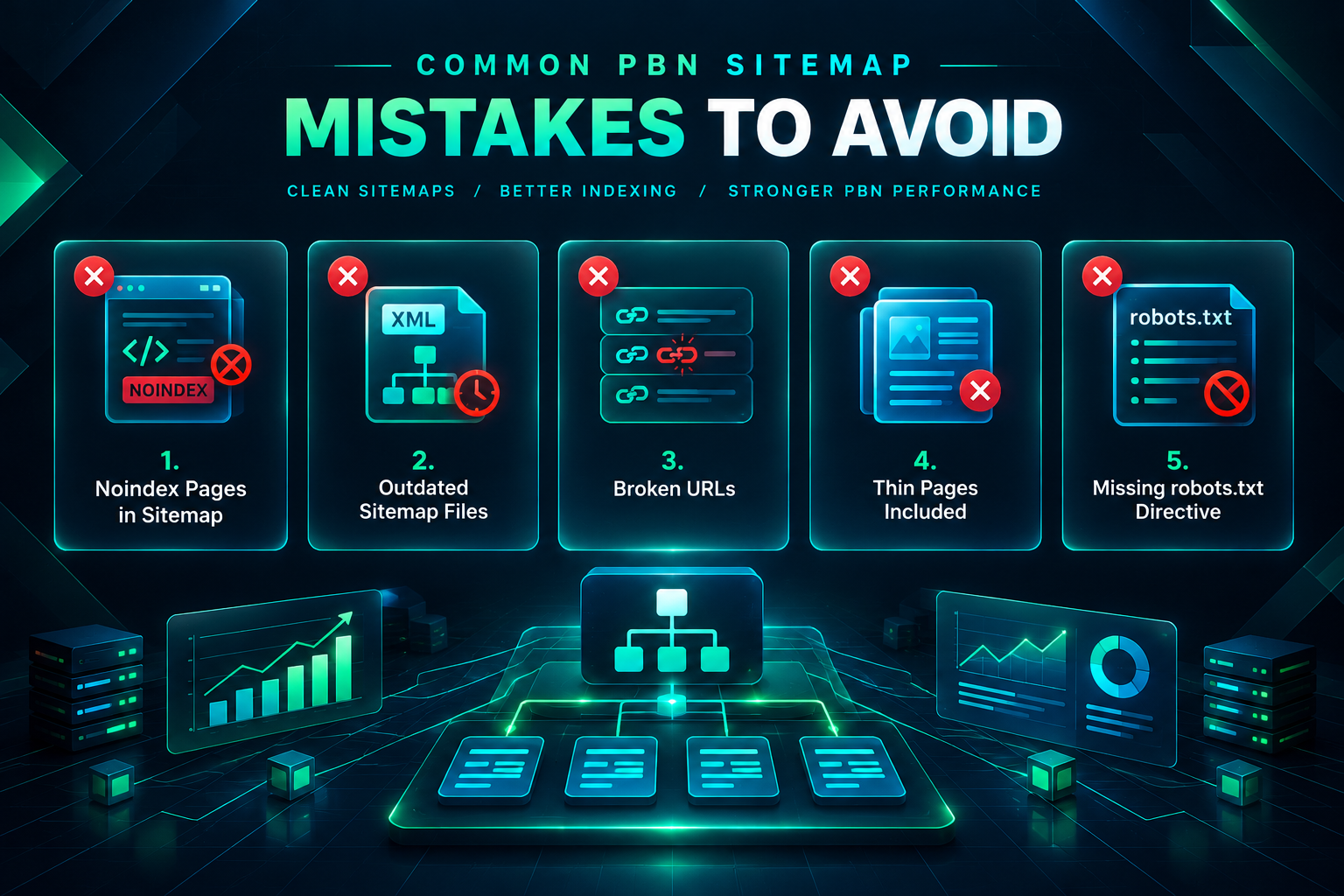
- Including noindex pages in the sitemap: A URL that carries a noindex directive should not appear in the sitemap. Including it sends a contradictory signal and wastes crawl budget. Most sitemap plugins exclude noindex pages automatically, but this should be verified after any plugin update or settings change.
- Outdated sitemap files: If a sitemap plugin is deactivated or a site migration removes the sitemap file without replacing it, the submitted sitemap URL returns a 404 error. Search Console will report this, but it may go unnoticed if the property is not monitored regularly.
- Submitting a sitemap with broken URLs: URLs in the sitemap that return 301 redirects, 404 errors, or 5xx server errors reduce sitemap quality. Crawlers may deprioritize future sitemap-guided crawls if a high proportion of submitted URLs are inaccessible.
- Including low-quality thin pages: Tag archives, author pages, and paginated archives with minimal unique content dilute the sitemap and may draw crawler attention to pages that reflect poorly on the site’s overall content quality.
- Forgetting to update the robots.txt sitemap directive after a domain migration: If a PBN site is moved to a new domain or the sitemap URL changes, the robots.txt file and the Search Console submission both need to be updated to reflect the new location.
Sitemap Management as Part of a Broader PBN Indexing Strategy
XML sitemap management is one component of a broader approach to ensuring that PBN link placements get indexed and remain indexed over time. Sitemap submission accelerates discovery, but it does not override content quality signals, technical accessibility issues, or crawl behavior driven by the site’s overall link profile and authority.
Content quality on the page containing the link placement affects whether the crawler indexes and retains that page. A well-written, topically relevant article that provides genuine informational value is more likely to be indexed and remain indexed than a thin placeholder post. This is a practical consideration when planning content for PBN sites, separate from any policy discussion about link-building methods.
Server reliability also affects indexing. A PBN site hosted on an unreliable server that returns frequent 5xx errors during crawl attempts will accumulate crawl errors in Search Console and may be crawled less frequently over time. Choosing reliable hosting for each PBN site and monitoring uptime is a basic operational requirement that directly affects sitemap effectiveness.
Ping services and indexing APIs are sometimes used alongside sitemap submission to accelerate the indexing of new content. These services notify search engines of new or updated URLs directly. Their effectiveness varies and is not guaranteed, but they can be a useful supplementary step for new PBN sites that have not yet established a regular crawl cadence. Use them as a complement to proper sitemap submission rather than a replacement.
Frequently Asked Questions
How often should I update the sitemap on a PBN site?
Most WordPress sitemap plugins update the sitemap automatically whenever content is published or edited, so manual updates are rarely necessary. What matters more is periodically verifying that the sitemap file is accessible, that it reflects the current state of the site, and that the submitted URL in Search Console is still returning a valid file. A monthly check is a reasonable baseline for active PBN sites.
Does submitting a sitemap guarantee that my PBN pages will be indexed?
No. Sitemap submission is a discovery signal, not an indexing guarantee. Search engines decide independently whether to index a submitted URL based on crawlability, content quality, and other signals. Submitting a sitemap improves the likelihood that pages are discovered promptly, but indexing depends on the page meeting the crawler’s quality and accessibility requirements.
Should I use a sitemap index file or a single sitemap file for a PBN site?
For most PBN sites with a focused content strategy and a manageable number of URLs, a single sitemap file is sufficient. A sitemap index file becomes useful when the site has multiple distinct content types you want to monitor separately in Search Console, or when the total URL count approaches the 50,000 URL per-file limit. Start with a single file and add a sitemap index only if the site’s scale justifies it.
Can I use the same Google account for Search Console across all my PBN sites?
Technically yes, but using a single account creates a visible association between all properties in that account. Whether this is a concern depends on your network management approach and footprint considerations. Some operators use separate accounts or delegate access through additional users to reduce cross-domain associations. This is an operational decision rather than a technical sitemap requirement.
What should I do if Search Console shows that many sitemap URLs are excluded?
Review the specific exclusion reasons in the Coverage or Indexing report. Common causes include noindex directives, canonical tags pointing to other URLs, soft 404 responses, and pages that Google has chosen not to index due to content quality signals. Address technical exclusions such as accidental noindex settings promptly. For pages excluded due to content quality, improving the depth and relevance of the content on those pages is the appropriate response.
Does sitemap management affect the link value passed by a PBN placement?
Sitemap management affects whether the page containing the link placement gets indexed. A link on an unindexed page cannot pass value to the target URL because the crawler has not processed the page. Ensuring that placement pages are indexed is therefore a prerequisite for the link to function as intended. Beyond indexing, the link value depends on other factors including the domain’s authority, the topical relevance of the content, and the placement context.
Building a Reliable Sitemap Process Across Your PBN Network
Effective XML sitemap management for a private blog network is less about any single technical step and more about establishing a consistent, repeatable process across every site in the network. Each domain needs its own sitemap generated accurately, submitted through the appropriate webmaster tools, and monitored for indexing health on a regular schedule. The overhead of managing this across multiple sites is real, but the alternative, relying on passive crawl discovery alone, introduces unnecessary delays between content publication and indexing that reduce the practical value of each link placement.
The most common failure points are configuration errors made during initial site setup, sitemap files that become outdated after plugin changes or migrations, and Search Console properties that go unmonitored for extended periods. Building a simple network-level tracking system that records sitemap status, indexed URL counts, and last audit dates for each domain makes it easier to catch these issues before they compound.
If you are evaluating PBN backlink placements or building out a network and want to ensure that the technical foundation supports effective indexing, reviewing your sitemap configuration and submission process is a practical starting point. PBN Backlinks Service can help you assess placement quality and discuss the technical requirements that support consistent link indexing across a network. Reaching out to review your specific setup is a straightforward way to identify gaps before they affect campaign performance.