

Maintaining a private blog network over time means dealing with a steady stream of technical issues, content gaps, and domain health concerns — and not every problem deserves the same urgency. Knowing how to prioritize repairs across a PBN allows you to protect the link equity your network generates, prevent avoidable indexing failures, and allocate maintenance time where it produces the most measurable benefit for your target sites.
Key Takeaways
- Repairs should be triaged by the potential impact on link equity delivery, indexing status, and footprint exposure rather than addressed in random order.
- Sites that pass the most link value to high-priority target pages deserve the earliest attention when issues arise.
- Indexing failures, broken internal links, and thin or duplicate content are typically higher-priority concerns than cosmetic or minor technical issues.
- A consistent audit schedule — rather than reactive fixes — reduces the risk of compounding problems across multiple PBN sites simultaneously.
- Footprint patterns such as shared hosting signals, identical CMS configurations, or uniform anchor profiles should be reviewed periodically and addressed systematically rather than ignored until a problem becomes visible.
Why Repair Prioritization Matters for PBN Performance
A private blog network is only as effective as the links it actively delivers. When PBN sites develop technical problems, content issues, or indexing failures, the link placements on those sites may stop contributing to the target page’s backlink profile in any meaningful way. Because most network operators manage multiple sites simultaneously, attempting to fix every issue at once is rarely practical. A structured prioritization framework helps you direct limited time and resources toward the repairs that protect the most link value first.
The core principle is straightforward: the severity of a repair should be weighted by the importance of the site within the network and the nature of the problem itself. A site that hosts a contextual backlink pointing to a competitive money page warrants faster attention than a site carrying a lower-priority placement to a secondary target. Similarly, a problem that prevents a page from being indexed is more urgent than a slow load time that does not affect crawlability. Combining these two dimensions — site importance and issue severity — gives you a practical triage system.
Step One: Map Each PBN Site by Link Value and Target Priority
Before you can prioritize repairs, you need a clear picture of which sites in your network are doing the most work. Start by mapping each PBN domain to the target pages it links to, and then rank those target pages by their commercial importance. A site linking to your primary revenue page or a highly competitive keyword target sits at the top of the priority hierarchy. A site linking to a supporting informational page or a lower-competition target sits lower.
Within this mapping, also note the placement type on each site. A contextual link embedded within a relevant, substantive article typically carries more potential value than a sitewide or footer placement. If a high-priority target page receives its link from a well-maintained PBN site with strong topical relevance and a clean backlink profile, that site should be treated as a critical asset. Any technical or content issue affecting it should move to the front of the repair queue.
Useful data points to record for each site include: the domain’s referring domain count and profile quality as measured by tools such as Ahrefs or Majestic, the topical relevance of the site’s content to the target niche, the current indexing status of the linking page, and the anchor text used in the placement. This inventory does not need to be elaborate — a simple spreadsheet updated regularly is sufficient — but having it in place makes triage decisions faster and more consistent.
Step Two: Classify Issues by Severity
Once you have a site-level priority map, the next step is to classify the types of problems that commonly affect PBN sites and assign each a severity tier. Not all issues carry equal weight, and treating a minor formatting problem with the same urgency as a deindexed linking page wastes maintenance capacity.
Critical Issues: Address Immediately
Critical issues are those that directly prevent a link from being crawled, indexed, or attributed to the target page. These include: the linking page being deindexed or returning a non-200 HTTP status code; the PBN domain itself having expired or lapsed into a parked or redirected state; a broken link where the anchor text no longer points to the correct target URL; and server downtime that has persisted long enough to affect Googlebot’s crawl schedule. Any of these conditions means the placement is effectively inactive, and the link equity it was intended to pass is not being delivered. Restoring the page’s indexing status or fixing the broken link should happen as quickly as possible for high-priority sites.
High-Priority Issues: Address Within Days
High-priority issues do not immediately break a link but create conditions that may reduce its value or increase footprint exposure over time. Thin or low-quality content on the linking page is a common example: a page with minimal original text, obvious template filler, or content that bears no topical relationship to the target niche may be crawled but contribute less effectively to the target page’s authority signals. Similarly, a site with a large number of outbound links from a single page dilutes the value of each individual placement. Duplicate content across multiple PBN sites — particularly if the same article template has been reused — is another high-priority concern because it creates a detectable pattern that may draw algorithmic scrutiny.
Medium-Priority Issues: Address Within Weeks
Medium-priority issues affect site quality and long-term sustainability without causing an immediate link failure. These include: outdated CMS installations or plugins that create security vulnerabilities; slow page load times that may affect crawl frequency; missing or poorly structured internal linking that limits the flow of authority within the site; and inconsistent publishing schedules that leave a site dormant for extended periods. These issues matter because a well-maintained PBN site that resembles a genuine, active web property is generally more durable than one that shows obvious signs of neglect. Addressing medium-priority issues on a rolling schedule — rather than waiting until they escalate — keeps the network in better overall condition.
Low-Priority Issues: Address During Scheduled Maintenance
Low-priority issues are cosmetic or minor technical concerns that have no direct effect on link delivery or indexing. These include: minor formatting inconsistencies, missing image alt text on non-linking pages, outdated author bios, or small typographical errors in non-linking content. These can be batched and addressed during regular scheduled maintenance windows without disrupting higher-priority work.
Step Three: Apply the Priority Matrix
With both dimensions defined — site importance and issue severity — you can apply a simple priority matrix to every repair task. A critical issue on a high-priority site is always addressed first. A low-priority issue on a low-importance site is always addressed last. The middle combinations require judgment: a critical issue on a low-priority site still needs to be fixed because an inactive link is wasteful regardless of its target, but it can wait until the most important sites are stabilized. A medium-priority issue on a high-priority site should be scheduled promptly because the cumulative effect of multiple medium issues on a critical asset can erode its effectiveness over time.
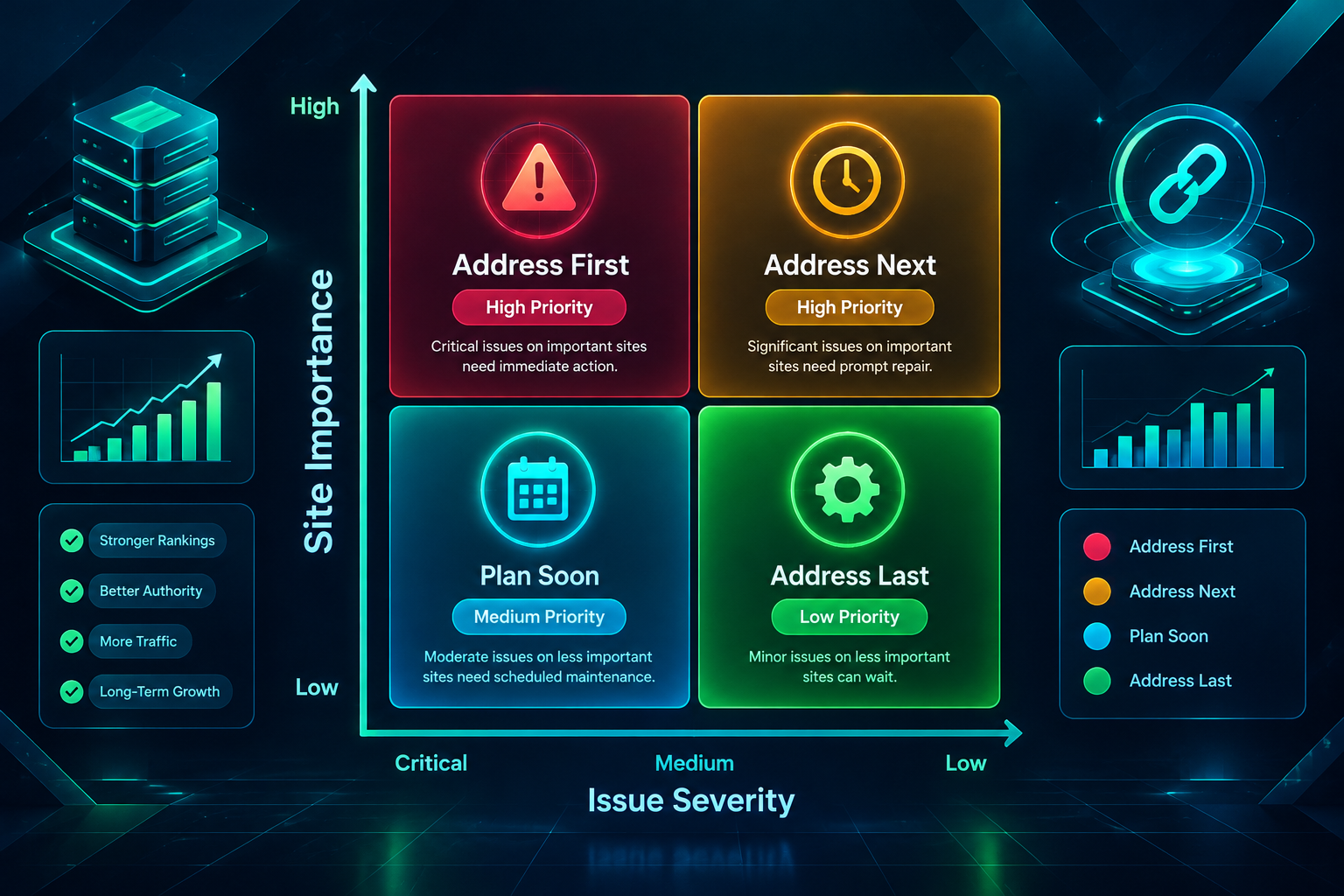
This matrix approach prevents two common maintenance mistakes. The first is spending disproportionate time on easily visible but low-impact problems — fixing a broken image on a secondary site while a linking page on a primary site sits deindexed. The second is ignoring gradual quality degradation on important sites because no single issue seems urgent enough to act on immediately. The matrix makes both types of neglect visible.
Footprint and Pattern Repairs: A Separate Priority Track
Technical and content repairs address individual site health, but footprint concerns operate at the network level and require a separate assessment track. Footprint patterns — characteristics that make multiple PBN sites identifiable as part of the same network — can include shared hosting environments, identical CMS themes or plugin configurations, uniform publishing schedules, overlapping WHOIS data, or anchor text distributions that are unusually consistent across sites. These are not issues that affect a single site in isolation; they are patterns that become more visible as the network grows.
Footprint repairs are generally lower in urgency than critical technical issues but should be addressed systematically rather than deferred indefinitely. When auditing for footprint concerns, prioritize the sites that link to your most competitive target pages, since those are the placements most likely to attract scrutiny if a pattern is detected. Diversifying hosting environments, varying CMS configurations, using different themes and plugins across sites, and ensuring that content quality and publishing cadence differ meaningfully between sites are all practical steps. These changes do not need to happen simultaneously across the entire network; a phased approach that starts with the highest-priority sites and works outward is more manageable and less disruptive.
Anchor text distribution is worth reviewing separately. If a significant proportion of the placements pointing to a single target page use identical or near-identical anchor text, that uniformity may be worth adjusting over time by varying the anchor text in new placements or, where practical, updating existing ones. The appropriate distribution depends on the target page, the niche, and the existing backlink profile — there is no universally correct ratio, and published thresholds from search engines on this point are not available. The goal is a profile that reflects natural variation rather than a mechanically repeated pattern.
Building a Repeatable Audit and Repair Schedule
Reactive maintenance — fixing problems only after they become visible — tends to be less efficient than a scheduled audit cycle. A repeatable audit process allows you to catch issues at an earlier stage, batch similar repairs together, and track the overall health of the network over time.
A practical audit schedule for most PBN operators involves three layers. The first is a monthly check of indexing status for all linking pages across the network. Tools such as Google Search Console (where the PBN site is verified), third-party index checkers, or manual site: queries can confirm whether key pages remain indexed. Any deindexed linking page should be flagged immediately and moved into the critical repair queue. The second layer is a quarterly content and technical review of each site, covering content quality, internal linking structure, outbound link counts, CMS and plugin versions, and page load performance. Issues identified here are classified by severity and scheduled accordingly. The third layer is a semi-annual footprint and profile review that looks at the network as a whole — hosting diversity, theme and plugin variation, anchor text patterns, and publishing consistency.

Documenting each audit cycle in a shared log makes it easier to track which issues have been addressed, which are pending, and whether recurring problems on specific sites suggest a deeper structural concern. A site that repeatedly develops the same type of issue — frequent deindexing, persistent thin content, or recurring plugin conflicts — may warrant a more fundamental review of its setup rather than repeated point fixes.
When to Retire or Replace a PBN Site
Not every PBN site is worth repairing indefinitely. Some sites reach a point where the cost of ongoing maintenance exceeds the link value they deliver, or where accumulated issues make restoration impractical. Recognizing when to retire a site and replace it with a better-quality domain is part of effective network management.
Signs that a site may be approaching retirement include: a persistent inability to maintain indexing despite repeated technical fixes; a backlink profile that has degraded significantly since the domain was acquired, with referring domains dropping or the remaining links coming from low-quality sources; content that cannot be meaningfully improved without a complete rebuild; or a hosting and configuration setup that creates footprint exposure that cannot be resolved without rebuilding the site from scratch. In these cases, retiring the site and redirecting maintenance resources toward acquiring a stronger replacement domain is often the more productive decision.
When evaluating replacement domains, the same quality criteria that apply to initial PBN domain selection remain relevant: historical topical relevance, the quality and stability of the existing referring domain profile, clean indexing history, and the absence of previous spam or manual action signals. A domain that scores well on these factors is more likely to deliver durable link value than one acquired purely on the basis of a single high authority metric.
Coordinating Repairs Across a Larger Network
For operators managing networks of ten or more sites, coordinating repairs without losing track of individual site status requires a more structured workflow. Assigning each site a health score based on its current audit results — combining indexing status, content quality, technical condition, and footprint risk into a single composite rating — makes it easier to sort the repair queue and communicate priorities across a team.
Batching similar repair types together also improves efficiency. Updating CMS installations and plugins across multiple sites in a single session is faster than addressing each site individually. Similarly, commissioning content improvements for several sites at once allows for consistent quality standards and reduces the per-site cost of content production. The key is ensuring that batched repairs do not introduce new uniformity patterns — for example, publishing identically structured articles across multiple sites on the same day creates a detectable signal that individual scheduling would avoid.
For agencies or SEO specialists managing PBN placements on behalf of clients, maintaining a clear separation between the repair schedule and the client-facing reporting cycle is important. Clients typically care about whether their target pages are receiving active, indexed link placements — not about the internal maintenance details of the network. Reporting should focus on placement status and indexing confirmation, while the repair workflow operates as an internal operational process.
Frequently Asked Questions
How often should I audit PBN sites for repair needs?
A monthly check of indexing status for all linking pages is a practical baseline. A more thorough content and technical review every quarter, combined with a network-level footprint assessment twice a year, covers most maintenance needs without creating an unsustainable workload. High-priority sites that link to competitive target pages may warrant more frequent spot checks.
What is the most common critical issue affecting PBN link delivery?
Deindexed linking pages are among the most common and impactful critical issues. If the page hosting the placement is not indexed, the link it contains is not contributing to the target page’s backlink profile in any active way. Checking indexing status regularly and restoring deindexed pages promptly is one of the highest-return maintenance activities for most PBN operators.
Should I fix footprint issues before or after technical issues?
Technical issues that directly affect link delivery — broken links, deindexed pages, expired domains — should generally be addressed before footprint concerns, because they have an immediate effect on whether placements are active. Footprint repairs are important for long-term network durability but rarely require the same urgency as a broken or inactive link. Address critical technical issues first, then work through footprint improvements on a scheduled basis.
How do I decide whether to repair or retire a struggling PBN site?
The key factors are whether the site’s core issues are fixable at a reasonable cost and whether the domain’s underlying quality still justifies the investment. A site with persistent indexing problems, a degraded referring domain profile, or a configuration that cannot be meaningfully improved without a full rebuild is often better retired and replaced with a stronger domain. If the domain’s historical relevance and link profile remain solid and the issues are technical rather than structural, repair is usually the better choice.
Does fixing content quality on a PBN site improve the value of existing link placements?
Improving the quality and topical relevance of content on a PBN site can support the overall credibility of the site as a web property, which may in turn support the value of the placements it hosts. A page with substantive, relevant content surrounding a contextual link is generally in a stronger position than one with thin or generic filler. The precise effect on any individual placement depends on multiple factors, and results will vary by site, niche, and competitive context.
Building a Repair Framework That Protects Your Network’s Long-Term Value
Prioritizing repairs across a PBN is fundamentally a resource allocation problem. Every network has a finite maintenance budget — whether measured in time, money, or both — and the goal is to direct that budget toward the repairs that protect the most link value and prevent the most significant risks. The framework described here — mapping sites by link value and target priority, classifying issues by severity, applying a priority matrix, maintaining a separate footprint review track, and running a repeatable audit schedule — gives you a structured way to make those decisions consistently rather than reactively.
The most durable PBN operations are those that treat maintenance as an ongoing operational discipline rather than an occasional emergency response. Sites that are audited regularly, repaired systematically, and retired when they no longer justify the investment tend to deliver more stable link equity over time than networks managed purely on an ad hoc basis. The investment in a structured repair process pays dividends in the form of more reliable placements, fewer critical failures, and a network that remains effective as competitive conditions evolve.
If you are evaluating the quality of your current PBN placements, assessing whether your network’s maintenance approach is fit for purpose, or considering new domain acquisitions to strengthen or replace underperforming sites, PBN Backlinks Service can help you review your requirements and identify the most effective path forward for your specific campaign goals.