

Receiving a hosting abuse report for a PBN site can feel urgent, but the appropriate response depends heavily on what the report actually alleges, which hosting provider sent it, and what evidence or action they are requesting. Most abuse reports follow a structured process, and understanding that process allows you to respond methodically rather than reactively. This article explains what typically triggers abuse reports for PBN-related sites, what hosts generally require in a response, how to assess the severity of a complaint, and what practical steps help you manage hosting relationships across a private blog network.
Key Takeaways
- Hosting abuse reports for PBN sites most commonly relate to spam complaints, DMCA notices, or terms-of-service concerns rather than direct SEO-related enforcement.
- A timely, factual response that addresses the specific allegation is usually more effective than ignoring the report or disputing it without evidence.
- The type of response required depends on the nature of the complaint: spam, copyright, phishing, or general ToS violations each follow different resolution paths.
- Distributing PBN sites across multiple hosting providers and IP ranges reduces the risk that a single abuse report affects your entire network.
- Keeping records of domain ownership, content publication dates, and hosting account details simplifies the response process when a complaint arrives.
What Triggers Hosting Abuse Reports for PBN Sites
Hosting providers receive abuse reports through several channels: automated spam detection systems, third-party complaint aggregators such as SpamCop or Spamhaus, DMCA takedown requests submitted by copyright holders, and manual reports submitted by other website owners or users. For PBN sites specifically, the most common triggers fall into a few categories.
Spam complaints are the most frequent. If a PBN site is sending outbound links to destinations that have been flagged by spam databases, or if the site’s IP address appears on a blocklist, the hosting provider may receive an automated complaint. This does not necessarily mean the site itself is sending spam email; it can mean that the IP range the site shares with other hosted accounts has a poor reputation, or that a third party has flagged the site’s outbound linking patterns through a web spam reporting tool.
DMCA notices arise when content published on a PBN site is alleged to infringe on a copyright holder’s work. This can happen if content was scraped, if images were used without a license, or if a previous owner of the domain published infringing material that was not removed when the domain changed hands. Expired and aged domains used for PBNs sometimes carry historical content issues that surface after reactivation.
General terms-of-service complaints are less structured. A competitor, a disgruntled party, or an automated system may flag a site for content that the hosting provider considers low-quality, deceptive, or in violation of acceptable use policies. The threshold for what constitutes a ToS violation varies significantly between hosting providers, which is one reason that hosting provider selection matters for PBN management.
Phishing or malware flags are less common for well-maintained PBN sites but can occur if a domain was previously used for malicious purposes and those flags were not cleared before the domain was repurposed. Checking a domain’s reputation through tools such as Google Safe Browsing, Spamhaus, and MXToolbox before building on it helps identify these issues in advance.
Understanding the Abuse Report Structure
Most hosting providers route abuse complaints through a dedicated abuse department, separate from general customer support. When a complaint is received, the provider typically sends a notification to the account holder’s registered email address. This notification usually includes the nature of the complaint, the specific URL or IP address involved, the name of the reporting party or system, and a deadline for response or remediation.
The deadline is important. Hosting providers vary in how long they allow before taking action, but many will suspend an account or take down a specific site if no response is received within 24 to 72 hours for serious complaints such as phishing or DMCA notices. Spam complaints may allow more time, but ignoring them entirely often results in escalating action.
Reading the report carefully before responding is essential. Abuse reports frequently contain automated language that sounds more severe than the underlying issue. A complaint that references a spam database listing, for example, may require only that you request delisting from that database rather than making any changes to the site itself. Responding to the wrong aspect of a complaint wastes time and may create confusion with the hosting provider’s abuse team.
How to Respond to Different Types of Abuse Reports
Responding to Spam Complaints
When a spam complaint references an IP blocklist or a spam database entry, the first step is to identify which database flagged the IP and why. Tools such as MXToolbox’s blacklist checker allow you to look up an IP address across multiple databases simultaneously. If the listing is on a shared IP that the hosting provider controls, the issue may resolve itself as the provider manages their IP reputation, and your response to the abuse team can simply acknowledge the complaint and note that the site does not send email or engage in the flagged activity.
If the complaint references outbound links from the PBN site to a destination that has been flagged as spam, review the links on the site and remove or nofollow any that point to destinations now associated with spam or malware. Document the changes you made, including the specific URLs modified and the date of modification, and include this documentation in your response to the hosting provider’s abuse team. A factual, specific response that demonstrates you have reviewed and addressed the complaint is generally more effective than a general denial.
For complaints that appear to be automated and lack specific evidence, you can request clarification from the abuse team about what specific content or behavior triggered the report. Hosting providers are generally willing to provide this information, and understanding the precise trigger allows you to address it accurately rather than making unnecessary changes.
Responding to DMCA Notices
A DMCA takedown notice requires a more structured response. Under the Digital Millennium Copyright Act, a hosting provider that receives a valid DMCA notice is required to act on it, typically by removing or disabling access to the allegedly infringing content. As the account holder, you have two options: comply with the takedown by removing the content, or submit a counter-notice if you believe the complaint is invalid.
If the content in question was scraped, used without a license, or is genuinely infringing, removing it promptly and notifying the abuse team of the removal is the most straightforward resolution. Include the URL of the removed content and the date of removal in your response. Most hosting providers will close the complaint once removal is confirmed.
If you believe the DMCA notice is invalid, for example because you hold the rights to the content, the content is in the public domain, or the notice does not meet the legal requirements for a valid DMCA claim, you may submit a counter-notice. A counter-notice is a formal legal document, and the requirements for a valid counter-notice are specific. If you are considering this route, reviewing the statutory requirements or consulting a legal professional before submitting is advisable. Submitting an invalid counter-notice does not help your position with the hosting provider.
For PBN sites built on expired domains, DMCA issues sometimes relate to content that was published by a previous domain owner. If the infringing content was not published by you and predates your ownership, this context is worth including in your response, along with evidence of when you acquired the domain and when the content was published.
Responding to General Terms-of-Service Complaints
ToS complaints are the most variable category because acceptable use policies differ between hosting providers. When a complaint references a ToS violation, read the specific section of the provider’s acceptable use policy that the complaint cites. If the complaint does not cite a specific section, ask the abuse team to identify which policy the site is alleged to have violated.
If the site’s content or configuration genuinely conflicts with the provider’s policy, the practical options are to modify the content or configuration to bring it into compliance, or to migrate the site to a hosting provider whose policies are compatible with the site’s purpose. For PBN operators, the latter is often the more efficient choice, particularly if the complaint is from a provider with restrictive policies that are likely to generate further complaints.
If the complaint appears to be a competitor report or a bad-faith filing with no substantive basis, document this assessment and respond to the abuse team with a factual explanation of why the site does not violate the cited policy. Hosting providers do investigate complaints before taking action, and a well-reasoned response that addresses the specific allegation can result in the complaint being closed without further action.
Practical Steps for Managing Abuse Reports Across a PBN
Managing abuse reports efficiently across a private blog network requires some organizational groundwork that is easier to establish before complaints arrive than after. Keeping a record of each PBN site’s hosting account details, the registered abuse contact email for each provider, domain acquisition dates, and content publication history allows you to respond quickly and accurately when a complaint arrives.
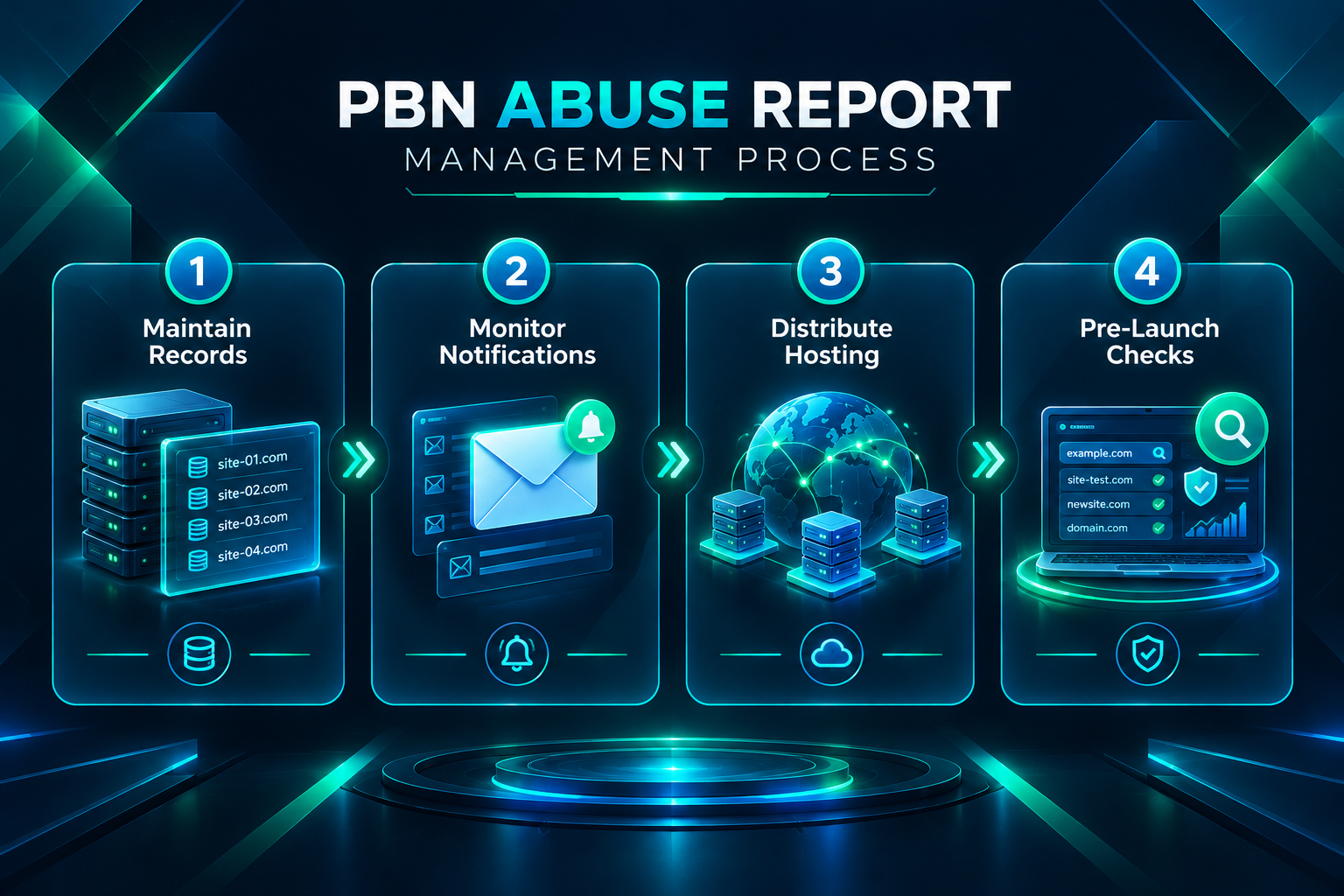
Using a dedicated email address for hosting account registrations, separate from your primary business email, ensures that abuse notifications are not missed in a busy inbox. Some operators use a monitoring service or a simple email filter to flag messages from hosting providers’ abuse departments for immediate attention.
Distributing PBN sites across multiple hosting providers and, where practical, across different IP ranges or data centers reduces the operational impact of any single abuse complaint. If one hosting account is suspended while a complaint is being resolved, the rest of the network continues to function. This distribution also reduces the likelihood that a single abuse report triggers a review of multiple sites simultaneously.
For sites built on expired or aged domains, conducting a pre-launch reputation check is a useful step. Reviewing the domain’s history through the Wayback Machine, checking its IP and domain against major spam databases, and reviewing its backlink profile for any associations with previously flagged content helps identify potential abuse triggers before the site goes live. Addressing these issues at the domain selection stage is considerably less disruptive than managing a complaint after the site is indexed and linking.
Hosting Provider Selection and Its Effect on Abuse Report Risk
Not all hosting providers handle abuse reports in the same way. Some providers have automated systems that suspend accounts immediately upon receiving a complaint, before any human review takes place. Others have abuse teams that review complaints before taking action and allow account holders a reasonable opportunity to respond. Understanding a provider’s abuse handling process before committing to hosting a PBN site there is a practical due diligence step.

Providers that specialize in hosting for SEO purposes or that explicitly permit a wider range of content types in their acceptable use policies may be more familiar with the types of sites that generate abuse complaints and may handle those complaints with more nuance. This does not mean that any provider will ignore valid complaints, but it does mean that the response process may be more predictable and less likely to result in immediate suspension without notice.
Offshore hosting providers are sometimes used for PBN sites because their acceptable use policies may be broader and their response to certain types of complaints may be slower. This is a practical consideration, but it is worth noting that slower complaint handling can also mean slower resolution of legitimate issues such as malware flags or IP blocklist entries that affect the site’s ability to function effectively.
Dedicated IP addresses, rather than shared hosting IPs, reduce the risk that another account on the same server generates a complaint that affects your site’s IP reputation. For PBN sites where IP diversity is already a consideration for footprint management, dedicated IPs or VPS hosting may align with both the hosting strategy and the abuse risk management goals.
What to Do If a PBN Site Is Suspended
If a hosting provider suspends a PBN site before you have had the opportunity to respond to a complaint, contact the abuse department directly and request the specific reason for the suspension and the complaint details. Most providers will share this information, and understanding the precise basis for the suspension is necessary before you can respond effectively.
If the suspension is based on a complaint that you can address, provide the abuse team with a factual response that documents the steps you have taken or will take to resolve the issue. Request reinstatement once the issue is resolved. Some providers will reinstate an account after a satisfactory response; others may require a waiting period or may decline reinstatement for certain types of violations.
If reinstatement is not possible or not practical, migrating the site to a new hosting provider is the operational priority. Before migrating, ensure that the underlying issue that triggered the complaint has been addressed, so that the same complaint does not follow the site to the new host. If the complaint was a DMCA notice, confirm that the infringing content has been removed before republishing the site elsewhere. If the complaint was a spam or ToS issue, review the site’s content and configuration against the new provider’s acceptable use policy before going live.
Keeping a current backup of each PBN site’s files and database simplifies migration significantly. A site that can be restored from a recent backup and pointed to a new host within a few hours has minimal downtime, which limits the impact on any links the site is providing during the suspension period.
Frequently Asked Questions
How quickly do I need to respond to a hosting abuse report?
Response timelines vary by provider and complaint type. DMCA notices and phishing or malware complaints typically require a response within 24 to 48 hours to avoid suspension. Spam complaints may allow 48 to 72 hours or more. Reading the specific deadline in the notification and responding before it passes is the safest approach. If you need more time to investigate, sending an initial acknowledgment to the abuse team and requesting a brief extension is often possible.
Can I dispute a hosting abuse report if I believe it is invalid?
Yes. For DMCA notices, a formal counter-notice is the legal mechanism for disputing an invalid claim. For spam or ToS complaints, you can respond to the abuse team with a factual explanation of why the site does not violate the cited policy. Hosting providers do review responses before taking further action, and a well-documented dispute can result in the complaint being closed. The strength of your response depends on the specificity and accuracy of the evidence you provide.
Will a hosting abuse report affect my other PBN sites on the same account?
This depends on the hosting provider and the nature of the complaint. Some providers investigate and act only on the specific site named in the complaint. Others may review all sites on the same account if the complaint suggests a pattern of behavior. Distributing PBN sites across separate hosting accounts and providers limits the exposure of the broader network to any single complaint.
What information should I include in my response to an abuse report?
Include the complaint reference number or ticket ID, the specific URL or IP address involved, a factual description of the site and its content, the steps you have taken or will take to address the complaint, and any supporting documentation such as content removal confirmations, domain acquisition records, or evidence that the complaint is based on inaccurate information. Keep the response factual and specific; avoid general statements that do not address the particular allegation.
How do expired domains affect the risk of receiving abuse reports?
Expired and aged domains may carry historical reputation issues including prior spam database listings, previous DMCA complaints, or associations with content that violated hosting policies. Checking a domain’s reputation before building on it, reviewing its archived content through the Wayback Machine, and verifying that it is not listed on major spam databases reduces the likelihood of inheriting a previous owner’s compliance problems. Domains with clean histories are generally lower-risk from an abuse report perspective.
Does responding to an abuse report expose my PBN to additional scrutiny?
Responding to an abuse report through the hosting provider’s standard process does not inherently expose the network to additional scrutiny beyond what the complaint itself has already triggered. Hosting providers are not search engines, and their abuse handling processes are separate from search engine crawling and indexing. Addressing a hosting complaint promptly and accurately is a network management task, not an SEO disclosure event.
Managing Abuse Reports as Part of a Broader PBN Hosting Strategy
Handling hosting abuse reports effectively is ultimately a function of how well the network’s hosting infrastructure is organized before complaints arrive. PBN sites that are distributed across multiple providers, registered with accurate contact details, maintained with clean and original content, and built on domains with verified reputations are less likely to generate complaints and easier to manage when complaints do occur. When a report does arrive, a methodical response that addresses the specific allegation with factual documentation is consistently more effective than either ignoring the complaint or responding with a general denial.
The hosting layer of a private blog network is a practical operational concern distinct from the SEO function of the links those sites provide. Keeping the two layers organized separately, with clear records for each, allows you to resolve hosting issues without disrupting the broader link-building strategy. If you are evaluating how your current PBN hosting setup handles compliance risk, or if you are building out a network and want to assess domain and placement quality as part of that process, PBN Backlinks Service can help you review your requirements and identify an approach that fits your campaign goals.