

Recording content licenses for PBN websites is a practical administrative task that sits at the intersection of copyright compliance, network management, and operational due diligence. Whether you are sourcing written articles, images, or multimedia for private blog network sites, maintaining clear records of what content you own, licensed, or commissioned protects you from third-party copyright claims and helps you manage each site in the network with greater confidence. This guide explains what content license records are, what information they should contain, how to organize them across multiple PBN sites, and how this documentation fits into a broader network management workflow.
Key Takeaways
- Content license records document the legal basis on which each piece of content on a PBN site is used, covering original commissions, stock licenses, creative commons assets, and public domain material.
- Each record should identify the content item, the license type, the licensor or creator, the permitted uses, any attribution requirements, and the expiry date where applicable.
- Organizing records by domain makes it easier to audit individual PBN sites, transfer ownership, or respond to a copyright claim without searching across an entire network.
- Accurate records reduce the risk of inadvertent copyright infringement, which can result in takedown notices, hosting disputes, or financial liability unrelated to search engine considerations.
- A consistent record-keeping system scales more efficiently as a private blog network grows, particularly when multiple writers, image sources, or content vendors are involved.
Why Content License Records Matter for PBN Sites
Private blog network sites function as independent web properties, each requiring its own content to appear credible, topically relevant, and useful to readers and crawlers. Because PBN operators often source content from multiple channels simultaneously — freelance writers, content agencies, stock image libraries, AI-assisted drafting tools, or repurposed public domain material — the provenance of that content can become unclear over time. Without a record-keeping system, it is difficult to confirm whether a specific article was commissioned as a work-for-hire, whether a photograph carries a commercial use license, or whether a piece of content was licensed for a single site or can be republished across the network.
Copyright law in most jurisdictions treats the absence of a license as infringement by default. A Digital Millennium Copyright Act (DMCA) takedown notice directed at a hosting provider can result in content removal or account suspension regardless of whether the underlying PBN link strategy is affected. Keeping accurate content license records is therefore a matter of operational continuity rather than a purely theoretical legal concern. It also simplifies the process of selling or transferring individual PBN domains, since a buyer will want to know whether the content on the site is fully owned or subject to ongoing license terms.
Types of Content Used on PBN Sites and Their License Categories
Understanding the license category for each type of content is the first step toward building a useful record-keeping system. The main categories that appear across most private blog network sites are described below.
Commissioned or Work-for-Hire Content
When a writer is paid to produce an article specifically for a PBN site, the resulting content is typically owned by the commissioning party under a work-for-hire arrangement, provided the agreement is documented. A written contract or a platform-generated order confirmation that specifies work-for-hire terms is the primary record for this category. Without that documentation, copyright may remain with the writer by default in many jurisdictions, which limits the operator’s ability to republish, modify, or transfer the content.
Licensed Stock Content
Stock image libraries such as Shutterstock, Adobe Stock, and Getty Images issue per-image or subscription-based licenses that specify permitted uses, including whether the image may appear on a commercial website, whether attribution is required, and whether the license is transferable. These licenses are typically non-exclusive and may restrict use to a defined number of impressions or domains. Recording the license reference number, the platform, the permitted use tier, and the expiry or renewal date for each stock asset is essential when managing content across multiple PBN sites.
Creative Commons Licensed Material
Creative Commons licenses allow content to be reused under specific conditions that vary by license version. The CC BY license requires attribution. The CC BY-NC license restricts commercial use. The CC BY-ND license prohibits derivative works. PBN sites that incorporate Creative Commons text, images, or audio need to record the specific license version, the original source URL, and whether attribution has been provided in the published content. Using a CC BY-NC asset on a commercially oriented PBN site without checking the license terms is a common source of inadvertent infringement.
Public Domain Material
Content in the public domain — including works whose copyright has expired, US government publications, and material explicitly released into the public domain — can generally be used without a license. However, the public domain status of a specific work can depend on the jurisdiction, the publication date, and whether the work was properly registered or renewed under older copyright regimes. Recording the basis for a public domain determination, such as a publication date before 1928 for US works or a government source URL, provides a defensible record if the status is later questioned.
AI-Generated Content
Content produced using AI writing tools occupies an evolving area of copyright law. In many jurisdictions, AI-generated text without meaningful human authorship may not qualify for copyright protection, which means the operator cannot assert ownership over it in the traditional sense but also faces limited third-party claims against it. The relevant record for AI-generated content should note the tool used, the date of generation, and any human editing applied, since substantial human editing may affect the copyright analysis. Terms of service for AI platforms vary on whether commercial use and publication are permitted, so recording the platform’s terms at the time of use is advisable.
What a Content License Record Should Contain
A content license record does not need to be a complex legal document. A structured spreadsheet or a simple database entry for each content item is sufficient for most PBN operators. Each record should include the following fields.
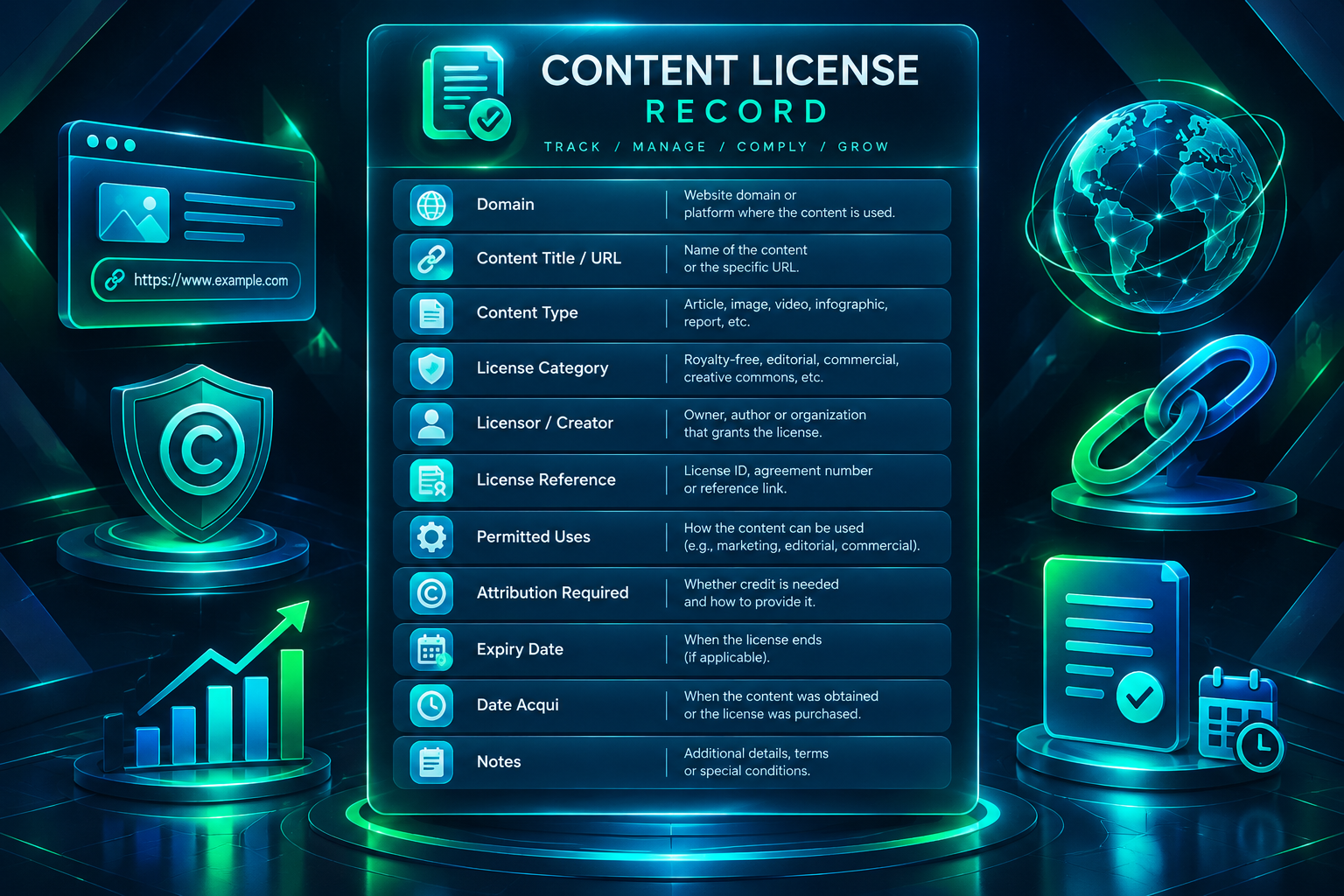
- Domain: The specific PBN site on which the content is published, identified by its full domain name.
- Content title or URL: The article title, image filename, or published URL that uniquely identifies the content item.
- Content type: Article, image, video, audio, infographic, or other format.
- License category: Work-for-hire, stock license, Creative Commons, public domain, AI-generated, or other.
- Licensor or creator: The name of the writer, the stock platform, the original author, or the AI tool used.
- License reference: The contract number, platform order ID, Creative Commons license URL, or other identifier that links the record to the original agreement.
- Permitted uses: Whether the license covers commercial use, republication across multiple domains, modification, or sublicensing.
- Attribution requirement: Whether attribution is required and, if so, the form it must take and where it appears in the published content.
- Expiry or renewal date: The date on which a time-limited license expires or must be renewed, or a note that the license is perpetual.
- Date acquired: The date on which the content was commissioned, purchased, or downloaded.
- Notes: Any restrictions, territorial limitations, or special conditions relevant to the specific license.
How to Organize Records Across a Multi-Site Network
A private blog network with more than a handful of sites requires a record-keeping structure that allows records to be filtered and retrieved by domain, by content type, or by license expiry date. A flat spreadsheet works for small networks, but it becomes difficult to manage as the number of sites and content items grows. The following organizational approaches are commonly used by network operators.
Domain-Based Folder Structure
Creating a dedicated folder for each PBN domain — whether in a cloud storage service, a local drive, or a project management tool — allows all content-related documents for that site to be stored together. Within each domain folder, subfolders for written content, images, and other media keep the records organized by content type. Copies of contracts, license certificates, and platform receipts are stored alongside the relevant spreadsheet or database entry. This structure makes it straightforward to compile all records for a specific domain when auditing, selling, or transferring that site.
Centralized Spreadsheet with Domain Filtering
A single master spreadsheet covering all PBN sites, with a domain column that allows filtering, is a practical alternative for operators who prefer a unified view. Each row represents one content item, and the domain column links it to the relevant site. Conditional formatting or a separate tab for expiring licenses helps identify records that require renewal or replacement before a license lapses. Google Sheets or a similar collaborative tool allows multiple team members to update records without version conflicts.
Content Management System Metadata
Some PBN operators use WordPress or another CMS for their network sites and record license information directly in the post or media metadata fields. WordPress allows custom fields to be added to posts and media library items, which can store license type, source, and expiry information alongside the content itself. This approach keeps the record close to the content but requires a consistent tagging convention across all sites and may be harder to audit at the network level without a plugin or export tool.
Practical Steps for Recording Content Licenses on New PBN Sites
Establishing a record-keeping habit from the moment a new PBN site is set up is more efficient than reconstructing records retrospectively. The following sequence covers the main steps involved in recording content licenses as a site is built and populated.

- Define your content sources before commissioning: Decide in advance whether articles will be commissioned as work-for-hire, sourced from a content agency, or produced using an AI tool. Clarify the license terms with each source before content is delivered, and request written confirmation of work-for-hire status where applicable.
- Create a domain record entry at site launch: When a new PBN domain is set up, create its corresponding folder or spreadsheet section immediately, even before any content is added. This prevents the accumulation of unrecorded content items that must be traced later.
- Log each content item at the point of publication: Add a record for each article or image at the time it is published rather than in batches. Batch logging increases the risk of missing items or misattributing license details.
- Store supporting documents alongside the record: Save a copy of the writer’s contract, the stock platform receipt, or the Creative Commons source URL in the domain folder at the same time the record is created. Do not rely on platform accounts remaining accessible indefinitely, since subscription cancellations or account closures can make historical receipts inaccessible.
- Set calendar reminders for expiring licenses: Time-limited stock licenses and subscription-based content agreements require renewal or replacement before they lapse. A calendar reminder set 30 to 60 days before the expiry date gives sufficient time to renew the license or replace the content with a fully owned alternative.
- Review records when transferring or selling a domain: Before transferring a PBN domain to another party, compile the content license records for that site and confirm that all licenses are either transferable or that the content will be replaced. Non-transferable licenses may require the buyer to source replacement content after the transfer.
Common Record-Keeping Gaps and How to Address Them
Retrospective audits of PBN content libraries frequently reveal the same categories of missing or incomplete records. Identifying these gaps early reduces the effort required to bring records up to standard.
The most common gap is the absence of a written work-for-hire agreement for commissioned articles. Many PBN operators commission content through freelance platforms or direct arrangements without requesting a formal agreement, relying instead on an informal understanding that the content is owned outright. Addressing this gap requires contacting the original writer to obtain a retroactive written confirmation of the work-for-hire arrangement, or treating the content as licensed rather than owned and recording it accordingly.
A second common gap involves images sourced from search results or social media without verifying the license. Images found through a general web search are not in the public domain by default, and using them without a license creates copyright exposure. Auditing the image library for each PBN site and replacing unlicensed images with properly licensed alternatives — or with original images — is the most straightforward resolution. Tools such as Google Reverse Image Search or TinEye can help identify the original source of an image so that the license status can be assessed.
A third gap involves AI-generated content where the platform’s terms of service were not reviewed at the time of use. AI platform terms change periodically, and the commercial use permissions that applied when content was generated may differ from current terms. Recording the platform name and the approximate date of generation allows the relevant terms to be retrieved and assessed if a question arises later.
Content License Records and Domain Transfers
When a PBN domain is sold or transferred, the content on that site is typically included in the transaction. The transferability of content licenses depends on the terms of each individual license. Work-for-hire content that is fully owned by the operator transfers with the domain without restriction. Stock image licenses issued by major platforms are generally non-transferable and require the new owner to obtain their own license for the same images. Creative Commons licenses are inherently transferable because they attach to the content itself rather than to a specific licensee.
Providing a content license summary to a prospective buyer as part of the due diligence process demonstrates that the network has been managed with attention to operational detail. It also allows the buyer to identify which content items will require re-licensing after the transfer and to factor that cost into the acquisition price. A domain with fully documented, transferable content licenses is a more straightforward acquisition than one where the license status of the content is unknown.
Integrating Content License Records into Broader PBN Management
Content license records are one component of a broader PBN site management system that also covers domain registration details, hosting account information, backlink placement records, anchor text logs, and indexing status. Integrating content license records into the same management framework — whether that is a project management tool, a shared drive, or a custom database — reduces the administrative overhead of maintaining separate systems for each category of information.
For operators managing a network on behalf of clients or as part of a link-building service, documented content license records also support transparency and accountability. Being able to demonstrate that the content on each PBN site is properly licensed contributes to the overall quality and credibility of the network, which is relevant to the placement value that each site can provide.
Frequently Asked Questions
Do I need a separate license record for every image on a PBN site?
Yes, each image should have its own record, particularly if images are sourced from different platforms or under different license types. A single stock subscription may cover multiple images, but each image’s license reference and permitted use should be recorded individually so that the record remains useful if the subscription lapses or if a specific image is questioned.
What happens if I cannot locate the original license for content already published on a PBN site?
If the original license cannot be located, the safest approach is to treat the content as unlicensed and either replace it with properly licensed material or contact the original creator to obtain written confirmation of the license terms. Continuing to publish content without a traceable license creates ongoing copyright exposure that is not resolved by the passage of time.
Can I use the same article on multiple PBN sites if I commissioned it as work-for-hire?
If the content is fully owned under a work-for-hire arrangement, the operator generally has the right to publish it on multiple sites. However, publishing identical content across multiple PBN sites may affect how search engines assess the uniqueness and quality of each site’s content, which is a separate consideration from the copyright question. From a license record perspective, note each site on which the content appears so that the record reflects actual usage.
Are there tools that help manage content licenses across multiple websites?
General project management tools such as Notion, Airtable, or Google Sheets are commonly used for content license tracking because they allow custom fields, filtering, and shared access. Dedicated digital asset management (DAM) platforms offer more structured license tracking features but may be more than necessary for smaller networks. The most important factor is consistency in how records are created and maintained, rather than the specific tool used.
Does recording content licenses affect the SEO performance of a PBN site?
Content license records are an administrative and legal tool rather than a direct SEO factor. They do not influence how a search engine crawls or ranks a page. Their value lies in reducing operational risk, supporting domain transfers, and maintaining network management standards that contribute to the overall quality and longevity of each PBN site.
What should I do when a stock image license expires?
When a stock image license expires, the image should either be re-licensed under a current subscription or replaced with an image that is fully owned or licensed under a perpetual agreement. Publishing an image after its license has expired creates the same copyright exposure as using an unlicensed image. The expiry date field in the content license record, combined with a calendar reminder, is the most reliable way to catch expiring licenses before they lapse.
Building a Record-Keeping System That Scales with Your Network
Content license records for PBN sites are most valuable when they are created consistently from the outset rather than assembled retrospectively. A simple, well-maintained system — whether a spreadsheet, a folder structure, or a lightweight database — provides a reliable reference for every content item across the network, reduces the risk of copyright disputes, and simplifies the process of auditing, transferring, or expanding individual sites. As a private blog network grows, the administrative overhead of maintaining these records is modest compared to the operational clarity they provide. If you are building or expanding a PBN and want to discuss how content quality and network management fit into a broader link-building strategy, the team at PBN Backlinks Service can help you assess your requirements and identify the right approach for your goals.