
Safe Pace For Building PBN Links Without Raising Red Flags
Building PBN backlinks at the right pace starts with link velocity—the rate at which new backlinks appear over time. A money site with no history cannot usually absorb higher velocity the same way an aged authority site with steady referring domains can.
At pbnbacklinksservice.com, our agency manages private blog networks through aged domains, contextual link placement, outbound link control, hosting diversification, and ongoing indexing checks. The goal is not to add hundreds of links quickly. The goal is to build links at a pace that looks natural for the site, niche, and backlink profile.
Key principles we use before adding links:
- Review site age, domain history, and organic traffic signals.
- Compare current links per month against new referring domains per month.
- Match anchor text to page intent, keyword difficulty, and existing anchors.
- Diversify types of links so PBN backlinks do not dominate the profile.
- Monitor indexing, ranking volatility, and link quality after placement.
PBN Link Velocity Basics
PBN link velocity is one of the most sensitive parts of a controlled link building strategy. The right pace depends on baseline authority, competition, and how search engines already perceive the money site.
A professional PBN agency does not treat every campaign the same. A new affiliate site, a local business, and an aged site in highly competitive SEO niches require different velocity management, anchor text distribution, and contextual backlink planning.

Mon-Fri: 09:00 AM – 06:00 PM
PBN Link Velocity Meaning
PBN link velocity means the number of private blog network links gained during a specific period, usually measured per month. In practical SEO work, link velocity also includes timing, anchor variety, topical relevance, and the ratio between PBN backlinks and other referring domains.
Our placement process usually follows this sequence:
- Audit current backlink profile in Ahrefs, Semrush, Majestic, and Google Search Console.
- Identify natural patterns in referring domains and anchors.
- Set a conservative links monthly target.
- Place contextual backlinks on relevant PBN site pages.
- Review indexing, ranking changes, and anchor distribution.
Why Velocity Matters
Velocity matters because search engines evaluate backlink growth patterns alongside content quality, relevance, authority, and user intent. A high velocity campaign can look normal for a brand with PR activity, but unusual for a small money site with no brand signals.
As an agency operating a PBN network, we focus on controlled growth rather than fast bulk placement. Poor velocity management can create unnatural link patterns, weak link equity signals, and ranking volatility, especially when multiple PBN sites link with similar anchors in a short period.
How PBN Links Differ From Other Backlinks
PBN backlinks differ from editorial outreach, guest posts, niche edits, and digital PR because the infrastructure is controlled by the agency. That control allows better planning around content context, outbound links, anchor text, placement timing, and maintenance.
A high-quality PBN is built on expired domains or aged domains with verified history, clean referring domains, topical relevance, and active indexing. PBN backlinks provide contextual authority when placed inside useful content that matches the target page and avoids visible network patterns.
Google Stance On PBN Links In 2026
Google’s public documentation focuses on link quality, relevance, usefulness, and unnatural link patterns. From a practical agency perspective, this means professional PBN campaigns need careful domain vetting, editorial standards, anchor planning, and footprint protection.
We do not present PBN backlinks as risk-free. Execution quality determines campaign risk profile. Search engines evaluate patterns through algorithm systems and manual review signals, so careless mass placement, low-quality links, repeated anchors, and thin content can reduce value or create instability.
Link Velocity Versus Link Volume
Link volume is the total number of backlinks acquired. Link velocity is the rate and pattern of backlink acquisition over time. A campaign with 20 links placed gradually can be cleaner than a campaign with 20 links published in one week.
The distinction matters because velocity management considers timing, source diversity, anchor text, and existing authority. A site can build too slowly and fail to compete, or build too fast and create unnatural link signals that make the campaign harder to stabilize.
Safe PBN Link Velocity Factors

Safe PBN link velocity depends on measurable SEO signals, not guesswork. Before recommending PBN backlink packages, our team reviews backlink baseline, keyword difficulty, competition, domain history, and target page quality.
A controlled plan also considers budget, timeline, risk tolerance, and the role of PBN backlinks inside the wider link-building strategy. Some campaigns use a mix of editorial links, niche edits, guest posts, tiered link building, and PBN placements to diversify authority sources.
Site Age And History
Site age influences how many links per month a money site can absorb without creating unusual growth patterns. Aged websites with steady content publishing, organic traffic, and existing referring domains can usually handle more link equity than brand-new websites.
New domains require slower placement because search engine rankings have fewer trust signals to evaluate. Our team compares PBN links for new vs aged websites before setting velocity, especially when the campaign targets competitive niches or highly competitive keywords.
Current Backlink Baseline
The current backlink baseline shows how many new referring domains per month the website already receives. Ahrefs, Semrush, Majestic, and Google Search Console help identify whether the backlink profile has stable growth, sudden drops, or previous high velocity periods.
A site gaining two referring domains per month should not suddenly receive hundreds of links from similar sources. A stronger website with regular editorial mentions, branded searches, and consistent publishing can absorb higher velocity with better stability.
Niche Competitiveness
Niche competitiveness changes the required pace. Low-competition niches may respond to a small number of contextual backlinks, while highly competitive industries often need stronger authority signals, better content, and more sustained link-building.
| Niche Type | Typical Need | Velocity Approach |
| Local SEO | Lower authority gap | Slow, selective placements |
| Affiliate SEO | Moderate competition | Steady monthly links |
| Finance or iGaming | Highly competitive | Stronger vetting and pacing |
Content Output Pace
Content output pace should align with backlink acquisition. If a money site publishes one article every two months but suddenly gains many links monthly, the pattern can look disconnected from site activity.
Our agency matches link velocity with content velocity whenever possible. A site publishing guides, comparisons, product pages, and supporting blog content can justify more contextual backlinks because the backlink growth connects to visible content expansion.
Brand Activity Signals
Brand activity signals include branded searches, social mentions, business listings, PR coverage, newsletter campaigns, and direct traffic growth. These signals help backlink growth look natural because authority building is connected to real marketing activity.
A strong brand footprint supports faster link-building because search engines can see more than backlinks. When brand signals are weak, our agency uses conservative PBN placement, broader anchor variation, and more supporting link types to reduce campaign concentration.
Existing Link Types And Sources
Existing link types show whether PBN backlinks should be introduced slowly or used as part of a mixed campaign. A profile with editorial backlinks, citations, niche edits, and guest posts can absorb PBN links more naturally than a profile dominated by one source.
We review ratios before building quality links. A balanced backlink profile includes varied domains, different CMS platforms, diverse anchors, and contextual placements that do not point only to one money site page.
Natural Link Acquisition Patterns
Natural link acquisition patterns are rarely perfectly even. Real backlink growth includes pauses, bursts after content updates, branded mentions, and mixed sources. The best PBN strategy imitates realistic growth without forcing identical placement intervals.
Our agency uses velocity management to avoid mechanical scheduling. Controlled does not mean robotic. A professional PBN network uses variation in publish dates, anchor text, content formats, hosting environments, and outbound links.
Irregular Placement Timing
Irregular placement timing means backlinks are published with natural variation rather than fixed weekly patterns. Search engines can evaluate repetitive timing, especially when similar PBN site structures and anchor text appear together.
A practical schedule may include one placement in week one, no placement in week two, two placements in week three, and another placement later. The pattern should support campaign goals while avoiding the appearance of automated adding links across multiple PBN sites.
Correlation With Content And Activity
Backlink acquisition should correlate with content updates, new service pages, refreshed guides, PR mentions, and broader SEO activity. When contextual link placement supports active content growth, the campaign looks more coherent.
Our team prefers placing PBN backlinks after target pages have sufficient content depth, internal links, and keyword relevance. Link equity works better when the destination page has clear intent, useful information, and a reason to attract authority.
Gradual Acceleration For Growing Sites
Gradual acceleration works well when a website is moving from early growth into competitive search engine rankings. Instead of jumping from zero to 20 links per month, the campaign may move from two to five, then eight, then more if signals remain stable.
This measured approach helps our team monitor indexing, keyword movement, and ranking volatility. A website can build too slowly in competitive niches, but sudden high velocity without supporting signals creates avoidable campaign risk.
Mixed Link Types And Sources
Using a mix of link sources creates a more durable backlink profile. PBN backlinks can support authority pages, while citations, guest posts, niche edits, digital PR, and tiered links add variety.
Useful link type combinations include:
- PBN backlinks for controlled authority and contextual relevance.
- Guest posts for brand visibility and editorial context.
- Niche edits for relevance from aged content.
- Citations for local or entity consistency.
- Tiered links to strengthen supporting assets.
PBN Link Velocity Benchmarks By Site Stage
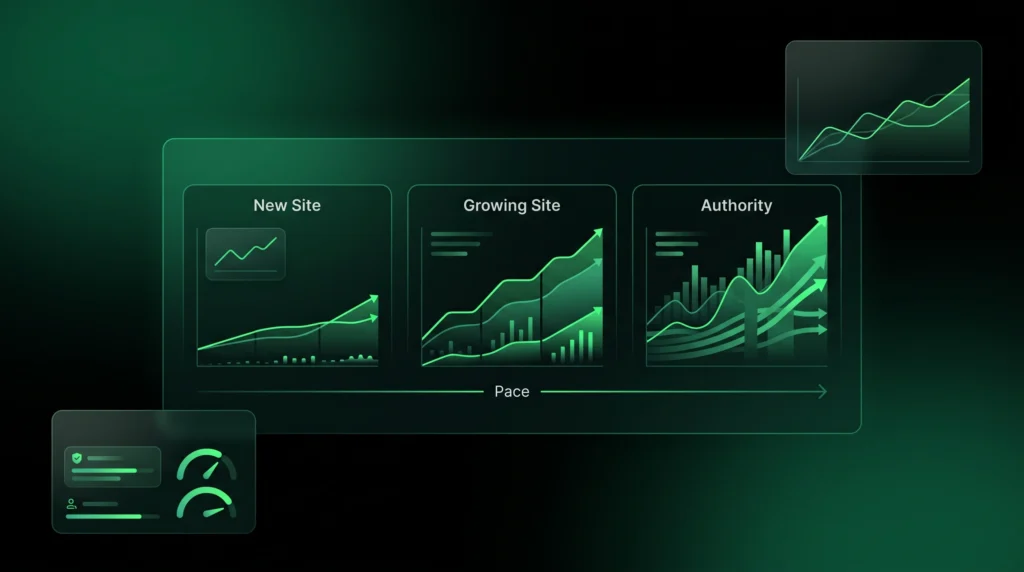
PBN link velocity benchmarks should be flexible because every site has different authority, niche pressure, and backlink history. A benchmark is a planning range, not a guarantee.
Our agency uses benchmarks only after checking domain age, referring domains, organic traffic, content quality, target keyword competition, and existing anchor text. The strongest campaigns adjust pace based on data rather than fixed packages alone.
New Sites With No Link History
New sites with no link history need conservative link velocity. A small number of contextual backlinks can be enough to test indexation, anchor response, and early keyword movement.
For a new money site, we often begin with branded anchors, naked URLs, and topical supporting content before adding keyword-rich anchors. This keeps the backlink profile balanced while the site earns more content, internal links, and trust signals.
Low Competition Niches
Low competition niches usually need fewer PBN links because the ranking threshold is lower. A few relevant placements from aged domains can influence search engine rankings when the target page already satisfies intent.
For local services or narrow affiliate topics, link quality matters more than high volume. Our team prioritizes topical relevance, low outbound links, clean domain history, and indexation stability rather than fast placement across many sources.
Medium Competition Niches
Medium competition niches often require steady links monthly, especially when competitors already have strong referring domains. A controlled campaign may combine PBN backlinks with guest posts, niche edits, and supporting content updates.
The pace should still reflect the site’s baseline. If a site already gains links per month from normal activity, PBN placement can increase authority without overwhelming the backlink profile.
High Competition Niches
High competition niches require stronger planning because competitors may have authority backlinks, aged domains, and broad content hubs. Highly competitive keywords often need sustained link-building, internal optimization, and technical SEO support.
For these campaigns, we avoid simple bulk placement. A powerful PBN strategy uses highly relevant domains, careful anchor text distribution, staggered timing, and ongoing performance reviews to manage risk while competing against established websites.
Authority Sites With Existing Link Profiles
Authority sites with existing link profiles can often absorb higher velocity because the backlink baseline is already active. A site receiving regular editorial links and branded mentions can handle more PBN placements than a dormant domain.
Even so, our agency avoids careless scale. We review anchor saturation, page-level link equity, outbound link patterns, and indexing stability before adding links. Growth should look like expansion, not a disconnected spike.
Red Flags That Trigger Problems
Red flags usually come from poor execution rather than the concept of private blog networks itself. Weak expired domain history, low-quality content, visible footprints, aggressive anchors, and unnatural link velocity can reduce link value.
A professional PBN agency reviews these issues before publication. The goal is to make every placement useful, relevant, and operationally clean enough to support the campaign over time.
Sudden Link Spikes
Sudden link spikes occur when a site receives many similar links in a short period without matching content growth or brand activity. A spike is more concerning when links come from related network structures, repeated templates, or matching anchor text.
Before scaling, our team checks ranking movement, indexation, and new referring domains per month. If the money site has no history of high velocity, gradual placement is usually the better operational choice.
Repeated Anchor Text Patterns
Repeated anchor text patterns can make a campaign look engineered. Exact-match anchors are useful in moderation, but excessive repetition can weaken the natural profile around a keyword.
Anchor review should include:
- Branded anchors and company names.
- Naked URLs and generic references.
- Partial-match keyword anchors.
- Page title anchors.
- Topical phrases related to content intent.
- Exact-match anchors used selectively.
Weak Domain History
Weak domain history reduces link quality before the backlink is even placed. An expired domain with spam history, irrelevant redirects, deindexed pages, or poor referring domains can create unstable value.
Our agency checks archived content, historical topics, anchor profile, referring domains, organic traffic history, and index status. A high-quality PBN starts with domain history that supports topical relevance and avoids obvious expired domain abuse signals.
Similar Hosting Or Site Footprints
Similar hosting patterns create visible network signals when many PBN site properties share the same infrastructure, templates, plugins, CMS settings, or unique IP addresses. PBN hosting needs variation because footprints can reduce campaign resilience.
For readers comparing risk factors, our detailed guide on PBN footprints explains why hosting, CMS, themes, outbound links, and analytics patterns should be diversified across private blog networks.
Low Quality Content Around Links
Low quality content around links weakens contextual relevance. A backlink placed inside thin, generic, or unrelated content provides less topical value than a link inside a focused article that supports the destination page.
Our editorial workflow requires original content, relevant headings, natural anchor placement, and outbound link review. The PBN site should look like a maintained website, not a page created only to pass link equity.
Unbalanced PBN Versus Other Links
An unbalanced backlink profile appears when most new links come from one type of source. PBN backlinks can be effective, but the profile should not depend only on multiple PBN sites pointing to the same money site.
Balance depends on niche and stage. Some campaigns need citations, guest posts, niche edits, social profiles, branded mentions, and internal linking updates alongside PBN placements to create stronger authority distribution.
Safer PBN Setup For Scaling
Safer PBN setup requires infrastructure discipline. A professional network is not a collection of random blogs; a controlled PBN network includes aged domain acquisition, hosting diversification, original content, outbound link limits, CMS variation, and indexing monitoring.
At pbnbacklinksservice.com, our internal process is designed around quality control before scale. Building a PBN without these checks can make link-building is slow to recover when domain quality, indexing, or footprint issues appear.
Domain Acquisition
Domain acquisition is the foundation of PBN building. Aged domains and expired domains should be selected for history, relevance, backlink profile strength, and clean indexation signals.
Our domain review process includes:
- Check archived website topics and previous ownership patterns.
- Review referring domains in Ahrefs, Semrush, Majestic, and Moz.
- Identify spam anchors, foreign-language shifts, or irrelevant redirects.
- Confirm indexability and historical organic traffic when available.
- Approve only domains that fit campaign quality standards.
Hosting Diversification
Hosting diversification helps separate PBN site properties across infrastructure. A strong PBN hosting setup avoids obvious patterns across servers, DNS, CMS configuration, and site design.
Operational hosting checks include:
- Different hosting providers where practical.
- Variation in unique IP addresses and server environments.
- Separate CMS logins, themes, plugins, and layouts.
- No shared analytics or tracking footprints across the network.
- Independent site maintenance schedules.
Website Setup And Structure
Website setup should make each PBN site function as a real content property. A rebuilt aged domain needs relevant categories, original pages, internal links, author details where appropriate, and a layout that fits the historical topic.
We avoid identical templates across the network. CMS variation, theme differences, navigation structure, and content depth all support footprint protection while making contextual backlinks more useful for target pages.
Content Strategy For Long-Term Viability
Content strategy keeps a private blog network alive beyond one link placement. A maintained PBN site should publish niche-relevant content, update older articles, and avoid excessive commercial outbound links.
Our editorial team plans topics around domain history and target relevance. This approach helps search engines connect the aged domain to its original topical identity while supporting contextual link placement inside useful articles.
Strategic Link Placement And Anchor Text Optimization
Strategic link placement combines page relevance, anchor text distribution, and content context. A link should appear where the sentence naturally supports the destination page, not in a forced block of commercial copy.
Before publication, our team reviews safe anchor text for PBN backlinks to balance branded, partial-match, generic, URL, and exact-match anchors. This keeps anchor distribution practical for SEO and reduces unnatural link concentration.
Ongoing Maintenance And Performance Monitoring
Ongoing maintenance protects link value after placement. A PBN backlink is not finished when the article goes live; indexing, uptime, content status, outbound links, and ranking movement need review.
Our monitoring workflow tracks:
- Index status of the PBN page and domain.
- Link presence and anchor text accuracy.
- Money site keyword movement and volatility.
- Outbound links added near the placement.
- Domain health, uptime, and crawlability over time.
Scaling PBN Links Without Overthinking
Scaling PBN links should be systematic, not emotional. Many site owners build too slowly because they fear every placement, while others build too fast because they want immediate movement.
The better approach is controlled iteration. Start with a baseline, place links in stages, monitor results, and increase pace only when the backlink profile, rankings, and indexation remain stable.
Establish Baseline Before First Links
A baseline shows what the backlink profile already looks like before adding links. Without a baseline, link velocity decisions become guesswork.
Our baseline review includes referring domains, anchor text, organic traffic, ranking pages, content depth, and current links per month. This helps our team decide whether the first PBN placements should target the homepage, service pages, blog assets, or tiered supporting pages.
Set Monthly Link Targets
Monthly link targets should reflect site authority, competition, and risk profile. A new site may start with a few placements, while an authority site in competitive niches may support stronger monthly link-building.
The target is not only a number. We also define anchor mix, destination pages, content topics, placement timing, and expected review dates. This makes velocity management measurable rather than reactive.
Build In Variation
Variation makes backlink acquisition look less mechanical. A campaign should not repeat the same anchor type, page type, publish date, CMS setup, or content structure across every placement.
Practical variation can include different article lengths, domain topics, supporting outbound links, branded anchors, partial-match anchors, and timing gaps. The purpose is consistency at the strategy level and variation at the execution level.
Stagger Link Placement
Staggered placement spreads PBN backlinks across time instead of concentrating links into one short window. This matters when one money site receives links from multiple PBN sites.
A good schedule may delay some placements until content updates, new pages, or ranking movements appear. Staggering also gives the agency time to monitor indexing and decide whether the campaign can safely increase links monthly.
Monitor Ranking And Indexation Signals
Ranking and indexation signals show whether placements are being recognized and whether the campaign is moving in the right direction. Ahrefs, Google Search Console, Semrush, and manual checks help track changes after publication.
We monitor link discovery, target keyword movement, impressions, page indexing, and volatility. If rankings fluctuate briefly, the response is not panic; the response is data review, anchor audit, and measured adjustment.
Adjust Pace Before Scaling Further
Adjusting pace is part of professional SEO management. If links are indexed, rankings improve, and anchor distribution remains balanced, the campaign may scale gradually.
If indexation is unstable or keyword movement looks inconsistent, adding more links may not solve the issue. The better move may be improving target page content, internal links, technical SEO, or the mix of types of links.
Detecting PBN Risk In Link Profile
Detecting PBN risk means reviewing backlinks for quality, relevance, footprints, and unnatural link patterns. Risk is not only about whether a link comes from a private blog network; risk is about how the backlink was built, placed, and maintained.
A professional audit looks for weak domain history, excessive outbound links, thin content, similar hosting, repeated anchors, and poor indexing. These checks help separate a high-quality PBN from low-quality links with limited value.
How To Identify PBN Links
PBN links can often be identified through patterns in domain history, content quality, hosting similarities, outbound links, and anchor text. A single signal is rarely enough; multiple signals together create a clearer risk profile.
Our review looks at whether the PBN site has original content, topical focus, indexed pages, clean history, and controlled external linking. A well-managed private blog network is much harder to classify through obvious surface patterns.
Best Tools For Detecting PBN Links
Ahrefs, Semrush, Majestic, Moz, Google Search Console, and manual site review all help evaluate backlink quality. Each tool provides different data, so relying on one platform can miss important context.
Ahrefs is useful for referring domains and anchor data. Majestic helps evaluate trust and topical signals. Semrush can show visibility changes. Google Search Console confirms how the money site receives search data from Google’s own reporting.
Common PBN Footprints
Common PBN footprints include repeated hosting, identical themes, shared plugin stacks, copied content formats, similar author names, and excessive outbound links to commercial sites. These patterns become more visible when multiple PBN sites link to one money site.
Common checks include:
- Same IP ranges or hosting providers across many domains.
- Matching CMS themes, plugins, and layouts.
- Repeated outbound links to similar money sites.
- Thin content with identical formatting.
- Aggressive keyword anchors across several placements.
When To Pause Link Building
A campaign should pause when ranking volatility, indexing instability, anchor imbalance, or weak placement quality appears. Pausing does not mean the strategy failed; it means the campaign needs review before more authority is added.
Our agency may pause adding links to improve target pages, adjust anchors, diversify link sources, or replace weak placements. Strong SEO management includes knowing when to scale and when to stabilize.
Frequently Asked Questions
Most campaigns should start slowly, then increase link velocity after indexing, rankings, and anchor distribution look stable. A new money site may need only a few PBN backlinks per month, while an aged authority site can often handle more. The safest pace depends on backlink baseline, niche competition, content output, and existing referring domains.
New sites usually need fewer PBN links at the beginning because search engines have limited historical signals for the domain. A controlled campaign may begin with branded, URL, and partial-match anchors before using stronger keyword anchors. The exact number depends on niche competitiveness, content quality, technical SEO, and how many non-PBN links already exist.
PBN links can influence rankings after the source page is indexed and search engines process the new authority signal. Some movement can appear within weeks, while competitive keywords may require longer testing and more supporting work. Results depend on domain quality, anchor relevance, link placement, money site strength, and overall backlink profile health.
Search engines evaluate link patterns, content quality, relevance, anchor distribution, and unnatural link signals. Poorly managed PBN backlinks can increase campaign risk through visible footprints, weak domains, or aggressive anchors. A professional PBN strategy reduces avoidable risk through domain vetting, hosting diversification, original content, link velocity control, and ongoing review.
PBN links can be mixed with editorial outreach, guest posts, niche edits, citations, digital PR, and tiered link strategies. A mixed backlink profile often looks more natural because authority comes from different types of links. The right mix depends on competition, budget, timeline, risk tolerance, and how strongly the money site already performs in organic search.