

PBN footprints are repeatable signals that connect multiple sites inside one private blog network. As a PBN agency operating owned infrastructure, pbnbacklinksservice.com evaluates footprints before every contextual link placement because link equity depends on domain quality, topical relevance, indexing stability, and controlled network management.
A professional private blog network is not built by randomly placing backlinks across many sites. A controlled PBN strategy uses aged domains, verified domain history, original content, diversified hosting, careful anchor text distribution, and link velocity planning to reduce visible patterns across multiple sites.
What Are PBN Footprints?
PBN footprints are technical, content, ownership, or linking patterns that make networks of sites look connected. Search engine systems and manual reviewers can evaluate common signals such as IP address overlap, repeated templates, identical plugins, shared analytics, similar outbound links, and unnatural publishing behavior.
Our agency reviews footprints before link placement because controlled PBN backlinks require infrastructure discipline. The goal is not to hide weak sites. The goal is to build and manage real websites with original content, limited outbound links, topical consistency, and stable indexing.
- Technical signals include hosting, DNS, CMS, and tracking patterns.
- Link signals include anchor text, target pages, and outbound link volume.
- Content signals include templates, author profiles, and publishing style.
- Behavioral signals include timing, update frequency, and crawler patterns.
PBN Meaning In Backlink Building
A PBN, or private blog network, is a network of websites used to publish contextual backlinks to selected money site pages. In professional backlink building, PBN backlinks provide controlled authority links from aged domains with measurable backlink profile strength, topical relevance, and verified indexation.
The value comes from planning. Aged domains, original articles, niche alignment, and conservative outbound link control help PBN sites pass stronger contextual signals than low-quality bulk placements across random sites and blogs.

Mon-Fri: 09:00 AM – 06:00 PM
How Private Blog Networks Influence SEO Risk
Private blog networks influence SEO risk through execution quality. A controlled PBN campaign can support authority building, but weak expired domain selection, aggressive anchor text, poor content, or unnatural link velocity can create ranking volatility and reduced link value.
As network owners, we manage risk through domain vetting, backlink audit checks, page-level relevance, and placement pacing. PBN performance depends on quality control, not just the existence of backlinks.
Why Footprints Reveal Coordinated Site Control
Footprints reveal coordinated site control when different sites share too many technical, content, or link behavior patterns. One pbn may look natural, but an entire network can become easier to map when every site uses the same template, similar plugins, identical author names, or matching hosting provider records.
Search engine crawlers actively look for patterns across multiple sites. A safe pbn strategy separates infrastructure, publishing cadence, content style, and outbound link behavior.
PBN Footprint Types Cheat Sheet
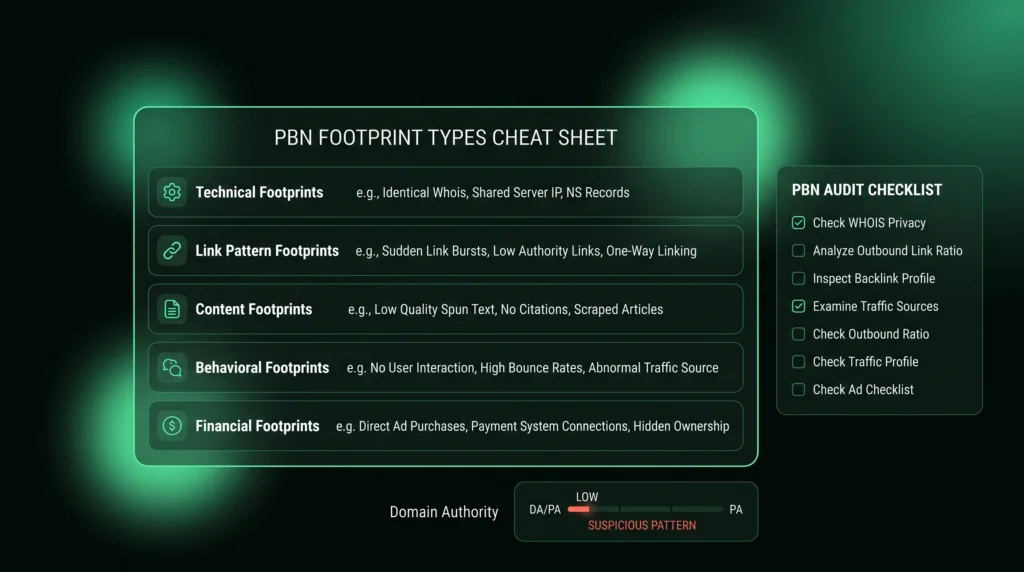
PBN footprint types fall into five practical categories: technical, link pattern, content, behavioral, and financial signals. A professional audit checks each category before any backlink is approved for client use.
- Technical footprints: IPs, DNS, hosting provider, CMS, theme, plugins.
- Link pattern footprints: anchors, outbound targets, link placement style.
- Content footprints: repeated article formats, author names, images, topic gaps.
- Behavioral footprints: publishing time, crawling patterns, update schedule.
- Financial footprints: registrar billing, ownership details, bulk buy hosting patterns.
This checklist helps SEO professionals compare different sites, audit link networks, and identify dangerous footprints before budget is committed.
Technical Footprints
Technical footprints are infrastructure signals that connect network sites. Common examples include the same IP address, related server blocks, repeated DNS records, shared WordPress configurations, identical plugins, and the same analytics or monetization codes across many sites.
A professional PBN agency diversifies hosting across multiple providers, uses different IP addresses, varies CMS setups when appropriate, and keeps every site technically independent. Infrastructure variation protects credibility at network level.
Link Pattern Footprints
Link pattern footprints appear when backlinks across different sites behave too similarly. Examples include repeated money site targets, identical anchor text, same article placement style, and outbound links pointing to one niche too often.
Our process evaluates anchor text distribution, destination page variety, and outbound link limits before placement. A natural link profile needs branded, partial-match, topical, and URL anchors placed with controlled timing.
Content Footprints
Content footprints show when multiple sites use the same editorial format, thin writing, repeated outlines, similar AI phrasing, or generic niche coverage. Even when text is technically unique, repeated judgment patterns can create visible similarity.
We build PBN content around niche relevance, aged domain history, and site-level topical identity. Original content helps every pbn property look like an independent website, not a recycled link placement shell.
Behavioral Footprints
Behavioral footprints involve timing, publishing rhythm, crawl frequency, and update habits across network sites. When several sites publish similar articles, link to similar targets, and update on the same schedule, the type of network becomes easier to recognize.
Our team staggers publishing and link placement. We also monitor indexing, organic traffic movement, and crawler access patterns so the network of websites behaves more like independent editorial properties.
Financial Footprints
Financial footprints can come from shared registrar accounts, repeated renewal dates, bulk domain purchasing patterns, payment records, and ownership similarities. These signals are often overlooked when building a network quickly.
A professional PBN infrastructure separates acquisition sources, registrar usage, ownership records where appropriate, and renewal timing. Strong operational control reduces unnecessary connections between several sites and protects campaign stability.
Why PBN Footprints Put Rankings At Risk
PBN footprints create risk when search engine systems can associate many sites with coordinated link placement behavior. Risk does not come from one isolated backlink alone. Risk usually grows when low-quality domains, visible infrastructure overlap, aggressive anchors, and unnatural link velocity appear together.
Professional PBN backlinks require the same seriousness as paid outreach, niche edits, or digital PR placements. Before publishing, our agency reviews domain history, topical fit, outbound link volume, anchor distribution, money-site authority, and indexing quality.
Search engine results are influenced by many signals. PBN backlinks can support ranking movement when execution quality is strong, but poor campaign control can reduce link equity or create instability in SERPs.
Algorithmic Detection Signals
Algorithmic detection signals are repeatable patterns that a crawler can evaluate at scale. These signals may include identical templates, common IPs, thin content, excessive outbound links, repeated anchors, and unnatural growth in backlinks.
A professional campaign reduces algorithm-visible patterns through diversified hosting, varied site design, original content, different cms configurations, and measured anchor text distribution. The objective is controlled authority building with fewer obvious connections across network sites.
Manual Review Exposure
Manual review exposure increases when a backlink profile looks unnatural during an audit. Reviewers can inspect site quality, content relevance, outbound links, author information, indexation status, and whether multiple sites appear related.
Our agency approaches PBN management as quality assurance. Every placement should make editorial sense inside the article, match the niche, support the target page, and avoid patterns that make link networks look careless.
Penalties, Deindexation, Traffic Loss
Ranking volatility, deindexation risk, and traffic loss can appear when networks rely on weak domains, low editorial standards, or repeated technical signals. We monitor PBN deindexation signals such as lost index status, sudden page drops, crawl changes, and organic visibility decline.
Professional monitoring does not promise guaranteed rankings. Professional monitoring helps identify reduced link value early, allowing the campaign team to adjust anchors, remove risky placements, or pause links from unstable network sites.
Risk Before Buying PBN Links
Risk before buying PBN links should be evaluated through measurable quality checks, not sales claims. A safe and reliable provider should explain domain sourcing, audit criteria, link placement standards, and indexation monitoring.
- Review aged domain history before purchase.
- Check referring domains with Ahrefs, Semrush, or Majestic.
- Confirm topical relevance between PBN site and target page.
- Inspect outbound link volume and anchor text patterns.
- Verify indexation before and after link placement.
Technical And Infrastructure Footprints
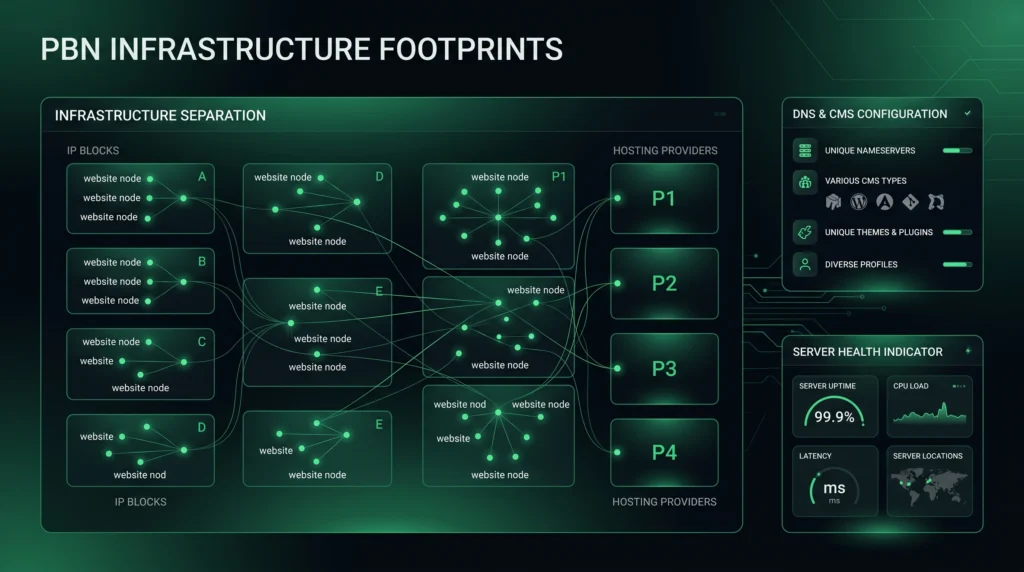
Technical footprints are the easiest patterns to create and often the easiest patterns to prevent. When multiple sites use the same hosting provider, same IP range, same WordPress theme, same plugins, and same analytics account, the entire network becomes more connected than necessary.
Our infrastructure standards separate sites across multiple providers, avoid bulk buy hosting setups, vary CMS choices where useful, and document every technical decision. Technical independence supports better quality control across multiple sites.
- Use different hosting providers and server locations.
- Avoid repeated themes, plugins, and page builders.
- Separate DNS, registrar, and CDN configurations.
- Keep tracking codes unique or remove unnecessary tracking.
- Review every site before contextual link placement.
Shared Hosting, IP, Server Blocks
Shared hosting, one IP address, and related server blocks can connect network sites quickly. Many low-quality operators build a pbn by putting several sites on one cheap hosting account, which creates obvious overlap across multiple sites.
We place network sites across different hosting environments and different ip addresses. Different hosting reduces infrastructure similarity, while stronger server hygiene improves crawler access, uptime, and indexing stability.
WHOIS, Registrar, Domain Ownership Patterns
WHOIS, registrar, and domain ownership patterns matter because expired domain acquisition can leave visible records. Aged domains should be reviewed for ownership history, past use, archive snapshots, and backlink profile quality before being added to network infrastructure.
Our team evaluates domains before acquisition, especially when clients want to buy PBN domains for SEO. The right expired domain has clean history, relevant backlinks, and no obvious abuse patterns.
DNS, Nameserver, CDN Similarity
DNS, nameserver, and CDN similarity can create technical connections across network sites. If every pbn site uses the same configuration, the group of sites may appear operationally related even when content and design are different.
We vary DNS providers, CDN usage, nameserver patterns, and security settings. This infrastructure planning helps different sites behave like independent web properties rather than one pbn copied across many sites.
CMS, Plugin, Theme Stack Repetition
CMS, plugin, and theme stack repetition creates recognizable patterns. WordPress is common across the web, but using the same template, identical plugin set, same menu structure, and repeated design blocks across network sites weakens independence.
Our team varies themes, layouts, plugin choices, internal linking, category structures, and article formatting. Every site should have its own editorial identity, technical stack, and topical purpose.
Analytics, Tracking, Monetization Codes
Analytics, tracking, and monetization codes can connect network sites when the same Google Analytics account, tag manager container, ad unit, or affiliate ID appears across several sites. These details are small, but crawler analysis can process them at scale.
We avoid unnecessary shared tracking across network sites. When analytics are needed, tracking setups are separated and reviewed during technical audit work before link placement goes live.
SSL, Email, Security Configuration Matches
SSL, email, and security configuration matches can expose shared operating habits. Repeated certificate issuers alone are common, but identical email setups, security plugins, login paths, and firewall rules across sites can add to other signals.
Our technical team reviews SSL, admin access, email records, and security configurations as part of footprint protection. Risk control improves when small signals are managed before they combine into larger patterns.
Content, Template, Site Design Footprints
Content and design footprints appear when network sites look editorially manufactured instead of independently maintained. Thin articles, repeated layouts, copied author bios, generic stock images, and identical sidebar structures can make different sites feel like one network.
Our editorial process gives every site a niche identity, content calendar, category structure, and design pattern. PBN content should support the domain’s history, link profile, and likely audience. A domain about outdoor equipment should not suddenly publish finance, casino, health, and SaaS content without a credible topical bridge.
Quality content also supports E-E-A-T signals. Practical author pages, real topic coverage, useful internal links, and consistent publishing help network sites appear more like real websites with a purpose beyond backlinks.
Repeated Publishing Style Across Network
Repeated publishing style becomes visible when every article uses the same length, same intro pattern, same heading style, and same conclusion format. A crawler can compare language patterns across sites, especially when articles target similar keywords.
Our writers vary article structure, search intent angle, formatting, and editorial voice. Different sites need different content habits, even when the agency manages all publishing internally.
Thin Content, Spun Text, AI Pattern Reuse
Thin content, spun text, and repeated AI pattern reuse weaken site quality. Low-quality pages can reduce link equity because contextual backlinks work best when surrounded by useful, relevant, and original content.
Our agency writes placement content around topical relevance, user intent, and natural editorial flow. We also review articles before publishing so every backlink appears inside a meaningful paragraph, not a generic placeholder.
Template Similarity And Fake Design Diversity
Template similarity can remain obvious even when colors and logos change. Using the same template across many sites, same menu structure, same homepage blocks, and same widget layout creates a repeated visual footprint.
We vary theme frameworks, homepage layouts, navigation, category pages, and blog presentation. Design diversity should be functional, not cosmetic, because fake diversity still produces recognizable patterns.
Topic Mismatch Between Domain History And Current Content
Topic mismatch occurs when an expired domain has a clear historical niche but the rebuilt website publishes unrelated content. A domain with past authority in gardening should not become a mixed blog about crypto, pets, and real estate overnight.
Our domain history checks use archive review, backlink context, anchor text history, and organic traffic clues. The rebuilt content plan should match the strongest historical signals of the aged domain.
Stock Images, Author Profiles, About Pages
Stock images, author profiles, and about pages can create content footprints when reused across network sites. Identical portraits, vague author bios, and generic company pages make network sites feel assembled rather than maintained.
We create distinct author identities, site descriptions, editorial policies, and visual choices. The goal is simple: every site should look like it has a real niche, audience, and publishing reason.
Link Profile Footprints: Outbound, Inbound, Anchor Text
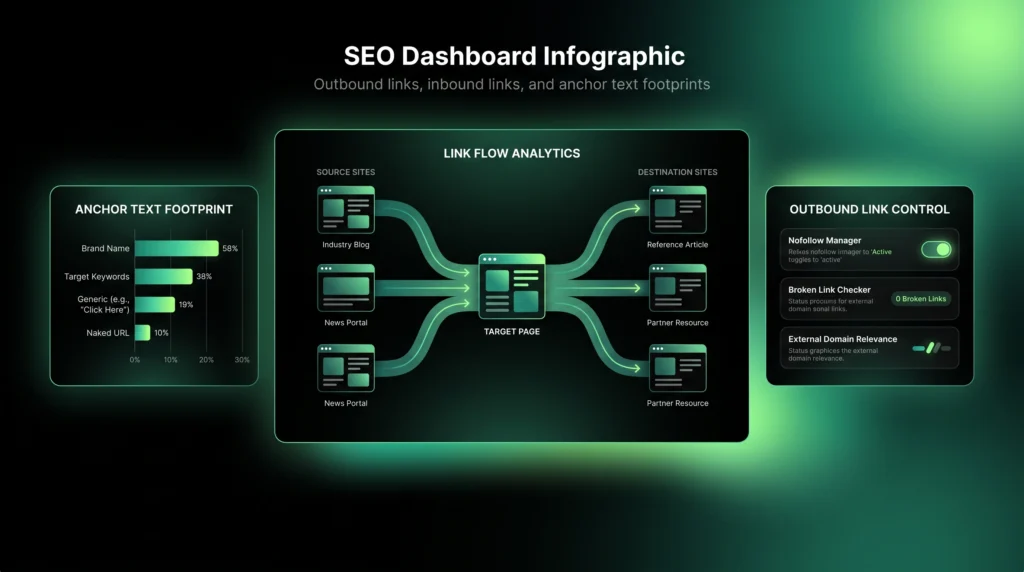
Link profile footprints are among the most important signals in PBN backlink management. Search engine systems can evaluate where links point, how often money pages receive anchors, whether outbound links are relevant, and whether several sites link to the same targets.
Our placement team reviews outbound link count, page relevance, anchor text distribution, and existing referring domains before publishing. Contextual backlinks should support content meaning, not interrupt it. A link placed inside a strong topical paragraph is more credible than a link forced into a generic article.
PBN backlinks provide stronger campaign control when outbound limits, anchor variation, and target page quality are managed together. Strong link placement is a planning decision, not a copy-paste task.
Outbound Link Patterns To Money Sites
Outbound link patterns appear when several network sites link to the same money site pages, use similar anchors, and publish links within the same timeframe. This pattern becomes more visible when many sites in one network point to one client.
- Limit outbound links per site and per article.
- Mix branded, topical, URL, and partial-match anchors.
- Place links inside relevant editorial context.
- Avoid linking several network sites to the same page too quickly.
- Review money-site backlink profile before new placement.
Anchor Text Over-Optimization
Anchor text over-optimization happens when exact-match keyword anchors appear too often. A natural link profile usually includes branded anchors, naked URLs, generic phrases, topical phrases, and occasional partial-match terms.
Our anchor planning considers current backlink profile, keyword difficulty, search engine results, and page intent. Aggressive anchors can create more risk than the PBN link itself, so anchor distribution is reviewed before publication.
Target Page Clustering
Target page clustering occurs when too many backlinks point to the same commercial URL. Even strong authority backlinks can look unnatural if every placement supports one landing page without supporting informational pages, category pages, or brand pages.
Our agency distributes links across target pages based on campaign goals. Money site authority grows more naturally when contextual link placement supports both commercial and informational assets.
Inbound Link Profile Reuse
Inbound link profile reuse happens when multiple PBN sites have similar referring domains, repeated anchor histories, or shared expired domain sources. This can happen when network owners buy domains from the same auctions without deeper backlink analysis.
We audit referring domains with Ahrefs, Semrush, Majestic, and manual review. Strong aged domains should have diverse referring domains, relevant historical links, and no obvious low-quality backlink clusters.
Behavioral, Timing, Entity, Identity Footprints
Behavioral, timing, entity, and identity footprints show how network sites operate over time. These signals include publishing frequency, update patterns, author names, brand mentions, social profiles, contact details, and the rhythm of contextual link placement.
A controlled private blog network needs editorial pacing. If many sites publish similar articles and build links on the same day, link velocity may appear unnatural. Our team uses staggered placement schedules, varied publishing windows, and campaign-specific anchor calendars.
Entity variation matters too. Different sites should not share the same author identity, about page language, address style, or contact formatting unless there is a legitimate reason. Operational realism supports long-term network stability.
Publishing Schedule And Link Timing
Publishing schedule and link timing are core parts of footprint protection. A sudden burst of backlinks from network sites can create unnatural link velocity, especially for newer money sites or pages with weak authority.
Our agency plans PBN link velocity based on keyword competition, current referring domains, page age, and campaign risk profile. Conservative timing protects link value better than rapid bulk placement.
Entity Signals, Author Names, Brand Mentions
Entity signals include author names, brand references, organization pages, social mentions, and topical associations. When every site has similar author names, bio formats, and brand language, the network of websites can appear centrally controlled.
We build distinct site-level entities with unique editorial positioning. Entity diversity helps each PBN site support its own niche identity instead of looking like part of one repeated publishing system.
Social Profiles, Contact Details, Legal Pages
Social profiles, contact details, and legal pages should fit each site’s purpose. Repeated email formats, copied privacy pages, identical footer text, and matching business details can add unnecessary similarity across different sites.
Our site maintenance team creates separate contact conventions, policy pages, and supporting trust pages. These details do not replace domain authority, but they improve site credibility and reduce careless operational overlap.
How To Spot Sites With PBN Links
You can spot sites with PBN links by reviewing technical signals, domain history, backlink quality, content consistency, and outbound link behavior. A single signal rarely proves anything. A cluster of repeated patterns across multiple sites is more meaningful.
Our agency performs manual and tool-based checks before accepting a site into managed infrastructure. The audit compares what the site claims to be with what the domain history, backlink profile, content quality, and indexation status actually show.
- Check whether the domain is indexed.
- Review historical snapshots and previous niche.
- Analyze referring domains and anchors.
- Inspect outbound links and target pages.
- Compare design, CMS, plugins, and hosting.
- Evaluate content quality and publishing behavior.
Backlink Profile Review Process
Backlink profile review starts with referring domains, anchor text history, link type, and topical relevance. Tools like Ahrefs, Semrush, Majestic, and Moz help identify expired domain strength, but manual review is still required.
Our audit checks whether backlinks come from real pages, relevant websites, and stable referring domains. A strong metric alone is not enough when the backlink profile contains irrelevant, low-quality, or obviously manufactured links.
Domain History And Archive Checks
Domain history and archive checks reveal whether an aged domain had a legitimate past. Archive snapshots can show previous niche, language, ownership changes, redirects, spam periods, and content gaps.
Our acquisition team reviews historical content before rebuilding a site. An expired domain with clean history, stable topical signals, and relevant backlinks is stronger than a high-metric domain with confusing or abused history.
Manual Site Quality Review
Manual site quality review evaluates what a crawler and a real reader can see. We inspect content depth, navigation, contact pages, internal links, category logic, image use, outbound links, and whether every site serves a realistic niche purpose.
A PBN site should not look abandoned. Real websites with original content, updated pages, and controlled outbound linking usually provide better campaign stability.
Competitor Link Overlap Analysis
Competitor link overlap analysis shows whether multiple ranking websites receive backlinks from the same group of sites. In competitive niches, SEO teams often compare link networks to estimate strategy, authority gaps, and link equity sources.
Our agency uses competitor data carefully. Link overlap can reveal useful opportunities, but every potential placement still needs domain history review, topical fit, and outbound link control before approval.
Tools For Checking PBN Sites
SEO tools help identify patterns, but tools do not replace agency judgment. A professional audit combines crawler data, backlink metrics, archive review, and manual site inspection.
- Ahrefs: referring domains, anchors, link growth, lost links.
- Semrush: organic traffic, keyword visibility, backlink trends.
- Majestic: Trust Flow, topical categories, historical link data.
- Screaming Frog: technical review, outbound links, metadata.
- Google Search Console: indexing checks for owned properties.
Risk Reduction, Damage Control, Safer Alternatives
Risk reduction begins before link placement and continues after publication. A controlled PBN campaign reviews domain quality, content relevance, anchor text, link velocity, infrastructure separation, indexation stability, and target page strength.
If risky backlinks already exist, the response should be measured. Not every questionable link needs immediate removal, and not every ranking change is caused by PBN backlinks. Professional diagnosis compares ranking movement, crawl data, indexing, anchor ratios, and competitor activity.
Some websites use editorial outreach, guest posts, niche edits, digital PR, PBN backlinks, or tiered link building depending on budget, competition, timeline, and risk profile. The best strategy is the one with clear quality standards and realistic expectations.
How Footprints Accumulate Before Network Gets Burned
Footprints accumulate when small patterns combine. Same hosting, same themes, same anchors, same money site targets, thin content, and synchronized publishing can turn several minor signals into one visible network pattern.
A professional agency prevents this by treating every pbn property as a separate website. Footprint protection works best when infrastructure, content, link placement, and timing are managed together.
What To Do When Risky PBN Links Appear
When risky PBN links appear, the first step is diagnosis. Review whether the link is indexed, whether the source site still has quality signals, whether anchor text is aggressive, and whether rankings changed after placement.
Our team checks PBN backlink indexation checks before making decisions. If a placement has reduced value or creates unnecessary risk, adjustment may be better than immediate removal.
Link Removal, Disavow, Monitoring Workflow
Link removal, disavow, and monitoring decisions should follow evidence. We review link source quality, anchor distribution, traffic movement, indexing status, and page-level ranking trends before taking action.
- Export backlink data from Ahrefs, Semrush, and Google Search Console.
- Separate low-quality links from controlled placements.
- Contact providers when removal is practical.
- Use disavow only when risk evidence is clear.
- Monitor rankings, crawl activity, and indexation changes.
Outreach, Guest Posts, Digital PR
Outreach, guest posts, digital PR, niche edits, and PBN backlinks can all support authority building when used with quality standards. These methods differ in control, cost, timeline, editorial approval, and link placement certainty.
Our agency does not frame one method as universally better. Campaign planning depends on niche competition, existing backlink profile, budget, link velocity, and tolerance for controlled network-based placements.
Sustainable Portfolio Link Building
Sustainable portfolio link building uses multiple link sources without creating overlap across client campaigns. Agencies managing competitive clients need client isolation, anchor variation, niche separation, and careful reporting.
Our managed PBN services limit outbound links, review target pages, stagger placement timing, and maintain network sites with original content. Long-term stability comes from operational discipline, not volume alone.
Agency And Client Isolation Practices
Agency and client isolation practices prevent one campaign from creating risk for another. Competitive clients should not receive repeated links from the same network sites, same anchors, or same publishing batches.
Our internal records track placement history, anchor usage, target URLs, domain categories, and outbound link counts. This documentation helps maintain separation across multiple sites, different niches, and long-term campaigns.
FAQ About PBN Footprints And Risky Networks
A PBN in SEO is a private blog network used to publish contextual backlinks from controlled websites to target pages. Professional PBN backlinks rely on aged domains, topical relevance, original content, and outbound link limits. Quality depends on execution, because weak domains, poor anchors, or visible network footprints can reduce link value.
PBN backlinks can support SEO when the campaign uses strong aged domains, relevant content, conservative anchor text, and controlled link velocity. The strategy is best suited for websites with clear quality standards and realistic risk tolerance. Results depend on domain quality, money-site strength, competition, and ongoing monitoring.
You check PBN sites by reviewing indexation, domain history, referring domains, anchor text, outbound links, hosting, CMS setup, content quality, and topical relevance. Ahrefs, Semrush, Majestic, archive tools, and manual review help identify strengths and visible patterns. One weak signal matters less than several connected signals.
A PBN network becomes risky when multiple sites share obvious footprints such as repeated IPs, same templates, shared plugins, thin content, aggressive anchors, and unnatural link velocity. Risk also increases when expired domains have poor history or irrelevant backlinks. Professional management reduces these issues through vetting and separation.
PBN links can contribute to ranking volatility when placements come from low-quality domains, irrelevant content, over-optimized anchors, or unstable indexed pages. A controlled campaign reduces risk by reviewing domain history, backlink profile strength, topical relevance, and target page quality before publication. No provider should promise guaranteed rankings.
You can avoid risky PBN footprints by diversifying hosting, using different ip addresses, varying WordPress themes and plugins, limiting outbound links, publishing original content, and controlling anchor text distribution. Strong agencies also monitor indexing, link velocity, and domain quality after placement. The strongest protection is disciplined operation across every site.