

Shutting down a private blog network is rarely a simple process. Whether you are consolidating assets, retiring a campaign, or restructuring your link-building infrastructure, the records you preserve before closing a network can determine how much value and operational knowledge you retain afterward. Archiving PBN records systematically means you can recover domain histories, reconstruct link maps, audit past placements, and make informed decisions about which assets are worth repurposing rather than abandoning entirely.
Key Takeaways
- Archiving PBN records before shutdown preserves domain history, link placement data, content assets, and hosting configurations that are difficult or impossible to reconstruct later.
- A structured record-keeping process covers domain registration details, backlink profiles, anchor text logs, content archives, and registrar or hosting account credentials.
- Preserved records allow you to evaluate which expired or aged domains retain enough link equity to be repurposed, sold, or redirected rather than simply dropped.
- Link maps and placement logs help you understand the ongoing impact of past PBN placements on target sites, even after the network itself goes offline.
- The archiving process should begin well before the planned shutdown date to allow time for crawling, exporting, and verifying each record category.
Why Archiving PBN Records Matters Before Closure
A private blog network represents a significant investment of time, capital, and domain research. When a network is shut down without a structured archiving process, that investment can disappear almost entirely. Domain registration data, content, backlink profiles, hosting configurations, and placement logs are all time-sensitive records. Once a domain expires or a hosting account is closed, recovering the associated data becomes difficult and sometimes impossible. Archiving before shutdown converts what might otherwise be a total write-off into a documented asset inventory that informs future link-building decisions.
Beyond preserving financial value, archived records serve an operational purpose. If you manage link placements for client websites, a clear record of which PBN domains linked to which target pages, using which anchor text, allows you to monitor the downstream effect of those placements even after the network is no longer active. Ranking changes, indexing shifts, and backlink profile fluctuations on target sites can be assessed against the historical placement data rather than guessed at. This is particularly relevant when a client asks why a specific page’s backlink count changed or why a previously indexed link no longer appears in a crawl tool.
Archiving also supports domain repurposing decisions. Some PBN domains, particularly aged domains with strong referring domain histories and clean anchor text distributions, may retain enough link equity to justify redirection, sale, or reuse in a future network. Without a documented record of each domain’s metrics, content history, and backlink profile at the time of shutdown, evaluating repurposing potential requires starting the research process from scratch, often with less complete data than was available before the domain lapsed.
Domain Registration and Ownership Records
The first category of records to archive covers domain registration details. For each domain in the network, document the registrar, registration date, expiry date, renewal cost, and the account credentials or account reference used to manage the domain. If domains are registered across multiple registrars to reduce footprint, maintain a consolidated record that maps each domain to its registrar account. This prevents confusion during the shutdown process and ensures that domains intended for renewal or transfer are not accidentally allowed to lapse.
Alongside registration data, record the original acquisition source for each domain. Domains acquired through auction platforms, expired domain marketplaces, or direct purchase from previous owners often carry historical context that affects their repurposing value. Knowing that a domain was acquired at auction because of its referring domain profile, for example, is information that helps a future buyer or a new campaign manager assess the asset accurately. Note the acquisition price, the platform or seller, and the date of acquisition for each domain in the network.
If any domains are registered under privacy protection services, document the underlying registrant details separately in a secure internal record. Privacy protection masks public WHOIS data but does not eliminate the need for internal ownership documentation. When transferring or selling a domain after network closure, the registrant details will be required to complete the process.
Backlink Profile Exports and Link Maps
Exporting the backlink profile of each PBN domain before shutdown is one of the most operationally valuable steps in the archiving process. Tools such as Ahrefs, Semrush, and Majestic each index backlink data differently and at different update frequencies, so running exports from more than one tool increases the completeness of the record. For each domain, export the full referring domain list, the individual backlink list with source URLs and target URLs, the anchor text distribution, and the link attribute data including follow and nofollow designations.
These exports serve two distinct purposes. First, they document the inbound link profile of each PBN domain itself, which is relevant when assessing whether a domain retains enough authority to justify repurposing or sale. A domain with a strong, topically relevant referring domain profile and a clean anchor text distribution is a materially different asset from one with a thin or heavily manipulated profile. Second, the exports capture the outbound link data, meaning the placements each PBN domain made to target sites. This outbound record forms the basis of your link map.
A link map is a structured record that connects each PBN domain to the target pages it linked to, the anchor text used for each placement, the approximate date the link was published, and the page on the PBN domain where the link appeared. Maintaining this map in a spreadsheet or database format allows you to cross-reference it against target site backlink profiles after shutdown. If a target site’s referring domain count drops following network closure, the link map tells you exactly which placements were lost and from which domains, rather than requiring a full retrospective audit.
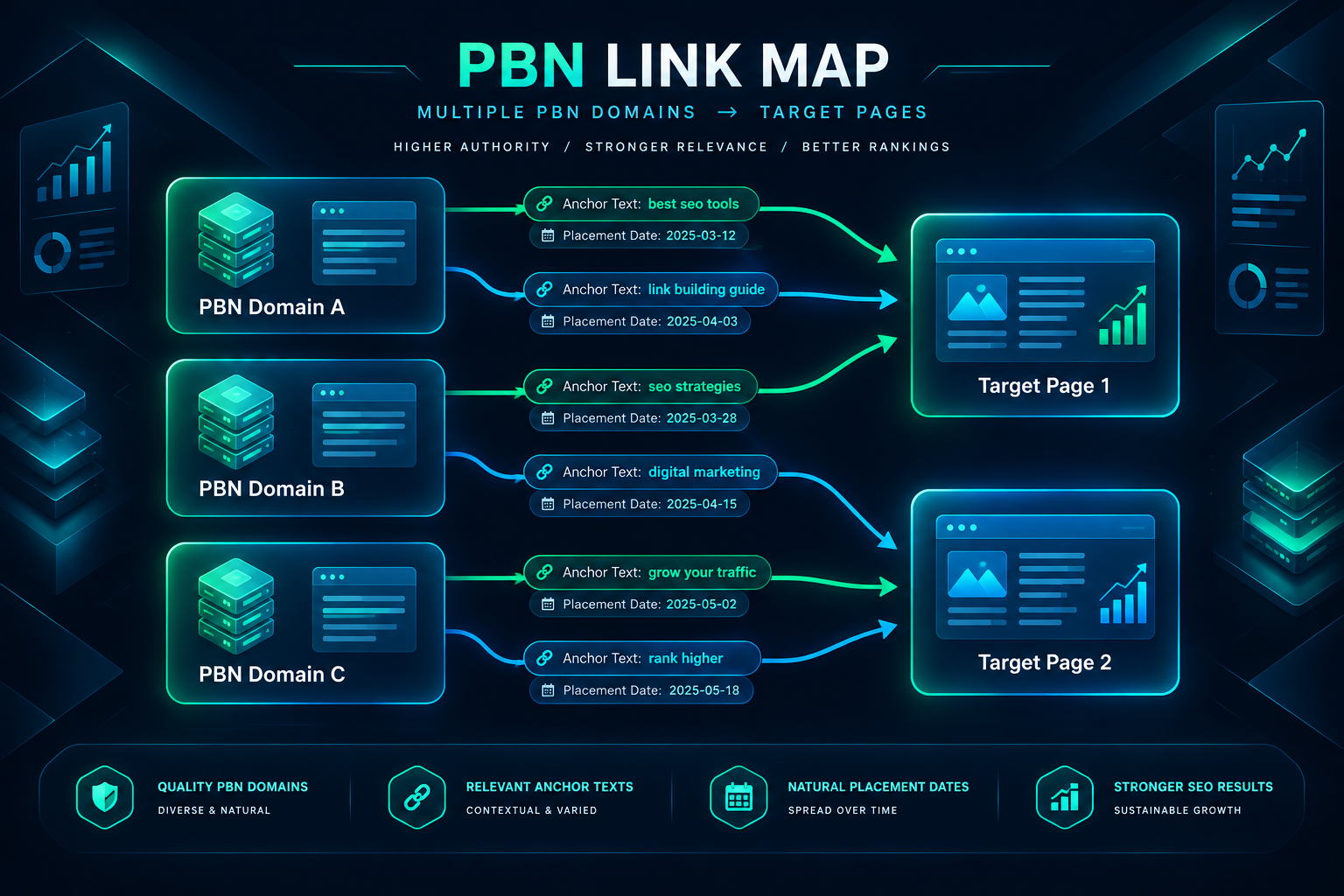
Where possible, supplement the tool exports with a manual crawl of each PBN domain’s outbound links before the domain goes offline. Crawling tools such as Screaming Frog can extract all outbound links from a domain’s pages in a single pass, providing a ground-truth record that is not dependent on a third-party index’s crawl frequency or coverage gaps.
Content Archives and On-Page Asset Records
The content published on PBN domains represents a secondary but meaningful asset category. Before shutting down a network, archive the full text of every article or page that contained a link placement. This serves several purposes: it documents the contextual environment of each link, it preserves content that may be repurposed or adapted for future use, and it provides a reference point if a client or campaign manager later questions the quality or relevance of a specific placement.
Content archiving can be approached at different levels of completeness. At a minimum, export the raw text of each placement page, including the title, body content, and the anchor text and target URL of each embedded link. A more complete archive includes the full HTML of each page, any associated images, and the internal linking structure of the domain. The Wayback Machine at web.archive.org may already hold snapshots of some PBN domains, but relying on public archiving alone is not sufficient because crawl coverage is inconsistent and some pages may never have been indexed by the archive.
For WordPress-based PBN sites, which represent a common CMS choice for private blog networks, the most reliable content export method is a full database backup combined with a file system backup of the WordPress installation. A database backup captures all posts, pages, metadata, and settings in a format that can be restored to a new installation if needed. Exporting content through the WordPress built-in export tool produces an XML file that is portable but does not capture all database fields or plugin-generated content. For a complete record, a direct database export via phpMyAdmin or a hosting control panel backup tool is preferable.
Hosting Configuration and Technical Records
Hosting configuration details are often overlooked during network shutdown but can be important when evaluating footprint management decisions or when troubleshooting issues that emerge after closure. For each domain in the network, record the hosting provider, the server or plan type, the IP address or IP range, the nameserver configuration, and any CDN or proxy services such as Cloudflare that were used to manage the domain’s DNS. If the network used a spread of hosting providers and IP ranges to reduce footprint visibility, this configuration data documents the approach taken and informs future network design decisions.
Record any custom server configurations, redirect rules, or .htaccess settings that were applied to individual domains. If a domain was set up with a 301 redirect to a target site or to a holding page, document the redirect destination and the date it was implemented. Redirect configurations affect how link equity flows after a domain goes offline, and understanding the redirect history of each domain is relevant when assessing the residual value of the asset.
Hosting account credentials should be stored securely and separately from the domain registration records. If hosting accounts are being closed as part of the shutdown, export any available server logs before canceling the account. Server logs can provide a record of crawl activity, which may be useful for understanding how frequently each PBN domain was crawled by search engine bots during its active period.
Anchor Text Logs and Placement Strategy Records
Anchor text strategy is one of the most operationally sensitive aspects of a PBN campaign, and preserving a detailed anchor text log before shutdown is essential for managing the ongoing backlink profiles of target sites. For each target site that received links from the network, compile a complete record of every anchor text variation used, the domain from which it was placed, the target URL it pointed to, and the approximate publication date. This record allows you to assess the anchor text distribution across the remaining backlink profile of each target site after the PBN links go offline.
Anchor text distribution affects how a target site’s backlink profile appears to search engine evaluation systems. When a set of PBN links with specific anchor text patterns is removed from a profile, the remaining distribution shifts. Having a documented record of the removed anchors allows you to understand the new distribution and make informed decisions about future link-building activity on the same target site. Without this record, assessing the impact of the network closure on anchor text balance requires a full retrospective audit of the target site’s backlink profile, which is time-consuming and may not capture the pre-closure state accurately.
Beyond anchor text, preserve any campaign notes or strategy documents that describe the placement rationale for each domain. Notes about why a specific domain was chosen for a particular niche, how the content was structured to support topical relevance, or how link velocity was managed over the campaign period are all records that inform future campaign design. These documents are rarely recoverable after a network is shut down and accounts are closed.
Metrics Snapshots and Domain Valuation Records
Third-party authority metrics such as Domain Rating from Ahrefs, Domain Authority from Moz, Trust Flow from Majestic, and similar proprietary scores are not Google ranking signals, but they are commonly used as proxy indicators of domain quality during acquisition and repurposing decisions. Before shutting down a network, take a snapshot of the current metrics for each domain across the tools you use. Record the metric values, the tool version or date of the snapshot, and any notable changes in metrics that occurred during the domain’s active period in the network.
These snapshots serve as a baseline for evaluating domain value at the time of closure. If you plan to sell domains from the network, the metrics snapshot provides documentation that supports the asking price. If you plan to repurpose domains in a future network or redirect them to a target site, the metrics record helps you prioritize which domains are worth the effort. A domain with a stable referring domain count, a clean anchor text profile, and consistent metrics over time is a materially stronger candidate for repurposing than one with declining metrics or a history of aggressive anchor text patterns.
Alongside third-party metrics, record the organic traffic history of each domain if traffic data is available. Domains that attracted genuine organic traffic during their active period, even modest amounts, may carry additional value as repurposing candidates. Google Search Console data, if the domains were verified, provides the most direct record of impressions, clicks, and indexed pages. Export this data before removing the domain from Search Console or before the domain expires and verification is lost.
Sequencing the Archiving Process Before Shutdown
The archiving process should begin at least four to six weeks before the planned shutdown date for a network of moderate size. Starting early allows time to run multiple tool exports, complete manual crawls, export database backups, and verify that each record category is complete before any domains are allowed to lapse or hosting accounts are canceled. Rushing the process in the final days before shutdown increases the risk of missing records that cannot be recovered afterward.
A practical sequence for the archiving process begins with the most time-sensitive records. Domain registration details and expiry dates should be documented first, because an accidentally lapsed domain can be acquired by a third party within days of expiry. Backlink profile exports from Ahrefs, Semrush, and Majestic should follow, as these exports capture the link data at a specific point in time and the index data will continue to change after the network goes offline. Content exports and database backups come next, followed by hosting configuration records and metrics snapshots.
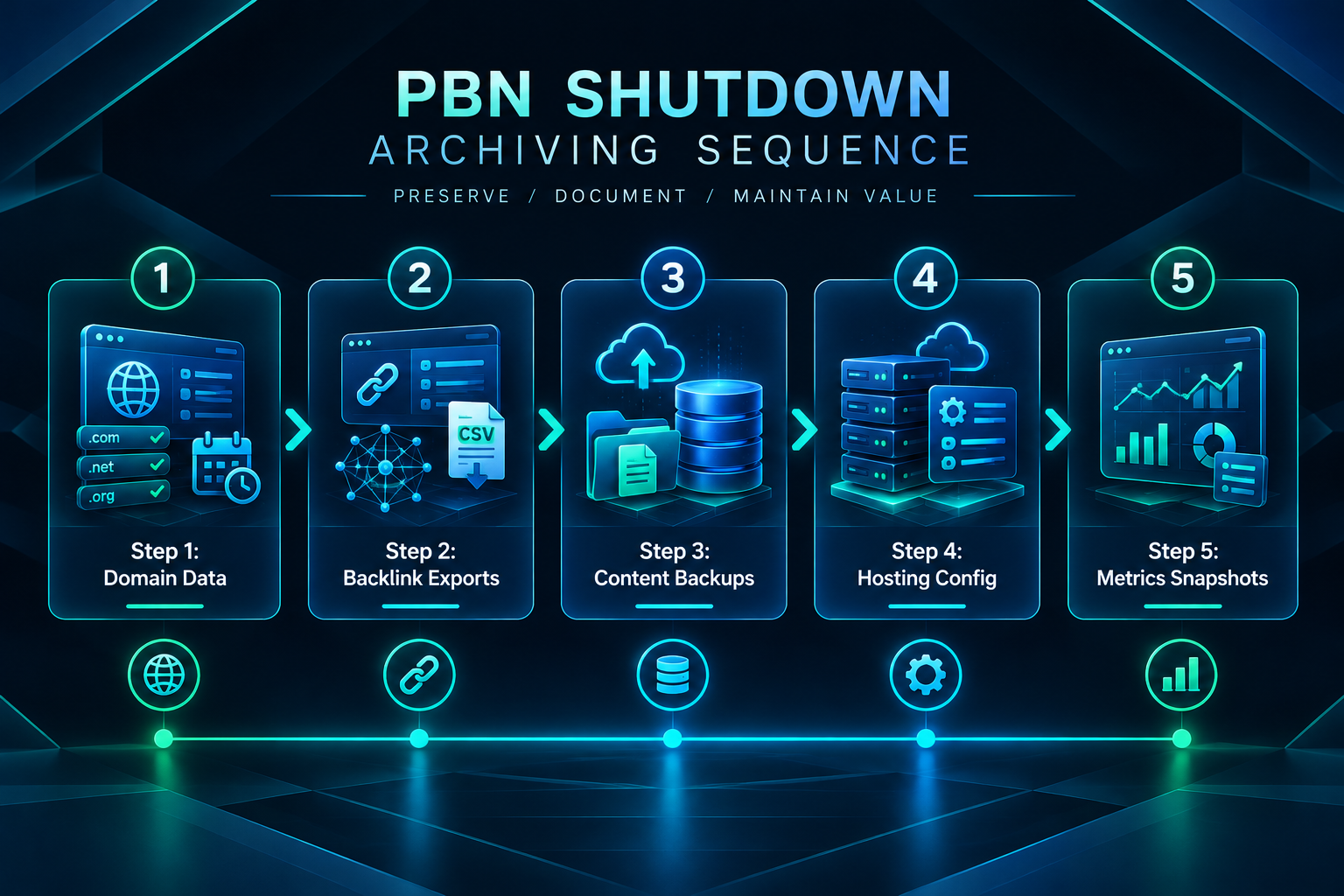
Once the record categories are complete, compile them into a structured archive organized by domain. A folder structure that groups each domain’s records together, with consistent file naming conventions, makes the archive usable for future reference rather than a disorganized collection of exports. Store the archive in at least two locations, such as a local drive and a cloud storage service, to protect against data loss. Sensitive records including account credentials should be stored in an encrypted format or a dedicated password management system rather than in plain text files.
What to Do With Archived Records After Shutdown
Archived PBN records have several practical uses after a network is closed. Domain repurposing decisions are the most immediate application. Using the backlink profile exports and metrics snapshots, you can identify which domains from the closed network are strong enough to redirect to a target site, sell to another operator, or incorporate into a future network. Domains with high-quality referring domain profiles, clean anchor text histories, and stable metrics are the strongest candidates. Domains with thin profiles, aggressive anchor patterns, or declining metrics may not justify the cost of renewal and transfer.
Link maps and anchor text logs remain useful for monitoring target site performance after network closure. If a target site experiences a ranking change following the shutdown, the link map allows you to identify which placements were lost and assess whether the change correlates with the removal of specific links. This is not a definitive diagnostic tool, because ranking changes can result from many factors, but it provides a structured starting point for investigation rather than requiring a full retrospective audit.
Campaign strategy records and placement notes inform future link-building decisions. Understanding which domain types, content approaches, and anchor text strategies produced the most stable placements during the network’s active period helps refine the approach for future campaigns. This institutional knowledge is only available if it was documented during the network’s operation and preserved through the archiving process.
Planning a Network Shutdown With Minimal Data Loss
Archiving PBN records before shutting down a network is fundamentally a data management exercise, but it has direct implications for the long-term value of your link-building investment. The domains, content, placement history, and configuration data that make up a private blog network represent accumulated research and operational decisions that are difficult to reconstruct from scratch. A structured archiving process converts that accumulated knowledge into a documented asset inventory that remains useful long after the network itself goes offline.
If you are evaluating a network shutdown and want to understand which domains or placements may retain value, or if you are planning a new PBN campaign and want to build record-keeping practices into the process from the start, reviewing your archiving approach with an experienced link-building specialist can help you identify gaps before they become permanent losses. PBN Backlinks Service works with website owners and SEO professionals on domain assessment, placement strategy, and backlink profile evaluation. Discussing your network’s asset inventory before making closure decisions may reveal repurposing opportunities that are not immediately obvious from the metrics alone.
Frequently Asked Questions
How long before shutdown should I start archiving PBN records?
For a network of moderate size, beginning the archiving process four to six weeks before the planned shutdown date gives you enough time to complete all record categories without rushing. Larger networks with many domains may require more lead time, particularly if you are running exports from multiple backlink analysis tools and completing manual crawls of each domain.
Which backlink analysis tools are most useful for exporting PBN domain profiles?
Ahrefs, Semrush, and Majestic each index backlink data independently and at different update frequencies. Running exports from more than one tool produces a more complete record than relying on a single source. Screaming Frog is useful for crawling each domain’s outbound links directly, providing a ground-truth record that is not dependent on a third-party index’s coverage.
What happens to PBN links pointing to target sites after the network goes offline?
When a PBN domain goes offline or expires, the links it contained are no longer accessible to crawlers. Backlink analysis tools will eventually remove or mark these links as lost in their indexes, and the referring domain count for the target site will decrease accordingly. The timing of this change varies depending on how frequently each tool recrawls the source domain. A link map created before shutdown allows you to track which placements were lost and when.
Can archived PBN domains be repurposed or sold after network closure?
Yes, domains with strong referring domain profiles, clean anchor text histories, and stable third-party metrics can be repurposed through redirection, incorporated into a future network, or sold to another operator. The archived records, particularly the backlink profile exports and metrics snapshots, provide the documentation needed to assess repurposing value and support a sale if that is the intended outcome.
Is it necessary to archive content from every page on each PBN domain?
At a minimum, archive the content from every page that contained a link placement, including the full text, the anchor text used, and the target URL. A more complete archive includes all pages on each domain, which is practical for smaller networks. For larger networks, prioritizing placement pages and the domain’s most-linked pages is a reasonable approach if time or resources are limited.
Should Google Search Console data be exported before shutting down PBN domains?
If any PBN domains were verified in Google Search Console, exporting the available performance and coverage data before removing the domain or allowing it to expire is worthwhile. This data provides a direct record of impressions, clicks, and indexed pages that is not available through third-party tools and cannot be recovered after verification is lost.