

Whether PBN links can cause a sitewide penalty is one of the most practically important questions in link-building risk assessment, and the honest answer is more nuanced than most discussions suggest. Google’s documented enforcement system distinguishes between actions that affect individual pages and actions that affect an entire domain, and the scope of any enforcement response depends on factors that are not fully disclosed publicly. Understanding what is actually documented, what remains uncertain, and what variables may influence enforcement scope helps website owners and SEO practitioners make more informed decisions about their backlink strategy.
Key Takeaways
- Google’s manual action system formally distinguishes page-level and sitewide enforcement, and these are not the same outcome.
- No publicly documented threshold specifies how many PBN links, or what proportion of a backlink profile, triggers a sitewide rather than page-level response.
- Algorithmic link devaluation, manual actions, ranking declines, and sitewide penalties are distinct concepts and must not be treated as interchangeable.
- The scope of any enforcement response is likely influenced by the scale, pattern, and perceived intent of the link-building activity, though Google has not published a formula for this determination.
- Quality assessment, backlink profile monitoring, and provider transparency are the most actionable factors within a website owner’s control.
How Google Distinguishes Page-Level and Sitewide Enforcement
Google’s Search Console documentation describes manual actions as either partial matches or sitewide matches. A partial match manual action targets specific pages or sections of a website where a policy violation has been identified, leaving the rest of the site unaffected in terms of that particular action. A sitewide manual action applies to the entire domain and is typically associated with patterns that Google’s reviewers determine affect the site as a whole rather than isolated pages. These are formally different outcomes with different implications for organic visibility, and conflating them leads to inaccurate risk assessments.
When a manual action is issued for unnatural links, Google’s documentation indicates that the action may be applied to the specific pages receiving or benefiting from those links, or to the entire site if the pattern is considered pervasive. The distinction matters because a page-level action may suppress rankings for targeted pages while leaving other sections of the site largely intact, whereas a sitewide action affects all indexed pages. Neither outcome is guaranteed by the presence of PBN links alone, and neither is the only possible response. Google may also choose to algorithmically devalue specific links without issuing any manual action at all, which is a separate mechanism entirely.
It is important to be precise about terminology here. A ranking decline is not the same as a manual action. Algorithmic devaluation of a link is not the same as a penalty. Deindexation of a page is not the same as a sitewide penalty. Each of these represents a different type of search-engine response with different causes, different signals in Search Console, and different implications for recovery. Treating all of these as equivalent overstates the certainty of any particular outcome.
What Factors May Influence Enforcement Scope
Google has not published a formula that determines when a link-related enforcement action becomes sitewide rather than page-level. However, the documented language around manual actions for unnatural links refers to patterns, scale, and the degree to which manipulative link-building appears to be a deliberate site-wide strategy. Several factors are reasonably understood to be relevant to this assessment, even though the precise weighting of each factor is not public.
The proportion of a site’s backlink profile that consists of links Google considers manipulative is one plausible factor. A small number of flagged links pointing to a handful of pages may be more likely to result in a page-level response than a large-scale pattern of similar links pointing across many pages of the same domain. However, this is an inference from the documented language, not a confirmed threshold. Google has not stated that a specific percentage of a backlink profile triggers a sitewide action.
The apparent intent behind the link-building activity is another factor referenced in Google’s spam policies. Links that appear to be part of a coordinated scheme to manipulate rankings across an entire site are treated differently from isolated instances. This is why the scale, consistency, and footprint of a link-building campaign may affect the scope of any enforcement response, even if the individual links are similar in type.
The history of the domain receiving the links also matters. A site that has previously received a manual action, has a thin or low-quality content profile, or has other policy concerns may face a different enforcement response than a well-established site with a diverse and largely organic-looking backlink profile. Enforcement scope is not determined by link type alone.
Anchor text distribution is another variable that SEO practitioners commonly discuss in relation to enforcement risk. A backlink profile dominated by exact-match commercial anchor text pointing to the same pages, particularly when those links come from sources that share detectable patterns, may attract more scrutiny than a profile with varied anchor text and diverse link sources. Again, no public threshold defines when anchor text concentration becomes a trigger for sitewide action.
Algorithmic Devaluation vs Manual Actions: A Critical Distinction
A significant portion of Google’s response to links it considers manipulative does not involve manual actions at all. Google’s systems are designed to identify and algorithmically devalue links that appear to be part of link schemes, meaning those links may simply not pass ranking signals rather than triggering a formal penalty. This is an important distinction for anyone assessing PBN-related risk, because algorithmic devaluation does not appear in Search Console as a manual action, does not require a reconsideration request, and may not produce the dramatic ranking collapse associated with a sitewide penalty.
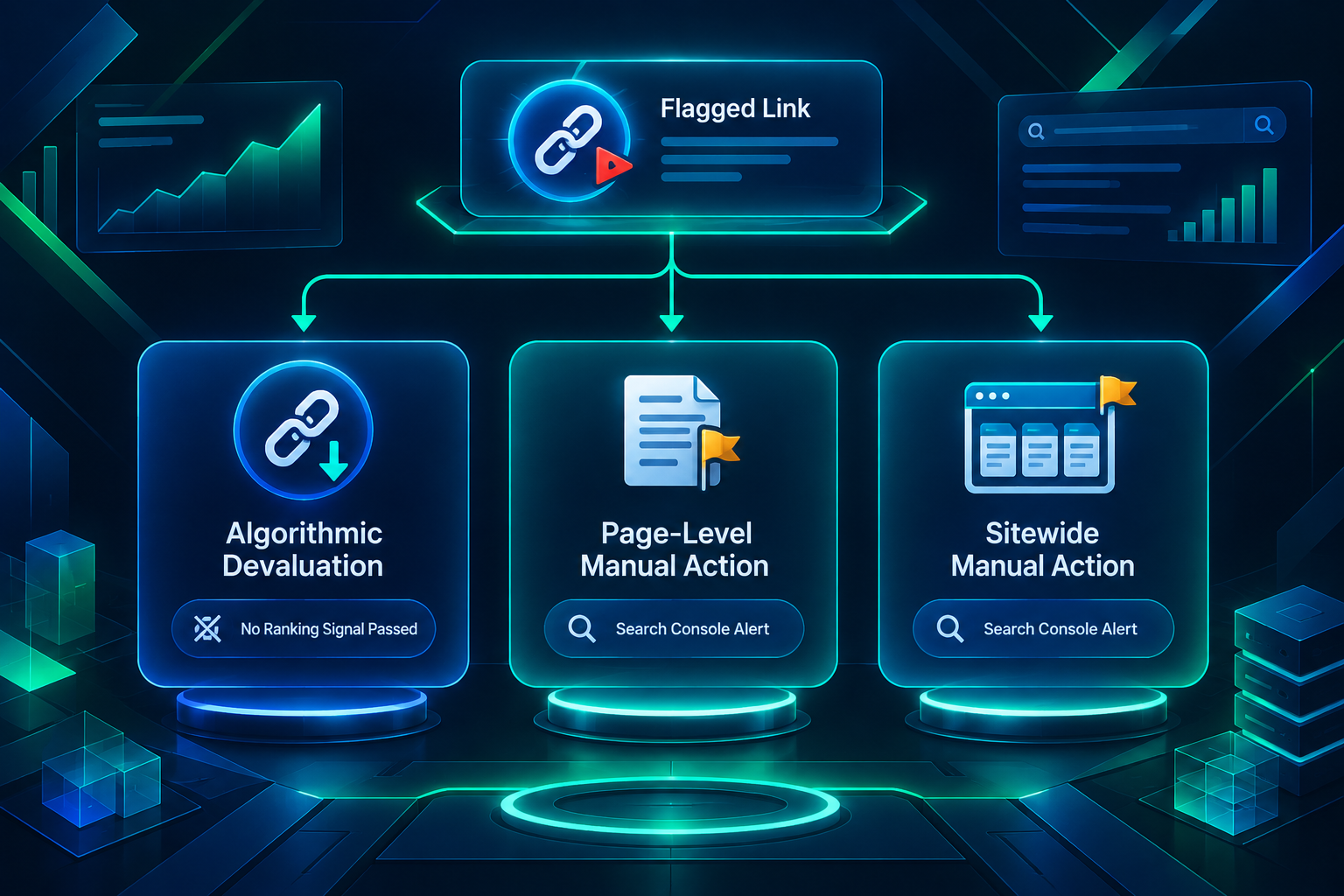
The practical implication is that many websites using PBN links may experience one of several outcomes: the links pass some ranking value, the links are devalued and pass little or no value, or in cases where Google’s reviewers identify a pattern that warrants manual review, a manual action is issued. The last outcome is the one most commonly described as a penalty, and it is the one that can be sitewide in scope. But it is not the automatic or inevitable result of every PBN link placement, and the conditions under which manual review is triggered are not fully documented.
Website owners who observe a ranking decline after acquiring PBN links should not automatically assume a sitewide manual action has occurred. Search Console’s manual actions report is the appropriate place to check for a formal action. A ranking decline without a manual action may reflect algorithmic changes, content quality assessments, competitor improvements, or link devaluation, none of which are the same as a sitewide penalty.
The Role of Network Quality and Footprint in Enforcement Risk
The characteristics of the PBN itself are relevant to enforcement risk, though they do not determine outcomes with certainty. Networks that share obvious footprints, such as identical hosting configurations, similar site structures, thin or templated content, and overlapping ownership signals, may be more readily identified by automated systems. Networks built on domains with strong, relevant link histories, genuine topical content, and varied technical configurations present a different profile. These are quality and implementation variables, not fixed characteristics of every private blog network.
Domain history is a particularly relevant factor. Expired domains used in a PBN carry the backlink profile and topical associations of their previous use. A domain with a strong, relevant link history from its original purpose may contribute more meaningful signals than one with a thin or manipulated history. Conversely, a domain that was previously penalized, used for spam, or has an inconsistent topical history may introduce additional risk rather than ranking value. Evaluating domain history before use is a standard part of responsible PBN domain selection.
Topical relevance between the PBN site and the target page is another quality factor. A contextual link from a PBN site covering a closely related topic, placed within genuinely useful content on a relevant page, presents a different signal profile than a link from an unrelated site with thin content. The placement context, surrounding content quality, and relevance of the linking page to the target page all contribute to how the link is assessed, both algorithmically and by human reviewers if a manual review occurs.
Page-Level Effects and When They May Occur
A page-level manual action for unnatural links is the more targeted enforcement outcome. It may affect specific pages that are receiving links Google considers manipulative, without extending the action to the entire domain. This type of action is more likely when the flagged link pattern is concentrated on particular pages rather than distributed across the site, and when the rest of the site’s backlink profile and content quality do not suggest a site-wide manipulation strategy.
Page-level actions are still meaningful in their impact. If the pages receiving a partial manual action are the site’s primary commercial or ranking pages, the practical effect on organic visibility can be significant even without a sitewide action. The distinction between page-level and sitewide is about the formal scope of enforcement, not about whether the outcome matters to the website’s performance.
Recovery from a page-level manual action typically involves addressing the specific links or patterns identified, submitting a reconsideration request with documentation of the steps taken, and waiting for Google’s review. The timeline for this process varies and is not guaranteed. Disavowal of specific links may be part of the response, but it is not automatically required in every situation, and its effectiveness depends on the specific circumstances of the action.
Monitoring Your Backlink Profile and Search Console
Active monitoring is the most practical tool for detecting enforcement actions early and assessing the health of a backlink profile over time. Google Search Console’s manual actions report provides direct notification of any formal action issued against a site, including whether the action is partial or sitewide. Checking this report regularly, particularly after significant link-building activity, is a basic operational step for any site using external link-building strategies.
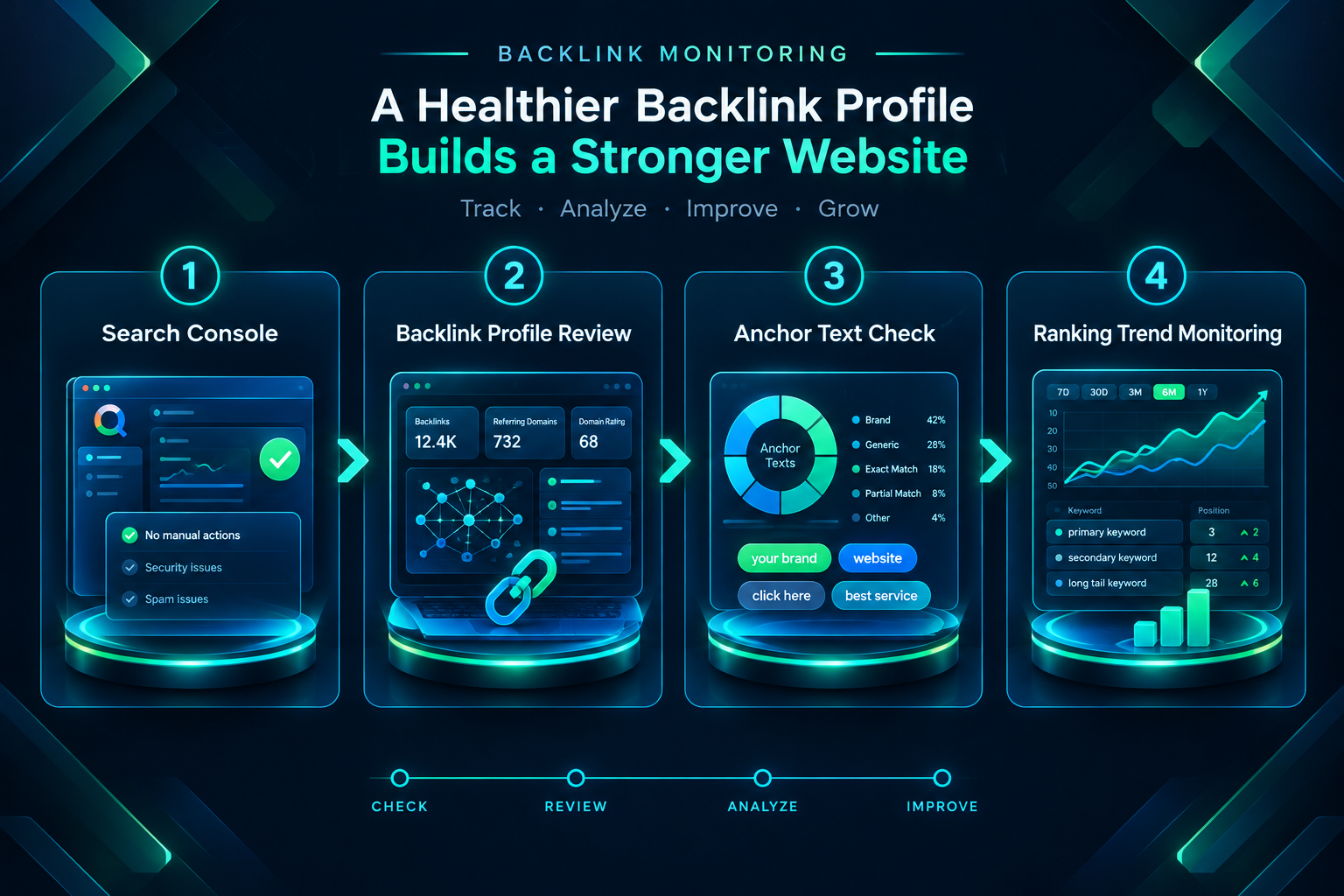
Third-party backlink analysis tools such as Ahrefs, Semrush, and Majestic provide visibility into the referring domain profile, anchor text distribution, and link velocity. These tools use proprietary metrics such as Domain Rating, Domain Authority, and Trust Flow, which are not Google ranking scores but can help identify patterns in a backlink profile that may warrant attention. A sudden spike in referring domains with similar characteristics, a heavily concentrated anchor text profile, or a large proportion of links from sites with thin content may be worth reviewing before they attract algorithmic or manual scrutiny.
Monitoring organic ranking trends alongside backlink profile changes helps distinguish between ranking movements caused by link-building activity and those caused by other factors such as algorithm updates, content changes, or competitor activity. Attributing a ranking change to a specific cause requires more than a temporal correlation, and a website-specific review is necessary before drawing conclusions about enforcement scope or cause.
What Remains Publicly Unknown
Several aspects of Google’s enforcement process for link-related issues are not publicly documented, and this uncertainty is material to any honest risk assessment. Google has not published the specific signals, thresholds, or scoring systems used to determine whether a link pattern warrants a page-level or sitewide manual action. The rate at which PBN links are algorithmically devalued versus escalated to manual review is not disclosed. The proportion of sites using PBN links that receive any formal enforcement action is not publicly known.
Industry observations, SEO community discussions, and case studies provide some evidence about outcomes, but this evidence is inherently selective and difficult to generalize. Sites that experience penalties are more likely to be discussed publicly than sites where PBN links produce no formal enforcement response. This reporting bias means that the visible evidence overstates the frequency of sitewide penalties relative to the full range of outcomes across all sites using PBN links.
The absence of a public threshold also means that no provider, SEO specialist, or tool can reliably predict whether a specific link-building campaign will result in a page-level action, a sitewide action, algorithmic devaluation, or no formal response. Honest risk communication acknowledges this uncertainty rather than presenting either guaranteed safety or guaranteed penalty as the expected outcome.
Frequently Asked Questions
Does having PBN links automatically trigger a sitewide penalty?
No. The presence of PBN links does not automatically result in any specific enforcement action. Google’s response may range from algorithmically devaluing the links, to issuing a page-level manual action, to issuing a sitewide manual action, depending on factors including the scale, pattern, and apparent intent of the link-building activity. Many sites with PBN links in their backlink profiles do not receive formal manual actions.
How can I tell if my site has received a sitewide manual action?
Google Search Console’s manual actions report is the definitive source. A sitewide manual action will appear there with a description of the issue and the scope of the action. A ranking decline without a corresponding manual action in Search Console is not a sitewide penalty, even if it coincides with link-building activity.
What is the difference between a manual action and algorithmic devaluation?
A manual action is a formal enforcement decision made by a Google reviewer and reported in Search Console. Algorithmic devaluation means Google’s systems have assessed specific links as not passing ranking signals, without a formal action being issued. Algorithmic devaluation does not appear in Search Console and does not require a reconsideration request. The two mechanisms are distinct and have different implications for site management.
Does the quality of the PBN affect the risk of a sitewide penalty?
Network quality is a relevant variable. Networks with obvious shared footprints, thin content, weak domain histories, and poor topical relevance may be more readily identified by automated systems. Networks built with greater attention to domain history, content quality, topical relevance, and technical diversity present a different profile. Quality does not eliminate policy risk, but it is a meaningful factor in how a network’s links are assessed.
If I receive a page-level manual action, will it automatically become sitewide?
A page-level manual action does not automatically escalate to a sitewide action. The two are separate enforcement decisions. However, if the underlying link pattern is not addressed and the activity continues or expands, the conditions that led to the page-level action may change. Addressing the identified issue and submitting a reconsideration request is the documented path for resolving a manual action.
Should I disavow PBN links if I receive a manual action?
Disavowal may be part of a reconsideration request response, but it is not universally required in every situation. The appropriate response depends on the specific manual action, the links involved, and the site’s overall backlink profile. A website-specific review is necessary before deciding whether disavowal is the right step, and Google’s own guidance on reconsideration requests provides the most relevant framework for this decision.
Assessing PBN Enforcement Risk for Your Specific Website
The question of whether PBN links can cause a sitewide penalty has a factually accurate answer: yes, a sitewide manual action is a documented possible outcome, but it is one of several possible outcomes and is not the automatic or inevitable result of every PBN link placement. The scope of any enforcement response depends on factors including the scale and pattern of the link-building activity, the apparent intent, the quality and footprint of the network, the existing backlink profile of the target site, and the site’s overall compliance with Google’s spam policies. None of these factors are assessed in isolation, and no public threshold defines when page-level enforcement becomes sitewide.
What this means practically is that enforcement risk assessment requires a website-specific review rather than a generalized conclusion. A site with a diverse, well-established backlink profile, high-quality content, and a modest number of contextually relevant PBN placements occupies a different risk position than a site whose backlink profile consists almost entirely of links from a single network with obvious shared characteristics. Monitoring Search Console for manual actions, tracking backlink profile changes with tools like Ahrefs or Semrush, and working with providers who are transparent about their network quality and domain selection process are the most actionable steps available.
If you are evaluating a PBN link-building strategy or reviewing an existing backlink profile, PBN Backlinks Service can help you assess placement quality, domain history, and campaign fit before committing to a specific approach. Understanding the scope of what you are working with is the starting point for any informed decision about link-building strategy.