

PBN backlinks are most often discussed in the context of Google, but a meaningful share of organic search traffic flows through Bing, and website owners running link-building campaigns reasonably want to know whether PBN placements carry ranking value on Microsoft’s search engine as well. The short answer is that Bing uses backlinks as a ranking signal, and a contextual link from a relevant, indexed page can influence Bing rankings regardless of whether that page belongs to a private blog network. The longer answer involves understanding how Bing evaluates link quality, where its approach differs from Google’s, and what that means for a PBN-based link-building strategy.
Key Takeaways
- Bing treats backlinks as a meaningful ranking signal, and PBN placements on indexed, relevant pages can contribute to Bing rankings in the same way they may contribute to Google rankings.
- Bing’s link evaluation places notable weight on topical relevance, anchor text context, and the authority of the linking domain’s backlink profile rather than relying solely on proprietary metrics like Domain Rating or Domain Authority.
- Bing’s Webmaster Guidelines address link schemes and paid links, but the specific detection methods, enforcement thresholds, and penalty scope Bing applies are not publicly documented in the same detail as Google’s systems.
- Because Bing and Google use different crawl frequencies, indexing pipelines, and ranking algorithms, the timing and magnitude of ranking changes from PBN placements may differ between the two engines.
- Website-specific factors — including existing backlink profile, niche competition on Bing, content quality, and technical SEO — affect how much any individual PBN placement contributes to Bing rankings.
How Bing Uses Backlinks as a Ranking Signal
Bing’s ranking algorithm is not publicly documented at the same level of technical detail as Google’s systems, but Microsoft has confirmed through its Webmaster Guidelines and official blog posts that backlinks remain a core ranking factor. Bing evaluates the quality, relevance, and authority of pages linking to a target URL, and it uses those signals alongside on-page content, user engagement data, and technical factors to determine ranking positions.
Where Bing’s approach appears to differ from Google’s is in the relative weight it assigns to certain signals. Industry observations and Bing’s own published guidance suggest that Bing places considerable emphasis on the topical relevance of the linking page, the naturalness of anchor text, and the overall authority of the linking domain as reflected in its own backlink profile. A contextual PBN placement on a page that covers a closely related topic, uses varied and relevant anchor text, and sits on a domain with a credible link history is therefore more likely to carry meaningful weight on Bing than a placement that lacks those characteristics.
Bing also uses click-through data and user engagement signals more explicitly than Google acknowledges doing, which means that even a well-linked page needs to satisfy user intent to sustain rankings. PBN backlinks can support a page’s authority signal on Bing, but they work alongside content quality and on-page relevance rather than substituting for them.
What Bing’s Webmaster Guidelines Say About Link Schemes
Bing’s Webmaster Guidelines include a section on link schemes and describe paid links intended to manipulate rankings as a practice that may result in lower rankings or removal from the index. This language is broadly similar to Google’s link spam policies, though the specific terminology and scope differ. Bing does not publish a detailed technical description of how it identifies manipulative links, what detection signals it uses, or at what threshold a manual or algorithmic action is triggered.
It is important to distinguish between what Bing’s guidelines state as policy and what is actually known about enforcement behavior. The guidelines establish that Bing reserves the right to act on links it considers manipulative, but the frequency, scope, and precision of that enforcement are not publicly documented. SEO practitioners who have monitored Bing rankings over time generally observe that Bing’s link-related enforcement appears less aggressive in practice than Google’s, though this is an industry observation rather than a confirmed technical fact. Bing has not published data on the rate at which it issues manual actions for link schemes, and no reliable public study has measured this with a controlled methodology.
The practical implication is that the policy risk associated with PBN placements on Bing is real but less precisely defined than on Google. Website owners should treat Bing’s guidelines as a genuine constraint rather than ignoring them, while also recognizing that the documented enforcement behavior differs from Google’s and that the threshold for action is not publicly known.
Key Differences Between Bing and Google Link Evaluation
Understanding where Bing and Google diverge in their approach to backlinks helps clarify what PBN placements may realistically offer on each engine.
Crawl frequency and indexing speed: Google’s crawl infrastructure is generally faster and more comprehensive than Bing’s for most websites. A PBN placement may be crawled and indexed by Google before Bing picks it up, which means ranking changes on Bing may lag behind Google by days or weeks depending on the crawl priority Bing assigns to the linking domain. Submitting the linking URL through Bing Webmaster Tools can accelerate this process.
Domain authority signals: Google’s link evaluation is closely associated with its PageRank-derived systems, which assess the quantity and quality of links pointing to a domain across the entire web graph. Bing uses its own authority assessment, and while the underlying concept is similar, the weighting and calculation differ. A domain that scores well on third-party metrics like Ahrefs DR or Moz DA may not translate identically to Bing’s internal authority assessment. Evaluating a PBN domain’s actual backlink profile — the quality and relevance of sites linking to it — is more informative than relying on any single proprietary metric.
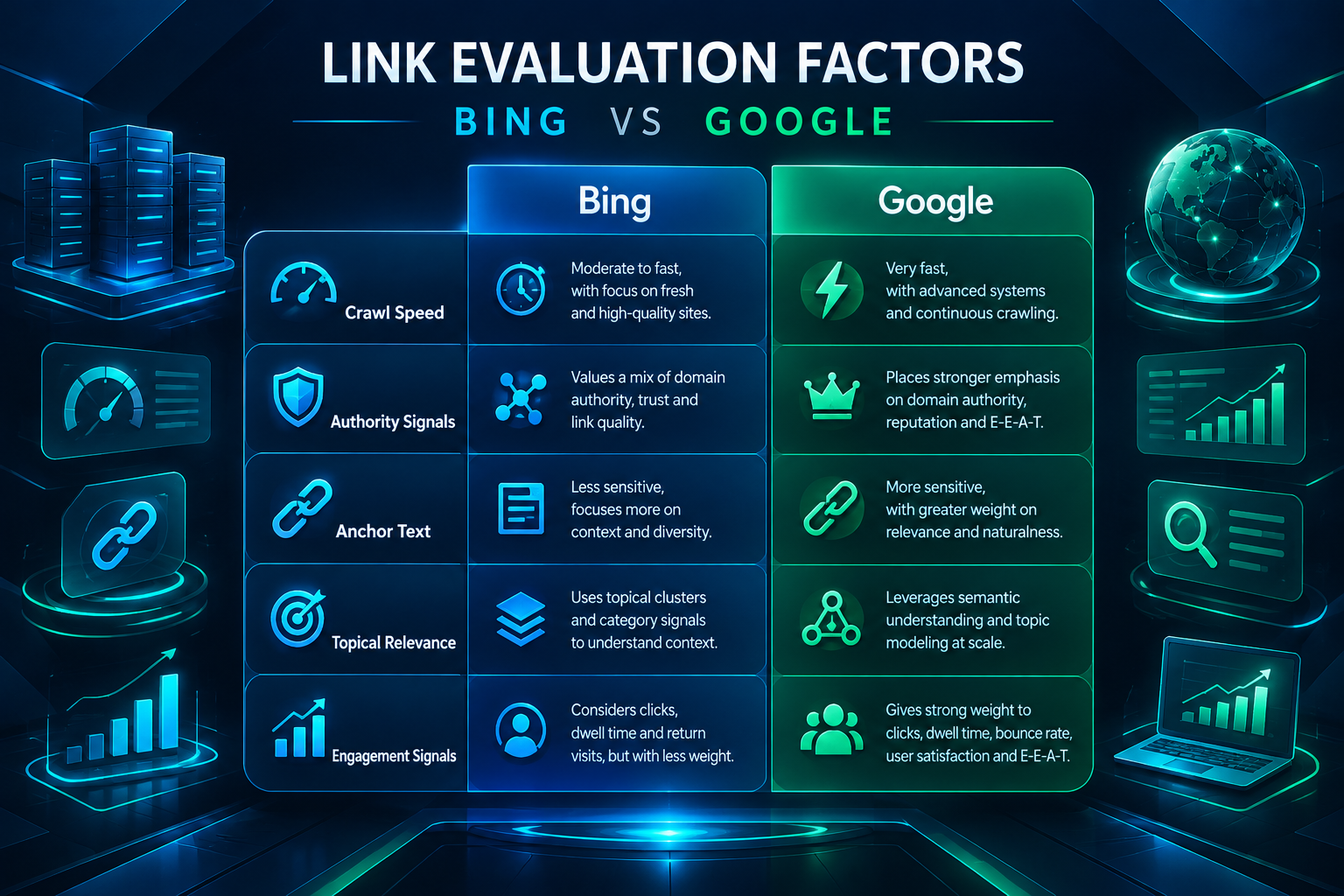
Anchor text sensitivity: Bing’s published guidance and practitioner observations suggest that Bing responds to anchor text signals in a broadly similar way to Google, rewarding relevant and varied anchor text while treating over-optimized exact-match patterns as a potential quality concern. The specific thresholds at which anchor text patterns become a negative signal are not published by either engine.
Topical relevance weighting: Bing’s documentation and observed ranking behavior suggest that topical relevance between the linking page and the target page is a meaningful quality signal. A PBN placement on a page that covers a closely related subject is likely to carry more weight than a placement on a topically unrelated page, regardless of the domain’s authority metrics.
Engagement and behavioral signals: Bing has been more explicit than Google about incorporating user engagement data — including click-through rates, dwell time, and bounce signals — into its ranking model. This means that a page receiving PBN-supported ranking improvements still needs to deliver a satisfying user experience to maintain those positions over time.
What Makes a PBN Placement More Likely to Influence Bing Rankings
Not every PBN placement carries equal weight on Bing, and several placement-level factors affect how much ranking influence a given link may provide.
- Indexing status of the linking page: A link on a page that Bing has not crawled or indexed provides no direct ranking signal. Confirming that the linking domain and specific placement page are indexed in Bing is a basic quality check before assessing any link’s contribution.
- Topical relevance of the linking page: A placement on a page whose content closely matches the subject matter of the target page is more likely to carry contextual authority on Bing than a placement on a generalist or unrelated page.
- Domain backlink profile quality: The PBN domain’s own backlink profile — the number, quality, and relevance of sites linking to it — affects how much authority it can pass. A domain with a credible, diverse backlink history from relevant sources is more likely to carry meaningful weight than one with a thin or low-quality link profile.
- Anchor text variation and relevance: Using a mix of branded, partial-match, and topically relevant anchor text across PBN placements is generally preferable to concentrating exact-match anchors, both for Bing and Google.
- Placement context within the page: A contextual link embedded within relevant body content is generally considered more valuable than a link placed in a footer, sidebar, or navigation element, because the surrounding text provides topical context that search engines use to interpret the link’s relevance.
- Domain history and previous use: A PBN domain with a clean indexing history, no previous spam associations, and a relevant content archive is more likely to contribute positively than one with a history of thin content, previous repurposing, or spam-related issues.
Bing’s Market Share and Why It Matters for Link-Building Strategy
Bing’s global search market share is substantially smaller than Google’s, but it is not negligible. Bing powers search results across Microsoft’s own properties, powers DuckDuckGo’s web results in some configurations, and has a disproportionately strong presence among desktop users, older demographics, and certain English-speaking markets including the United States and United Kingdom. For websites in niches where these audiences are commercially valuable — financial services, insurance, B2B software, home improvement, and similar categories — Bing traffic can represent a meaningful share of organic revenue.
For link-building strategy, this means that a PBN campaign designed primarily to improve Google rankings may also produce Bing ranking improvements as a secondary effect, provided the placements meet Bing’s quality signals. There is no need to build a separate link-building campaign exclusively for Bing; the same placement quality factors that tend to produce value on Google — topical relevance, indexed domains, varied anchor text, contextual placement — are broadly aligned with what Bing’s guidelines and observed behavior suggest it values.
The practical implication is that website owners evaluating PBN backlinks should not treat Bing as an afterthought. Confirming that PBN domains are indexed in Bing, that placement pages are crawlable, and that the linking content is topically relevant adds a layer of quality assurance that benefits both engines simultaneously.
Monitoring PBN Placement Impact on Bing Rankings
Measuring the specific contribution of individual PBN placements to Bing rankings is difficult for the same reasons it is difficult on Google: ranking changes result from multiple interacting signals, and isolating the effect of a single link requires controlled conditions that are rarely available in live campaigns. That said, monitoring Bing rankings before and after placements go live provides useful directional data.
Bing Webmaster Tools is the primary free resource for tracking Bing-specific ranking positions, crawl status, and indexing data. It provides keyword-level impression and click data, page-level crawl reports, and the ability to submit URLs for faster indexing. Monitoring the indexing status of PBN placement pages through Bing Webmaster Tools helps confirm that the links are being seen by Bing’s crawler.
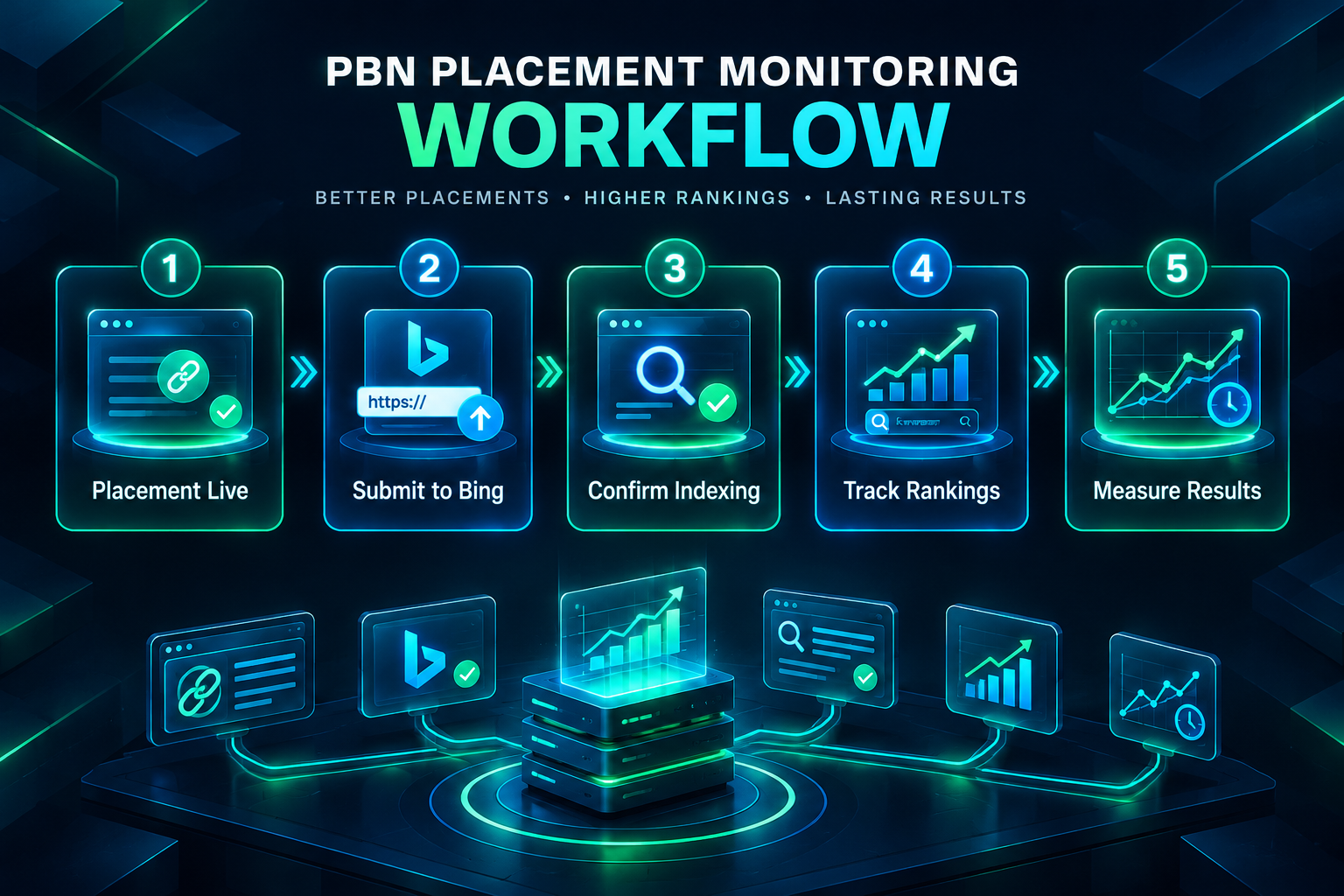
Third-party rank tracking tools that support Bing — including Semrush and Ahrefs, both of which offer Bing rank tracking in their position monitoring features — allow website owners to track keyword movements on Bing separately from Google. Running parallel tracking for both engines after a PBN campaign provides a clearer picture of whether placements are contributing to Bing rankings and at what pace.
Expected timelines for Bing ranking changes following PBN placements are generally longer than for Google, reflecting Bing’s slower crawl frequency for many domains. A placement that Google indexes within days may take one to several weeks to appear in Bing’s index, and ranking changes may follow indexing by additional weeks. This lag is a normal characteristic of Bing’s crawl infrastructure rather than an indicator that the placement is ineffective.
Campaign Suitability: When PBN Placements May Be Worth Considering for Bing
PBN backlinks may be worth considering for Bing rankings in situations where the target website already has a reasonable technical foundation, relevant content, and some existing backlink profile, but is not ranking competitively for target keywords on Bing. In competitive niches where Bing’s organic results are dominated by well-linked pages, additional authority signals from PBN placements may help a target page become more competitive.
Websites that derive or could derive meaningful revenue from Bing’s specific user demographics — particularly desktop-heavy, commercially oriented audiences — have a stronger case for treating Bing rankings as a distinct optimization goal rather than a secondary benefit of Google-focused campaigns. For these websites, confirming that PBN placements are indexed in Bing and monitoring Bing-specific ranking movements adds practical value to the campaign assessment process.
Websites with existing technical SEO issues, thin content, or previous manual actions on either Google or Bing should address those issues before evaluating whether additional backlinks are likely to produce ranking improvements. PBN placements support a page’s authority signal, but they are unlikely to overcome fundamental content or technical deficiencies on their own.
Frequently Asked Questions
Does Bing penalize PBN links the same way Google does?
Bing’s Webmaster Guidelines address link schemes and paid links, and Bing reserves the right to take action on links it considers manipulative. However, Bing does not publish the same level of technical detail about its detection methods or enforcement thresholds as Google does. Industry observations suggest that Bing’s link-related enforcement is less frequently triggered in practice, but this is not a confirmed technical fact, and the specific conditions under which Bing acts are not publicly documented.
Do I need to submit PBN placement pages to Bing Webmaster Tools?
Submitting placement pages through Bing Webmaster Tools is not strictly required, but it can accelerate indexing. Bing’s crawl frequency for many domains is slower than Google’s, so manual submission of the linking URL can reduce the lag between a placement going live and Bing discovering the link. This is a practical step worth taking when Bing rankings are a campaign priority.
Will a PBN link indexed by Google automatically be indexed by Bing?
Not automatically. Google and Bing operate independent crawl systems, and a page indexed by Google may not yet be indexed by Bing, or may be indexed by Bing at a different crawl depth or frequency. Checking the indexing status of PBN placement pages in Bing separately from Google is a useful quality verification step.
How long does it take for PBN placements to affect Bing rankings?
The timeline varies depending on how quickly Bing crawls the linking domain, how frequently it recrawls the target page, and how competitive the target keyword is. In general, Bing ranking changes following new backlinks tend to appear more slowly than on Google, often taking several weeks from the time Bing indexes the placement. Monitoring through Bing Webmaster Tools and a rank tracking tool that supports Bing provides the clearest picture of progress.
Does topical relevance matter more on Bing than on Google for PBN placements?
Bing’s published guidance and observed ranking behavior suggest that topical relevance between the linking page and the target page is a meaningful quality signal. While both engines value relevance, some practitioners observe that Bing’s ranking model responds more directly to topical alignment. Choosing PBN placements on pages that closely match the subject matter of the target page is therefore a quality factor that benefits both engines.
Can PBN links help with rankings on DuckDuckGo and other Bing-powered engines?
DuckDuckGo’s web results have historically drawn on Bing’s index for organic listings, which means that improvements in Bing rankings may also be reflected in DuckDuckGo results. Other search engines that license Bing’s index may similarly reflect Bing ranking changes. This is a secondary consideration rather than a primary campaign goal, but it means that Bing-effective PBN placements may have a broader reach than Bing’s own market share suggests.
Assessing PBN Backlinks for Your Bing Ranking Goals
PBN backlinks can carry ranking value on Bing when placements are on indexed, topically relevant pages with credible domain backlink profiles and contextual link placement. The core quality factors that tend to produce value on Google — relevance, varied anchor text, indexed domains, clean domain history — are broadly aligned with what Bing’s guidelines and observed behavior suggest it evaluates. The main practical differences are Bing’s slower crawl frequency, its distinct internal authority assessment, and the less publicly documented nature of its link-related enforcement.
For website owners whose target audiences overlap with Bing’s user base, treating Bing rankings as a parallel goal rather than an afterthought is a reasonable approach. Confirming that PBN placement pages are indexed in Bing, monitoring Bing-specific keyword movements through Bing Webmaster Tools and a compatible rank tracker, and selecting placements based on topical relevance and domain quality are the practical steps that connect a PBN campaign to measurable Bing ranking outcomes.
If you are evaluating PBN backlinks for a campaign that includes Bing as a meaningful traffic source, PBN Backlinks Service can help you assess placement quality, domain suitability, and campaign fit based on your specific website, niche, and ranking goals. Reviewing your backlink profile and target keywords before committing to a placement strategy is the most reliable way to determine what level of link-building activity is appropriate for your situation.