

Key Takeaways
- Domain privacy alone does not make a PBN safe — it is one element of a broader footprint-avoidance strategy that also includes IP address diversification, hosting separation, and varied registrant data.
- Enabling WHOIS privacy on every PBN domain through the same provider on the same date creates a detectable pattern known as privacy monoculture, which can itself become a footprint.
- Since January 2025, RDAP (Registration Data Access Protocol) has replaced WHOIS as the ICANN standard, producing machine-readable, structured registration data that makes automated ownership pattern detection easier for Google and third-party tools.
- Some TLDs including .us and .in prohibit domain privacy by registry policy, meaning registrants must expose real data or risk policy violations.
- Experienced PBN operators often prefer a mixed approach — combining selective WHOIS privacy with varied fake registrant data — rather than applying one method uniformly across all domains.
What Domain Privacy Actually Does
Domain privacy protection, often called WHOIS privacy or a proxy privacy service, replaces your real registrant details in the public registration database with generic contact information supplied by the privacy provider. Instead of your name, address, phone number, and email appearing in a WHOIS lookup, a visitor sees the registrar’s or a third-party proxy’s details. Services such as WhoisGuard, offered free with Namecheap registrations, are among the most widely used examples.
The practical effect is that a casual lookup of your domain no longer reveals that you personally own it. For ordinary website owners, this prevents spam, reduces unwanted contact, and protects personal information. For PBN operators, the appeal is obvious: if no single name or address ties multiple domains together, the network is harder to identify through registration records alone.
What domain privacy does not do is remove your details from the registrar’s internal records. The registrar still holds your real information to comply with legal and contractual obligations. Privacy services substitute public-facing data; they do not erase ownership records.
How RDAP Has Changed the Landscape Since January 2025
Until recently, WHOIS was the standard protocol for querying domain registration data. In January 2025, ICANN formally transitioned to RDAP — the Registration Data Access Protocol — as the replacement standard. RDAP matters for PBN operators because its output is structured, machine-readable JSON rather than unformatted plain text. That structured format makes it significantly easier for automated systems, including Google’s crawlers and third-party SEO tools like Ahrefs and Semrush, to parse and compare domain registration patterns at scale.
Where WHOIS lookups were once manual and inconsistent between registrars, RDAP provides a standardized query format that can be queried programmatically across large domain sets. This means that domain registration patterns — clustered registration dates, shared registrar accounts, identical nameservers, and even patterns in how privacy is applied — are now easier to detect automatically than they were under the old WHOIS system. The transition does not make privacy irrelevant, but it does reinforce why privacy alone is insufficient protection for a PBN.
The Real Question: Does Privacy Reduce PBN Footprint Risk?
The honest answer is: it can reduce one specific signal, but it rarely eliminates meaningful risk on its own. A PBN footprint is any pattern of evidence that allows Google’s algorithms or a manual review team to identify that multiple domains are owned or controlled by the same entity and used to artificially manipulate link equity toward a money site. Registration data is one such signal — but it is only one among many.
Google’s SpamBrain system, the machine-learning-based link-spam detection framework, evaluates link graph patterns holistically. SpamBrain does not rely solely on WHOIS or RDAP data. It can identify PBN-style link patterns through anchor text diversity anomalies, link velocity, topical relevance mismatches, domain authority distributions, and IP address clustering — all without ever reading a registrant’s name. Hiding registrant details through WHOIS privacy therefore addresses a surface-level signal while leaving deeper structural patterns untouched.
That said, registration data remains a real and usable signal. A manual review team investigating a suspected PBN will query registration records as part of their process. Failing to apply any form of privacy or data variation leaves an obvious, easily detectable ownership pattern that is unnecessary to expose. The practical position taken by most experienced operators is: use some form of privacy or data variation on every PBN domain, but treat it as a minimum baseline rather than a comprehensive solution.
Domain Privacy Options: A Comparison
PBN operators generally consider three approaches to managing registrant details. Each carries different trade-offs in cost, detectability, and risk.
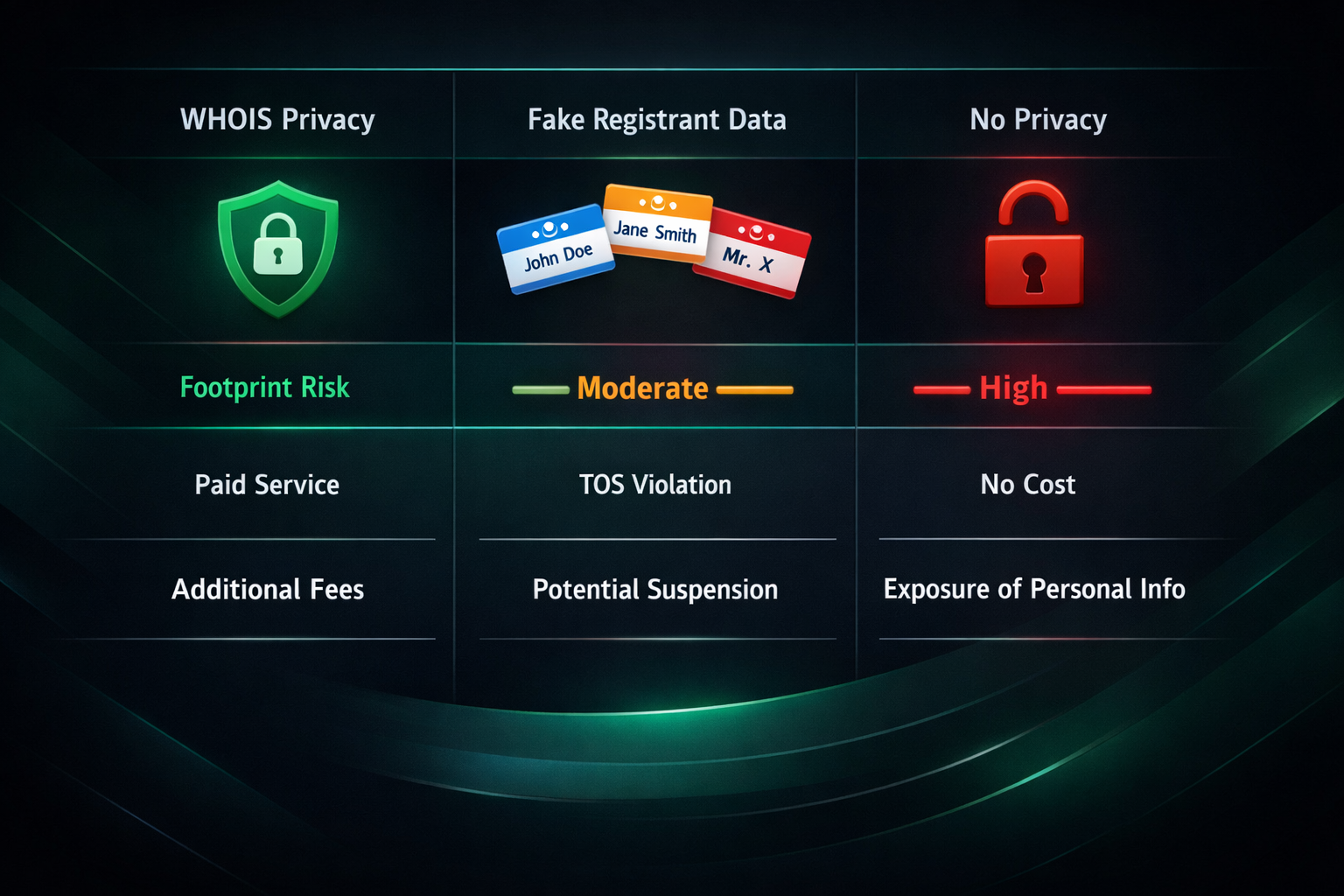
| Approach | How It Works | Footprint Risk | Cost | Key Limitation |
|---|---|---|---|---|
| WHOIS Privacy (proxy service) | Registrar or third-party replaces your public registrant data with proxy contact details | Moderate — uniform use across all domains through the same provider on the same date is a detectable pattern | Free (Namecheap/WhoisGuard) to ~$10–15/year per domain | Privacy monoculture; provider’s name appears uniformly; historical records may still exist |
| Fake / Varied Registrant Data | Different fictional or varied names, addresses, and emails entered at registration | Lower if well varied — each domain appears to have a distinct owner | No add-on cost | Potentially violates registrar terms of service; may trigger ICANN verification; illegal in some jurisdictions |
| No Privacy (real data exposed) | Your genuine registrant details appear publicly in RDAP/WHOIS lookup results | High — a single name ties every domain in the network together instantly | None | Directly exposes network ownership; easiest single point of detection |
The Privacy Monoculture Problem
One of the most underappreciated footprint risks in PBN management is what practitioners call privacy monoculture: the pattern that emerges when every domain in a network has WHOIS privacy enabled through the same provider, activated at the same time, often on the same date as domain registration. Rather than obscuring ownership, this uniformity signals that the domains were set up in a single deliberate batch by the same operator following the same workflow.
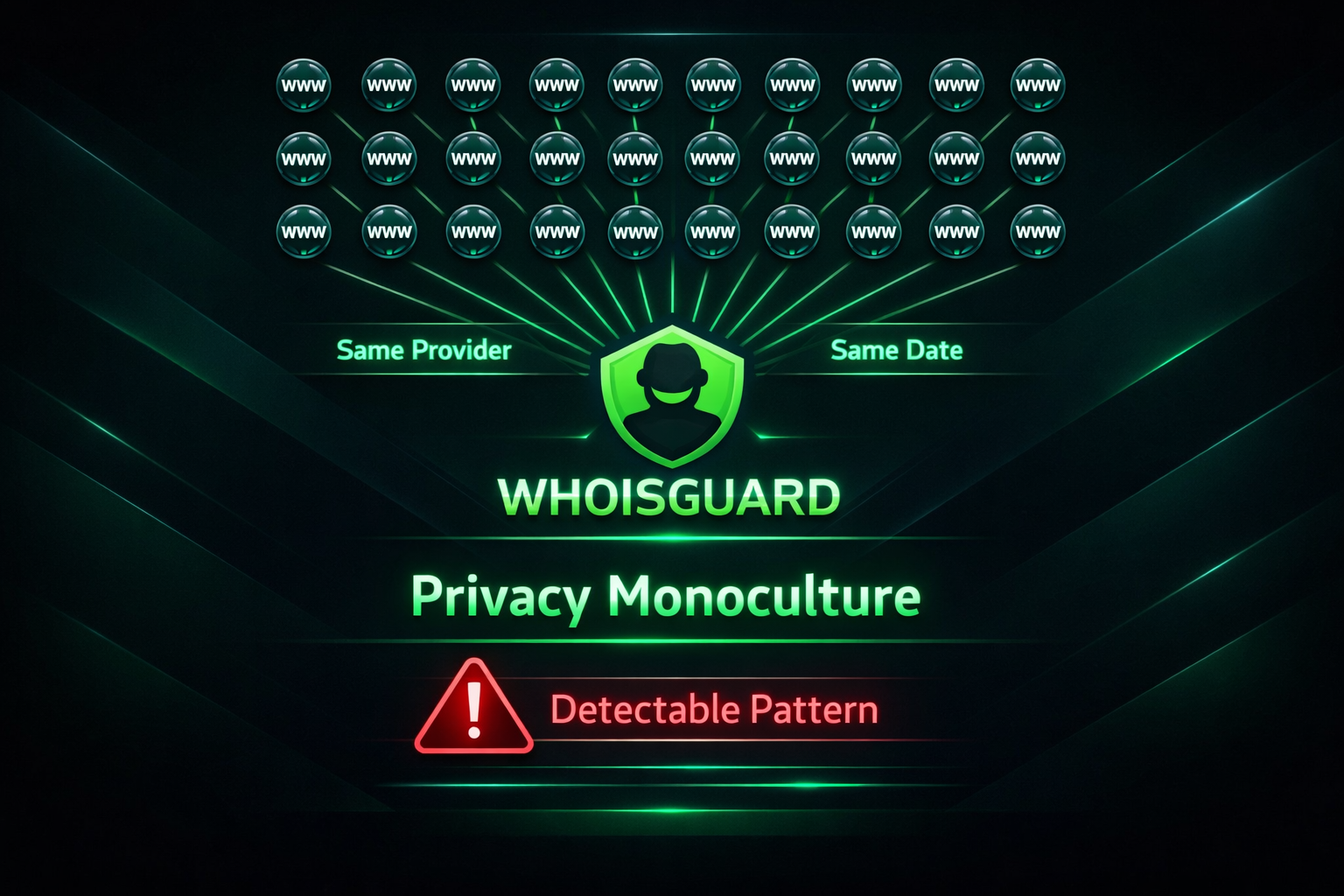
RDAP’s machine-readable format makes this pattern easier to detect at scale than it was under legacy WHOIS. A query revealing that 30 expired domains all have WhoisGuard privacy enabled, all registered through Namecheap, all on the same date, and all pointing to similar nameserver configurations is not meaningfully less identifiable than the same domains listing one person’s name. The footprint has simply moved from a name to a procedural fingerprint.
The practical implication is that even a beneficial tool like domain privacy should be applied with variation: different providers where possible, staggered activation dates, and mixed with other approaches rather than uniformly applied. Treating privacy as a checkbox that automatically solves the footprint problem is the mistake most new PBN operators make.
Fake WHOIS Data vs. Privacy Services: The Community Debate
Within PBN communities, there is a long-running debate about whether fake registrant data — using fictional names, addresses, and contact details at the point of registration — is preferable to formal WHOIS privacy services. The argument for fake data is that varied, unique fictional identities for each domain genuinely make each registration look independent, avoiding the uniformity that privacy services introduce.
The argument against fake WHOIS data is legal and contractual rather than technical. Providing false information in a domain registration may violate ICANN’s registration policies and most registrar terms of service. In some countries, deliberately false registration data carries legal risk. Registrars may cancel or suspend domains found to contain materially false registrant information following ICANN verification challenges.
The consensus that has emerged among experienced operators is a mixed approach: use genuine WHOIS privacy on some domains, varied fake registrant data on others, and ensure the pattern itself is not uniform. No single method should be applied identically to every domain in the network. This mixed strategy reduces any one detectable pattern without concentrating all risk in a legally questionable practice.
TLD Restrictions on Domain Privacy
Not every top-level domain permits privacy protection. Registry policies for certain country-code TLDs explicitly prohibit registrants from hiding their contact information. The most commonly encountered TLD restrictions include:
- .us — The .us registry requires that registrant contact information remain publicly accessible. WHOIS privacy services cannot be applied to .us domains.
- .in — India’s country-code TLD similarly restricts privacy protection, requiring real registrant data to be publicly visible.
- Some other regional TLDs impose equivalent requirements depending on their registry’s terms.
For PBN builders who use these TLDs — perhaps because they acquired expired domains with strong domain metrics in these extensions — privacy is not an option. This means the decision shifts entirely to whether to use accurate data or varied fake registrant data, each carrying its own implications. Knowing which TLDs support privacy before acquiring a domain avoids discovering the limitation after registration.
Registrar Account Concentration as a Hidden Footprint
Even with WHOIS privacy fully enabled on every domain, registrar account concentration remains a detectable pattern that privacy services do not address. When 40 domains are registered under the same registrar account — even with perfect privacy protection applied — that account represents a single point of ownership that is accessible to the registrar, to law enforcement, and potentially to parties who identify the account through other means.
More practically, some registrar platforms expose account-level metadata that clustering analysis can identify. Domains registered in the same account often share identical nameserver configurations at the moment of registration, identical default settings, and identical registration timestamps. RDAP’s structured format makes cross-referencing these details more systematic than it was under legacy WHOIS.
Distributing domains across multiple registrar accounts — using providers such as Namecheap, NameSilo, GoDaddy, and internetbs.net — reduces registrar account concentration as a footprint. This is standard guidance in footprint-free PBN management and applies regardless of which privacy method is chosen.
Domain Privacy as Part of a Broader Footprint Strategy
Registration data is one of many signals that can expose a private blog network. A complete footprint-avoidance strategy addresses several layers simultaneously, and domain privacy contributes to only one of them.
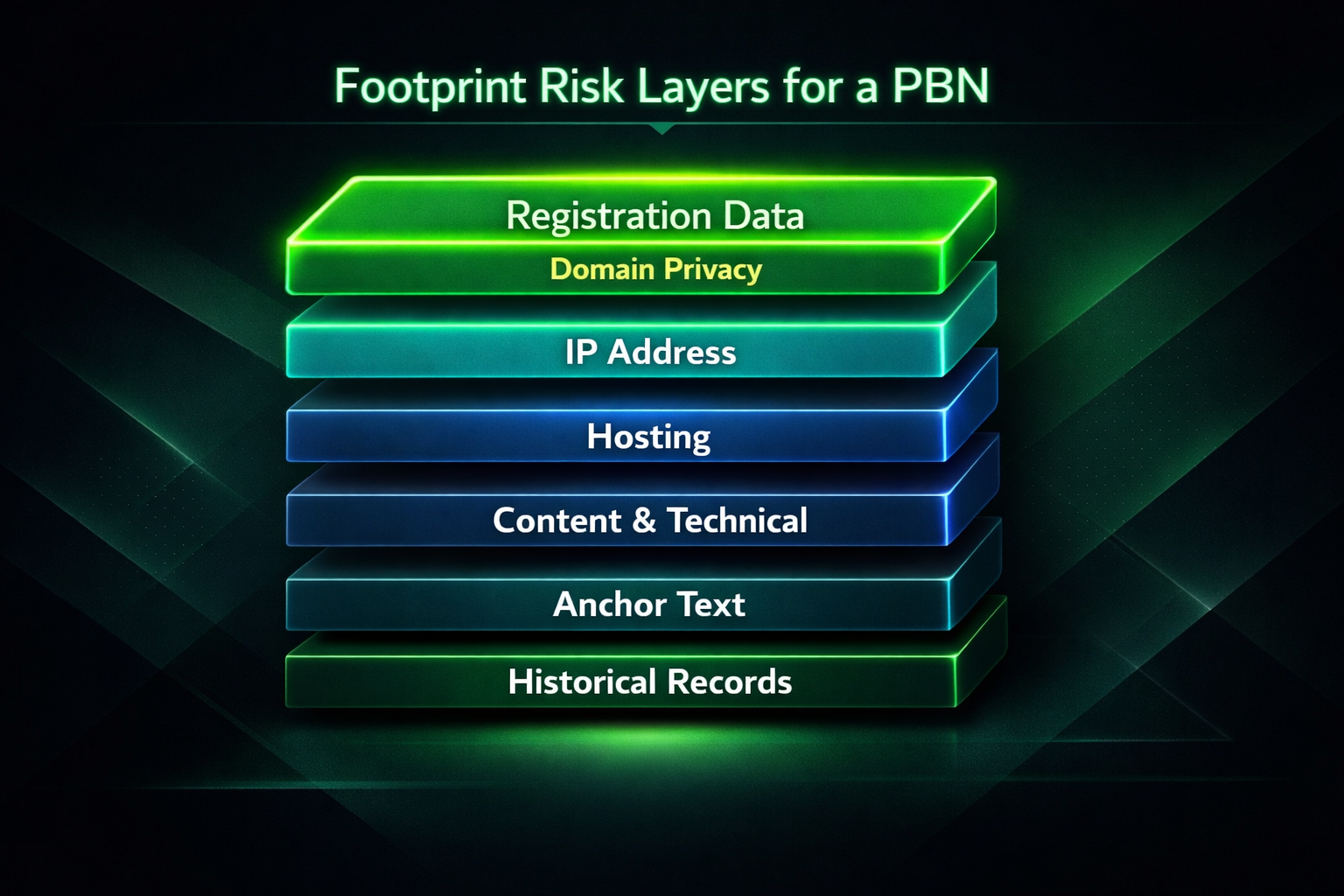
- IP address diversification: Each PBN domain should ideally sit on a unique C-class IP subnet. Shared hosting that places multiple PBN domains on the same IP address creates an infrastructure-level pattern that is independent of registration data.
- Hosting diversification: Using different hosting providers for different domains prevents a single provider’s account from tying domains together. Cloudflare masking can obscure origin IP addresses but introduces its own uniformity if applied to every domain.
- Content and technical variation: Identical WordPress themes, plugins, Google Analytics IDs, or site structures across domains are detectable patterns that are unrelated to registration data.
- Domain registration patterns: Staggering registration dates and avoiding clustering domains around the same calendar period reduces date-clustering as a footprint signal.
- Anchor text diversity: Unnatural anchor text patterns in links pointing to a money site remain one of SpamBrain’s most reliable signals for identifying artificial link schemes.
- Wayback Machine history: For expired domains, publicly archived historical ownership data may exist regardless of current privacy settings. Pre-2018 WHOIS records stored in third-party archives are accessible and can reveal previous ownership chains.
Domain privacy addresses only the registration data layer. Ignoring the other layers while applying careful privacy settings leaves the network exposed through multiple other vectors.
Archived WHOIS Records and Historical Exposure
A practical limitation that applies specifically to expired domains is that historical WHOIS data is often already archived. Before GDPR and widespread privacy adoption in 2018, most domain registration records were fully public and were captured by third-party WHOIS archive services. Acquiring an expired domain with strong domain authority does not erase that archived ownership history.
If a domain’s historical WHOIS records show it was previously owned by someone connected to your current registrations, that link may persist in publicly accessible archives regardless of whatever privacy settings you apply today. This is particularly relevant for domains acquired through expired domain marketplaces, where ownership chains are often long and publicly documented.
Before incorporating an expired domain into a PBN, checking its archived registration history through WHOIS lookup archives and the Wayback Machine is a practical due diligence step. Historical ownership patterns can reveal whether a domain carries historical exposure that current privacy settings cannot address.
Is Domain Privacy Worth the Cost?
For many registrars, domain privacy is now free. Namecheap includes WhoisGuard at no additional charge. NameSilo similarly offers free WHOIS privacy on most domain registrations. For domains registered at registrars that charge for privacy — typically $5–15 per year per domain — the cost calculation depends on network size and the renewal cost of the domain itself.
On a per-domain basis, the cost of privacy is modest compared to the hosting cost and domain renewal cost of maintaining a functional PBN site. The more meaningful question is not whether the cost is justified, but whether privacy is being applied thoughtfully or as a uniform batch setting. Applied thoughtfully as part of a varied footprint strategy, the marginal cost is easily justified. Applied identically to every domain in one session, the privacy service may add cost while introducing its own detectable pattern.
Frequently Asked Questions
Does Google directly penalize domains using WHOIS privacy?
No evidence suggests Google penalizes the use of WHOIS privacy as a standalone factor. Domain privacy is a legitimate, widely used service for privacy and spam-prevention purposes across millions of ordinary websites. The risk for PBN operators is not the use of privacy itself, but the uniform pattern that emerges when every domain in a network uses the same privacy service activated at the same time through the same registrar account.
Is providing fake registrant data illegal?
This depends on jurisdiction and registrar terms. Under ICANN’s registration policies, providing materially false registration data is a violation that can result in domain suspension. In some countries, deliberately false contact information in a public registry may have additional legal implications. Before using varied or fictional registrant data, understanding the registrar’s verification process and applicable local regulations is important. Many experienced operators prefer formal privacy services partly because they avoid this legal exposure.
What TLDs do not allow WHOIS privacy?
.us and .in are the most frequently cited examples of TLDs where the registry prohibits privacy protection by policy. Some other country-code TLDs impose similar requirements. If you are considering a domain acquisition in one of these extensions, verify the registry’s privacy policy before purchase, as privacy will not be available regardless of registrar.
Does RDAP make PBN detection easier than WHOIS did?
RDAP produces structured, machine-readable JSON output rather than unformatted plain text, which makes automated querying and pattern comparison across large domain sets more practical. This does not fundamentally change what data is visible — privacy settings still mask the same registrant fields — but it does make systematic pattern detection at scale easier for automated systems, including tools used by Google and third-party analysts.
Can a PBN be fully undetectable with good domain privacy?
No. Domain privacy addresses one registration-data signal among many. SpamBrain and Google’s manual review processes evaluate link graph patterns, anchor text distributions, IP clustering, content quality, technical configurations, and link velocity independently of registration data. A PBN with perfect privacy settings but shared IP addresses, identical themes, and unnatural anchor text patterns remains detectable through those other signals.
Should I use the same privacy provider for all PBN domains?
Using the same provider on all domains — particularly if activated at the same time through the same registrar account — creates the privacy monoculture pattern that reduces the practical value of the privacy itself. Where different registrars offer different privacy providers, distributing domains across accounts and providers adds meaningful variation to the registration fingerprint.
Making a Practical Decision About Domain Privacy for Your PBN
Domain privacy is a reasonable baseline for every PBN domain where it is available and permitted by the TLD registry. The decision to use it is straightforward — the harder decisions are how to apply it without introducing a uniform pattern, and how to integrate it into a wider footprint-avoidance strategy that addresses hosting, IP address diversification, content variation, and anchor text management.
The most defensible approach combines selective use of WHOIS privacy with varied registrant data across different domains, distributed across multiple registrar accounts, with staggered registration dates that avoid date-clustering. No single setting or service resolves PBN footprint risk comprehensively. The RDAP transition of January 2025 has made machine-readable registration data more accessible to automated detection systems, reinforcing the value of variation over uniformity in every aspect of domain registration strategy.
For operators building or auditing a PBN, treating domain privacy as one configurable variable within a multi-layered footprint strategy — rather than a definitive solution — is the most accurate and practical way to approach the question.