

Accepting a PBN link without reviewing the content surrounding it is one of the most common oversights in link-building campaigns. The placement page’s content quality directly affects how much contextual authority a link can carry, how naturally it sits within the page, and whether the placement is likely to hold its value over time. Running a structured set of content-quality checks before accepting any PBN placement gives you a clearer picture of what you are actually acquiring — and helps you make better decisions about which placements belong in your campaign.
Key Takeaways
- Content quality on the placement page matters as much as domain metrics when evaluating a PBN link — thin, irrelevant, or templated content reduces the contextual value of any link it contains.
- Topical relevance between the placement page, the linking domain, and your target page is one of the most important factors to assess before accepting a placement.
- Paragraph depth, natural language, and genuine informational value are practical signals that a page was written to serve readers rather than purely to host links.
- Checking the placement page’s indexing status, internal linking structure, and crawl accessibility confirms that search engines can actually discover and process the link.
- Domain history and the quality of existing outbound links on the placement page provide important context that raw authority metrics alone do not capture.
Why Content Quality on the Placement Page Matters
A PBN link’s value is not determined solely by the domain’s authority metrics. The page where the link actually lives plays a significant role in how search engines interpret the placement. A contextual backlink embedded within a well-written, topically relevant article on a page that receives crawl attention is a meaningfully different signal from the same link dropped into a short, generic paragraph on a page that has little informational substance. Understanding this distinction is the starting point for any useful content-quality evaluation.
Search engines assess the context surrounding a link — the words immediately before and after it, the overall topic of the page, the depth of the content, and the relationship between the linking page and the destination. When the placement page contains genuinely useful content that relates to your niche, the link sits within a coherent topical context. When the page is thin, off-topic, or clearly assembled without editorial care, the surrounding context provides little support for the link’s relevance signal.
Content quality also affects longevity. Placement pages built around substantive content are more likely to remain indexed, attract occasional organic visits, and retain their structure over time. Pages that exist purely as link containers with minimal content are more vulnerable to being deindexed or restructured, which can affect the link’s continued accessibility to crawlers.
Topical Relevance: The First Check to Run
Before examining any other quality signal, assess whether the placement page’s topic is genuinely related to your target page’s niche. Topical relevance operates at two levels: the domain level and the page level. A domain that has historically covered topics adjacent to your niche provides a broader relevance context, but the individual placement page needs to address a subject that logically connects to the page you are linking to.
For example, a contextual PBN backlink from a page about home renovation financing to a mortgage comparison page carries a clear topical relationship. The same link placed on a page about travel destinations would lack that connection, regardless of the domain’s authority metrics. When evaluating topical relevance, read the page’s title, headings, and body content to confirm that the subject matter aligns with your target page’s topic cluster.

Also consider whether the anchor text you plan to use fits naturally within the page’s content. If the placement page discusses a topic that requires significant editorial stretching to accommodate your anchor, that is a signal that the relevance fit is weak. Strong placements allow the anchor text to appear as a natural reference within the article’s existing argument or informational flow.
Assessing Content Depth and Informational Value
Content depth is one of the clearest indicators of whether a placement page was built with genuine editorial intent. A page with substantive content — multiple paragraphs covering a topic from different angles, specific details, useful explanations, and a logical structure — demonstrates that effort was invested in creating something a reader might actually find useful. This is distinct from a page that reaches a word count through repetition, filler phrases, or loosely connected sentences.
When reviewing a placement page, look for the following characteristics that indicate genuine informational depth:
- The article addresses a specific topic rather than covering several unrelated subjects in the same piece.
- Paragraphs develop ideas rather than restating the same point in different words.
- The content includes specific details, examples, or explanations that would require some knowledge of the subject.
- Headings and subheadings reflect the actual content beneath them rather than serving as keyword containers.
- The writing reads naturally rather than sounding like it was assembled from disconnected phrases.
Word count alone is not a reliable proxy for depth. A 1,500-word article that covers a topic thoroughly is more valuable as a placement context than a 3,000-word article padded with repetitive content. Focus on whether the page would provide genuine value to a reader who arrived at it through a search query, not on whether it meets an arbitrary length threshold.
Evaluating Writing Quality and Natural Language
The quality of the writing on a placement page is a practical signal that is easy to assess without specialist tools. Read several paragraphs of the content and consider whether the language flows naturally, whether sentences are grammatically coherent, and whether the article reads as though it was written by someone with at least a working familiarity with the subject.
Common writing-quality issues that reduce a placement page’s value include heavily templated sentence structures that repeat across multiple articles on the same domain, machine-generated text that is grammatically correct but semantically shallow, excessive keyword repetition within paragraphs, and abrupt topic shifts that suggest the article was assembled from separate content fragments. None of these issues are automatically disqualifying on their own, but a placement page that exhibits several of them simultaneously is unlikely to provide strong contextual support for a link.
Also check whether the link placement itself reads naturally within the surrounding text. The sentence containing your link should make sense as part of the paragraph’s argument. A link that is inserted into an otherwise unrelated sentence, or that appears in a paragraph that exists solely to host the link, is a weaker contextual placement than one that is woven into the article’s informational flow.
Checking Indexing Status and Crawl Accessibility
A PBN link on a page that search engines cannot access or have chosen not to index provides no ranking signal, regardless of the content quality. Confirming that the placement page is indexed and crawlable is a basic technical check that should precede any deeper content evaluation.
To check whether a page is indexed, use a site: search in Google for the exact URL. If the page does not appear in results, it may not be indexed, though absence from a site: search is not always conclusive. You can also use Google Search Console if you have access to the domain, or check the page’s HTTP response code to confirm it returns a 200 status rather than a redirect or error.
Review the page’s robots meta tag and the domain’s robots.txt file to confirm that crawlers are not being blocked from accessing the placement page or following its outbound links. A noindex directive on the placement page means the link will not be processed as part of an indexed document. A nofollow attribute on the link itself means the link is explicitly instructed not to pass PageRank, which is a separate consideration from content quality but equally important to verify before accepting a placement.
Internal linking from the domain’s other pages to the placement page also affects how much crawl attention the page receives. A placement page that is linked from the domain’s homepage, category pages, or other well-indexed articles is more likely to be crawled regularly than an orphaned page with no internal links pointing to it.
Reviewing the Domain’s Content History and Consistency
The placement page does not exist in isolation — it is part of a domain with its own content history, topical focus, and publishing patterns. Reviewing the broader domain context helps you assess whether the placement page is consistent with the site’s established editorial direction or whether it appears to have been added specifically to host links without fitting the site’s existing content.
Use the Wayback Machine or a similar archive tool to review what the domain published historically. A domain that has consistently covered topics related to your niche over an extended period provides a more coherent topical context than one that recently pivoted to publishing content across unrelated subjects. Significant changes in content direction, publishing frequency, or topic coverage after a domain changed ownership can indicate that the site’s historical authority may not be as relevant to its current content as the metrics suggest.
Also look at the range of topics covered across the domain’s published articles. A site that covers a focused set of related subjects demonstrates topical consistency. A site that publishes articles on dozens of unrelated topics — finance, health, travel, technology, and home improvement all on the same domain — may have been built to accommodate link placements across multiple niches rather than to serve a specific audience.
Assessing Outbound Link Quality on the Placement Page
The other outbound links on a placement page provide useful context about the page’s editorial standards. A page that links to authoritative, relevant resources alongside your placement is a different environment from one that links exclusively to other commercial targets with exact-match anchor text. Reviewing the outbound link profile of the placement page helps you understand the company your link will be keeping.
Check how many outbound links the placement page contains. A page with a very high number of outbound links relative to its content length may have been designed primarily as a link distribution page rather than as an informational resource. There is no fixed threshold that defines too many links, but a page with ten or more outbound links in a 600-word article is worth examining more carefully to understand whether the links serve the content or the content serves the links.
Also review the anchor text distribution of the existing outbound links. A page where every outbound link uses exact-match commercial anchor text — with no branded, navigational, or natural-language anchors — suggests that the link profile was constructed rather than developed editorially. This pattern can affect how the page’s outbound links are interpreted in aggregate.
Practical Content-Quality Checklist for PBN Placements
Running a consistent evaluation process across multiple placements makes it easier to compare options and identify which ones meet your quality threshold. The following checklist covers the core content-quality factors discussed in this article and can be applied to any PBN placement before you accept it.
- Topical relevance: Does the placement page’s subject matter relate logically to your target page’s niche and topic cluster?
- Content depth: Does the article develop its topic with specific details and coherent paragraphs, or does it rely on filler and repetition to reach a word count?
- Writing quality: Does the content read naturally, with grammatically coherent sentences and a consistent editorial voice?
- Link placement context: Does the sentence containing your link make sense as part of the surrounding paragraph’s argument?
- Anchor text fit: Does your planned anchor text appear naturally within the page’s content without requiring editorial stretching?
- Indexing status: Is the placement page indexed in Google, and does it return a 200 HTTP status?
- Crawl accessibility: Are crawlers permitted to access the page and follow its outbound links?
- Internal linking: Does the domain link internally to the placement page from other indexed pages?
- Domain content consistency: Does the placement page fit the domain’s established topical focus and publishing history?
- Outbound link profile: Are the other outbound links on the placement page reasonable in number and anchor text variety?
How Content Quality Interacts with Domain Metrics
Domain authority metrics — whether measured by Ahrefs Domain Rating, Moz Domain Authority, Majestic Trust Flow, or another proprietary score — are useful starting points for evaluating a PBN domain, but they do not capture content quality at the page level. A domain with a high DR score can still host placement pages with thin, irrelevant, or poorly written content. Conversely, a domain with a moderate authority score may offer placement pages with strong topical relevance and genuine informational depth.
The most useful evaluation approach combines domain-level metrics with page-level content assessment. Use authority metrics to filter out domains with very weak backlink profiles or obvious spam histories, then apply the content-quality checks described in this article to the specific placement pages being offered. This two-stage approach gives you a more complete picture than relying on either signal alone.
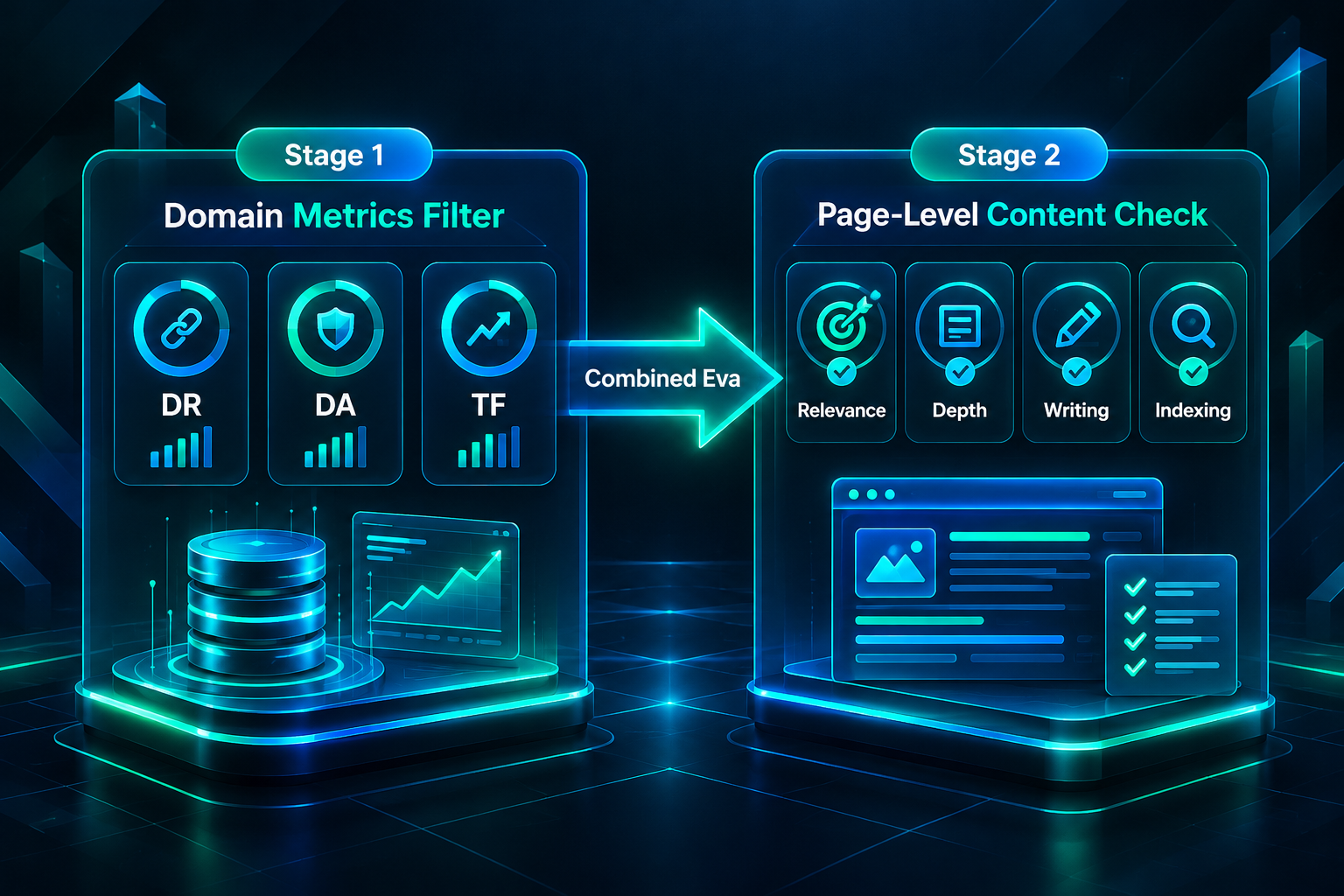
It is also worth noting that proprietary metrics like DR, DA, and TF are not Google ranking scores. They are third-party estimates of a domain’s link authority based on each tool’s own data and methodology. A high score on one of these metrics does not guarantee that a placement will produce a ranking improvement, and a moderate score does not automatically disqualify a domain from providing useful contextual link value when the placement page content is strong.
Questions to Ask Your PBN Link Provider
If you are sourcing PBN placements through a provider rather than building and managing your own network, the content-quality evaluation process should include a set of questions directed at the provider before you commit to a placement. Transparent providers will be able to answer these questions clearly and provide access to the placement pages for your own review.
- Can I review the specific placement page and the article where my link will appear before accepting the placement?
- Is the placement page already published and indexed, or will it be created after I place the order?
- What is the domain’s primary topical focus, and how does the placement page relate to that focus?
- How many outbound links does the placement page currently contain, and what types of anchors are used?
- Is the content on the placement page original, and was it written specifically for this domain?
- What is the domain’s publishing history, and how long has it been active under its current ownership?
- Are there any noindex or nofollow directives on the placement page or the outbound links?
A provider that is unwilling to share placement page URLs for pre-acceptance review, or that cannot answer basic questions about content origin and indexing status, is one where the content-quality evaluation process cannot be completed properly. The ability to review placements before accepting them is a basic standard worth insisting on.
Frequently Asked Questions
Does the length of the placement page article affect link value?
Article length is a secondary factor compared to content depth and topical relevance. A shorter article that covers its topic thoroughly and places your link naturally within a relevant paragraph can be a stronger placement than a longer article padded with filler content. Focus on whether the content is substantive rather than whether it meets a specific word count.
Should I reject a placement if the domain covers multiple topics?
Not automatically. Many legitimate websites cover a range of related subjects. The key question is whether the specific placement page is topically relevant to your target page, and whether the domain’s content history shows a coherent editorial direction rather than an obvious pattern of publishing across unrelated niches purely to accommodate link placements.
How do I check whether a placement page is indexed without Search Console access?
Use a site: search in Google with the exact URL of the placement page. If the page appears in results, it is indexed. You can also check the page’s HTTP response code using a tool like Screaming Frog or a browser extension to confirm it returns a 200 status, and review the page source for any noindex meta tags that might prevent indexing.
What is the difference between a nofollow link and a deindexed placement page?
A nofollow attribute on the link itself instructs search engines not to pass PageRank through that specific link, but the placement page may still be indexed and visible. A deindexed placement page means the entire page has been removed from search engine results, which means the link cannot be discovered through normal crawling of indexed content. Both are separate issues that require different checks during your evaluation.
Can a placement page with average writing quality still provide link value?
Writing quality exists on a spectrum, and a placement page does not need to be exceptionally well-written to provide contextual link value. The more important factors are topical relevance, genuine informational substance, natural link placement, and confirmed indexing. A page with competent but unremarkable writing that meets these criteria is generally preferable to a page with polished writing that is off-topic or thin in substance.
How often should I re-check placement pages after accepting a link?
Periodic monitoring is worthwhile, particularly for placements that are important to your campaign. Check that the placement page remains indexed, that the link is still present and correctly formatted, and that the page’s content has not been significantly altered in ways that affect topical relevance or link context. The frequency of these checks can be adjusted based on the importance of the placement and the provider’s track record.
Building a Content-Quality Standard for Your PBN Link Evaluation
Evaluating content quality before accepting a PBN link is not a single check — it is a structured process that combines topical assessment, writing quality review, technical verification, and domain context analysis. Each of these dimensions contributes to a more complete picture of what a placement is actually worth, beyond what any single authority metric can tell you.
The practical value of this process is that it allows you to distinguish between placements that offer genuine contextual link value and those that are unlikely to contribute meaningfully to your campaign. Applying consistent evaluation criteria across multiple placement options also makes it easier to compare them objectively and allocate your link-building budget toward the placements most likely to serve your goals.
If you are working with a provider to source PBN placements, the content-quality checks described in this article give you a clear framework for the questions to ask and the signals to look for before committing to any placement. Providers who welcome this level of scrutiny and make placement pages available for pre-acceptance review are generally better positioned to deliver placements that hold their value over time. If you would like to discuss placement quality standards or review options for your specific campaign, PBN Backlinks Service can help you assess what fits your requirements.