

Every SEO professional eventually confronts the same question: how many backlinks does a website need to rank competitively? The honest answer is that no universal number of backlinks guarantees a specific position.
What exists instead is a framework — built from competitor analysis, SERP data, and industry benchmarks — that allows for precise, data-driven backlink targets. This guide provides that framework, from the first page entry point all the way to the #1 position.
Search Intent and Ranking Targets Clarification
Different ranking thresholds — Top 10, Top 5, Top 3, and #1 — reflect distinct competitive environments and dramatically different traffic potential. Moving from position 10 to position 1 isn’t a linear progression; it’s an exponential increase in authority requirements, link quality, and overall SEO investment. Each threshold demands a separate backlink strategy, not a single unified approach scaled upward.
The query “how many backlinks do I need to rank” carries both transactional and analytical intent. Users searching this phrase are typically SEO professionals, agency clients, or business owners who need quantified benchmarks, not philosophical explanations about link value. This article addresses that intent directly: ranking position benchmarks, competitor analysis methodology, and a step-by-step backlink gap calculation that replaces guesswork with actionable data.

Mon-Fri: 09:00 AM – 06:00 PM
What Actually Determines Backlink Requirements in 2026
Referring Domains vs. Total Backlinks
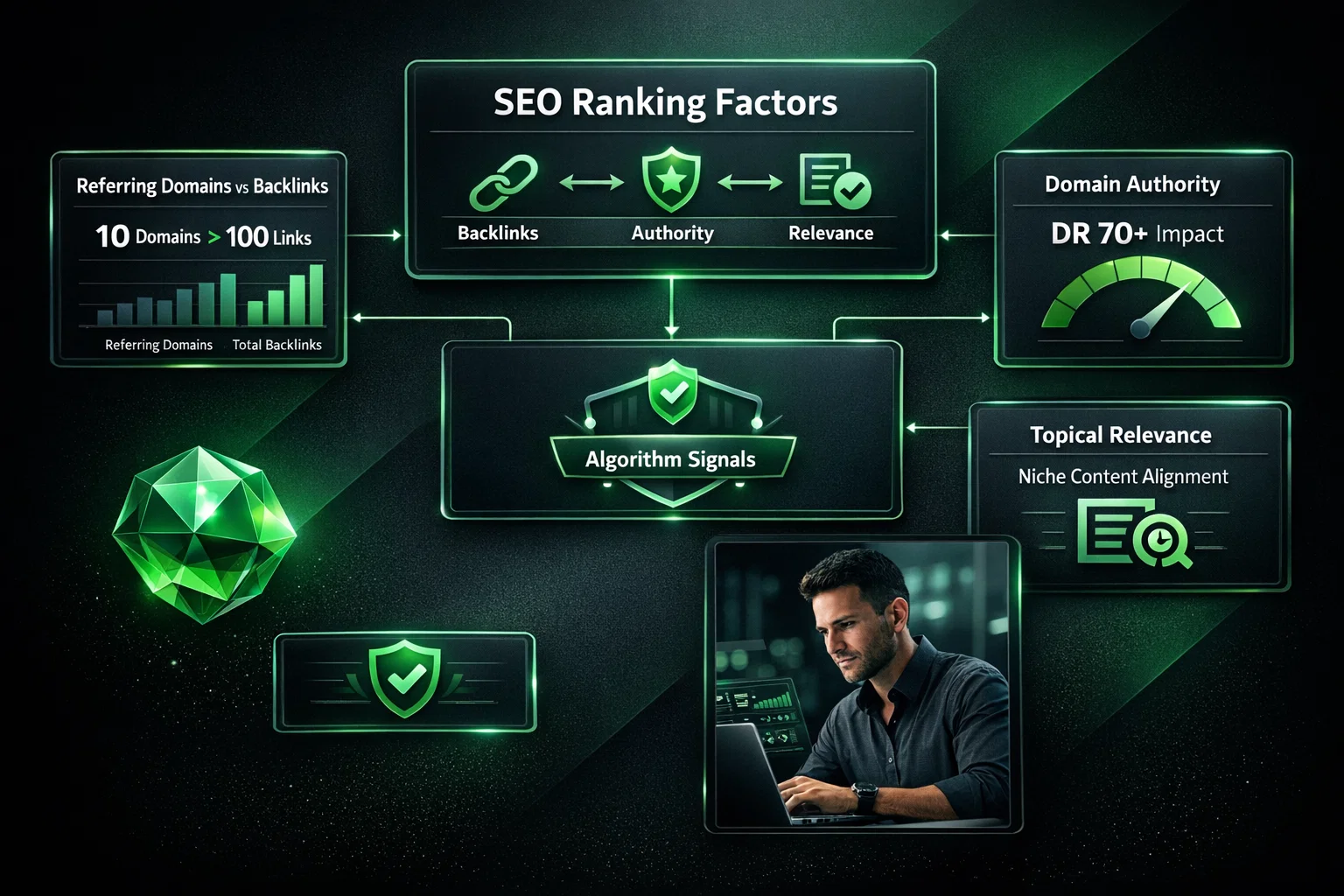
Search engines prioritize unique referring domains over raw backlink volume. Ten links from ten separate domains consistently outperform 100 links from a single source, because domain diversity sends stronger trust and relevance signals to Google’s ranking algorithms. This distinction matters enormously when planning a link-building campaign.
Multiple large-scale backlink studies — including those published by Ahrefs using their index of over 35 trillion links — confirm that domain diversity correlates more strongly with top-10 rankings than total link count. An inflated backlink count from a narrow set of sources produces diminishing returns quickly, while a growing portfolio of unique referring domains compounds authority over time.
Domain Authority and Link Quality
Authority metrics such as Ahrefs’ Domain Rating (DR) and Moz’s Domain Authority (DA) influence how much ranking weight each backlink transfers. A single editorial link from a DR 70+ publication may replace the ranking influence of dozens of low-quality directory links, which means quality backlinks from reputable sources are not merely preferable but strategically essential.
Key quality indicators that determine a backlink’s ranking contribution include:
- Organic traffic of the linking domain — Sites with real, measurable traffic signal genuine editorial credibility.
- Topical relevance — A link from a contextually aligned domain carries stronger semantic value.
- Editorial placement — In-content links placed naturally within the article body text outperform footer or sidebar placements.
SERP Competition and Keyword Difficulty
Backlink requirements scale directly with keyword difficulty and SERP saturation. Informational queries with low commercial intent typically require fewer links to rank in the top 10. Commercial and transactional keywords — particularly in high-value verticals — demand significantly higher authority thresholds before Google surfaces a page among the top results.
Highly competitive niches, including finance, health, legal services, SaaS, and iGaming, consistently demonstrate the highest backlink thresholds in any comparative SERP analysis. In these industries, pages ranking in the top 3 often accumulate thousands of referring domains built over years of sustained link-building investment.
Content Quality and Intent Match
Content relevance reduces dependency on high backlink volume. Pages that fully satisfy search intent — covering the topic comprehensively and matching the format Google’s users expect — often rank with fewer links than technically superior pages that fail at intent alignment. Google’s behavioral signals, including click-through rate and dwell time, amplify the ranking impact of well-matched content.
Conversely, a strong backlink profile cannot overcome an intent mismatch. If a page targeting a transactional keyword delivers informational content, or if a local keyword lands on a national landing page, links alone will not push that page into competitive positions.
Backlink Benchmarks by Ranking Position
Top 10 Rankings (Page 1 Entry Point)
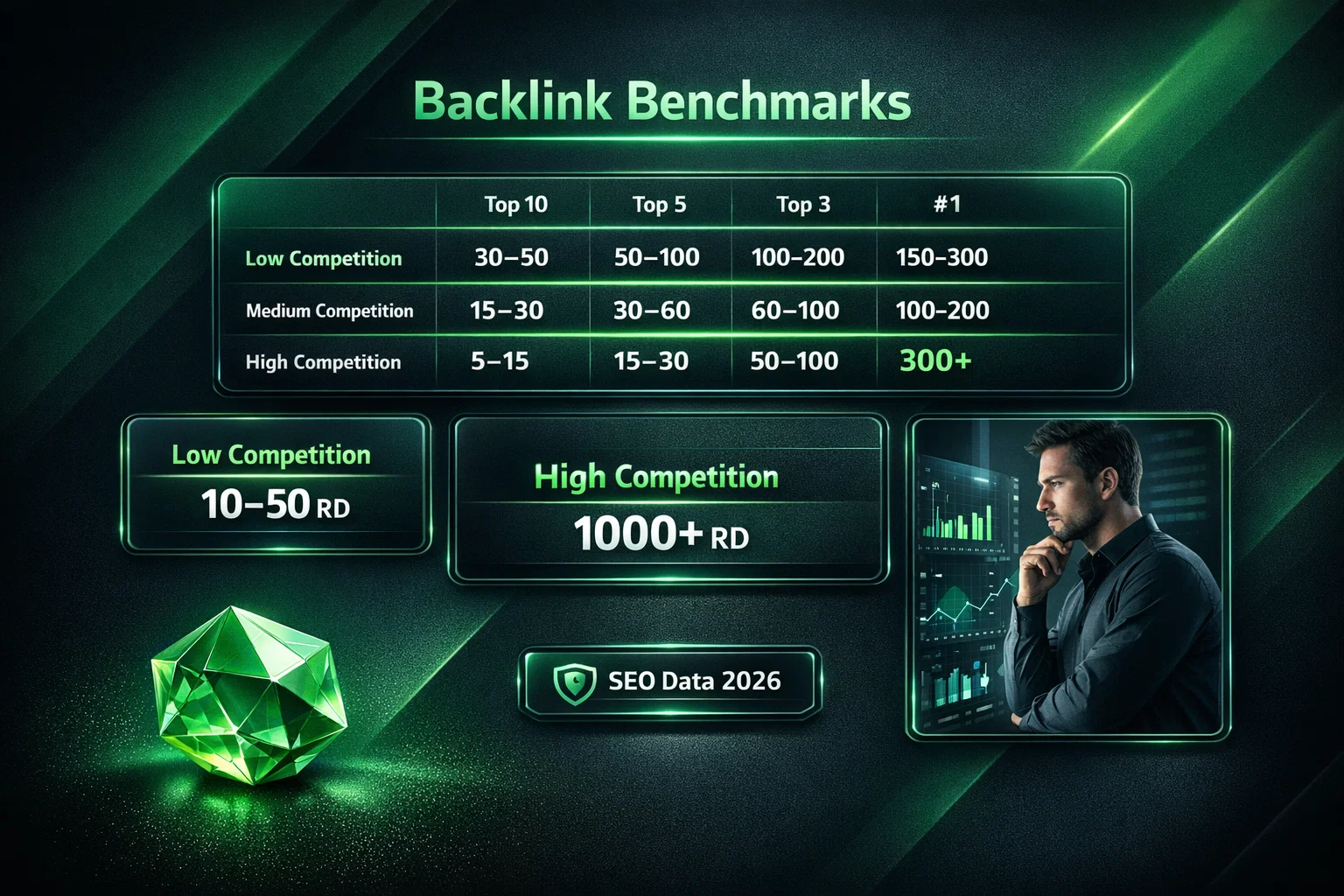
Entering Google’s first page is the initial milestone, and the referring domain requirements at this threshold vary substantially by competition level. Typical benchmarks based on SERP analysis across industries:
| Competition Level | Referring Domains Required |
| Low competition | 10–50 referring domains |
| Medium competition | 50–150 referring domains |
| High competition | 150–300+ referring domains |
At this stage, ranking in the top 10 depends more on topical relevance and basic domain authority than aggressive link acquisition. A new website with strong content and 20–30 high-quality backlinks from reputable sources can realistically enter Page 1 for low-difficulty keywords within three to six months.
Top 5 Rankings
Moving from a lower Page 1 position into the top 5 requires measurable authority growth and a more deliberate anchor text strategy. Pages competing at this level face direct competition from established domains that have been building backlinks for years.
| Competition Level | Referring Domains Required |
| Low competition | 50–150 referring domains |
| Medium competition | 150–300 referring domains |
| High competition | 300–600+ referring domains |
At the top 5 threshold, link quality and anchor text distribution become critical ranking factors. Overuse of exact-match anchors triggers algorithmic scrutiny, while a natural distribution of branded, partial-match, and topical anchors signals organic growth patterns.
Top 3 Rankings
The top 3 positions capture the vast majority of clicks for most keywords — typically 50–60% of total organic traffic combined. Reaching this tier requires a robust backlink profile with meaningful editorial link representation.
| Competition Level | Referring Domains Required |
| Low competition | 100–250 referring domains |
| Medium competition | 250–500 referring domains |
| High competition | 500–1,000+ referring domains |
SERP analysis consistently shows a strong correlation between the top 3 positions and editorial backlinks from media publications, industry associations, and high-authority niche sites. Guest posts alone, particularly from lower-DR sources, rarely sustain top 3 rankings in competitive SERPs without supporting editorial coverage.
Position #1 in Google
The first position in Google is the most resource-intensive ranking target and often reflects total SERP dominance rather than marginal link-building advantages over Position 2 or 3.
| Competition Level | Referring Domains Required |
| Low competition | 150–400 referring domains |
| Medium competition | 400–800 referring domains |
| High competition | 1,000–5,000+ referring domains |
Achieving and maintaining Position #1 requires dominance across all SEO signals simultaneously: domain authority, content depth, user engagement metrics, site speed, and a continuous stream of new links to prevent competitor displacement. In ultra-competitive verticals, the top-ranking page often has accumulated its backlink profile over three to five years of sustained investment.
Why “Number of Backlinks” Is a Misleading Metric
Link Quality Distribution
A backlink profile dominated by low-DR directory links, forum comments, or irrelevant site-wide links actively weakens ranking potential in competitive SERPs. The total backlink count displayed in tools like Ahrefs or SEMrush can be misleading without filtering for link quality distribution. What matters is the proportion of high-authority, contextually placed backlinks within the total profile.
Search algorithms evaluate link trust signals — including spam score, topical alignment, and link placement — not raw link volume. A website with 500 low-quality backlinks pointing at it may rank below a competitor with 80 carefully acquired high-quality links from reputable sources.
Topical Relevance and Context
Backlinks from contextually relevant pages carry stronger semantic ranking signals than links from unrelated domains. An iGaming site receiving links from finance or legal industry publications benefits from that authority transfer because topical proximity reinforces the link’s relevance signal.
Sidebar links, footer links, and blogroll placements — even from high-DR domains — contribute minimal ranking impact compared to contextual links placed within article body text. The surrounding content informs Google about the link’s topic, making editorial placement within relevant content significantly more valuable per link.
Link Velocity (Growth Rate)
Consistent backlink acquisition signals natural, organic growth to Google’s algorithms. A pattern of 20–30 new referring domains per month reads as healthy editorial activity. Acquiring 300 new links in a single week — regardless of source quality — risks triggering algorithmic filters that scrutinize unnatural link velocity patterns.
Competitive niches require sustained monthly link growth simply to maintain existing rankings, because competitors continuously build new links as well. Periods of link-building inactivity can result in gradual ranking erosion even without any penalty signals.
How to Calculate the Exact Number of Backlinks You Need To Rank on Google Search
Step 1: Analyze SERP Competitors
Begin by pulling the top 10 ranking pages for your target keyword into Ahrefs Site Explorer or SEMrush Backlink Analytics. For each competing URL, record the referring domain count, Domain Rating, estimated organic traffic, and primary content type (informational, commercial, landing page). This establishes the actual competitive landscape rather than relying on generic industry estimates.
Step 2: Identify Median and Top Tier Values
From the data collected in Step 1, calculate two figures:
- Median referring domains — the midpoint across all 10 results, representing the baseline to reach Page 1.
- Top 3 average referring domains — the target benchmark for competitive positioning.
This approach replaces generic backlink estimates with data-driven targets specific to your keyword and niche, which is far more accurate than any published industry average.
Step 3: Calculate Backlink Gap
Apply the following formula to define your minimum acquisition requirement:
Backlink Gap = Competitor Average Referring Domains – Current Referring Domains
For example, if the top 3 competitors average 340 referring domains and your page currently has 85, the backlink gap is 255 referring domains. This becomes the foundational acquisition target, with quality-weighted adjustment based on the DR profile of competitors’ linking domains.
Step 4: Define Monthly Link Velocity
Set a realistic and sustainable acquisition pace based on the competition level:
| Competition Level | Recommended Monthly Velocity |
| Low competition | 5–10 new referring domains/month |
| Medium competition | 10–30 new referring domains/month |
| High competition | 30–100+ new referring domains/month |
Consistency over six to twelve months outperforms short-term volume spikes in both ranking stability and algorithmic trust accumulation. Monthly link velocity should be planned around the total backlink gap and realistic timeline to ranking targets.
Backlink Requirements by Industry (Comparative Analysis)
Low-Competition Niches
Local services (plumbing, landscaping, dental practices) and specialized niche blogs typically operate in lower-authority SERP environments where backlink requirements remain relatively moderate. In these verticals, 20–80 referring domains from locally relevant and topically aligned sources can produce Page 1 rankings within three to four months.
- Lower authority thresholds compared to national or global keywords
- Faster ranking timelines due to reduced competition
- Local citation links and niche editorial placements are often sufficient for top-5 positioning
Medium-Competition Niches
SaaS tools, B2B service providers, and regional e-commerce sites compete in SERPs that demand a balanced combination of content quality and structured link acquisition. Link velocity requirements are moderate but consistent, and competitor analysis frequently reveals a mix of guest posts, resource page inclusions, and digital PR.
- Balanced reliance on content marketing and backlink outreach
- Structured guest posting campaigns with DR 40–70 placements produce measurable results
- Anchor text diversification becomes increasingly important at this level
High-Competition Niches
Finance, health, iGaming, and insurance verticals present the most resource-intensive backlink requirements in organic search. Pages ranking in the top 3 for primary keywords in these niches have typically accumulated hundreds to thousands of referring domains, including editorial links from major national media publications.
- High-DR authority domains dominate SERPs, making topical authority essential
- Digital PR campaigns and newsjacking strategies become primary link acquisition channels
- Backlink building in these verticals is resource-intensive and requires sustained multi-year investment
When Fewer Backlinks Are Enough
Long-Tail Keywords
Long-tail keyword phrases with three or more words typically carry lower competition levels, which reduces referring domain requirements substantially. A page targeting “best project management software for remote teams in healthcare” will face a fraction of the SERP competition of a page targeting “project management software.” Ranking in the top 3 for long-tail queries is achievable with 10–40 relevant backlinks when content intent alignment is strong.
Strong Internal Linking Structure
Internal linking distributes page authority across a website’s content architecture. A new page on an established domain with strong topical authority can receive significant ranking boost from internal links pointing to it from high-traffic pages — reducing dependence on new external backlinks. Proper internal linking is often underutilized as an authority distribution tool, particularly on large content sites.
High Topical Authority Websites
Established domains that have published consistently within a specific niche accumulate topical authority that benefits all new pages published under that domain. A website with three years of fintech content and hundreds of referring domains can rank a new article in the top 10 within weeks, while a newer domain with similar content would require months of backlink acquisition to reach equivalent positions.
When More Backlinks Will Not Improve Rankings
Poor Content Quality
A weak or thin content page cannot be rescued by backlink volume alone. If the content fails to fully address search intent, provides insufficient depth, or delivers a poor reading experience, additional links will produce diminishing ranking returns. Google’s quality assessment systems evaluate content independently from backlink signals.
Search Intent Mismatch
Even a strong backlink profile from reputable sources cannot compensate for incorrect intent targeting. A page optimized for informational content that ranks for a transactional keyword will experience high bounce rates and low dwell time — behavioral signals that suppress rankings regardless of the referring domain count pointing at that URL. Resolving intent mismatch is a prerequisite before additional link building delivers value.
Technical SEO Issues
Indexing failures, slow page load times, poor Core Web Vitals scores, or mobile usability problems create ranking ceilings that links cannot overcome. If Google cannot efficiently crawl and index a page, links pointing to that URL cannot transfer authority effectively. Technical SEO issues must be resolved before any link-building investment can produce expected returns.
Types of Backlinks That Reduce Quantity Requirements
Editorial Links from Authority Sites
Editorial backlinks from major media publications — industry news sites, national newspapers, established trade journals — carry significantly amplified ranking signals compared to standard outreach placements. A single editorial link from a domain with DR 80+ and hundreds of thousands of monthly organic visitors can produce ranking movement that would otherwise require 20–30 standard guest post placements.
Contextual Niche Links
Backlinks placed contextually within topically aligned content on niche-relevant domains produce stronger semantic signals than general authority links. A backlink from a cybersecurity publication pointing to a VPN review page carries more ranking value than a link from a general lifestyle blog with equivalent DR, because topical proximity reinforces the relevance signal Google’s algorithms evaluate.
Digital PR Mentions
Digital PR campaigns that generate brand mentions with accompanying links improve domain trust and authority signals simultaneously. Coverage in recognized industry publications, data-driven studies shared across multiple outlets, and expert commentary placements create a backlink profile pattern that strongly correlates with top SERP positions in competitive niches.
Cost of Building High-Quality Backlinks in 2026
Average Market Pricing
Understanding the investment required for high-quality backlinks is essential for accurate SEO budget planning. Pricing in 2026 reflects not only domain authority metrics but also the complexity of outreach, editorial control, and placement quality. In practice, many SEO teams benchmark costs against structured offerings such as backlink packages, where link tiers are grouped by authority level and acquisition model.
| Link Type | Average Cost Range |
| Guest posts (DR 30–50) | $100–$300 per placement |
| Guest posts (DR 50–70+) | $300–$500+ per placement |
| Editorial placements | $300–$1,500+ per link |
| Digital PR campaigns | $1,000–$5,000+ per campaign |
| Niche PBN placements | $50–$200 per link |
Pricing varies significantly based on domain authority, niche competitiveness, and the level of editorial control involved. Automated or low-cost bulk link services typically deliver domains with artificially inflated metrics and no real organic traffic, making them poor investments for sustainable rankings.
ROI Considerations
Backlink investment must be evaluated against keyword commercial value and projected conversion potential. Spending $1,500 on an editorial placement for a keyword generating $50,000 in monthly revenue is easily justified — the same spend for a low-volume informational keyword requires more careful ROI analysis. High-cost backlinks from reputable sources are justified primarily for commercial-intent keywords where the ranking translates directly into measurable business outcomes.
Strategic Roadmap to Reach the #1 Position
Phase 1: Foundation (Top 10 Entry)
The foundation phase focuses on technical stability, content relevance, and initial link acquisition. Without resolving technical SEO issues and ensuring accurate intent alignment, subsequent link-building investment cannot reach its potential.
- Complete technical SEO audit and resolve crawling, indexing, and Core Web Vitals issues.
- Publish primary target page with full intent alignment and comprehensive content coverage.
- Acquire 10–30 initial referring domains from topically relevant sources to establish basic authority.
Phase 2: Growth (Top 5 and Top 3)
Moving from Page 1 into the top 3 requires deliberate authority expansion, content depth improvements, and refined anchor text strategy.
- Scale backlink acquisition through guest posting, niche edits, and outreach campaigns.
- Expand content coverage with supporting cluster pages and strengthen internal linking architecture.
- Optimize anchor text distribution — balancing branded, generic, and partial-match variations.
Phase 3: Dominance (#1 Position)
Reaching and maintaining Position #1 requires multi-channel authority building that goes beyond standard link outreach.
- Execute digital PR campaigns to earn editorial mentions from high-authority publications.
- Build brand authority signals through consistent citation, mention growth, and social proof.
- Maintain a continuous stream of new high-quality backlinks — 20–100+ per month, depending on competitive intensity — to prevent displacement by ranking competitors.
Frequently Asked Questions
No universal number of links guarantees any specific position in Google. The number of links required depends on keyword difficulty, niche competition, and the quality of links pointing at competing pages. Run a backlink analysis of the top 10 results to discover how many backlinks you actually need for your specific target.
The number of backlinks required to rank on Google’s first page ranges from 10–50 referring domains in low-competition niches to 300+ in high-competition verticals. Use a backlink checker like Ahrefs or SEMrush to see how many referring domains the websites ranking in the top 10 currently hold — that benchmark defines the links you need to build, not any generic estimate.
Pages that rank in the top three typically need 100–1,000+ referring domains, depending on competition level. Prioritizing links from authoritative, topically relevant domains reduces the total quantity of backlinks needed to reach those positions. A strong backlink profile built on high-quality links from reputable sources consistently outperforms a high raw link count from low-authority sources.
50 backlinks are sufficient only in low-competition niches with minimal SERP saturation. To rank for competitive keywords — finance, SaaS, iGaming — the number of high-quality backlinks required is significantly higher. In those verticals, 50 links represent an early foundation, not a complete approach to backlink building capable of reaching top rankings.
You need fewer links when targeting long-tail keywords, when your domain already holds strong topical authority, or when your content fully satisfies search intent with minimal competition. Relevant backlinks rather than high volume become the priority in these cases — even a link from a highly authoritative niche domain can move rankings more than dozens of unrelated links.
Calculate your backlink gap — competitor average referring domains minus your current referring domains — then divide by your target timeline. To maintain top positions, new links must be acquired consistently, since backlinks remain a dynamic signal and competitors continue building. Monitor your backlink profile monthly using Ahrefs or SEMrush to track progress and adjust link velocity accordingly.
Prioritizing backlinks from reputable sources over raw backlink volume produces stronger, more stable rankings. Quality of links — measured by domain authority, organic traffic, topical relevance, and editorial placement — determines the actual ranking weight each link transfers. Obtaining backlinks for your website from a small number of high-authority domains often delivers more ranking impact than scaling a weak-profile approach across hundreds of low-DR placements.