

Key Takeaways
- PBN links pass more than PageRank when the linking site carries genuine topical relevance — they can act as a topical entity signal that reinforces how Google categorizes your brand.
- Entity SEO and link building are converging strategies in 2026: Google’s Knowledge Graph, AI Overviews, and Generative Engine Optimization all rely on corroborating signals from multiple sources, including external links.
- Topically coherent PBN content amplifies entity-level topic authority more effectively than thin, keyword-only pages — but PBNs cannot replace E-E-A-T signals or substitute for genuine brand authority.
- A hybrid link strategy combining PBN backlinks with digital PR, schema markup, and brand mentions gives a more resilient and measurable entity footprint than PBNs alone.
- SpamBrain detection, Google’s entity pruning, and manual action risk mean that PBN deployment requires careful planning, footprint management, and ongoing maintenance.
What Is Entity SEO and Why Does It Matter?
Entity SEO refers to the practice of optimizing a website and brand so that Google understands who you are as a distinct, verifiable entity — not merely which keywords you target. Google’s search systems, including the Knowledge Graph, no longer evaluate pages in isolation. Instead, they map relationships between named entities: brands, people, places, topics, and the connections between them. When your brand is clearly recognized as a distinct entity within a relevant topical cluster, Google can serve your content with greater confidence across a broader range of semantically related queries.
Knowledge Graph inclusion is the clearest indicator of strong entity recognition. When Google assigns your brand a Knowledge Panel — drawing from sources such as Wikipedia, Wikidata, your own structured data, and corroborating signals from third-party sources — it signals that the search engine has resolved your brand as a unique, trustworthy entity rather than an ambiguous set of keywords. This distinction matters increasingly for competitive rankings, AI Overview citation eligibility, and Generative Engine Optimization (GEO), where AI systems must decide which brands to surface in synthesized answers.
Entity-based SEO is built on a multi-signal authority model. No single signal — not a Wikipedia article, not a backlink, not a schema tag — is sufficient on its own. Google looks for corroborating signals across sources: structured data on your site, unlinked brand mentions in editorial content, citations in directories, and the topical context of inbound links. This is the foundation on which PBN links can play a strategic role — if they are deployed intelligently.
How PBN Links Work: A Functional Overview
A private blog network (PBN) is a collection of websites — typically built on expired or aged domains — that are controlled by a single operator and used to build links pointing to a target site, commonly called the money site. The core appeal is control: the site owner can determine anchor text, link placement, topical context, and link velocity without relying on the editorial decisions of independent publishers.
PBN links pass link equity in the same way any external backlink does. Google’s systems evaluate the linking page’s authority, the relevance of the surrounding content, the anchor text used, and whether the link appears editorially natural. What distinguishes a well-constructed PBN from a low-quality one is the depth and topical coherence of the content on each network node. A PBN site built around thin, auto-generated text passes primarily raw PageRank — and even that is increasingly discounted by SpamBrain, Google’s machine-learning spam detection system. A PBN site with substantive, niche-specific content does something more: it acts as an external corroborating signal for the money site’s topical entity.
The concealed ownership footprint is the fundamental risk factor. When Google identifies that a group of sites share ownership signals — similar hosting, IP patterns, WHOIS data, interlinking patterns, or template design — it can devalue or penalize the entire network. Modern PBN operators invest heavily in footprint-free construction: separate hosting environments, independent design, natural content publishing schedules, and genuine referring domains pointing to network nodes. Even with these precautions, SpamBrain detection has become increasingly effective, and the risk of a manual action or algorithmic penalty remains real.
The Intersection: How PBN Links Reinforce Entity Signals
The strategic insight that connects PBN link building to entity SEO is this: a backlink is not just a vote for a URL — it is a contextual signal about what that URL represents. When a PBN site with genuine, in-depth content about a specific niche links to your money site, it contributes a topical entity signal, not merely a domain authority transfer. Google’s systems interpret the linking site’s content, the anchor text used, and the semantic relationships between the two sites as part of a broader picture of what your brand is about and where it belongs in the Knowledge Graph’s topical neighborhoods.
This means that topically coherent PBN content amplifies entity-level topic authority in a way that thin or off-topic content simply cannot. A PBN site covering fintech topics in depth, linking to a fintech money site using branded anchor text, tells Google something meaningful: multiple external sources associate this brand with this topic. That is structurally similar to what editorial citations and digital PR achieve — the difference is that the editorial independence is simulated rather than genuine, which is precisely why Google classifies PBN links as a link scheme under its Webmaster Quality Guidelines.
The anchor text choice is particularly important in this context. Branded anchor text — using your actual brand name rather than exact-match keywords — contributes directly to entity recognition. When multiple external sources, including PBN nodes, refer to your brand by name in topically relevant contexts, this pattern reinforces your entity home: the primary URL or Knowledge Graph node that Google associates with your brand identity. Over-optimized keyword anchors, by contrast, trigger SpamBrain detection flags and undermine the entity-building effect by making the link pattern appear manipulative rather than organic.
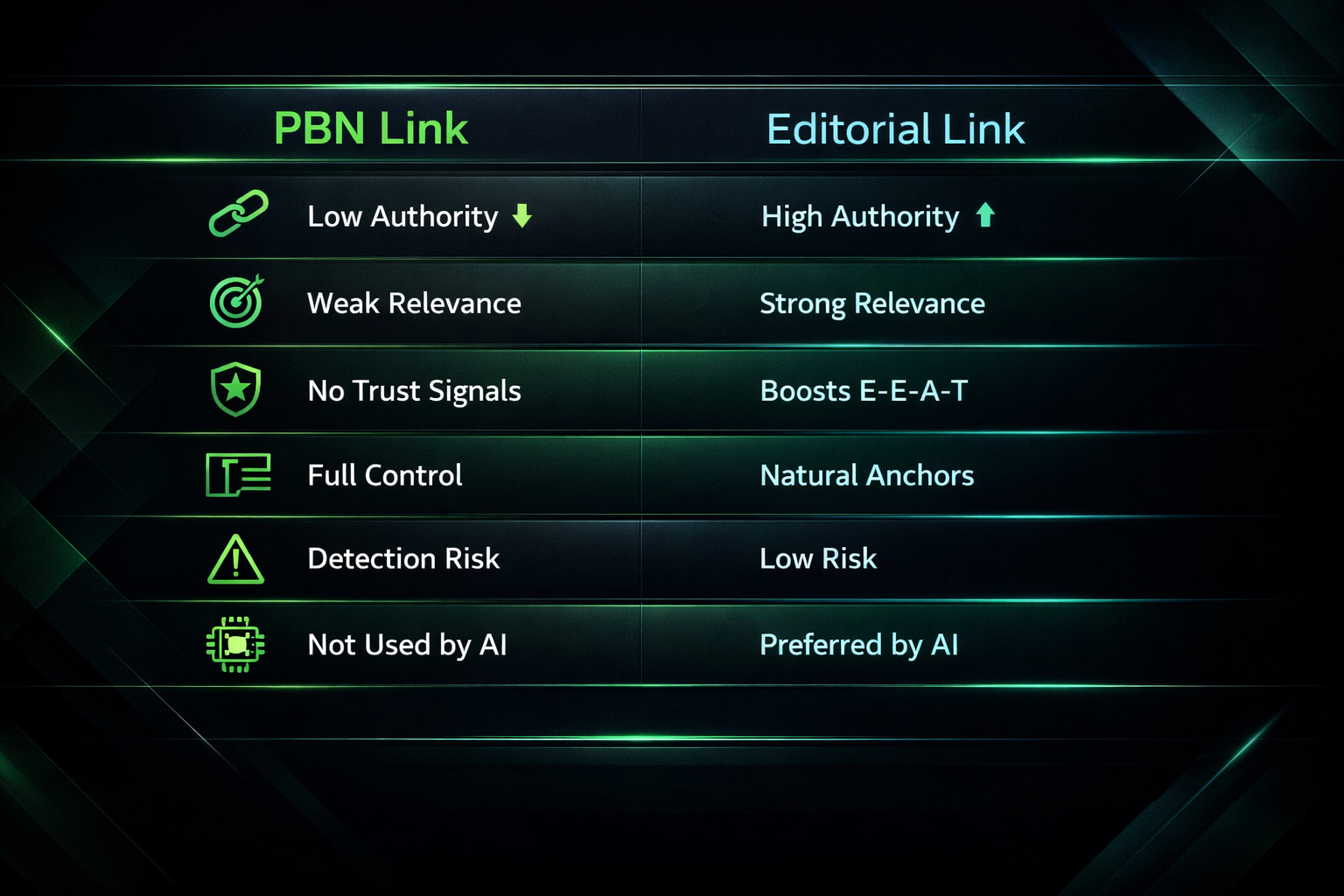
PBN Links vs. Natural Backlinks: Entity Signal Comparison
| Signal Dimension | Topically Coherent PBN Link | Editorial / Digital PR Link |
|---|---|---|
| Link equity (PageRank) | Yes, if domain has genuine history | Yes, often higher DR sources |
| Topical entity signal | Yes, when content is niche-deep | Yes, with higher credibility weight |
| E-E-A-T contribution | No — concealed ownership negates this | Yes — genuine editorial endorsement |
| Anchor text control | Full control | Limited — publisher decides |
| Brand mention quality | Moderate — dependent on content depth | High — independent editorial context |
| Knowledge Graph corroboration | Indirect — depends on indexing and relevance | Direct — Google weights editorial sources |
| AI Overview citation potential | Low — PBN content rarely cited directly | Higher — editorial sources are preferred |
| Detection and penalty risk | Significant — SpamBrain and manual review | Minimal — complies with guidelines |
| Scalability | High — operator controls volume | Low — dependent on outreach and newsworthiness |
| Cost structure | High upfront domain acquisition cost | Variable — time and PR resource intensive |
Schema Markup and the sameAs Property: Amplifying Entity Signals
Structured data is the most direct mechanism for communicating entity identity to Google’s systems. Implementing an Organization schema on your money site — including the sameAs property linking to verified external profiles such as your Wikipedia page, Wikidata entry, Google Business Profile, LinkedIn, and Crunchbase — tells Google explicitly which web presences belong to the same real-world entity. This structured data creates an entity home that external signals, including PBN backlinks, can reinforce.
Where PBN links and schema interact strategically is in the corroboration layer. Structured data tells Google what your entity claims to be; external links from topically relevant sources tell Google that others appear to recognize those claims. When PBN sites also implement basic schema identifying themselves as topically coherent publications within your niche, and when those sites link to your money site using branded anchor text, the combined signal is more meaningful than either element in isolation. Some advanced PBN operators implement Organization schema on network nodes specifically to strengthen the entity graph connection — though this adds indexing complexity and must be balanced against footprint risk.
It is worth stating clearly: schema markup on your money site is not optional in an entity-first SEO environment. Without it, PBN links and other external signals point to an entity that Google has not been explicitly told how to classify. Schema provides the definitional anchor; external links provide the corroboration. Neither is sufficient without the other for strong Knowledge Graph inclusion.
Tiered Link Building and Entity-Safe PBN Deployment
Tiered link building is a deployment method that reduces direct footprint risk while preserving link equity flow. In a tiered structure, Tier 1 links point directly to the money site — these should be the most authoritative, topically relevant, and carefully constructed PBN nodes, ideally supplemented by genuine editorial links. Tier 2 links point to the Tier 1 PBN sites themselves, reinforcing their own authority and ensuring they are well-indexed. Tier 2 sources can include lower-risk link types: web directories, niche forums, social profiles, and content syndication.
From an entity SEO perspective, tiered link building serves an additional function: it helps each Tier 1 node accumulate its own referring domains and appear as a more established, independent publication. A PBN site with multiple inbound links from diverse sources is less likely to be discounted as a thin network node and more likely to be treated by Google as a genuine topical resource — one whose outbound links carry meaningful entity signal weight. This is a structural approach to making PBN content function more like an editorial citation and less like a manufactured vote.
The entity-safe principle for Tier 1 PBN deployment can be summarized as: each network node should be able to stand independently as a topically coherent publication. If Google were to evaluate the site on its own merits — content depth, internal linking, publishing consistency, design quality — it should appear credible. The concealed ownership is the line Google prohibits; the content quality and topical coherence are what determine whether the entity signal is meaningful.
Local Entity SEO: PBN Links and Google Business Profile
For businesses with a local presence, entity SEO extends beyond the website to include the Google Business Profile (GBP) listing. Google treats a GBP listing as a distinct entity node — separate from the website — and evaluates its authority and relevance through its own set of corroborating signals: NAP consistency (name, address, phone number) across citations, review volume and sentiment, GBP category accuracy, and inbound signals pointing to the listing’s CID URL.
PBN links can be directed at a GBP CID URL rather than the money site itself. When this is done, the link passes a relevance and entity signal directly to the Maps listing, which can contribute to local pack rankings and map visibility. This is a practical and underserved application of PBN link building that many guides overlook. The same topical coherence principles apply: a link from a locally relevant or niche-relevant PBN site pointing to a GBP listing is more meaningful as an entity signal than a link from an unrelated domain.
NAP consistency across all citation sources — including any mentions on PBN sites — is essential. Inconsistent business name, address, or phone number data across the web creates entity disambiguation problems: Google may struggle to resolve whether two listings refer to the same real-world business, which undermines Knowledge Graph consolidation and local ranking performance.
AI Overviews, GEO, and the Entity-First Future
Generative Engine Optimization (GEO) is the emerging discipline of optimizing for visibility within AI-generated answers — including Google’s AI Overviews, AI Mode, Gemini, and third-party tools such as ChatGPT and Perplexity. These systems draw on the Knowledge Graph to resolve which entities are authoritative sources for a given topic. A brand that exists clearly and confidently within Google’s entity graph — with strong corroborating signals, schema markup, and genuine editorial citations — is significantly more likely to receive an AI Overview citation than a brand that exists only as a keyword-targeting website.
PBN links contribute to this indirectly. They are unlikely to be cited directly as sources within AI Overviews, because AI systems prefer editorially independent, high-authority publishers. However, by reinforcing topical entity signals and supporting the money site’s position within a topical cluster, PBN links can help establish the foundational authority that makes a brand eligible for AI citation. The direct path to AI Overview citation runs through genuine editorial content, digital PR, and Knowledge Graph inclusion — not PBN links. But PBN links, deployed strategically within a hybrid link strategy, can support the conditions that make those outcomes more achievable.
Google’s entity pruning — demonstrated clearly in its June 2025 core update activity — removes or demotes entities that go stale: brands that stop publishing, lose referring domains, or see their corroborating signals decay over time. This means that entity SEO, including any PBN-supported entity strategy, requires ongoing maintenance rather than a one-time build. Link velocity management, content freshness on PBN nodes, and sustained digital PR activity are all part of keeping an entity signal strong and avoiding pruning.
E-E-A-T Limitations of PBN Links
One of the most important honest assessments of PBN links in an entity context is their complete inability to contribute E-E-A-T signals. E-E-A-T — Experience, Expertise, Authority, and Trust — is Google’s framework for evaluating whether content and its sources are genuinely credible. An editorial citation from an established industry publication passes E-E-A-T because it represents an independent editorial judgment that your brand is worth referencing. A PBN link, by definition, does not: the operator controls both the linking site and the money site, which means there is no genuine independent endorsement.
For YMYL (Your Money or Your Life) topics — health, finance, legal, and similar categories where misinformation carries real-world risk — E-E-A-T weight is particularly high. Brands in these niches should treat PBN links as supplementary to a broader trust-building strategy, not as a primary authority mechanism. The brands that rank most consistently in YMYL categories tend to have strong editorial citation profiles, verified author credentials, and robust on-site E-E-A-T signals — things that PBN links cannot provide.
Compensating for this E-E-A-T gap requires deliberate investment in the elements PBNs cannot supply: genuine media coverage, industry association memberships and citations, verified author bios with professional credentials, and consistent brand mentions in independently published content. These signals work alongside link equity and topical entity signals to create the multi-signal authority model that Google’s current systems reward.
Measuring Entity Signal Progress
Measuring the impact of entity SEO activity — including PBN-supported entity building — requires looking beyond keyword rankings. Rankings for individual keywords are a downstream effect of entity authority; the upstream indicators tell a more complete story. Key metrics to track include: whether a Knowledge Panel has appeared for your brand name, the breadth of topics for which your site ranks (semantic ranking breadth rather than single-keyword positions), presence in AI Overview responses for topically relevant queries, and the volume and diversity of referring domains pointing to your site over time.

Tools such as Google Search Console can reveal whether your brand is triggering informational queries that suggest entity recognition — searches for your brand name combined with product or service terms, for instance. Third-party tools that track Knowledge Graph inclusion and monitor AI Overview citations are increasingly available and useful for GEO tracking. Unlinked brand mentions — tracked through media monitoring tools — serve as a proxy for how widely your entity is being discussed independent of direct link building activity.
One meaningful indicator of entity signal improvement from PBN activity specifically is an increase in the number of indexed referring domains within your topical cluster. If new PBN nodes are indexed, topically coherent, and linking to your money site with branded anchor text, you should expect to see gradual improvement in semantic ranking breadth — your site appearing for related queries beyond your primary target keywords. This is the clearest measurable sign that entity-level topic authority is being established, not merely keyword-level ranking strength.
The Hybrid Link Strategy: Where PBNs Fit in 2026
The most sophisticated SEO practitioners in 2026 are not choosing between PBN links and digital PR — they are combining them deliberately. The hybrid link strategy positions these two approaches as complementary tools with different strengths: digital PR builds genuine E-E-A-T, editorial credibility, and direct AI Overview citation eligibility; PBN backlinks provide surgical URL rating (UR) control for commercial pages where earned links are difficult to acquire at scale.
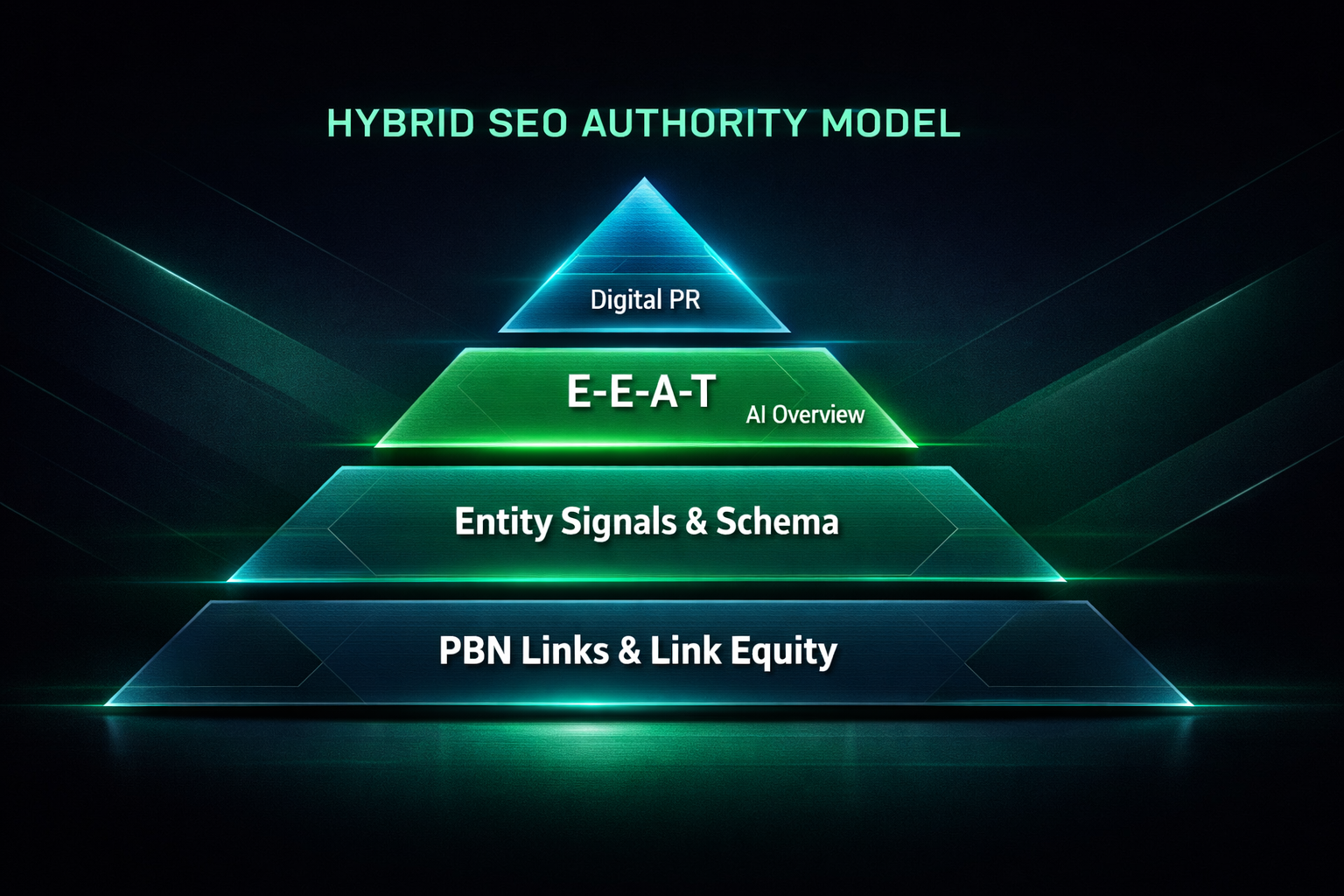
In practice, this means using digital PR and content marketing to build the entity’s editorial foundation — the Knowledge Graph recognition, the genuine brand mentions, the E-E-A-T signals — while using carefully constructed PBN links to support specific commercial landing pages that need additional link equity to compete for transactional queries. The PBN layer is not the visible face of the brand’s authority; it is the structural support that ensures commercial pages can compete while the editorial layer builds over time.
This hybrid model also provides resilience. If Google’s algorithms or a manual review action devalues some PBN links, a brand with a strong editorial citation profile and genuine Knowledge Graph inclusion retains substantial authority. A brand that relies entirely on PBN links for its rankings has no such foundation — a single algorithm update or manual action can collapse its visibility overnight. Entity-level topic authority, built through genuine corroborating signals, is far more durable than link equity alone.
Frequently Asked Questions
Do PBN links directly help with Knowledge Graph inclusion?
PBN links do not directly trigger Knowledge Graph inclusion — that process is driven by structured data, Wikipedia or Wikidata entries, editorial citations, and Google’s own entity resolution systems. However, topically coherent PBN content that uses branded anchor text can act as a corroborating signal that reinforces the entity’s topical positioning, which indirectly supports the conditions for Knowledge Graph recognition over time.
Can Google detect PBN links in 2026?
Google’s SpamBrain system has become significantly more effective at identifying link schemes, including PBN networks. Detection risk is highest for networks with shared hosting footprints, repetitive template design, thin content, and unnatural anchor text distributions. Well-constructed, footprint-free PBNs with genuine content reduce — but do not eliminate — detection risk. The possibility of a manual action or algorithmic penalty remains a real operational risk that any PBN user should factor into their strategy.
What anchor text should PBN links use for entity building?
Branded anchor text — using your actual brand name — is the most effective anchor type for entity recognition. It reinforces entity identity without triggering over-optimization signals. A natural anchor text distribution for entity building typically includes branded anchors, partial-match brand phrases, and some generic anchors (such as “learn more” or “visit here”), with exact-match keyword anchors used sparingly and only where they appear contextually justified.
Are PBN links suitable for YMYL websites?
PBN links carry elevated risk for YMYL sites — health, finance, legal, and similar categories — because Google applies heightened scrutiny to these niches and weights E-E-A-T signals heavily. A manual action on a YMYL site can have severe and lasting ranking consequences. Most practitioners advise that YMYL sites prioritize genuine editorial links and E-E-A-T investment, treating PBN links as a minor supplementary tactic if used at all.
How does Google’s entity pruning affect PBN-supported entity strategies?
Google’s entity pruning removes or demotes entities whose corroborating signals decay over time — stale content, reduced referring domain diversity, or declining brand mention volume. A PBN-supported entity strategy that relies on a fixed set of network nodes without ongoing content updates or supplementary digital PR activity is vulnerable to pruning. Sustained entity maintenance — refreshing PBN content, building new editorial citations, and maintaining active brand signals — is necessary to avoid this outcome.
What is the difference between passing link equity and passing a topical entity signal?
Link equity (PageRank) is the raw authority value transferred through a hyperlink, which contributes to a page’s ability to rank competitively. A topical entity signal is the contextual information carried by that link — the subject matter of the linking page, the anchor text used, and the semantic relationships implied by the link’s context. Thin PBN content mostly passes link equity; topically coherent PBN content passes both link equity and a topical entity signal, which is more valuable for competitive queries where entity-level topic authority is a ranking factor.
Building a PBN Strategy That Supports Entity SEO Sustainably
The core conclusion from examining how PBN links support entity SEO is that the quality of the approach determines whether you are building anything durable. A PBN strategy built on expired domains with thin content and aggressive keyword anchors delivers short-term ranking movement at high risk — it passes link equity without meaningful entity signal, and it is increasingly visible to SpamBrain detection. A PBN strategy built on topically coherent content, branded anchor text, proper schema implementation, and integration with genuine digital PR contributes to a multi-signal authority model that Google’s entity-first systems can recognize and reward.
The practical decision for any site owner considering PBN links in an entity SEO context comes down to three questions: Is the content on each network node genuinely deep and topically relevant to your niche? Is the anchor text distribution balanced toward branded and natural anchors rather than exact-match keywords? And is the PBN component part of a broader hybrid link strategy that includes genuine editorial links, schema markup, and active brand signal building? If the answer to all three is yes, PBN links can function as a legitimate structural tool within a sophisticated entity SEO strategy. If any answer is no, the entity signal value is likely to be minimal — and the risk exposure remains real regardless.