

Key Takeaways
- PBN backlinks are a gray-hat tactic that can accelerate SaaS authority growth but carry meaningful risks including algorithmic penalties and manual actions from Google.
- SaaS-specific link building prioritizes topical relevance over geography, meaning PBN domains should come from former tech, B2B, or software-focused publications.
- Commercial pages — comparison, alternative, feature, and integration pages — should receive PBN links before blog content, because these pages drive SaaS conversions.
- Anchor text distribution must be carefully controlled; exact-match anchors are particularly risky for recognized SaaS brands.
- A hybrid link building strategy that layers PBN links alongside white-hat tactics is more sustainable than relying on PBNs alone.
What Are PBN Backlinks and Why Do SaaS Companies Consider Them?
A Private Blog Network (PBN) is a collection of websites built on aged domains — typically expired domains with existing link equity — that are used to send backlinks to a target site, commonly called the money site. Each PBN site is designed to pass domain authority to the target while appearing, on the surface, to be an independent publication. In SEO terms, this is classified as a gray-hat tactic: not as transparent as earning editorial links naturally, but widely used by practitioners who need to move rankings faster than white-hat methods typically allow.
SaaS companies consider PBN backlinks primarily because of the authority gap problem. Competitive SaaS categories — project management tools, CRM platforms, marketing software, cybersecurity products — are dominated by well-funded incumbents with domain ratings in the 70s and 80s. A newer or growth-stage SaaS product competing in the same keyword space faces an uphill ranking battle even with strong content. PBN links, when used strategically, can compress the timeline required to compete for commercial keywords, particularly on pages that directly influence trial signups and subscription conversions.
It is important to be explicit: Google’s Webmaster Guidelines prohibit link schemes, and PBN link building falls within that category. The risk of algorithmic devaluation or a manual penalty is real and should be evaluated seriously before any campaign begins. This guide explains how the tactic works in practice, which scenarios make it more or less defensible, and how to structure a campaign that limits unnecessary exposure.
Why SaaS Link Building Is Different From Other Niches
Most PBN guidance is written for local businesses or e-commerce sites, where geographic relevance and product category matching are the dominant domain selection criteria. SaaS link building operates on different logic. A SaaS money site needs topical relevance above almost everything else: the PBN domains linking to it should have histories in technology, software, B2B marketing, developer tools, productivity, or adjacent verticals. A domain that previously hosted a restaurant review blog has essentially no topical authority to pass to a SaaS product, regardless of its domain rating.
The buyer journey is also different. SaaS buyers are typically researchers who compare multiple tools, read reviews, and evaluate pricing before committing. This means the pages that most directly influence revenue — comparison pages, alternative pages, integration pages, and feature pages — are also the pages most likely to rank for high-intent commercial keywords. These commercial pages are where PBN link equity can have the most measurable impact on organic traffic that converts.
Finally, SaaS brands face a unique over-optimization risk. A recognizable SaaS brand receiving an unusual volume of exact-match anchor text links in a short period will generate an unnatural link pattern that SpamBrain detection algorithms are specifically designed to identify. The anchor text strategy for an established SaaS product must be more conservative than what might be used for a generic information site.
Which Pages on a SaaS Site Should Receive PBN Links?
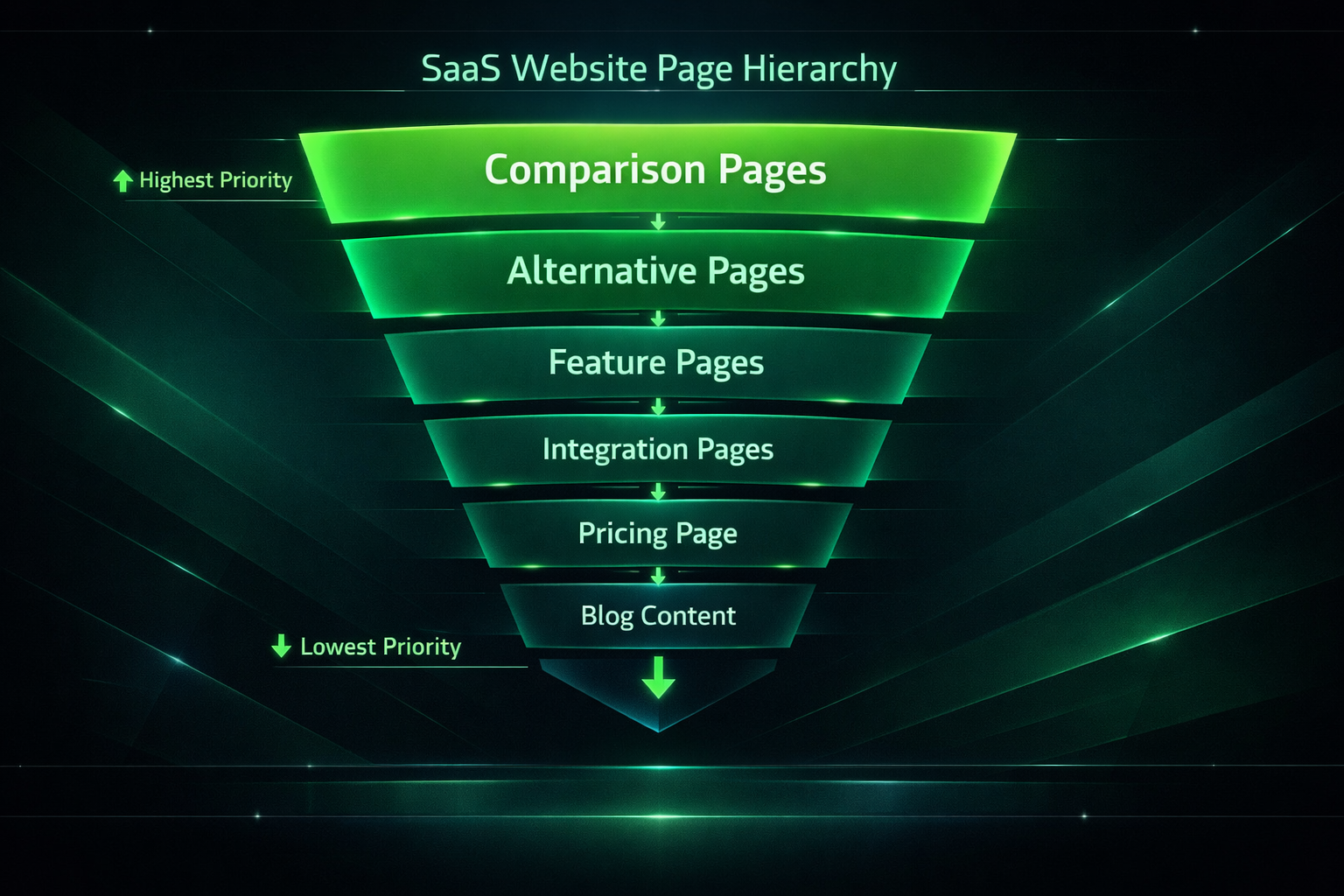
Page targeting is where SaaS-specific link building strategy diverges most clearly from general PBN advice. The priority hierarchy below reflects both the commercial value of each page type and the competitive difficulty of ranking for the keywords they target.
| Page Type | Priority | Reason | Recommended Anchor Type |
|---|---|---|---|
| Comparison pages (Tool A vs Tool B) | Highest | High purchase intent; often ranks quickly with authority | Partial match or branded |
| Alternative pages (Best alternatives to X) | High | Captures competitor brand traffic; conversion-ready audience | Partial match or generic |
| Feature pages | Medium-High | Targets mid-funnel users evaluating specific capabilities | Partial match |
| Integration pages | Medium | Niche but high-intent; often low competition | Branded or partial match |
| Pricing page | Medium | Rarely linked to externally; PBN links can make a real difference | Branded only |
| Blog / informational content | Lower | Useful for topical authority but less direct revenue impact | Generic or branded |
The logic behind prioritizing commercial pages is straightforward: these pages are the least likely to attract organic editorial links because they are promotional by nature. A useful research article might earn links naturally; a comparison page almost never will. PBN links fill that gap specifically where white-hat link building structurally fails to deliver.
Once PBN links are placed to a commercial page, internal linking strategy becomes critical. Passing link equity deeper into the site — for example, from a comparison page to a pricing page via a contextual internal link — amplifies the effect of each PBN placement without requiring additional external links to those deeper pages.
How to Vet PBN Domains for a SaaS Campaign
Domain quality is the single most important variable in a SaaS PBN campaign. Low-quality domains provide minimal ranking benefit while increasing the risk of a domain footprint that triggers SpamBrain detection. The following criteria represent a practical vetting checklist.
Domain Rating and History
A DR minimum threshold of 25 is a reasonable starting point for SaaS PBN domains, though DR 30–40 domains targeting competitive categories will deliver more meaningful link equity. Domain Rating alone is not sufficient — check the domain’s link profile in Ahrefs or a comparable tool to confirm that the referring domains are genuinely diverse and not themselves from low-quality networks. Wayback Machine checks are essential: confirm the domain previously hosted niche-relevant content in a technology, software, or B2B context, and that it was not previously used in an obvious link scheme.
Topical Match
Former tech blogs, SaaS review publications, developer-focused content sites, software comparison directories, and B2B marketing blogs are the highest-value domain categories for SaaS PBN campaigns. A domain with a clean history in one of these categories passes both link equity and topical relevance signals, which collectively have more ranking value than a high-DR domain from an unrelated niche.
Infrastructure and Footprint
A well-run PBN maintains unique hosting across Class C IP blocks to minimize the domain footprint that indicates network ownership. Shared hosting or shared IPs across multiple PBN sites is one of the clearest signals that Google’s algorithms use to identify and devalue network links. Content on each PBN site should be original niche-relevant content, not thin spun articles or templates duplicated across the network.
Red Flags to Avoid
- Domains with no Wayback Machine history or a history of doorway pages
- Domains with a spam score above 10% in Moz
- Networks where all sites share the same CMS theme, contact page template, or footer structure
- Providers who cannot demonstrate indexed posts with real crawl paths
- Unusually low prices that suggest volume over quality (below approximately $50 per link for DR 30+ domains)
- Providers unwilling to share domain URLs before purchase
Anchor Text Distribution for SaaS Brands
Anchor text strategy is where many SaaS PBN campaigns create unnecessary risk. Over-optimization — too many exact-match anchors pointing to a commercial page in a short window — is one of the clearest unnatural link patterns that both SpamBrain and manual reviewers can identify.
A practical anchor text distribution for a growth-stage SaaS product targeting a competitive keyword might look like this: approximately 40–50% branded anchors (the product name alone), 25–35% partial match anchors (a keyword phrase that includes the brand or a natural variation), 10–20% generic anchors (“learn more”, “this resource”, “click here”), and no more than 5–10% exact-match anchors. For a well-recognized SaaS brand, exact-match anchors should be kept even lower — closer to zero in some cases — because branded anchor text is more natural for a known product and exact-match distribution looks artificial by comparison.
Anchor text variation should also be enforced at the campaign level, not just the page level. If multiple PBN links point to the same comparison page, each should use a different anchor from within the recommended distribution, rather than repeating the same partial-match phrase across all placements.
Link Velocity: How Fast to Build by Growth Stage
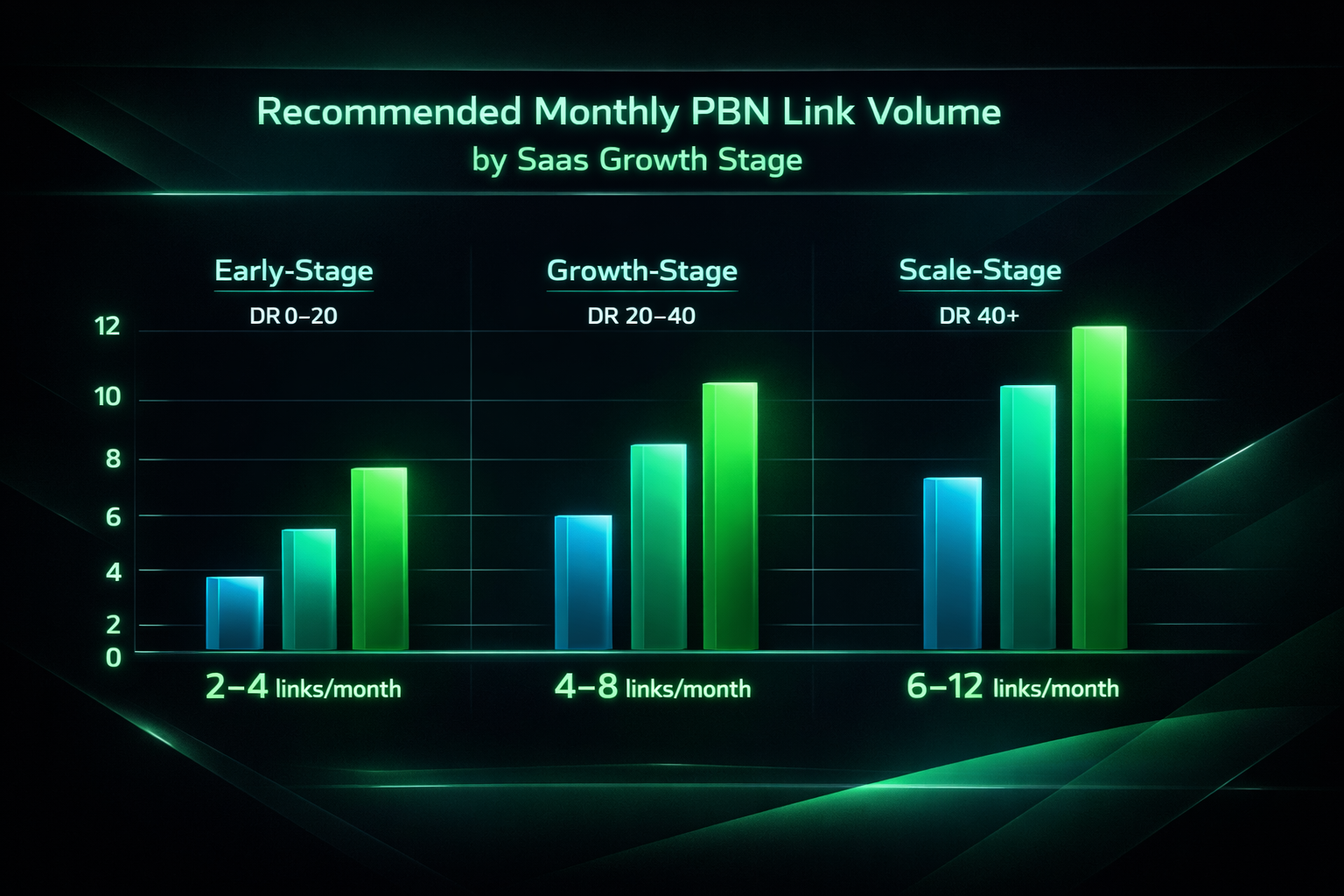
Link velocity — the rate at which new backlinks are acquired — needs to align with the site’s current authority level and history. A site with a DR of 10 that suddenly acquires 20 PBN links in a month will generate an unnatural growth spike. A site at DR 50 with an established diverse link portfolio can absorb additional links at a faster rate without triggering the same signals.
| Growth Stage | Approximate DR Range | Recommended Monthly PBN Links | Notes |
|---|---|---|---|
| Early-stage SaaS | 0–20 | 2–4 links per month | Prioritize homepage first; mix with branded outreach |
| Growth-stage SaaS | 20–40 | 4–8 links per month | Shift focus to comparison and alternative pages |
| Scale-stage SaaS | 40+ | 6–12 links per month | Distribute across commercial pages and integration pages |
DR movement from a well-executed PBN campaign is typically visible within four to eight weeks of links being indexed, though keyword ranking improvements on commercial pages may take longer depending on competitive intensity. Tracking organic traffic specifically to commercial pages — rather than overall organic traffic — gives a clearer picture of campaign effectiveness than DR movement alone.
Building a Hybrid Link Building Strategy
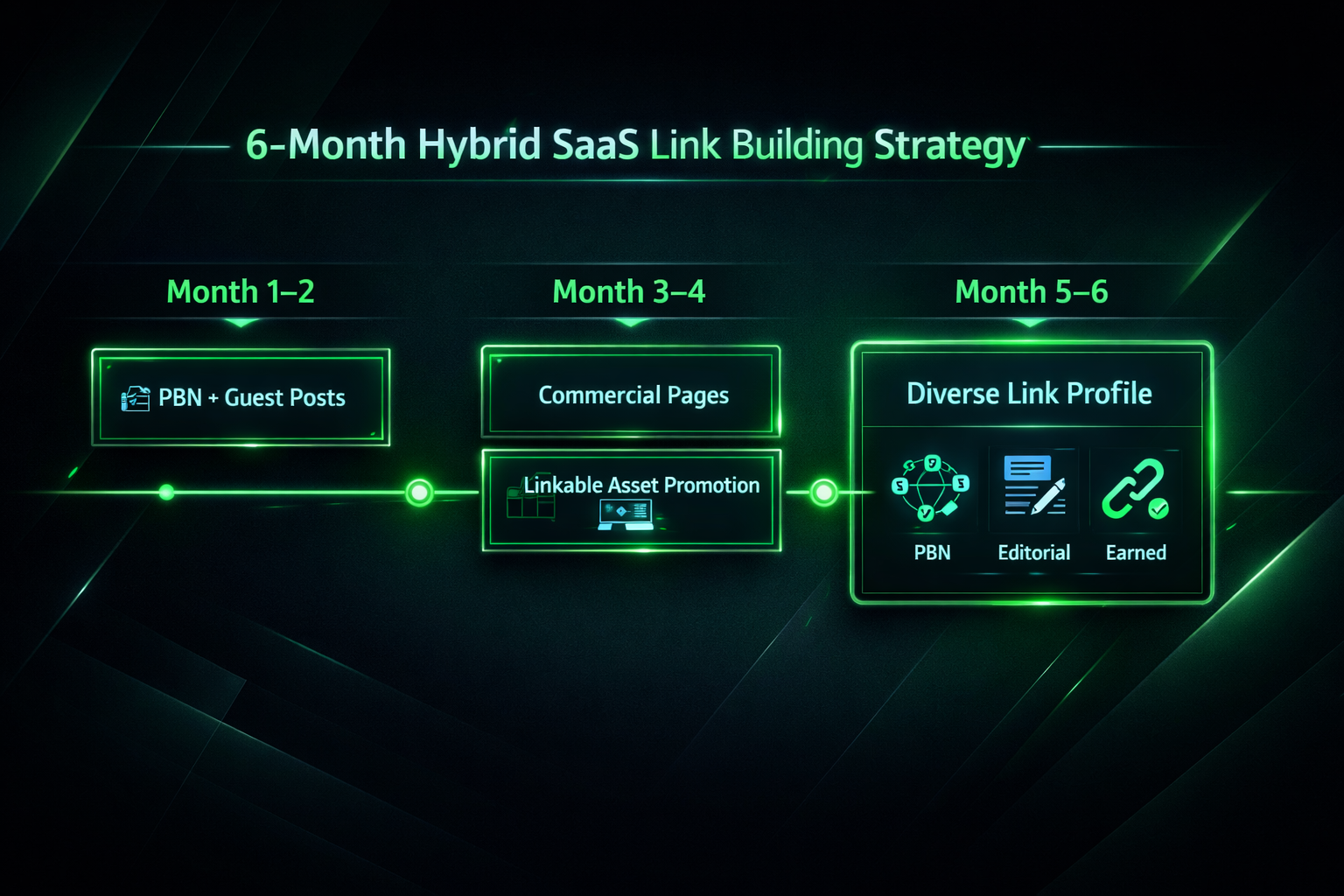
PBN links work most sustainably as part of a hybrid link building strategy rather than as a standalone channel. The combination of gray-hat PBN links and white-hat methods — guest posts on legitimate publications, digital PR placements, niche edits in existing relevant content, and linkable asset development — creates a diverse link portfolio that is harder for algorithms to pattern-match against and more resilient to algorithm updates.
A practical hybrid sequencing approach might look like this: in months one and two, place a small number of PBN links to the homepage and one high-priority comparison page while simultaneously pursuing two or three guest post placements. In months three and four, expand PBN coverage to additional commercial pages while a linkable asset — a research report, data study, or free tool — is promoted for natural link acquisition. By month six, the link profile should show a mix of PBN placements, editorial guest posts, and at least some organically earned links, which collectively present a more natural growth pattern than PBN links alone.
Guest posts and niche edits from real publications also pass a different quality of trust signal than PBN links, partly because they are more likely to generate referral traffic and social mentions alongside the link equity. This distinction matters increasingly as Google’s E-E-A-T evaluation frameworks become more sophisticated.
Risks, Detection, and What to Do If Things Go Wrong
The risks of PBN link building for SaaS websites are real and should not be minimized. Google’s SpamBrain detection system uses machine learning to identify unnatural link patterns, and the signals it looks for include shared hosting infrastructure, thin or templated content on linking sites, unusual anchor text concentration, and rapid link velocity spikes relative to a site’s history. Algorithmic devaluation — where Google simply stops counting the PBN links — is the most common outcome of detection; the links lose their value without triggering a visible penalty. A manual action, which results in a formal notification in Google Search Console and can cause significant ranking drops, is less common but more serious.
There are specific categories of SaaS companies for whom PBN links carry disproportionate risk and should generally be avoided. These include funded SaaS companies preparing for acquisition or an IPO, where a link penalty could materially affect valuation; enterprise SaaS brands with active public relations programs, where a penalty would be conspicuous; and heavily regulated SaaS products in fintech or healthtech, where reputational risk compounds the SEO risk.
If a SaaS site does receive a manual action that appears related to unnatural links, the recovery process involves three steps. First, audit the full backlink profile using Ahrefs or Google Search Console to identify the implicated links. Second, attempt to remove the links where possible by contacting site owners. Third, compile a disavow file listing domains or specific URLs that could not be removed, and submit it through Google Search Console. Recovery from a manual action typically takes several weeks to several months after the disavow file is processed and the reconsideration request is approved. Keeping a record of all PBN placements from the outset makes this process significantly easier if it becomes necessary.
When SaaS Companies Should Not Use PBN Links
Beyond the funded and regulated SaaS scenarios mentioned above, there are several additional situations where PBN links are a poor strategic choice. A SaaS product that already has strong white-hat link building momentum — active digital PR, a growing base of editorial mentions, a high-profile content program — risks disrupting a credible link profile by introducing PBN links that pattern differently from the established baseline. The marginal ranking benefit is unlikely to justify the risk in this context.
SaaS companies with a very small number of total backlinks should also be cautious. When a site has fewer than 50 referring domains, any cluster of PBN links will represent a disproportionately large share of the total link profile, making the pattern more visible. Building some foundational white-hat links first — through directory listings, partner pages, and guest contributions — before introducing PBN links creates a more natural baseline.
Finally, if the primary goal is AI Overview visibility rather than traditional organic rankings, the calculus changes. AI Overviews and LLM-powered search citations appear to weight E-E-A-T signals — author credentials, publication authority, content depth, and brand mentions across authoritative sources — more heavily than raw domain authority from link quantity. PBN links are unlikely to meaningfully improve AI Overview citation rates and may not be the right investment if that is the primary channel being optimized.
Measuring PBN Campaign Results for SaaS
Effective measurement for a SaaS PBN campaign goes beyond tracking domain rating movement. The metrics that most directly reflect campaign value are: keyword ranking changes for the specific commercial-intent terms targeted by each linked page; organic traffic volume to comparison, alternative, and feature pages specifically; and conversion-related metrics such as trial signups or demo requests that can be attributed to organic search on those pages. DR movement confirms that links are being indexed and counted, but it is a leading indicator rather than a business outcome.
Link indexation rate — the proportion of placed PBN links that are actually being crawled and indexed by Google — is also worth monitoring. A high proportion of unindexed links suggests that the PBN sites themselves have crawl or authority problems, which reduces the value of the placements regardless of the domain’s nominal DR.
Frequently Asked Questions
Do PBN backlinks still work for SaaS websites in 2025 and 2026?
PBN links can still produce ranking improvements for SaaS websites when the domains are high-quality, topically relevant, and placed as part of a carefully managed campaign. However, Google’s detection capabilities have improved significantly with AI-driven systems like SpamBrain, which means low-quality PBN links are more likely to be devalued rather than credited. Quality and relevance matter more than volume.
How many PBN links does a SaaS website need to see results?
There is no universal answer, as the required volume depends on the authority gap between the money site and its competitors, the competitiveness of the target keywords, and the quality of the PBN domains used. Early-stage SaaS products often see measurable ranking movement from as few as four to eight high-quality links placed to a specific commercial page, though more competitive categories may require sustained campaigns over several months.
Is there a DR minimum threshold for PBN domains used in SaaS campaigns?
A DR of 25 is a commonly cited baseline, but the more important factor is the quality and relevance of the domain’s historical link profile and content. A DR 28 domain with a genuine history in B2B software content will typically outperform a DR 40 domain with an irrelevant or questionable link history in a SaaS context.
What is the safest anchor text to use when building PBN links to a SaaS site?
Branded anchor text is generally the safest option for recognized SaaS products because it mimics the natural pattern of how real publications reference software tools. Partial match anchors add keyword relevance but should be used in limited proportions. Exact-match anchors carry the highest over-optimization risk and should represent a very small share of the anchor text distribution, if they are used at all.
Can PBN links be used alongside guest posting and digital PR?
Yes, and this hybrid approach is generally more sustainable than using PBN links in isolation. White-hat link building methods produce diverse, credible signals that complement the authority passed by PBN placements, and the mixed profile is harder to pattern-match against than a link profile composed primarily of PBN links.
What should I do if my SaaS site receives a Google manual action related to links?
Conduct a full backlink audit, identify the links most likely to have triggered the action, attempt removal where possible, and submit a disavow file covering any links that cannot be removed. File a reconsideration request through Google Search Console once the disavow file is submitted. Maintain thorough records of all steps taken, as documentation strengthens the reconsideration case.
Is a PBN Strategy Right for Your SaaS Website?
PBN backlinks are a tactical tool with a specific use case in SaaS SEO: closing an authority gap on high-value commercial pages when white-hat link building alone cannot move fast enough. Used with careful domain vetting, controlled link velocity, disciplined anchor text distribution, and a realistic understanding of the risks, they can contribute meaningfully to organic ranking growth on comparison, alternative, and feature pages. Used carelessly — with low-quality domains, excessive link velocity, or poor anchor text management — they create link profile problems that are difficult and slow to recover from.
The decision should be proportionate to the risk profile of the business. Early-stage SaaS products with limited link profiles and no immediate acquisition plans have more flexibility to experiment than funded companies or enterprise brands where a penalty would have outsized consequences. In all cases, treating PBN links as one component of a broader hybrid link building strategy — rather than a primary channel — produces better long-term outcomes and a more defensible link profile. A qualified SEO practitioner familiar with SaaS-specific link building can help assess whether the tactic is appropriate for a specific competitive context and growth stage.