

Managing a private blog network manually becomes increasingly difficult as the network grows. Checking site health, deploying content, verifying link placements, and tracking indexing status across dozens or hundreds of domains is time-consuming and error-prone. API automation addresses this by connecting your PBN infrastructure to programmatic workflows, allowing routine administration tasks to run without constant manual input. This guide explains the mechanisms, practical setup considerations, and realistic limitations of API-driven PBN management for SEO teams and agencies operating at scale.
Key Takeaways
- API automation reduces the manual overhead of PBN administration by connecting domain monitoring, content management, and link verification into programmable workflows.
- Common integration points include CMS REST APIs, domain registrar APIs, hosting control panel APIs, and third-party SEO data APIs for metrics and indexing checks.
- Automation is most valuable for networks with ten or more sites; smaller networks may not justify the setup investment.
- Automated workflows should complement human quality review, not replace it—content relevance, placement context, and footprint decisions still benefit from manual oversight.
- Choosing the right API stack depends on your hosting environment, CMS choice, and the specific administration tasks you want to automate.
Why Manual PBN Administration Doesn’t Scale
A private blog network requires ongoing attention across several operational layers: domain renewals, hosting uptime, CMS updates, content publication, internal linking, outbound link verification, and indexing confirmation. When a network contains fewer than ten sites, a spreadsheet and a weekly manual review may be sufficient. Once a network expands beyond that threshold, the cumulative time cost of manual checks grows proportionally, and the risk of missed renewals, broken links, or undetected downtime increases with each additional domain.
The core problem is that manual administration is sequential. A team member checking fifty sites one by one cannot realistically monitor all of them at the frequency needed to catch issues quickly. API automation converts these sequential checks into parallel, scheduled processes. A script can query the uptime status of every site in the network simultaneously, log the results, and trigger an alert only when a threshold is breached—completing in seconds what would take hours manually.
Beyond time savings, automation creates an auditable record. Every API call, response, and action can be logged, giving network administrators a timestamped history of content deployments, link verifications, and site health events. This operational visibility is difficult to achieve with manual workflows and becomes increasingly valuable when managing campaigns across multiple client projects.
Core API Integration Points for PBN Administration
Effective PBN automation typically involves several distinct API categories, each addressing a different layer of network management. Understanding what each integration point does helps you prioritize which automations to build first based on your network’s specific pain points.
CMS REST APIs for Content and Link Management
WordPress, which powers a large proportion of PBN sites, exposes a REST API that allows external applications to create, update, and retrieve posts, pages, categories, and metadata without logging into the WordPress dashboard. Using the WordPress REST API, an automation script can push a new article to a specific site, set its publication date, assign categories, and configure custom fields—all from a central management interface. The same API endpoint can be used to verify that a target outbound link is present in a published post, confirm its anchor text, and check that the post remains publicly accessible.
For networks using other CMS platforms, equivalent REST or GraphQL APIs are typically available. The principle is the same: a central orchestration layer communicates with each site’s CMS API to perform content operations programmatically. Authentication is usually handled through application passwords or OAuth tokens, which should be stored securely and rotated on a defined schedule to reduce exposure if credentials are compromised.
Domain Registrar and DNS APIs
Domain registrar APIs allow automated monitoring of expiry dates, WHOIS data, and nameserver configurations. For a PBN operator managing domains across multiple registrars, a unified script can query each registrar’s API daily, compile a renewal calendar, and send alerts when a domain approaches its expiry window. Some registrars also expose APIs for initiating renewals programmatically, which eliminates the risk of accidental expiry due to a missed manual renewal.
DNS APIs, available through providers such as Cloudflare, allow automated propagation of DNS record changes. If a site needs to be migrated to a different hosting environment, a DNS API call can update the A record across the entire network without requiring manual intervention in each registrar’s control panel. This is particularly useful when rotating hosting providers as part of a network maintenance strategy.
Hosting and Server Management APIs
Many hosting control panels expose APIs for server-level operations including site creation, SSL certificate provisioning, PHP version management, and backup scheduling. cPanel’s UAPI, Plesk’s API, and cloud provider APIs from services such as DigitalOcean or Vultr allow scripts to provision new PBN sites, configure web server settings, and monitor resource usage without manual dashboard access. Automating SSL certificate renewal through a hosting API or through the ACME protocol used by Let’s Encrypt ensures that sites do not serve expired certificates, which can affect both user trust signals and crawlability.
SEO Data and Indexing APIs
Third-party SEO tool APIs from providers such as Ahrefs, Semrush, and Majestic allow programmatic retrieval of backlink data, domain metrics, and referring domain counts. These APIs can be used to monitor the backlink profiles of PBN sites themselves, flagging unusual changes in referring domain counts that might indicate link loss or profile shifts. Indexing status can be checked through Google’s Indexing API, though this API is officially intended for job posting and livestream structured data; broader indexing verification typically relies on programmatic search queries or third-party crawling tools rather than an official Google endpoint.
Uptime monitoring APIs from services such as UptimeRobot or Freshping can be integrated into a central dashboard to provide real-time availability data for every site in the network. When a site goes offline, an automated alert can notify the administrator and, in some configurations, trigger a predefined recovery workflow.
Building a Centralized PBN Management Workflow
The practical goal of API automation is a centralized management layer that communicates with all network sites through their respective APIs, rather than requiring direct access to each site’s dashboard. This architecture is sometimes called an orchestration layer or a headless management interface.
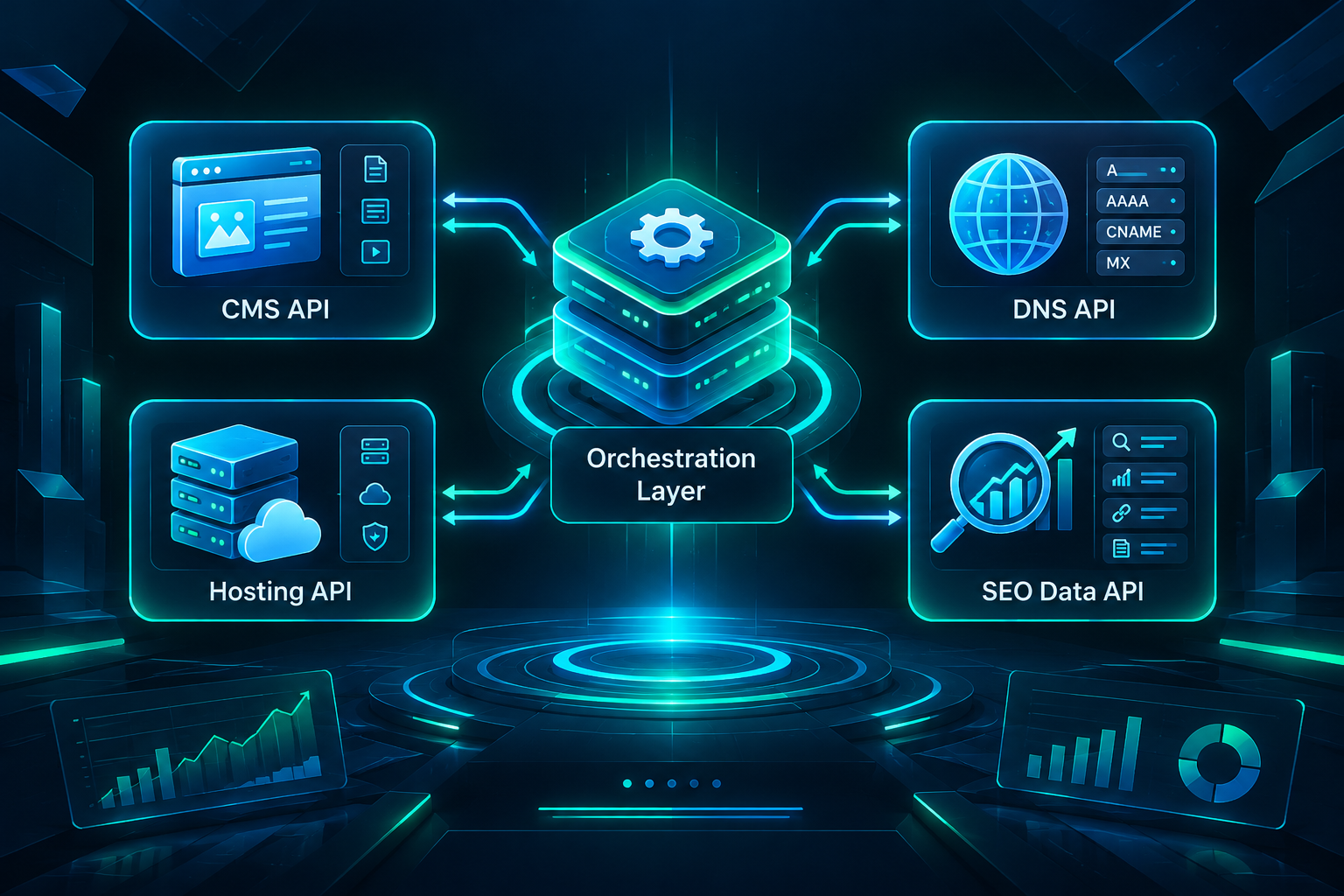
Choosing an Orchestration Approach
Several approaches exist for building this orchestration layer, ranging from custom-coded scripts to no-code automation platforms. The right choice depends on your team’s technical capacity and the complexity of the workflows you need.
- Custom scripts in Python or PHP: Offer maximum flexibility and can be tailored precisely to your network’s API endpoints and data structures. Require development time and ongoing maintenance as APIs change.
- Workflow automation platforms such as Make (formerly Integromat) or n8n: Provide visual workflow builders that connect APIs without requiring extensive coding. Suitable for teams with limited development resources. n8n can be self-hosted, which may be preferable for networks where data privacy is a consideration.
- Dedicated PBN management tools: Some commercial tools are built specifically for private blog network administration and include pre-built API integrations for common CMS platforms, uptime monitoring, and link verification. Evaluating these tools against your specific requirements is worthwhile before committing to a custom build.
- Headless WordPress with a central API gateway: For technically sophisticated teams, a central WordPress installation or a custom API gateway can act as the management hub, with each network site registered as a connected endpoint. This approach allows content to be drafted and approved centrally before being pushed to individual sites via the REST API.
Content Deployment Automation
Content deployment is one of the highest-value automation targets in PBN management. A typical automated deployment workflow involves preparing article content in a central repository or content management system, then using each site’s CMS API to publish the article with the correct outbound link, anchor text, and metadata. The workflow can include pre-publication checks—verifying that the target URL is live, that the anchor text matches the campaign specification, and that the article meets a minimum word count—before the post goes live.
Post-publication, the same workflow can trigger an indexing request, log the publication event with a timestamp, and schedule a follow-up check to confirm that the post is publicly accessible and that the outbound link resolves correctly. This end-to-end automation reduces the manual steps in a content deployment from ten or more individual actions to a single trigger, with all subsequent steps handled programmatically.
Link Verification and Monitoring
Verifying that placed links remain live is an ongoing requirement in PBN management. Content can be accidentally edited, plugins can strip links, and CMS updates can sometimes alter post formatting. An automated link verification workflow queries each published post through the CMS API or through an HTTP request, parses the response for the target outbound link, and logs whether the link is present, correct, and pointing to the intended URL. Discrepancies trigger an alert for manual review.
Link verification can be scheduled at whatever frequency the network’s operational requirements demand—daily checks are common for active campaigns, while weekly checks may be sufficient for stable placements. The key advantage over manual verification is consistency: an automated check runs on schedule regardless of team workload, whereas manual verification is often deferred during busy periods.
Footprint Considerations in Automated Workflows
One practical consideration when automating PBN administration is the potential for automation itself to introduce operational patterns that could be detectable. If every site in a network publishes content at exactly the same time each day, uses identical post metadata structures, or receives API calls from the same IP address range, these patterns may be observable to a sufficiently sophisticated crawler or analysis system. This does not mean automation should be avoided, but it does mean that workflow design should account for variation.
Introducing randomized publication timing within defined windows, varying content structures across sites, and distributing API calls across different network origins are practical steps that reduce the uniformity of automated operations. These are implementation choices rather than guarantees of any particular outcome, and the degree to which such patterns are actually evaluated by search engines is not publicly documented. The general principle is that automation should replicate the natural variation of manual operation rather than producing perfectly uniform outputs.
Human review remains important even in a highly automated workflow. Automated systems can verify that a link is present and that an article meets basic structural criteria, but assessing whether the content is genuinely relevant to the site’s topic, whether the placement context reads naturally, and whether the overall site maintains a coherent editorial identity requires judgment that current automation tools do not reliably provide. Building a review step into the deployment workflow—where a team member approves content before the API pushes it live—preserves quality control without sacrificing the efficiency gains of automation.
Monitoring, Alerting, and Reporting
A well-designed automated PBN management system produces structured data that can be aggregated into operational dashboards and reports. Key metrics to track programmatically include site uptime percentage, SSL certificate validity and expiry dates, domain expiry timelines, post publication status, outbound link integrity, and CMS version currency. Aggregating these metrics across the entire network gives administrators a single view of network health without requiring manual checks of individual sites.
Alerting thresholds should be configured based on operational priorities. A site going offline warrants an immediate alert; a domain with ninety days remaining before expiry warrants a scheduled reminder rather than an urgent notification. Tiered alerting reduces alert fatigue and ensures that genuinely urgent issues receive prompt attention.
For agencies managing PBN campaigns on behalf of clients, automated reporting can compile link placement status, uptime history, and indexing confirmation into structured reports that are generated on a defined schedule. This reduces the administrative overhead of client reporting and provides a consistent, verifiable record of campaign activity.
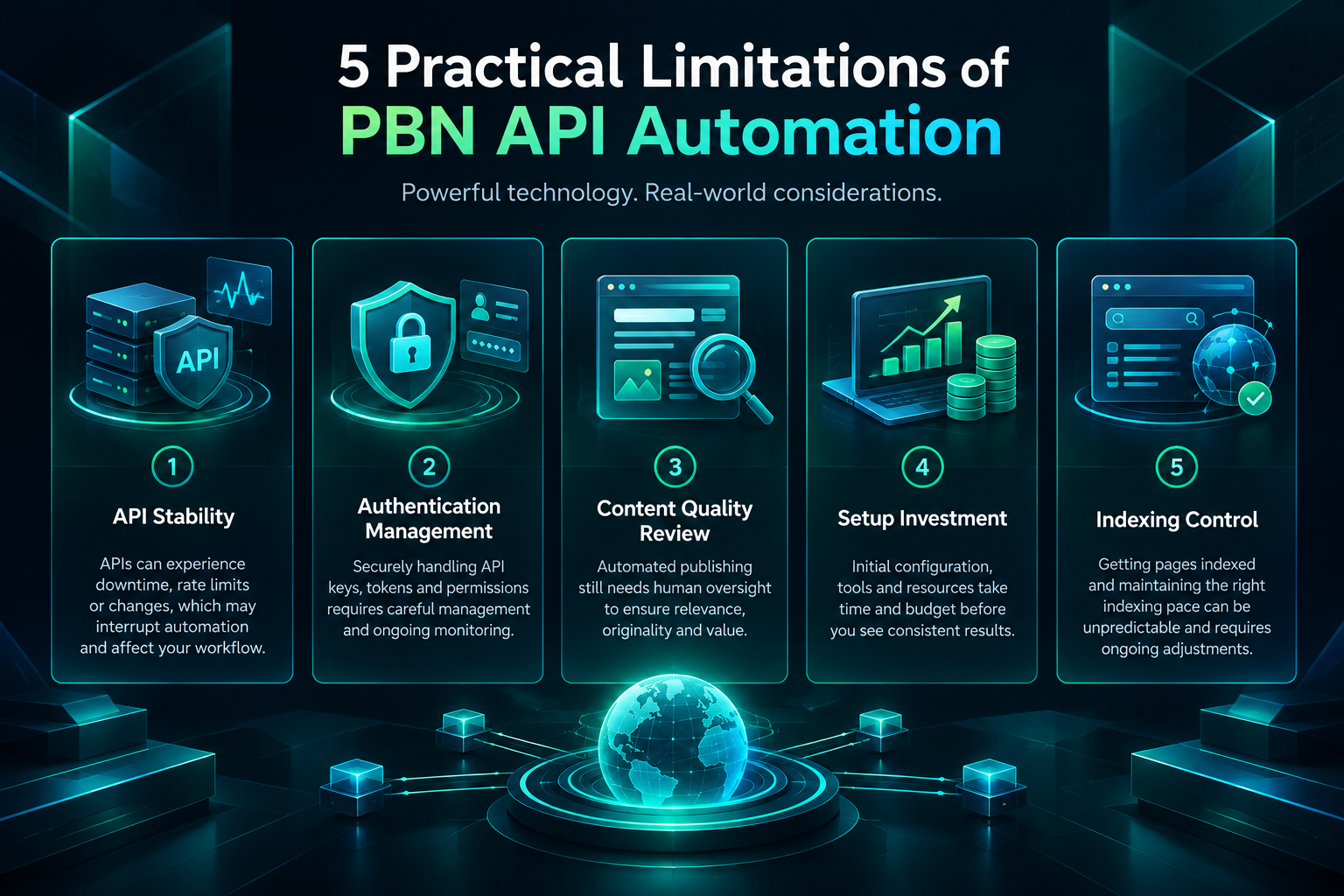
Practical Limitations of API Automation for PBNs
API automation is a powerful operational tool, but it has meaningful limitations that are worth understanding before committing to a build.
- API availability and stability: Third-party APIs change. Registrar APIs, hosting control panel APIs, and SEO tool APIs are updated by their providers, and breaking changes can disable automated workflows without warning. Maintaining an automated system requires ongoing monitoring of API changelogs and periodic updates to integration code.
- Authentication management: API credentials need to be stored securely, rotated regularly, and managed across potentially many sites. A credential management system or secrets vault is advisable for networks of significant size.
- Content quality cannot be fully automated: Automated content generation and deployment can produce high volumes of published articles, but content quality—topical relevance, readability, and contextual appropriateness—requires human judgment or sophisticated AI review that goes beyond simple structural checks.
- Setup investment: Building a robust automated management system requires meaningful upfront development time. For smaller networks, the return on this investment may not justify the effort compared to a well-organized manual workflow.
- Indexing is not directly controllable: Automated workflows can request indexing and verify crawlability, but whether and when a search engine indexes a specific page is determined by the search engine’s own crawl scheduling and quality assessment processes, not by the automation system.
Frequently Asked Questions
What is the minimum network size where API automation becomes worthwhile?
There is no fixed threshold, but most practitioners find that the setup investment in API automation begins to pay off when managing ten or more sites with active content deployment requirements. Smaller networks can often be managed efficiently with a structured manual workflow and a shared spreadsheet for tracking key dates and link status.
Can I use the WordPress REST API to manage PBN sites without installing additional plugins?
The WordPress REST API is enabled by default in WordPress installations from version 4.7 onward. Basic content creation and retrieval operations do not require additional plugins. However, some advanced operations—such as managing custom post types, specific metadata fields, or third-party plugin settings—may require additional REST API extensions or custom endpoints.
How do I handle API authentication securely across a large network?
Application passwords, available natively in WordPress since version 5.6, are a practical authentication method for REST API access. For broader infrastructure automation, environment variables or a dedicated secrets management tool such as HashiCorp Vault or AWS Secrets Manager can store and rotate credentials securely. Avoid hardcoding API keys or passwords directly in scripts.
Can automation help with detecting if a PBN site has been deindexed?
Automated scripts can check whether a specific URL returns a 200 HTTP status code and whether it appears in a site-specific search query, but neither check is a definitive confirmation of indexing status. Google Search Console provides indexing data for verified properties, and its API can be queried programmatically for sites where you have verified ownership. Third-party crawling tools also offer indexing status checks as part of their API offerings.
What happens if an API call fails during a content deployment?
A well-designed deployment workflow should include error handling that logs failed API calls, retries them after a defined interval, and escalates to a manual alert if retries are unsuccessful. Without error handling, silent failures can result in content that was never published or links that were never placed, which may go undetected until a manual audit.
Is it possible to automate anchor text variation across a network?
Yes. A central content management system can maintain an anchor text pool for each campaign, with the deployment script selecting from the pool according to a defined distribution logic. This allows programmatic variation of anchor text across placements without requiring manual selection for each individual post. The distribution logic should reflect the campaign’s anchor text strategy rather than applying a fixed formula.
Deciding Whether to Build or Buy Your PBN Automation Stack
The build-versus-buy decision for PBN management automation depends on three practical factors: technical capacity within your team, the specific workflows you need to automate, and the long-term maintenance commitment you can sustain. A custom-built system offers precise control and can be tailored to your exact network architecture, but it requires ongoing development attention as APIs evolve and network requirements change. Commercial PBN management tools or general-purpose workflow automation platforms reduce the initial build time but may not support every integration point your network requires.
For agencies and SEO teams managing PBN campaigns at scale, the operational efficiency gains from a well-implemented automation system are substantial. Routine tasks that previously consumed hours of team time each week can be reduced to minutes of review, freeing capacity for higher-value work such as content strategy, domain acquisition assessment, and campaign analysis. The key is to start with the highest-impact automation targets—typically uptime monitoring, link verification, and content deployment—and expand the system incrementally as each component proves reliable.
If you are evaluating how PBN backlinks fit into a broader link-building campaign, or if you want to discuss the operational requirements of managing placements at scale, PBN Backlinks Service can help you assess your requirements and identify an approach that matches your network’s size and goals.