

Calculating return on investment for a PBN campaign requires connecting link-building spend to measurable business outcomes — organic traffic, lead volume, revenue, or affiliate earnings — while accounting for the time lag between link placement and ranking movement. The process is more nuanced than a simple cost-per-link calculation, but it is entirely achievable with the right tracking framework and realistic expectations about timelines.
Key Takeaways
- PBN campaign ROI is best measured by comparing total campaign cost against the revenue or traffic value generated after rankings improve, not by link count alone.
- A meaningful ROI assessment requires baseline data — organic traffic, keyword rankings, and conversion rates — captured before the campaign begins.
- Ranking changes from PBN placements typically become measurable weeks to several months after links are indexed, depending on competition and website authority.
- Equivalent traffic value (the estimated cost to acquire the same visitors through paid search) is a useful proxy when direct revenue attribution is difficult.
- ROI varies significantly by niche, competition level, target page type, and the quality of the placements themselves, so campaign-level assessment is more reliable than industry averages.
Why Standard ROI Formulas Need Adapting for Link Building
The standard ROI formula — (Net Gain − Cost) ÷ Cost × 100 — works well for direct-response advertising where spend and revenue are linked within a short, measurable window. Link building, including PBN campaigns, introduces two complications that require adjustments: a delayed attribution window and an indirect revenue path. A PBN backlink does not generate revenue on the day it is placed; it may contribute to a ranking improvement that increases organic traffic, which then converts into leads or sales over subsequent months. Treating the campaign as a loss because no revenue appeared in week one would produce a misleading result.
The adapted approach separates the campaign into three measurable stages: the cost stage (what you spent and when), the ranking stage (whether target keywords moved and by how much), and the revenue stage (what that ranking movement was worth in traffic and conversions). Tracking all three stages with consistent data gives you a defensible ROI figure rather than an estimate based on assumptions.
Step 1 — Establish Your Baseline Before the Campaign Starts
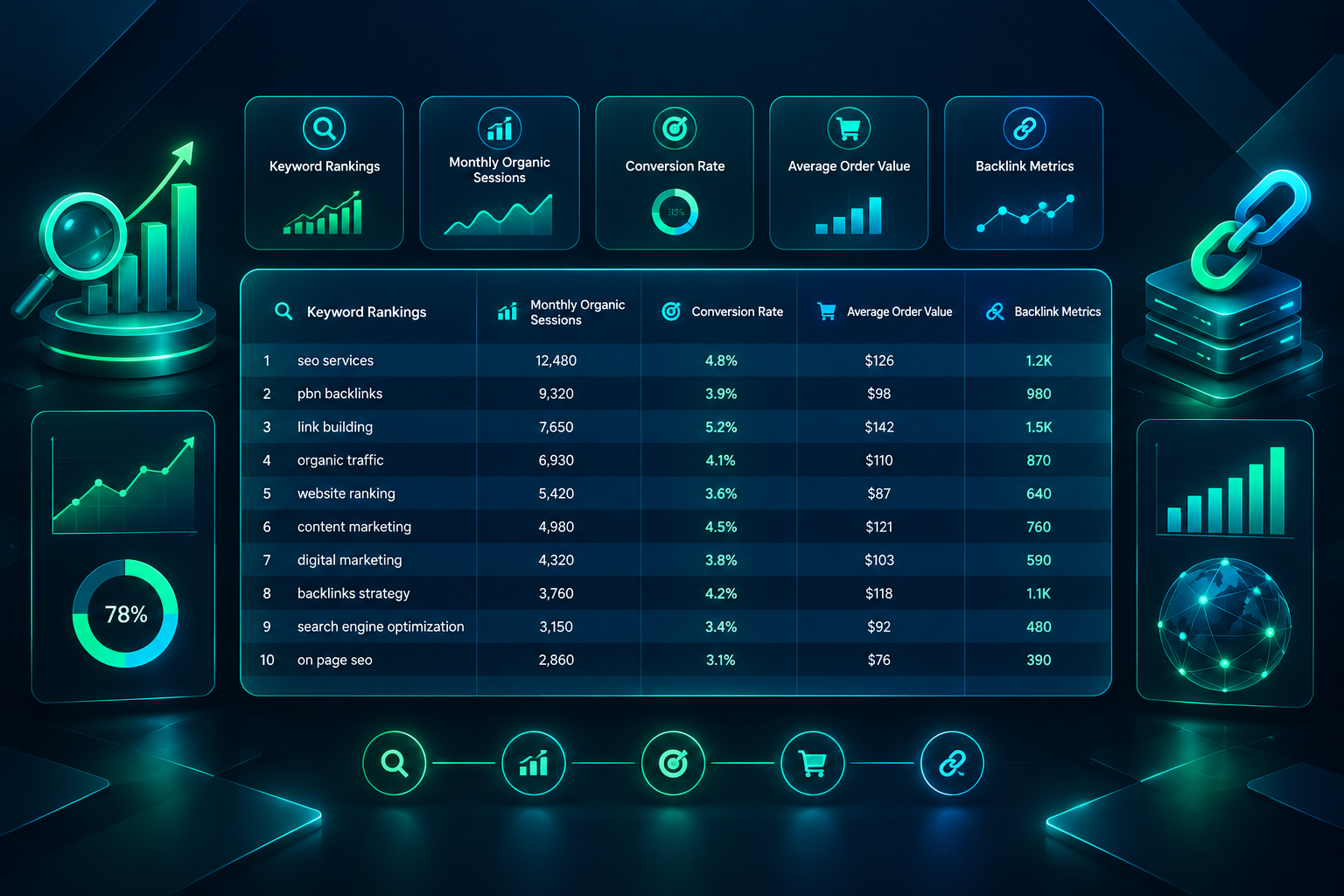
Accurate ROI measurement depends on knowing where you started. Before ordering PBN placements, record the following for each target page:
- Current keyword rankings for the primary and secondary terms you want to improve, using a rank-tracking tool such as Semrush, Ahrefs, or a dedicated rank tracker.
- Monthly organic sessions to the target page, pulled from Google Search Console or your analytics platform.
- Conversion rate for the target page — the percentage of organic visitors who complete a goal such as a purchase, form submission, or affiliate click.
- Average order value or revenue per conversion, so that traffic increases can be translated into estimated revenue.
- Current backlink profile metrics for the target page and root domain, including referring domain count and any proprietary metrics such as Domain Rating from Ahrefs or Trust Flow from Majestic, noted as tool-specific scores rather than Google ranking signals.
Capturing this baseline in a simple spreadsheet before the campaign begins gives you a clean comparison point. Without it, you are estimating improvement against a moving target, which makes ROI figures unreliable.
Step 2 — Record All Campaign Costs Accurately
Total campaign cost for a PBN link-building effort typically includes more than the price of the placements themselves. A complete cost record should cover:
- Link placement fees — the direct cost of each PBN backlink or backlink package purchased.
- Content costs — if you supplied or commissioned content for the target page or supporting pages as part of the campaign.
- SEO tool subscriptions — a proportional allocation of rank-tracking, backlink analysis, or keyword research tools used specifically for this campaign.
- Management time — if an in-house SEO specialist or agency manager spent time planning, briefing, and monitoring the campaign, that time has a cost even if it is not invoiced separately.
- Ongoing maintenance — some campaigns require additional placements over time to sustain or extend ranking gains, and those future costs should be factored into a multi-period ROI projection.
Using only the placement fee as the cost denominator will overstate ROI. A complete cost picture produces a more honest and useful figure for comparing campaigns or deciding whether to scale.
Step 3 — Define the Value You Are Measuring
The numerator in your ROI calculation — the gain — can be expressed in several ways depending on your business model. Choosing the right value metric before the campaign ends prevents post-hoc rationalization.
Direct Revenue Attribution
For e-commerce websites and service businesses with trackable conversions, direct revenue attribution is the most straightforward approach. If the target page generated 200 organic conversions in the three months after the campaign, and the average order value is £80, the attributable revenue is £16,000. Subtract the total campaign cost to get net gain, then divide by cost and multiply by 100 for the ROI percentage. The limitation is that organic conversions are rarely caused by a single factor; a PBN campaign running alongside a technical SEO improvement or a content update makes clean attribution difficult. Noting what else changed during the measurement period is important for honest reporting.
Equivalent Traffic Value
When direct revenue attribution is impractical — common for affiliate sites, informational publishers, and lead-generation pages with long sales cycles — equivalent traffic value provides a useful proxy. This method estimates what the additional organic traffic would have cost if purchased through paid search. If the target keyword has a cost-per-click of £3.50 in Google Ads and the ranking improvement generated an estimated 800 additional monthly clicks, the equivalent monthly traffic value is £2,800. Over a six-month measurement window, that is £16,800 in equivalent value against which you compare campaign cost. This is not actual revenue, but it gives a commercially grounded figure for comparing link-building spend against paid acquisition alternatives.
Ranking Position Value
A simpler but less precise approach assigns a value to ranking position changes based on estimated click-through rate differences between positions. Moving a keyword from position 8 to position 3 for a term with 2,000 monthly searches increases estimated clicks from roughly 40 to around 200 per month, based on commonly cited CTR curves. Multiplying the additional clicks by your site’s revenue per organic visitor gives an estimated monthly gain. This method is useful for early-stage assessment when conversion data is still accumulating, but it relies on CTR estimates that vary by query type, SERP features, and device mix.
Step 4 — Set a Realistic Measurement Window
One of the most common errors in PBN campaign ROI assessment is measuring too early. PBN backlinks, like most link-building placements, need to be crawled and indexed before they can influence rankings, and ranking changes — when they occur — often develop gradually rather than appearing overnight. A measurement window of 60 to 90 days after confirmed indexing of the placements is a reasonable minimum for competitive keywords. For lower-competition terms or websites with strong existing authority, movement may appear sooner. For highly competitive niches, a six-month window may be necessary before ranking changes are stable enough to assess.
Checking rankings weekly during the measurement window and recording the data in your baseline spreadsheet allows you to identify the point at which movement began, which helps separate the campaign’s contribution from seasonal traffic patterns or algorithm updates that affected the broader SERP. Google Search Console’s performance report, filtered by the target page and relevant queries, provides impression and click data that complements rank-tracker readings.
Step 5 — Apply the ROI Formula to Your Campaign Data
Once you have baseline data, total costs, a chosen value metric, and a completed measurement window, the calculation is straightforward. Using direct revenue attribution as an example:
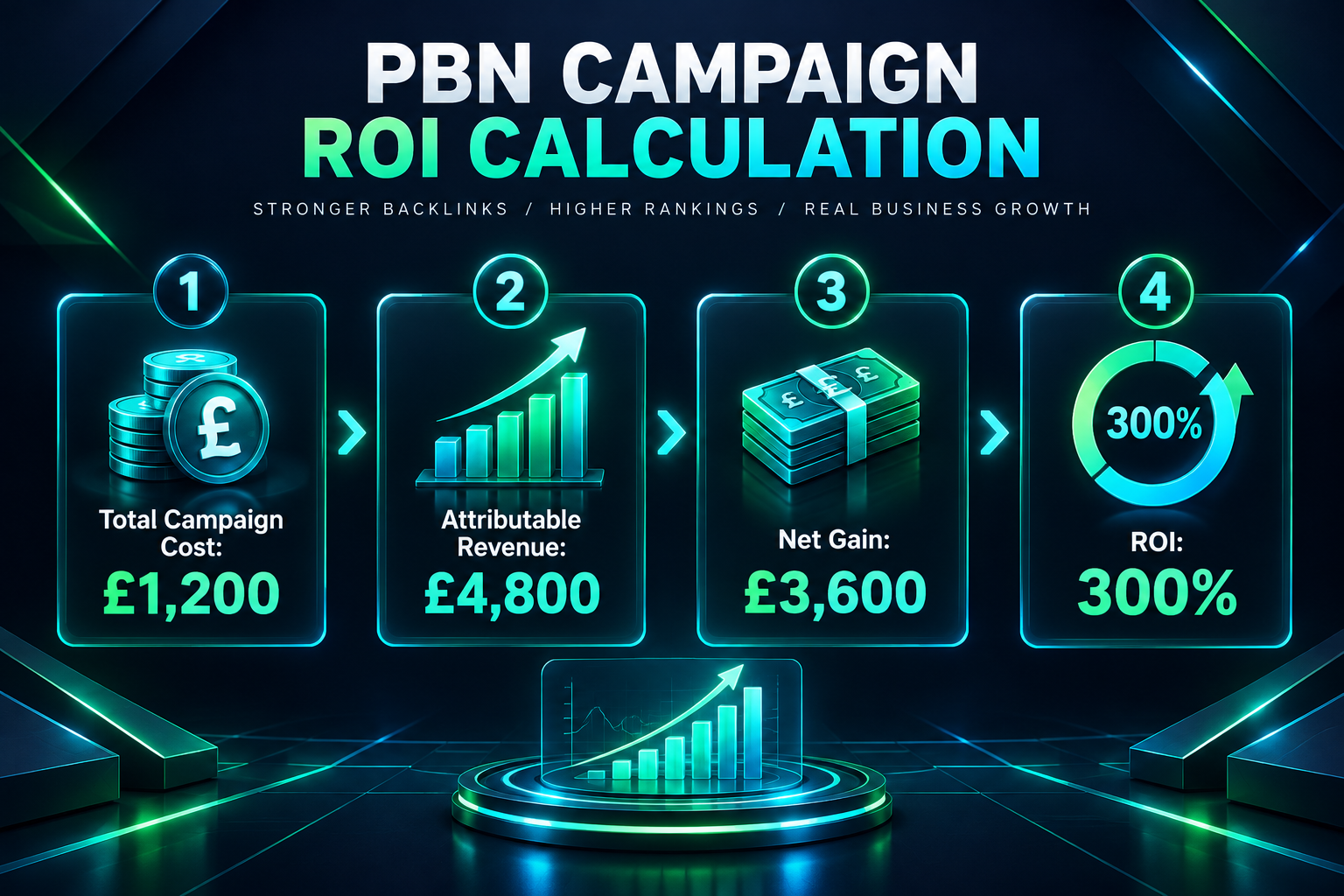
- Total campaign cost: £1,200 (placements, content, tool allocation, management time).
- Attributable revenue increase: £4,800 in additional organic revenue over the measurement window, based on conversion tracking.
- Net gain: £4,800 − £1,200 = £3,600.
- ROI: (£3,600 ÷ £1,200) × 100 = 300%.
Using equivalent traffic value instead, with the same cost and £4,200 in estimated traffic value over the window: net gain is £3,000, ROI is 250%. Neither figure is inherently more correct; the choice of value metric should reflect your business model and be applied consistently across campaigns so that comparisons are meaningful.
A negative ROI in the first measurement window does not necessarily mean the campaign failed. If rankings are still improving, or if the measurement window was shorter than the typical lag for your niche, extending the window and recalculating may produce a different result. Conversely, if rankings did not move at all after a reasonable period, that is a signal to investigate placement quality, indexing status, and whether the target page has other issues — technical problems, thin content, or a competitive gap that links alone cannot close.
Factors That Affect PBN Campaign ROI
ROI varies considerably across campaigns, and understanding the main drivers helps set realistic expectations and identify where to focus quality assessment.
Placement Quality and Topical Relevance
The quality of individual PBN placements — including the referring domain’s backlink history, the topical relevance of the linking page to the target page, and the context of the placement within the content — affects whether a link contributes meaningfully to ranking signals. A contextual backlink placed within relevant, substantive content on a domain with a credible link history is generally considered more likely to carry ranking value than a placement on a domain with a thin or unrelated history. When evaluating a PBN provider, asking about domain selection criteria, content quality standards, and placement context is relevant to forecasting ROI.
Anchor Text Distribution
Anchor text strategy influences how link equity is interpreted by search engines. A campaign that uses only exact-match anchor text for every placement may produce a different outcome than one that varies anchor text across branded, partial-match, and natural phrase variations. The appropriate distribution depends on the existing anchor profile of the target page and the competitive landscape of the target keywords. There is no publicly documented threshold from Google that defines a safe or unsafe anchor ratio, so provider guidance and campaign-specific assessment are more useful than fixed rules.
Competition Level and SERP Difficulty
A PBN campaign targeting a low-competition keyword in a niche with few authoritative competitors may produce measurable ranking movement with a modest number of placements. The same budget applied to a highly competitive keyword dominated by established domains with large, diverse backlink profiles may produce slower or smaller movement. Keyword difficulty scores from tools such as Ahrefs or Semrush provide a rough guide, but they are proprietary estimates rather than precise predictors of how many links are needed to achieve a specific ranking position.
Target Page Quality
Link building amplifies the signals already present on a page; it does not substitute for them. A target page with thin content, poor internal linking, slow load times, or weak relevance to the target keyword may not respond to additional backlinks in the way a well-optimized page would. Auditing the target page before the campaign — checking content depth, on-page optimization, Core Web Vitals, and internal link structure — helps ensure that the link-building investment has the best conditions to produce a measurable result.
Link Indexing
A PBN backlink that has not been crawled and indexed by search engines cannot contribute to ranking signals. Confirming that placements are indexed — using site: searches or a crawl tool — is a basic quality check that should be part of any campaign monitoring process. If placements are not indexing within a reasonable period, investigating the cause (noindex tags, crawl budget issues on the linking domain, or content quality problems) is necessary before attributing a lack of ranking movement to the links themselves.
Monitoring and Ongoing Assessment
ROI assessment for a PBN campaign is not a one-time calculation. Rankings fluctuate, algorithm updates affect SERPs, and the competitive landscape changes. Building a simple monthly monitoring routine — recording keyword positions, organic sessions to target pages, and conversion data — allows you to track whether initial gains are holding, improving, or declining over time. If rankings drop after an initial improvement, checking whether placements remain indexed and whether competitor link profiles have changed provides context for deciding whether additional placements or other SEO work is warranted.
Google Search Console is a useful free tool for monitoring organic impressions and clicks at the page and query level. Pairing it with a rank tracker gives a more complete picture than either tool alone. For affiliate publishers and e-commerce sites, connecting organic traffic segments in your analytics platform to revenue or goal completions allows ongoing revenue attribution without manual calculation each month.
Common ROI Calculation Mistakes to Avoid
- Measuring too early: Assessing ROI before placements are indexed or before sufficient time has passed for ranking changes to develop produces misleading results.
- Using only placement cost as the denominator: Omitting content, tool, and management costs overstates ROI and makes campaign comparisons inaccurate.
- Attributing all ranking movement to the PBN campaign: If other SEO work was running concurrently, isolating the campaign’s contribution requires careful documentation of what changed and when.
- Ignoring conversion rate changes: A ranking improvement that brings in more traffic does not automatically increase revenue if the new visitors convert at a lower rate. Tracking both traffic and conversions gives a more accurate revenue figure.
- Treating a single campaign result as a universal benchmark: ROI varies by niche, competition, page quality, and placement quality. One campaign’s result is a data point for your specific situation, not a reliable prediction for a different website or keyword set.
Frequently Asked Questions
How long should I wait before calculating ROI for a PBN campaign?
A minimum of 60 to 90 days after confirmed indexing of the placements is a reasonable starting point for competitive keywords. Lower-competition terms may show movement sooner, while highly competitive niches may require a six-month window before rankings are stable enough to assess. Recording data at regular intervals throughout the window is more informative than a single end-point measurement.
What is a realistic ROI target for a PBN link-building campaign?
There is no universal benchmark because ROI depends on campaign cost, niche competition, target page quality, placement quality, and the value of the keywords being targeted. A campaign targeting high-value commercial keywords in a moderately competitive niche may produce a strong positive ROI within six months; a campaign in a highly competitive space may take longer to break even. Setting a campaign-specific target based on your keyword’s traffic potential and your site’s conversion rate is more useful than comparing against an industry average.
Can I use equivalent traffic value if my site does not sell products directly?
Yes. Equivalent traffic value — estimating what the additional organic clicks would cost if purchased through paid search — is particularly useful for affiliate publishers, lead-generation sites, and informational websites where direct revenue attribution is difficult. It provides a commercially grounded comparison point even when conversion tracking is limited.
What should I do if rankings did not improve after the campaign?
First, confirm that the placements are indexed. If they are not, investigate whether the linking pages have crawl or indexing issues. If placements are indexed and rankings have not moved after a reasonable window, review the target page for on-page optimization gaps, content quality, internal linking, and technical issues. Also assess whether the competition level for the target keywords requires a larger or more sustained link-building effort than the initial campaign provided.
How do I account for ranking gains that decline over time?
If rankings improve and then decline, recalculate ROI using the revenue or traffic value generated during the period of improvement rather than projecting indefinitely. Declining rankings may indicate that competitor link profiles have strengthened, that placements have lost indexing, or that algorithm changes have shifted ranking factors. Ongoing monitoring allows you to identify the cause and decide whether additional placements or other SEO work is appropriate.
Should I calculate ROI per link or per campaign?
Campaign-level ROI is generally more meaningful than per-link ROI because ranking changes result from the cumulative effect of multiple placements, page quality, and other SEO factors rather than any single link. Per-link cost analysis is useful for comparing provider pricing, but attributing a specific ranking change to one individual placement is rarely possible with confidence.
Putting Your PBN Campaign ROI Assessment Into Practice
A well-structured ROI framework turns a PBN campaign from a speculative spend into a measurable investment. The process — establishing a baseline, recording complete costs, choosing a value metric suited to your business model, setting a realistic measurement window, and monitoring consistently — applies regardless of campaign size or niche. The key discipline is capturing data before the campaign starts and maintaining it throughout, rather than attempting to reconstruct a baseline after the fact.
The most useful insight from a completed ROI calculation is not just the percentage figure but what it reveals about where value was created or lost. A campaign that produced strong ranking movement but weak revenue gain may point to a conversion rate problem on the target page. A campaign with good conversion data but modest ranking movement may indicate that the target keywords need more placements, a longer timeline, or stronger on-page foundations. Both outcomes inform the next campaign decision more usefully than a pass/fail judgment.
If you are planning a PBN campaign and want to assess placement quality, domain selection criteria, or how a backlink package might fit your specific keyword targets and budget, PBN Backlinks Service can help you review your requirements and structure a campaign with measurable goals from the outset.