

Every site in a private blog network has a finite useful life, and recognizing when that life has ended is one of the more consequential operational decisions a network manager makes. Retiring a PBN site too early wastes a domain with residual link equity; keeping one active too long can drag down the quality and coherence of the entire network. This article walks through the specific signals, metrics, and practical considerations that inform a sound retirement decision, so you can evaluate each node on its own merits rather than applying a blanket rule.
Key Takeaways
- No single metric determines whether a PBN site should be retired; the decision depends on a combination of indexing status, link profile health, topical relevance, content quality, and ongoing maintenance cost.
- A site that has lost most of its referring domains, been deindexed, or accumulated a heavily spammy backlink profile is a strong candidate for retirement regardless of its original domain authority metrics.
- Topical drift — where the site’s content no longer aligns with the niche it is meant to support — reduces placement value and may warrant rebuilding or retiring the node.
- Retirement does not always mean abandoning the domain; in some cases, the domain itself retains value and can be repurposed, sold, or rebuilt on a cleaner content foundation.
- Regular audits of each network node, rather than reactive decisions, produce better long-term network performance and reduce the risk of maintaining underperforming assets.
Why Individual PBN Sites Need Periodic Evaluation
A private blog network is not a static asset. Each site within it ages, accumulates its own backlink history, gains or loses indexed pages, and either maintains or erodes its topical coherence over time. Network managers who treat every node as permanently viable tend to end up with a mixed portfolio: a handful of strong placements alongside several sites that contribute little measurable value and may introduce unnecessary complexity. Periodic evaluation of individual sites — rather than the network as a whole — is what keeps a PBN performing consistently.
The evaluation question is not simply whether a site is still live. It is whether the site continues to deliver meaningful link equity to the target pages it supports, whether it can do so without drawing disproportionate attention to the network’s structure, and whether the ongoing cost of maintaining it is justified by the benefit it provides. Those three dimensions — equity, footprint risk, and cost-efficiency — frame every retirement decision worth making.
Indexing Status and Crawl Health
The most immediate signal that a PBN site may need attention is a change in its indexing status. A site that Google or Bing has stopped indexing is no longer passing link equity through its placements, regardless of how strong its historical metrics appear in third-party tools. Before drawing conclusions, it is worth distinguishing between a temporary crawl gap and a sustained deindexation. A single missed crawl is not a retirement trigger; a site that has been absent from search results for several months, with no indexed pages visible through a site-colon query, is a more serious concern.
Crawl health issues that fall short of full deindexation also deserve attention. If a site has large numbers of pages returning 4xx or 5xx errors, if its XML sitemap is broken, or if its robots.txt is inadvertently blocking crawlers, those are maintenance problems that may be worth fixing rather than reasons to retire the domain. The distinction matters: a technically fixable crawl issue is different from a site that has been algorithmically suppressed or manually actioned. Diagnosing the cause before deciding on retirement saves domains that still have genuine value.
Signals Worth Checking
- Number of pages indexed over the past three to six months, tracked through Google Search Console if the site is verified, or estimated through site-colon queries.
- Crawl error rates reported in Search Console or identified through a crawl tool such as Screaming Frog.
- Whether the homepage and key placement pages are individually indexable.
- Whether the site appears in search results for its own brand name or primary topic terms.
Referring Domain Profile and Link Equity
A PBN site’s value as a link source depends substantially on the quality and stability of its own inbound link profile. When a domain was acquired specifically because it carried a strong set of referring domains from its previous life, the gradual loss of those links over time directly reduces the equity it can pass downstream. Monitoring referring domain counts through a tool such as Ahrefs or Semrush over a rolling twelve-month period gives a clearer picture of whether the site’s link profile is stable, slowly eroding, or collapsing.
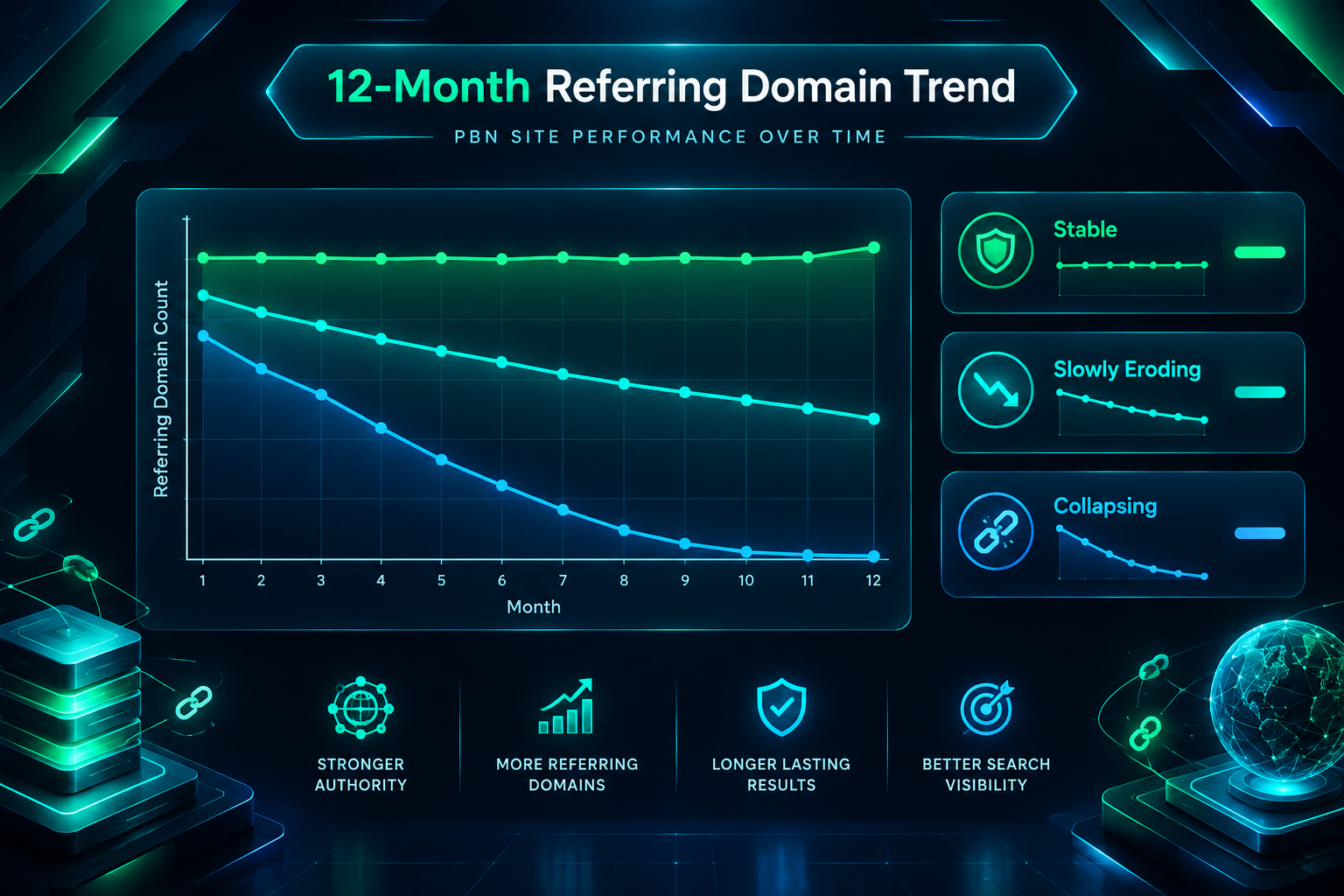
Referring domain loss is normal to some degree — older links naturally drop as source pages are removed or restructured — but a site that has lost the majority of its original referring domains may no longer justify its place in the network. The relevant question is not the raw count but the quality and topical relevance of the links that remain. A site retaining twenty strong, topically aligned referring domains from its original profile may outperform one that still shows a higher total count but has retained mostly low-quality or irrelevant links.
Anchor text distribution within the site’s own inbound profile is also worth reviewing. A heavily over-optimized anchor profile pointing to the PBN site itself can be a signal that the domain’s history includes aggressive link building that may have already attracted algorithmic scrutiny. This does not automatically make the site worthless, but it is a factor in assessing how much residual equity the domain realistically carries.
Topical Relevance and Content Coherence
A PBN site that was originally built around a specific niche loses placement value when its content drifts away from that niche, either because new posts were added without a clear editorial focus or because the target pages it supports have shifted to a different topic area. Topical relevance between a linking page and the page it links to is a meaningful quality factor, and a site whose content no longer aligns with the niche it is meant to serve is a weaker link source than one that maintains coherent subject matter throughout.
Evaluating topical coherence involves reviewing the site’s published content categories, the anchor text used in outbound placements, and whether the overall site theme would make sense to a reader encountering it for the first time. A site that covers an implausibly wide range of unrelated topics, or that has accumulated posts clearly written for link insertion rather than genuine subject coverage, has lower topical authority and may be a candidate for content restructuring rather than outright retirement — unless the domain’s other metrics also point toward retirement.
When the target niche has changed significantly and the PBN site cannot be reasonably repositioned to match it, retirement or repurposing becomes a more practical option than attempting to rebuild the site’s topical focus from scratch.
Content Quality and Site Presentation
Content quality on individual PBN sites affects both the perceived legitimacy of the placement and the likelihood that the site remains indexed and crawled over time. Sites with very thin content — short posts with minimal useful information, duplicated or near-duplicated articles, or content that reads as machine-generated without meaningful editing — are more likely to lose indexing over time and provide weaker placement context for the links they host.
A practical content audit of a PBN site involves reviewing a sample of its published posts for length, originality, internal linking structure, and whether the content would be useful to a reader genuinely interested in the topic. This is not about meeting an arbitrary word count but about whether the site functions as a coherent, readable resource. Sites that fall significantly below a reasonable content standard are candidates for either a content refresh or retirement, depending on whether the domain’s other characteristics make the investment worthwhile.
Site presentation — including page load speed, mobile usability, and the absence of broken elements — also contributes to crawl health and user experience signals. A site with persistent technical problems that have not been addressed over multiple maintenance cycles may not be worth the ongoing effort to maintain.
Footprint Considerations and Network Hygiene
Individual PBN sites can develop characteristics over time that make them easier to associate with other sites in the same network. Shared hosting environments, identical CMS configurations, overlapping content themes, and consistent internal linking patterns are examples of footprint elements that network managers typically try to vary across nodes. When a specific site has accumulated several of these characteristics in a way that is difficult to reverse — for example, because it shares a hosting account with multiple other network sites and cannot be easily migrated — retirement may be preferable to leaving a potentially identifiable node active.
Footprint assessment is inherently uncertain because search engines do not publish the specific signals they use to identify network relationships, and the threshold at which any particular combination of signals becomes actionable is not publicly documented. The practical approach is to evaluate each site’s footprint characteristics relative to the rest of the network and to prioritize retirement for sites where the combination of weak metrics and high footprint similarity makes the risk-to-benefit ratio unfavorable.
Network hygiene also involves considering whether a site has been used for placements across too many unrelated niches, which can make its outbound link profile look inconsistent and reduce the contextual value of individual placements. A site with a highly diverse and unrelated set of outbound links may be less valuable as a placement vehicle than one with a focused outbound profile, even if its inbound metrics appear similar.
Maintenance Cost Versus Placement Value
Every active PBN site carries ongoing costs: hosting, domain renewal, content updates, technical maintenance, and the time required to monitor its indexing and link profile. For sites that are delivering consistent, high-quality placements to target pages with measurable ranking benefit, those costs are straightforward to justify. For sites that have degraded in quality, lost most of their referring domains, or are no longer indexed, the cost-to-value ratio shifts unfavorably.
A useful way to frame this calculation is to estimate the placement value the site currently provides — based on its indexed status, referring domain quality, topical relevance, and content standard — and compare that against the annualized cost of keeping it active. Sites that fall below a reasonable value threshold relative to their maintenance cost are strong retirement candidates, particularly when the resources freed up could be redirected toward acquiring or building stronger replacement nodes.
This calculation should also account for the opportunity cost of maintaining a weak site. A network manager who spends time and budget maintaining ten underperforming sites may be better served by retiring five of them and investing those resources in improving the remaining five or acquiring better replacement domains.
When Retirement Does Not Mean Abandoning the Domain
Retiring a PBN site from active link-building use does not necessarily mean letting the domain expire. In some cases, the domain itself retains value that can be realized in other ways. A domain with a clean backlink history, strong topical relevance to a specific niche, and stable referring domains may be worth selling to another operator, repurposing as a genuine content site, or holding for future use in a different network configuration.
Before allowing a domain to expire, it is worth reviewing its current referring domain profile, its indexed page count, and its historical use. Domains that were used heavily for exact-match anchor placements across many unrelated niches may have a compromised profile that reduces their resale or repurposing value. Domains with a more conservative placement history and a coherent topical focus are more likely to retain value after the site is retired from its current role.
If the domain is allowed to expire, it will eventually become available for re-registration or auction, at which point its historical profile will be visible to other operators evaluating it for their own use. This is worth considering when deciding whether to let a domain drop or to sell it directly.
Building a Retirement Decision Framework
Rather than making retirement decisions reactively — for example, only when a site is deindexed or when a placement stops producing results — a structured evaluation framework applied to each network node on a regular schedule produces more consistent outcomes. The following factors, assessed together rather than individually, provide a practical basis for the decision.
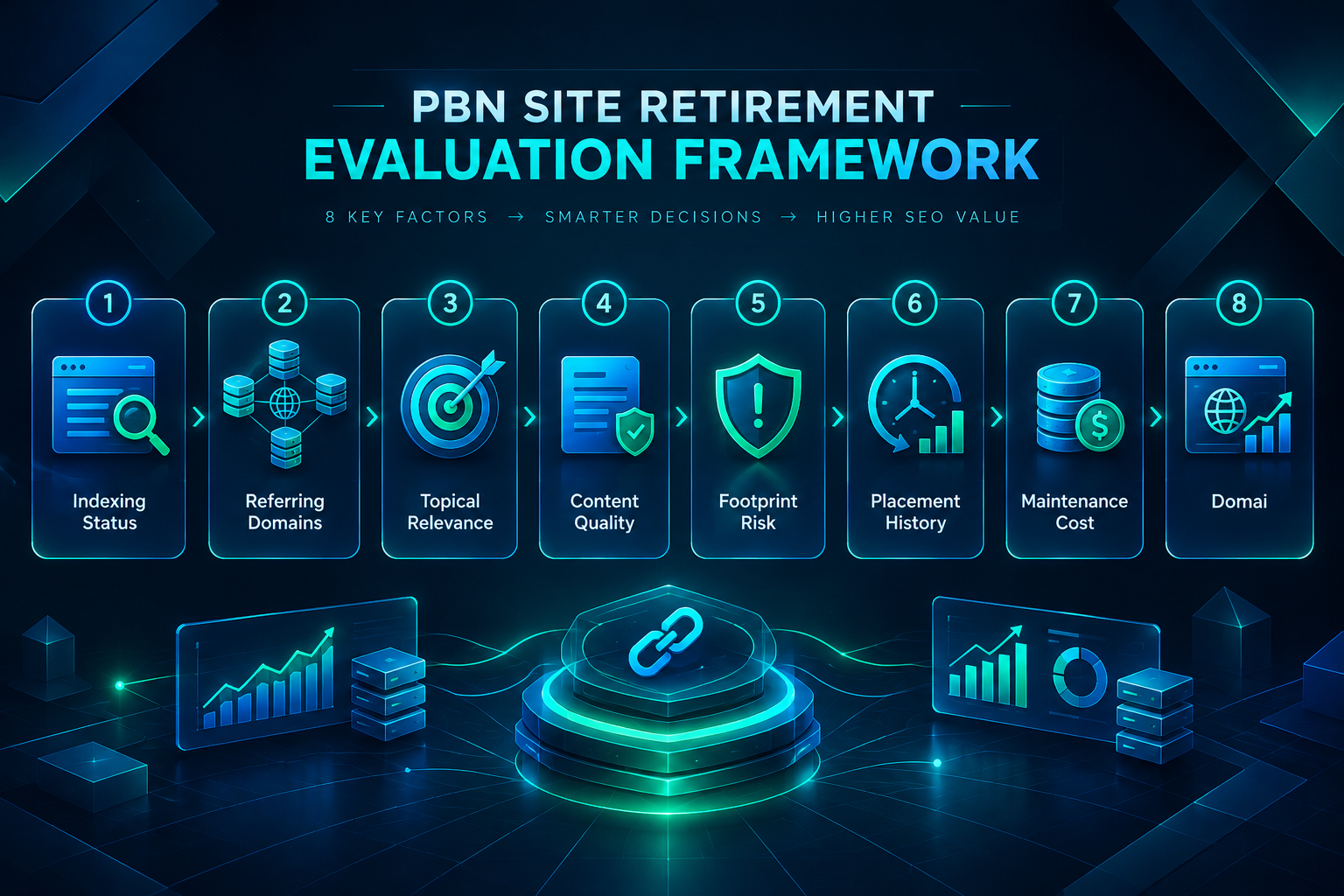
- Indexing status: Is the site currently indexed? Has its indexed page count changed significantly over the past six to twelve months?
- Referring domain stability: Has the site retained the referring domains that gave it value, or has it lost a significant proportion of them?
- Topical relevance: Does the site’s content align with the niche it is supporting? Is the alignment strong enough to make placements contextually credible?
- Content quality: Does the site’s published content meet a reasonable standard for length, originality, and usefulness?
- Footprint risk: Does the site share identifiable characteristics with other network nodes in a way that is difficult to address?
- Placement history: Has the site been used for placements across too many unrelated niches, or does it have a focused and coherent outbound link profile?
- Maintenance cost: Does the ongoing cost of keeping the site active justify the placement value it currently provides?
- Domain residual value: If the site is retired, does the domain retain enough value to sell, repurpose, or hold?
A site that scores poorly across most of these dimensions is a clear retirement candidate. A site that has one or two weaknesses but remains strong on the others may be worth a targeted improvement effort before the retirement decision is finalized.
Frequently Asked Questions
How often should individual PBN sites be evaluated for retirement?
A practical schedule is a full evaluation of each network node every six to twelve months, with lighter monitoring — such as indexing checks and referring domain counts — on a monthly or quarterly basis. Sites that show sudden changes in indexing status or referring domain counts warrant an immediate review outside the regular schedule.
Does a drop in third-party metrics like DR or DA mean a site should be retired?
Not automatically. Proprietary metrics such as Domain Rating from Ahrefs or Domain Authority from Moz reflect their own data and methodology, not Google’s assessment of a site. A metric drop may indicate referring domain loss, which is worth investigating, but the metric itself is not a retirement trigger. Evaluate the underlying referring domain profile rather than the summary score.
Can a deindexed PBN site recover, or should it always be retired?
Recovery is possible in some cases, particularly when deindexation resulted from a technical issue such as a misconfigured robots.txt or a lapsed hosting account rather than an algorithmic or manual action. If the cause is identifiable and fixable, and the domain’s other characteristics remain strong, a recovery attempt may be worthwhile. If the cause is unclear or the site’s metrics have also deteriorated significantly, retirement is often the more practical choice.
What should be done with placements on a site before it is retired?
Before retiring a site, review which target pages currently receive placements from it and assess whether those pages need replacement links from other network nodes. Abruptly removing link equity from a target page without a replacement can affect its ranking position, so planning the transition before retiring the site is preferable to acting immediately.
Is it worth rebuilding a weak PBN site rather than retiring it?
Rebuilding makes sense when the domain itself retains strong referring domain quality and topical relevance, and when the site’s weaknesses are primarily content or technical issues that can be addressed at reasonable cost. If the domain’s link profile has significantly degraded, or if the site has accumulated footprint characteristics that are difficult to reverse, the resources required to rebuild it may be better spent acquiring a stronger replacement domain.
How does retiring a PBN site affect the overall network’s performance?
Retiring underperforming sites generally improves network quality by concentrating maintenance resources on stronger nodes and reducing the number of weak placements in the portfolio. The short-term effect on target pages depends on how much equity those pages were receiving from the retired site and whether replacement placements are arranged before retirement.
Making the Retirement Decision With Confidence
Deciding whether to retire an individual PBN site is ultimately a resource allocation decision: is this domain still delivering enough value to justify the cost and attention required to keep it active? The answer depends on a combination of factors — indexing health, referring domain stability, topical relevance, content quality, footprint characteristics, and placement history — none of which is decisive on its own. A site that is weak on one dimension but strong on the others may be worth improving; a site that has deteriorated across most dimensions is a clear candidate for retirement or repurposing.
The most reliable approach is a structured, scheduled evaluation of each network node rather than reactive decisions made only when something goes visibly wrong. Regular audits surface problems early, when they are still addressable, and give network managers the information they need to make confident decisions about which sites to maintain, which to improve, and which to retire. If you are reviewing the composition of your network and want to assess domain quality or explore replacement placements, PBN Backlinks Service can help you evaluate your options and identify assets that align with your campaign goals.