

Inflated authority metrics on PBN domains are a genuine evaluation problem for anyone buying link placements or sourcing domains for a private blog network. Third-party scores such as Domain Rating, Domain Authority, and Trust Flow are calculated by independent tools, not by Google, and they can be manipulated through temporary link schemes, redirects, or selective crawl timing. Understanding how to distinguish a domain with genuine link equity from one carrying artificially boosted numbers helps you make better sourcing decisions and avoid paying for placements that deliver less value than their metrics suggest.
Key Takeaways
- Domain Rating, Domain Authority, and Trust Flow are proprietary tool metrics, not Google ranking scores. They can be inflated through temporary links, redirects, and crawl manipulation without any corresponding improvement in actual ranking power.
- A reliable domain evaluation combines multiple signals: backlink profile composition, referring domain quality, organic traffic history, indexing status, and topical relevance — not a single metric score.
- Common inflation patterns include sudden metric spikes from low-quality referring domains, high DR paired with near-zero organic traffic, and backlink profiles dominated by foreign-language or irrelevant sites.
- Wayback Machine archive checks, traffic data from tools such as Ahrefs or Semrush, and manual inspection of referring domains are practical steps that reveal discrepancies a headline metric score will not show.
- Provider transparency about domain sourcing, network composition, and placement context is a meaningful quality signal when evaluating a PBN link service.
Why Authority Metrics Can Be Misleading on PBN Domains
Domain Rating from Ahrefs, Domain Authority from Moz, and Trust Flow from Majestic are all calculated using each tool’s own crawl data and proprietary algorithms. None of these scores is a direct input into Google’s ranking systems, and none of the tool providers claims otherwise. Because these metrics are computed from link data that tools can observe, they are susceptible to manipulation by anyone who understands how the calculations work. A domain can accumulate a high DR score through a burst of links from other high-DR domains, even if those linking domains are themselves part of a link scheme or are later removed. The metric may remain elevated for weeks or months after the underlying links have disappeared or been devalued.
For PBN domain evaluation specifically, this creates a practical problem. A seller or provider can present a domain with a DR of 45 or a TF of 30 as evidence of strong link equity, when the actual backlink profile behind that score consists of temporary redirects, link exchanges, or low-quality referring domains that contribute little to real ranking power. The metric score looks credible in a spreadsheet, but the domain’s ability to pass meaningful authority to a target page may be substantially lower than the number implies. Recognizing the gap between a reported metric and the underlying profile quality is the core skill in PBN domain evaluation.
Common Patterns of Metric Inflation
Metric inflation on PBN domains tends to follow recognizable patterns. Identifying these patterns requires looking beyond the headline score and examining the data that produced it.
Sudden Metric Spikes Without Organic Growth
A domain that shows a sharp increase in DR or DA over a short period — particularly one that is not accompanied by any corresponding growth in estimated organic traffic — is worth examining carefully. Genuine authority growth typically correlates with increased search visibility because the same editorial links that improve a domain’s perceived authority also tend to drive referral traffic and improve rankings for the domain’s own content. When a metric rises steeply while organic traffic remains flat or near zero, the spike is more likely to reflect a temporary link acquisition pattern than durable link equity. Ahrefs and Semrush both display historical metric charts that make this kind of divergence visible.
Backlink Profiles Dominated by Irrelevant or Foreign-Language Domains
A high-authority score built primarily on links from domains in unrelated languages, unrelated industries, or geographies with no connection to the target niche is a common inflation signal. Link schemes that boost metrics often use networks of sites that are easy to acquire links from rather than sites that are topically relevant. When you pull the referring domain list in Ahrefs or Majestic and find that the majority of linking sites are in languages or niches entirely unrelated to the domain being evaluated, the metric score reflects quantity of links rather than quality or relevance. For a PBN domain intended to support a specific niche, topical alignment between the domain’s own content history and its referring domain profile is a meaningful quality indicator.
High Metric Score Paired With Minimal Indexed Content
A domain carrying a strong DR or TF score but hosting little or no indexed content — or content that was recently added after a long period of inactivity — warrants additional scrutiny. Genuine authority domains typically have a history of content that attracted links over time. A domain that was dropped, sat dormant, and was then re-registered may carry residual metric scores from its previous life, but those scores may not reflect the domain’s current indexing status or its ability to pass link equity in its present state. Checking the domain’s current indexed pages in Google Search by using a site: query, and comparing that against its Wayback Machine archive, reveals whether the domain has a coherent content history or was recently repurposed.
Referring Domain Count Disproportionate to Link Velocity History
Some inflated domains show a high referring domain count that accumulated over a very short window in the past, followed by a long period of stagnation or decline. This pattern can indicate a link burst campaign designed to push metrics rather than organic link acquisition over time. Ahrefs’ referring domains graph displays this history clearly. A domain that received 200 referring domains in a two-month period several years ago and has gained almost none since may have a metric score that reflects that historical burst rather than any ongoing editorial relevance. The practical question is whether those links are still live, still indexed, and still contributing to the score — or whether the metric is a residual artifact of a campaign that has since decayed.
Practical Checks for Evaluating PBN Domain Metrics
A structured evaluation process reduces the risk of acting on inflated or misleading metric scores. The following checks can be applied using widely available tools and do not require access to proprietary network data.
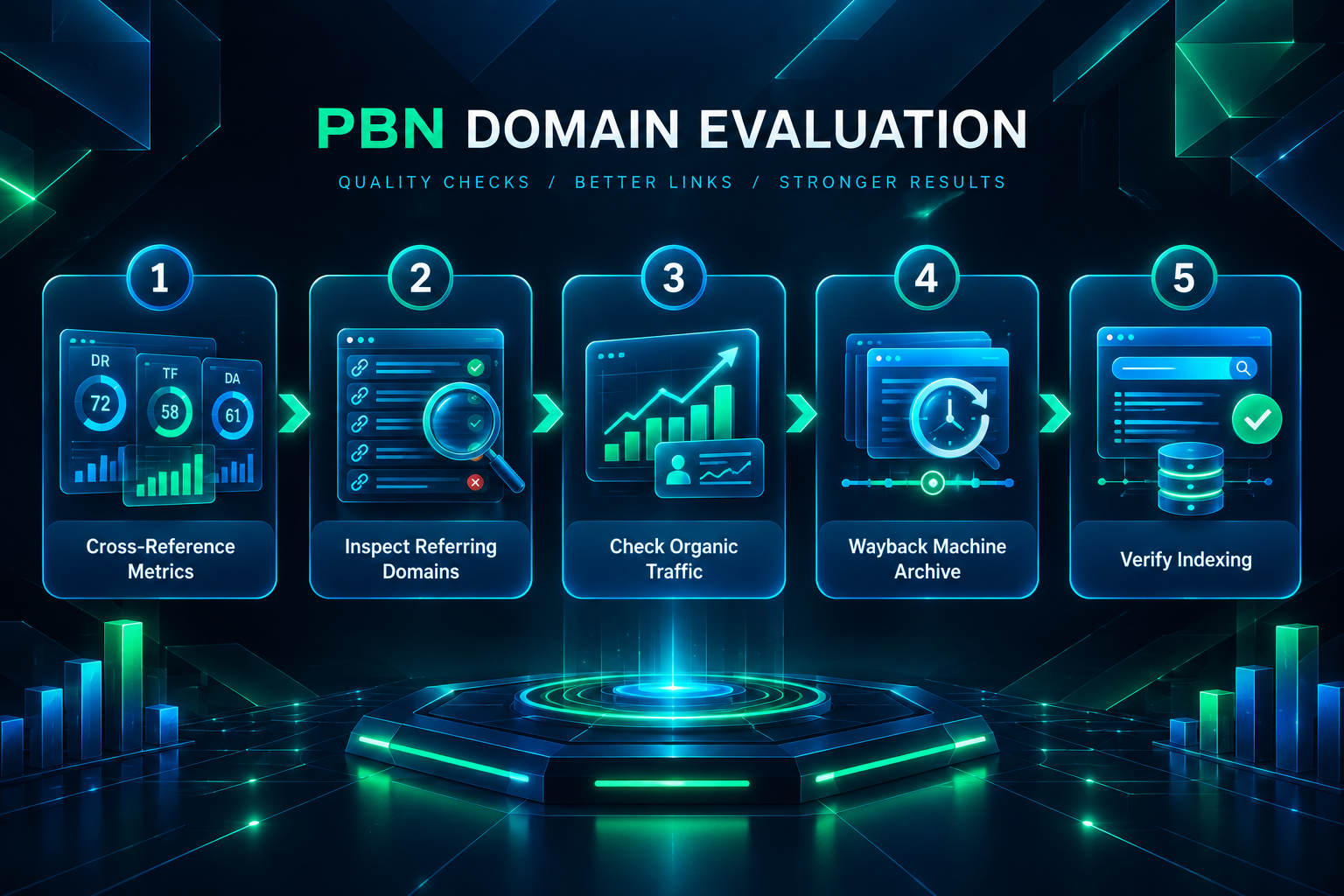
Cross-Reference Metrics Across Multiple Tools
DR from Ahrefs, DA from Moz, TF from Majestic, and the equivalent scores from Semrush are each calculated from different crawl datasets and different algorithms. A domain with genuinely strong link equity tends to show reasonable scores across multiple tools, even if the absolute numbers differ. A domain that shows a high DR but a very low TF, or a high DA but a near-zero Citation Flow from Majestic, may have a backlink profile that looks strong in one tool’s dataset but weak in another’s. Significant divergence across tools is a prompt to examine the backlink profile more closely rather than accepting any single score at face value.
Inspect the Referring Domain List Directly
Pulling the full referring domain list in Ahrefs or Majestic and reviewing a sample of the actual linking sites is one of the most reliable checks available. Look at whether the linking domains have their own real content, their own organic traffic, and their own coherent backlink profiles. A referring domain that itself has zero organic traffic, thin or auto-generated content, and a backlink profile consisting entirely of other low-quality sites contributes very little to the domain being evaluated, regardless of what metric score it carries. The quality of the referring domains is more informative than the count of referring domains or the aggregate metric score.
Check Organic Traffic Estimates
Organic traffic estimates from Ahrefs or Semrush provide a useful cross-check on metric credibility. A domain with a DR of 40 and an estimated organic traffic of fewer than 50 monthly visits is showing a significant disconnect between its authority score and its actual search performance. While organic traffic estimates are imperfect and can undercount traffic for some domains, a domain with genuinely strong link equity and relevant content would typically show some measurable search visibility. Near-zero traffic on a high-metric domain is not definitive proof of inflation, but it is a signal that warrants further investigation into the backlink profile and content history.
Review the Wayback Machine Archive
The Internet Archive’s Wayback Machine provides snapshots of a domain’s historical content. For a PBN domain evaluation, this check reveals whether the domain had a coherent content history in the niche it is now being used for, whether it went through a period of being parked or redirected, and whether its current content is consistent with the history that attracted its original links. A domain that was a legitimate industry resource for several years before being dropped and re-registered carries a different risk profile than one that was briefly used as a link scheme target and then repurposed. The archive check also helps identify domains that were previously used for adult content, gambling, pharmaceuticals, or other categories that may affect how their link equity is treated.
Verify Current Indexing Status
A domain that is not currently indexed in Google, or that has only a small fraction of its pages indexed relative to the number it appears to host, may have indexing issues that limit its ability to pass link equity regardless of its metric score. Running a site: query in Google for the domain gives a rough indication of its current indexed footprint. A domain with 200 pages but only 3 indexed results is showing a signal that deserves investigation before any placement decision is made. Indexing status alone does not determine link value, but a domain with persistent indexing problems is unlikely to function as an effective PBN placement regardless of what its DR or TF score suggests.
Understanding What Metrics Actually Measure
Domain Rating, as calculated by Ahrefs, reflects the strength of a domain’s backlink profile relative to other domains in Ahrefs’ index, using a logarithmic scale. A DR of 50 does not mean the domain is twice as powerful as a DR of 25; the scale is non-linear, and the score reflects relative position within Ahrefs’ dataset rather than an absolute measure of ranking power. Domain Authority from Moz uses a similar approach based on Moz’s own link index. Trust Flow from Majestic attempts to measure the quality of links by reference to a set of seed sites considered trustworthy, while Citation Flow measures link volume without quality weighting. Each metric captures something real about a domain’s link profile as seen by that tool’s crawler, but none of them is a direct measure of how Google evaluates the domain or how much ranking influence a link from that domain will carry.
This distinction matters for PBN domain evaluation because it means that a domain can have a high score on any of these metrics while still providing limited practical value as a PBN placement. The metric reflects the tool’s assessment of the domain’s link profile; it does not reflect Google’s assessment, the domain’s current content quality, its topical relevance to a target niche, or the placement context of any link it hosts. Evaluating a PBN domain purely on a single metric score is therefore an incomplete approach regardless of which tool produced the score.
Footprint Signals That Compound Metric Concerns
Inflated metrics are sometimes accompanied by other signals that indicate a domain may not function as intended within a PBN. These footprint signals do not by themselves prove that a domain is ineffective, but they add context to a metric evaluation.
Domains hosted on shared IP ranges alongside large numbers of other PBN sites, domains using identical CMS configurations across a network, and domains with thin or templated content that was added after re-registration are all patterns that experienced SEO practitioners consider when assessing network quality. A domain with a strong metric score but obvious footprint characteristics may carry a higher risk of being identified as part of a network, which affects how its links are treated over time. The combination of inflated metrics and visible footprint signals is a more significant concern than either factor in isolation.
When evaluating a PBN link service, asking about domain sourcing practices, content standards, hosting diversity, and how the network handles domain replacement over time provides more useful information than a metric score alone. A provider that can explain its domain vetting process in concrete terms is offering a more transparent basis for evaluation than one that presents only a list of DR or DA scores.
What Genuine Domain Quality Looks Like
A PBN domain with genuine link equity typically shows a combination of characteristics that are harder to fabricate than a single metric score. These include a backlink profile with referring domains that have their own real content and organic traffic, a history of content in a coherent niche that is relevant to the intended placement, metric scores that are broadly consistent across multiple tools, organic traffic estimates that reflect some actual search visibility, and an indexing history without extended gaps or obvious repurposing. No domain will satisfy every criterion perfectly, and the relative weight of each factor depends on the specific use case and target niche. The point is that genuine quality shows up across multiple dimensions simultaneously, while inflated metrics tend to be isolated to one or two scores that do not hold up when the underlying data is examined.
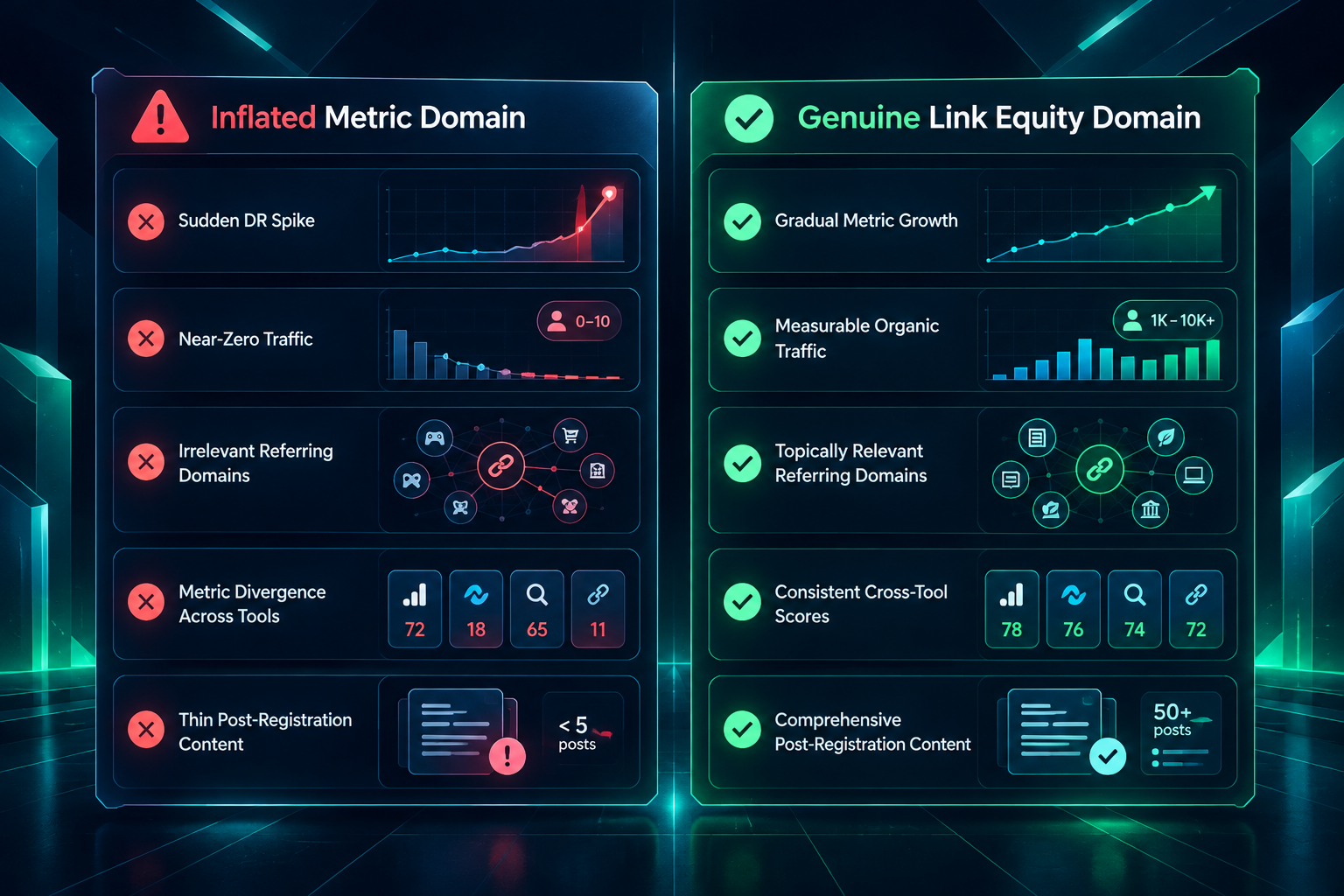
Topical relevance between the PBN domain and the target page it links to is a factor that metric scores do not capture at all. A domain with a moderate DR but strong topical alignment to the target niche may provide more practical value than a high-DR domain in an unrelated vertical. Evaluating placement context alongside domain metrics gives a more complete picture of likely link value than metrics alone.
Questions to Ask a PBN Link Provider
When evaluating a PBN link service, the following questions help assess whether the domains in the network have genuine quality or are presenting inflated metrics:
- How are domains sourced and vetted before being added to the network?
- What criteria are used beyond DR or DA scores when selecting domains?
- Can you provide the referring domain list or a sample of linking sites for a domain being offered?
- How is topical relevance between the PBN domain and the target niche assessed?
- What is the content standard for sites in the network, and how is content maintained over time?
- How does the network handle domains that lose metrics or indexing over time?
- Are traffic estimates available for the domains being offered?
A provider that engages with these questions in specific, concrete terms is demonstrating a more transparent approach to domain quality than one that relies solely on metric scores as a proxy for value.
Frequently Asked Questions
Can a domain have a high DR and still provide little ranking value?
Yes. Domain Rating reflects Ahrefs’ assessment of a domain’s backlink profile relative to its index. It is not a direct measure of how Google evaluates the domain or how much influence a link from that domain carries. A high DR built on temporary links, redirects, or low-quality referring domains may not translate into meaningful ranking power for a target page.
How quickly can metric inflation be identified?
In many cases, the signs of inflation are visible within a standard evaluation session using Ahrefs, Majestic, and the Wayback Machine. The historical metric chart, referring domain list, organic traffic estimate, and archive check together take roughly 15 to 30 minutes per domain and reveal most of the common inflation patterns described in this article.
Is a low organic traffic estimate always a red flag?
Not always. Some legitimate domains in narrow niches have low estimated traffic because their content targets low-volume keywords. However, a domain with a high authority score and near-zero estimated traffic across all keyword categories is showing a meaningful disconnect that warrants closer examination of the backlink profile and content history.
Do all PBN domains have inflated metrics?
No. Many PBN domains are sourced from expired or aged domains that accumulated genuine link equity during their previous life as active websites. The evaluation process described here is designed to distinguish domains with real underlying quality from those where the metric score has been artificially elevated. The presence of a high metric score is not itself evidence of inflation; the question is whether the data behind the score supports it.
Should I rely on a single tool’s metric when evaluating a domain?
Relying on a single metric from a single tool is generally insufficient for a thorough domain evaluation. Cross-referencing DR, TF, DA, and organic traffic estimates across multiple tools, combined with a direct inspection of the referring domain list and an archive check, provides a more reliable basis for assessing whether a domain’s authority score reflects genuine link equity.
What is the difference between a manual action and algorithmic devaluation of a link?
A manual action is a deliberate enforcement decision made by a search engine reviewer and is reported in Google Search Console. Algorithmic devaluation refers to a search engine’s automated systems assigning reduced or no weight to a link without a manual review. These are distinct outcomes with different implications. A link that is algorithmically devalued does not produce a manual action notification, and a manual action does not necessarily mean every link in a profile has been devalued. The two concepts should not be treated as interchangeable when assessing domain or placement risk.
Assessing PBN Domain Quality Beyond the Metric Score
Detecting inflated authority metrics on PBN domains is ultimately an exercise in looking past a single number to the data that produced it. Domain Rating, Trust Flow, and Domain Authority each capture something real about a domain’s link profile as seen by the tool that calculated them, but none of these scores is a complete or infallible measure of the ranking influence a link from that domain will carry. The patterns most associated with metric inflation — sudden score spikes without traffic growth, backlink profiles built on irrelevant or low-quality referring domains, high scores paired with minimal indexed content, and metric divergence across tools — are all detectable through a structured evaluation process using tools that are widely accessible to SEO practitioners.
The practical implication is that domain evaluation for PBN purposes benefits from a multi-signal approach: cross-tool metric comparison, direct inspection of the referring domain list, organic traffic cross-checks, Wayback Machine archive review, and current indexing verification. No single check is definitive, but the combination of these signals gives a substantially more accurate picture of a domain’s genuine link equity than a headline DR or DA score alone. Topical relevance between the domain and the intended placement target adds a further dimension that metric scores do not capture.
If you are evaluating PBN link placements or sourcing domains for a private blog network and want to discuss domain quality criteria, backlink profile assessment, or placement context in more detail, PBN Backlinks Service can help you work through the specific requirements of your campaign.