

Selling a website that has PBN backlinks in its link profile raises a practical question that many sellers overlook until late in the negotiation: what do you tell the buyer, when do you tell them, and how do you present that information clearly? Disclosure is not simply a legal formality — it directly affects deal credibility, valuation conversations, and the buyer’s ability to maintain or build on the site’s SEO after the transaction closes. This article explains what PBN link disclosure involves, what buyers typically want to know, how to structure that information, and what to consider when preparing a website for sale.
Key Takeaways
- Buyers conducting due diligence on a content or affiliate site will almost always review the backlink profile, so proactive disclosure of PBN links is more effective than waiting to be asked.
- Disclosure should cover the number of PBN placements, the domains involved, anchor text distribution, the provider or network used, and any ongoing costs such as link maintenance fees.
- Presenting PBN links clearly and accurately — rather than obscuring them — tends to support rather than undermine a deal, because it demonstrates that the seller understands the site’s SEO foundation.
- Buyers vary significantly in how they evaluate PBN links: some treat them as a neutral or positive ranking factor, others price in perceived risk, and a minority will decline a site on that basis alone.
- The quality of the PBN placements — domain history, topical relevance, placement context, and link profile diversity — matters more to most informed buyers than the simple presence of PBN links.
Why PBN Link Disclosure Matters in a Website Sale
When a buyer acquires a website, they are purchasing its revenue, its traffic, and the SEO infrastructure that supports both. The backlink profile is a core part of that infrastructure. A buyer who discovers PBN links after closing — particularly if they were not mentioned during due diligence — may feel misled, even if the links are performing well. That perception can damage the seller’s reputation in brokerage communities, create post-sale disputes, or complicate earnout arrangements where part of the purchase price depends on traffic or revenue performance after the handover.
Proactive disclosure also gives the seller control over the narrative. A seller who presents PBN links clearly, explains the quality of the placements, and provides supporting data is in a much stronger position than one who leaves a buyer to discover the links independently through Ahrefs, Semrush, or Majestic. Buyers who find undisclosed links through their own research are more likely to interpret the omission negatively, regardless of the actual link quality.
From a practical standpoint, most serious buyers of content sites, affiliate sites, and niche websites now conduct a structured backlink audit as a standard part of due diligence. PBN links are not automatically disqualifying for most buyers, but unexplained gaps between what the seller described and what the audit reveals almost always are.
What Buyers Typically Want to Know About PBN Links
Buyers evaluating a site with PBN backlinks generally want answers to a specific set of questions. Understanding these questions in advance allows a seller to prepare documentation that addresses them directly rather than responding reactively during negotiation.
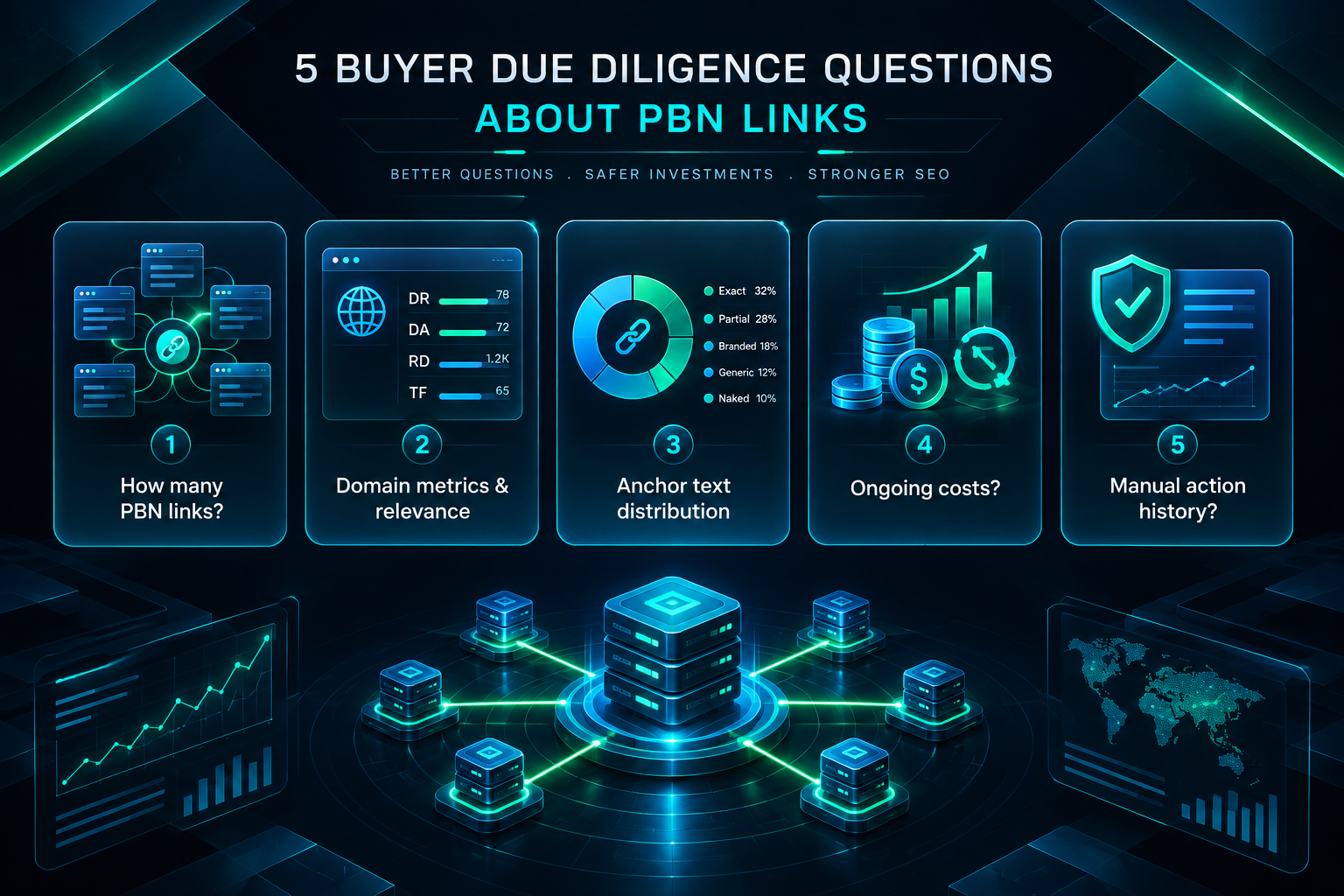
How Many PBN Links Are in the Profile?
The first question is usually quantitative. Buyers want to know how many referring domains in the backlink profile are PBN placements, and what proportion of the total link profile they represent. A site with 200 referring domains where 15 are PBN placements presents a different picture than one where 80 of 90 referring domains are PBN links. Neither situation is automatically problematic, but the ratio affects how a buyer assesses the site’s organic traffic dependency on those placements.
What Are the Domains and Placement Details?
Buyers will typically want a list of the PBN domains used, or at minimum the key metrics associated with those domains — domain rating, trust flow, referring domain count, and topical relevance. If the placements were made through a provider such as PBN Backlinks Service, the seller can describe the network’s general characteristics and the placement context: whether links are contextual, what anchor text was used, and which pages on the target site the links point to.
What Is the Anchor Text Distribution?
Anchor text strategy is a standard due diligence checkpoint. Buyers will look at whether the PBN placements use exact-match anchors, branded anchors, partial-match anchors, or generic phrases. A heavily exact-match anchor profile concentrated in PBN placements can be a concern for buyers who plan to continue building links after acquisition, because it limits their flexibility. Sellers who can show a varied and considered anchor text distribution across their PBN placements are in a stronger position.
Are There Ongoing Costs or Maintenance Requirements?
Some PBN link arrangements involve recurring fees — either for link maintenance, hosting on the provider’s network, or periodic renewal. Buyers need to know whether the links will remain live after the sale, whether any ongoing payments are required to keep them active, and whether those costs transfer with the site. If the links are permanent placements with no recurring cost, that should be stated clearly. If there is a maintenance arrangement, the buyer needs to understand the terms before closing.
Has the Site Received Any Manual Actions or Algorithmic Flags?
Buyers will check Google Search Console history where possible and will ask directly whether the site has received a manual action related to its link profile. A seller should be prepared to answer this honestly. If the site has a clean manual action history, that is worth stating explicitly. If there was a past manual action that has since been resolved, the seller should explain what happened and what steps were taken. Omitting this information is one of the most common causes of post-sale disputes in the content site market.
How to Structure PBN Link Disclosure in a Sale
Effective disclosure is organized, specific, and presented in a format that a buyer can review alongside their own due diligence data. The following structure covers the information most buyers need.
Prepare a Backlink Profile Summary
Export the site’s backlink data from a tool such as Ahrefs or Semrush and prepare a summary that identifies the total number of referring domains, the number of PBN placements, and the key metrics for those placements. If you used a provider, note the provider and the general characteristics of the network — domain age, domain rating range, topical focus, and placement type. This summary does not need to expose every domain in the network, but it should give the buyer enough information to assess the quality and scale of the PBN component.
Document Anchor Text Usage
Prepare a breakdown of the anchor text used across PBN placements. Group anchors by type: exact-match, partial-match, branded, and generic. If the anchor strategy was deliberate — for example, using branded and generic anchors in PBN placements to complement exact-match anchors from other sources — explain that rationale. Buyers who understand SEO will appreciate a seller who can articulate an anchor text strategy rather than one who simply placed links without a plan.
Clarify Link Permanence and Costs
State clearly whether the PBN placements are permanent or subject to ongoing fees. If there are recurring costs, provide the amount, frequency, and the terms under which those costs could change. If the links are managed through a provider, explain whether the buyer can take over the relationship directly or whether the arrangement needs to be renegotiated after the sale. Some buyers will want to continue using the same provider; others will want to diversify the link profile after acquisition. Either way, they need accurate information to plan.
Provide Search Console Access During Due Diligence
Granting a prospective buyer read access to Google Search Console during the due diligence period is standard practice for serious website sales. This allows the buyer to verify traffic data, check for manual actions, and review any security or crawl issues independently. If the site has a clean manual action history, Search Console access confirms that directly. If there are any outstanding issues, the buyer will find them regardless — so it is better to address them proactively.
Be Specific About Which Pages the Links Point To
Buyers want to know whether PBN links point to the homepage, to category pages, or to specific content pages. The distribution of link equity across the site affects how the buyer plans post-acquisition SEO. If PBN placements are concentrated on a small number of high-revenue pages, the buyer needs to understand that dependency. If links are distributed across the site’s content, that is worth noting as a positive characteristic of the link-building approach.
How Buyers Evaluate PBN Links During Due Diligence
Buyer attitudes toward PBN links vary considerably, and understanding that variation helps sellers position their disclosure appropriately. Experienced content site buyers and SEO-focused acquirers generally fall into three broad groups when they encounter PBN links in a backlink profile.
The first group treats PBN links as a neutral or positive factor, provided the placements are on quality domains with relevant content, the anchor text is varied, and the links have contributed to measurable ranking performance. These buyers are often experienced SEO practitioners who have used PBN links themselves and understand how to assess placement quality. For this group, clear and detailed disclosure is a positive signal about the seller’s SEO competence.
The second group prices PBN links as a risk factor without necessarily declining the deal. These buyers may adjust their valuation to account for what they perceive as a degree of uncertainty in the link profile, or they may plan to diversify the backlink profile after acquisition. For this group, disclosure that includes quality indicators — domain metrics, topical relevance, placement context, and traffic performance history — helps them make a more accurate assessment rather than applying a blanket discount.
The third group will decline a site if PBN links are present, regardless of quality. These buyers are typically operating under specific investment criteria, managing sites on behalf of clients with strict link-building policies, or simply prefer not to acquire sites with link profiles they cannot fully control. For this group, disclosure is still the right approach — it allows both parties to identify the mismatch early rather than after significant time has been invested in negotiation.
Understanding which type of buyer you are dealing with early in the conversation allows you to focus the disclosure on the information most relevant to their evaluation criteria.
Quality Factors That Affect How PBN Links Are Perceived
Not all PBN placements carry the same weight in a buyer’s assessment. The quality of the domains and placements in the network significantly affects how a buyer interprets the disclosure. Sellers who can demonstrate that their PBN links meet reasonable quality standards are in a better negotiating position than those who cannot.
Domain history and topical relevance are the most commonly evaluated factors. PBN placements on domains with a genuine history in the relevant niche, a clean backlink profile, and meaningful domain authority metrics are generally viewed more favorably than placements on domains with thin content, unrelated history, or obvious repurposing. If the placements were made through a provider that applies domain quality standards — checking referring domain history, content relevance, and link profile composition before accepting domains into the network — that is worth communicating to the buyer.
Placement context also matters. Contextual links embedded within relevant, substantive content on a topically appropriate page are generally assessed more favorably than footer links, sitewide links, or links on pages with no clear topical connection to the target site. Sellers should be able to describe the placement context for their PBN links, not just the domain metrics.
Link profile diversity is another factor buyers consider. A site whose backlink profile includes PBN placements alongside organic editorial links, directory citations, and other link types is generally viewed as having a more stable SEO foundation than one that relies almost entirely on PBN links. If the PBN placements represent a deliberate component of a broader link-building strategy rather than the entire strategy, that context is worth including in the disclosure.
Common Mistakes Sellers Make When Disclosing PBN Links
Several disclosure errors consistently create problems in website sale negotiations. Avoiding them makes the process smoother for both parties.
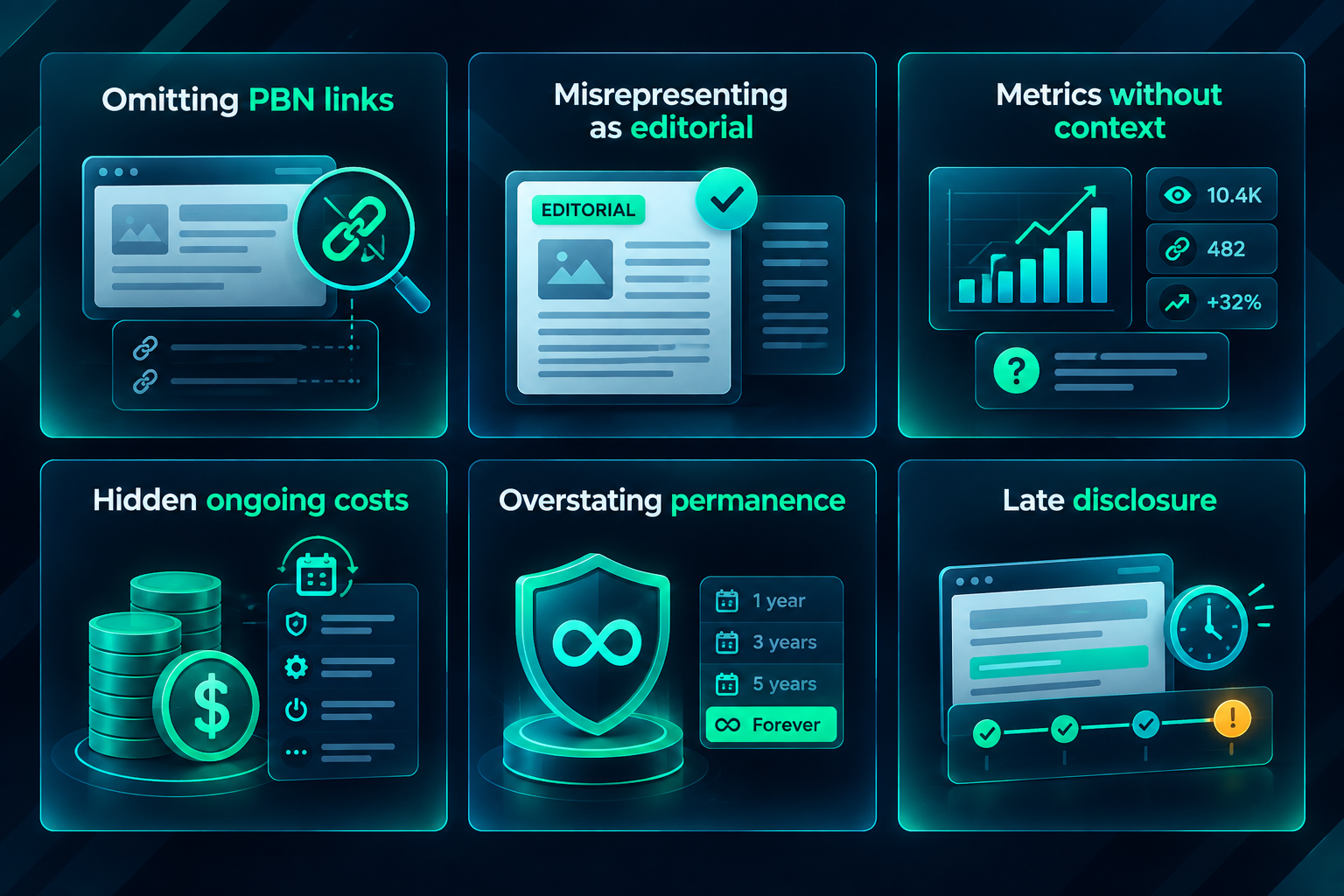
- Omitting PBN links entirely: Buyers who discover undisclosed PBN links through their own audit are more likely to walk away or significantly reduce their offer, even if the links are performing well. Omission is almost always counterproductive.
- Describing PBN links as editorial or organic: Misrepresenting the nature of a link placement — for example, describing a PBN placement as a naturally earned editorial link — is a material misrepresentation that can create post-sale disputes. Describe PBN placements accurately as paid or managed placements.
- Providing metrics without context: Listing domain rating scores without explaining what they represent, or providing a list of domains without noting their topical relevance, leaves buyers to draw their own conclusions. Context improves the quality of the disclosure.
- Failing to address ongoing costs: Buyers who discover after closing that PBN link maintenance requires recurring payments they were not told about will view this as a material omission. Clarify costs upfront.
- Overstating link permanence: If PBN placements are subject to network changes, domain expiry, or provider decisions that could affect link availability, do not represent them as guaranteed permanent placements. Describe what is known about link longevity accurately.
- Waiting until late in due diligence: Raising PBN link disclosure after a buyer has already invested significant time in due diligence creates friction. Include it in the initial information memorandum or listing description where possible.
Frequently Asked Questions
Do I have to disclose PBN links when selling a website?
There is no universal legal requirement to disclose PBN links specifically, but failing to disclose material facts about a website’s SEO infrastructure — including its backlink profile — can create post-sale disputes and damage your reputation in brokerage communities. Most reputable brokers and marketplaces expect sellers to provide accurate backlink profile information as part of standard due diligence documentation.
Will disclosing PBN links kill the deal?
Not necessarily, and in many cases it will not. Buyer attitudes toward PBN links vary significantly. Experienced SEO buyers often view quality PBN placements as a neutral or positive factor. Some buyers will price in a risk adjustment, and a minority will decline on that basis. Proactive, well-documented disclosure is generally more effective than allowing a buyer to discover links independently, which tends to create more concern than the links themselves.
What metrics should I include when disclosing PBN domains?
Include domain rating or domain authority, trust flow where available, the number of referring domains to the PBN domain, topical relevance to your site’s niche, and the type of placement — contextual, homepage, or inner page. If the placements were made through a provider, you can describe the provider’s general quality standards without necessarily exposing every domain in the network.
What if I used a PBN link provider and don’t have full details about the domains?
Contact your provider before listing the site for sale and request the information you need to answer likely buyer questions — domain metrics, placement context, anchor text used, and any ongoing cost or maintenance terms. Reputable providers such as PBN Backlinks Service can typically supply placement details that support a clear disclosure. If a provider cannot or will not supply basic placement information, that is itself a quality consideration worth noting.
Should I disavow PBN links before selling?
Disavowal is not a standard pre-sale step and is not universally appropriate. Disavowing links that are contributing to rankings could reduce the site’s organic traffic before the sale, which would directly affect its valuation. If the site has a clean manual action history and the PBN links are performing well, disavowal is generally not warranted. If there is a specific concern about a subset of low-quality placements, that is a decision that requires a careful assessment of the site’s specific situation rather than a blanket approach.
How do I explain PBN links to a buyer who is not familiar with SEO?
Describe PBN placements as managed link placements on third-party websites that were acquired or built specifically to host links pointing to your site. Explain that these placements were used to support the site’s search engine rankings, that they involve paid or managed arrangements rather than organic editorial links, and that they are a common link-building approach used across the content site market. Provide the key metrics and performance context so the buyer can assess the placements with the help of their own SEO advisor if needed.
Preparing Your Site’s PBN Link Profile for a Successful Sale
Disclosure of PBN backlinks during a website sale is most effective when it is treated as a documentation task rather than a negotiation obstacle. Sellers who prepare a clear, organized backlink profile summary — covering placement count, domain quality indicators, anchor text distribution, placement context, and cost terms — give buyers the information they need to make an informed assessment. That transparency tends to support deal credibility rather than undermine it, because it demonstrates that the seller understands the site’s SEO foundation and has nothing to conceal.
The quality of the PBN placements themselves matters significantly in how buyers respond to disclosure. Placements on topically relevant domains with meaningful metrics, contextual link placement, and a varied anchor text strategy are generally assessed more favorably than low-quality placements with thin content and aggressive exact-match anchors. If you are building or maintaining PBN links on a site you plan to sell, the quality standards applied during the link-building process directly affect the disclosure conversation later.
If you are preparing a site for sale and want to review your current PBN link profile, assess placement quality, or discuss how your backlink strategy might be documented for due diligence, PBN Backlinks Service can help you understand what your placements involve and how to present them accurately to prospective buyers.