

Documenting a PBN link experiment properly is what separates a useful data point from an anecdote you cannot act on. Without a structured record of your baseline conditions, the links you placed, the variables you controlled, and the metrics you tracked over time, any ranking movement you observe is difficult to attribute with confidence — and impossible to replicate or share meaningfully with others. This guide walks through a practical documentation framework that gives your PBN experiments analytical value, whether you are testing a single placement on one target page or running a structured multi-site comparison.
Key Takeaways
- A documented PBN experiment requires a clearly defined baseline, a single controlled variable, and a pre-specified measurement window before any links are placed.
- Recording placement details — including domain metrics, topical relevance, anchor text, and target page type — is essential for interpreting results and reproducing the test.
- Ranking changes, organic traffic shifts, and crawl or indexing events should be logged separately and timestamped to avoid conflating unrelated causes.
- Confounding factors such as algorithm updates, competitor link activity, and on-page changes must be noted throughout the experiment period.
- A single experiment rarely produces conclusive evidence; documentation enables you to build a cumulative body of observations across multiple tests.
Why Structured Documentation Matters for PBN Testing
PBN link experiments occupy a specific niche in SEO testing: the variables involved — domain history, placement context, anchor text, link velocity, topical relevance — are numerous, and the feedback loop from Google’s crawling and indexing pipeline introduces delays that can stretch from days to several weeks. Without a written record created before the experiment begins, it is easy to unconsciously reframe what you were testing once results appear. Structured documentation prevents that bias and makes your findings transferable.
The SEO community has a long history of informal PBN testing, but most published observations lack the methodological detail needed to evaluate whether the result was caused by the PBN link, a concurrent on-page change, a competitor’s link loss, or a broad algorithm update. A well-documented experiment does not eliminate uncertainty — ranking causation is inherently difficult to isolate — but it does allow you to state clearly what you observed, under what conditions, and what alternative explanations you accounted for.
Documentation also has practical value beyond the individual test. If you are running PBN placements across multiple client sites or affiliate projects, a consistent recording format lets you compare outcomes across niches, domain quality tiers, and placement types. Over time, that accumulated record becomes a genuine reference for campaign planning.
Setting Up the Experiment: Pre-Test Documentation
The most important documentation happens before a single link is placed. Pre-test records establish the baseline against which all subsequent changes are measured. Skipping this step means you are reconstructing history after the fact, which introduces significant recall bias.
Define the Research Question
Write down a specific, testable question before you begin. Vague questions such as “do PBN links work?” produce vague conclusions. A useful research question names the specific variable you are testing and the outcome you expect to observe. Examples include: “Does a single contextual PBN placement from a topically relevant domain with a partial-match anchor improve the target page’s ranking for its primary keyword within eight weeks?” or “Does increasing PBN link velocity from one placement per month to three placements per month on a new affiliate site accelerate ranking movement compared to the slower pace?” The more precisely you define the question, the more interpretable your results will be.
Record the Baseline Metrics
Capture a snapshot of every metric you intend to track before the experiment starts. At minimum, this should include the target page’s current ranking positions for the keywords you are monitoring, the page’s organic click-through rate and impressions from Google Search Console, the referring domain count and total backlink count from your chosen SEO tool (Ahrefs, Semrush, or Majestic are commonly used), and the domain-level authority metrics for the target site. Note the date and the tool version or data export date for each metric, because proprietary metrics such as Domain Rating, Domain Authority, and Trust Flow are recalculated periodically and a later snapshot may not reflect the pre-experiment state accurately.
Also record the competitive landscape for your target keywords at baseline. Note the top-ranking pages, their approximate backlink counts, and any recent changes you are aware of. If a competitor has just launched a major content push or lost a significant referring domain, that context belongs in your pre-test record.
Identify and Document Controlled Variables
A controlled experiment changes one variable at a time. In practice, PBN experiments rarely achieve laboratory-level control, but you should document which variables you are deliberately holding constant and which you cannot control. Variables you can typically control include: whether you make any on-page changes to the target page during the experiment window, whether you build links from other sources simultaneously, and the anchor text you use for the PBN placement. Variables you cannot fully control include algorithm updates, competitor activity, and seasonal search demand shifts. Documenting both categories is important — it tells a future reader (or your future self) exactly how much weight to place on the result.
Documenting the PBN Placement Itself
The placement record is the core of your experiment log. Every detail you record here determines how reproducible and interpretable the test is. A placement record with missing fields is significantly less useful than one that captures the full context.
Domain-Level Information
Record the following for each PBN domain used in the experiment: the domain name, its registration or expiration history if known, the primary niche or topical category of the domain’s existing content, the domain’s key authority metrics at the time of placement (DR, DA, TF, CF, or whichever metrics your toolset provides), the number of referring domains pointing to the PBN domain, and whether the domain has a meaningful indexed content footprint. Note whether the domain was previously expired and rebuilt, or whether it has been continuously active. These details affect how you interpret any ranking signal the placement may or may not produce.
Placement-Level Information
Record the specific page on the PBN domain where the link was placed, the surrounding content context (topical relevance to the target page, approximate word count of the host article, placement position within the content), the anchor text used and the anchor text type (exact match, partial match, branded, naked URL, or generic), the link attribute (followed or nofollowed), and the target URL receiving the link. Also note the date the content was published or updated on the PBN domain, and the date you first confirmed the link was live.
If you are using a PBN backlink service rather than a self-managed network, record the package or placement tier, any quality indicators the provider shares, and the delivery confirmation date. This information is relevant if you later need to cross-reference the placement against crawl or indexing events.
Anchor Text Strategy Record
Anchor text distribution is one of the most discussed variables in PBN link building, and it deserves its own documentation field. Record not just the anchor you used for this placement, but the existing anchor text profile of the target page’s backlink portfolio at the time of the experiment. Note the approximate ratio of branded, exact-match, partial-match, and generic anchors already pointing to the page. This context is necessary for interpreting whether the anchor you chose was consistent with the existing profile or represented a meaningful shift.
Tracking Metrics During the Experiment Window
Once the placement is live, systematic metric tracking begins. The experiment window should be defined in advance — a common choice for PBN experiments is eight to twelve weeks, though some ranking movements may take longer to stabilize, particularly for competitive keywords or newly indexed placements.
Crawling and Indexing Events
Log the date the PBN placement page was first crawled by Googlebot, if you can determine this. Google Search Console’s URL Inspection tool can provide crawl date information for pages you own, but for PBN domains you do not control directly, you may need to rely on third-party crawl data or observe when the linking page appears in backlink tool indexes. Note the date the link first appears in Ahrefs, Semrush, or Majestic, as this is a proxy for when the link entered the tool’s crawl database — though it does not confirm when Google processed it. Indexing and crawling are distinct events, and conflating them can lead to incorrect timeline interpretations.
Ranking Position Tracking
Record keyword rankings at consistent intervals — weekly snapshots are a practical standard for most experiments. Use the same rank-tracking tool throughout the experiment to avoid introducing measurement variance from tool differences. Note the ranking position for your primary target keyword and, where relevant, secondary keywords the page targets. Rank tracking tools report positions differently depending on whether they use desktop or mobile user agents, geographic location settings, and personalization filters, so document those settings in your methodology record.
Avoid drawing conclusions from a single week’s ranking movement. Rankings fluctuate for many reasons unrelated to link building, including crawl budget allocation, content freshness signals, and user engagement patterns. A meaningful signal in a PBN experiment is typically a sustained directional movement over multiple consecutive tracking periods, not a one-week spike or dip.
Organic Traffic and Search Console Data
Google Search Console provides impression and click data that complements rank tracking. Log weekly or bi-weekly exports of impressions, clicks, average position, and click-through rate for the target page. These metrics can reveal movement that rank trackers miss, particularly for pages that rank for a broad cluster of long-tail queries rather than a single primary keyword. Note any significant changes in impressions separately from changes in clicks, as they can indicate different things — an impression increase with flat clicks may suggest a ranking improvement for lower-volume queries, while a click increase with flat impressions suggests a CTR improvement.
Confounding Factor Log
Maintain a running log of any external events that could plausibly affect your target page’s rankings during the experiment window. This includes confirmed or suspected Google algorithm updates (which can be cross-referenced against publicly reported update timelines), significant changes to competitor pages ranking above or below your target, any on-page edits made to the target page, other backlinks acquired by the target page from any source, and any technical changes to the target site such as hosting migrations, Core Web Vitals changes, or internal linking restructures. Every entry in this log should be timestamped. A confounding factor log is what allows you to say, at the end of the experiment, whether an observed ranking change coincided with a plausible alternative cause.
Post-Experiment Analysis and Recording Findings
At the end of the defined experiment window, compile your observations into a structured findings record. This is distinct from the raw data log — it is your interpretation of what the data shows, stated with appropriate qualification.
Summarizing the Observed Outcome
State what happened to the target page’s rankings and organic traffic during the experiment window. Be specific: note the starting position, the ending position, the direction and magnitude of any movement, and the approximate timing of any observable change relative to the placement date and the first confirmed indexing of the link. If rankings did not change meaningfully, record that outcome with equal care — a null result is a valid and useful data point, particularly if the placement details are well documented.
Assessing Alternative Explanations
Review your confounding factor log and assess whether any logged event provides a plausible alternative explanation for the observed outcome. If a broad algorithm update was confirmed during the experiment window, note that the ranking movement cannot be attributed to the PBN placement with confidence. If no significant confounding events occurred and the ranking movement followed the placement by a timeline consistent with crawling and indexing delays, you can note that the placement is a plausible contributing factor — while acknowledging that correlation does not establish causation in a single-experiment context.
Documenting Limitations
Every PBN experiment has limitations, and recording them honestly makes your findings more credible and more useful. Common limitations to document include: the inability to confirm exactly when Google processed the link (as opposed to when it was crawled or when it appeared in third-party tools), the presence of uncontrolled variables such as competitor link activity, the small sample size of a single placement on a single page, and the possibility that the target page’s existing authority or content quality was the primary driver of any ranking movement. Stating these limitations does not invalidate the experiment — it contextualizes it correctly.
Building a Cumulative Experiment Record
A single PBN experiment, however well documented, produces limited generalizable insight. The value of structured documentation compounds when you apply the same framework across multiple tests. Over time, a cumulative record allows you to identify patterns: which domain quality tiers tend to produce observable ranking signals, which anchor text approaches correlate with stable versus volatile ranking movements, which niches show faster or slower response times, and which placement contexts appear to carry more or less weight.
A practical format for a cumulative record is a structured spreadsheet or database with one row per experiment and consistent column headers drawn from the documentation framework above. Key fields to include at the summary level are: experiment ID, target page URL, target keyword, placement date, PBN domain quality tier, anchor text type, experiment window length, observed ranking change (in positions), presence of significant confounding events (yes/no), and an overall confidence rating for the attribution. A low confidence rating does not mean the experiment was wasted — it means the result should be weighted accordingly when you draw broader conclusions.
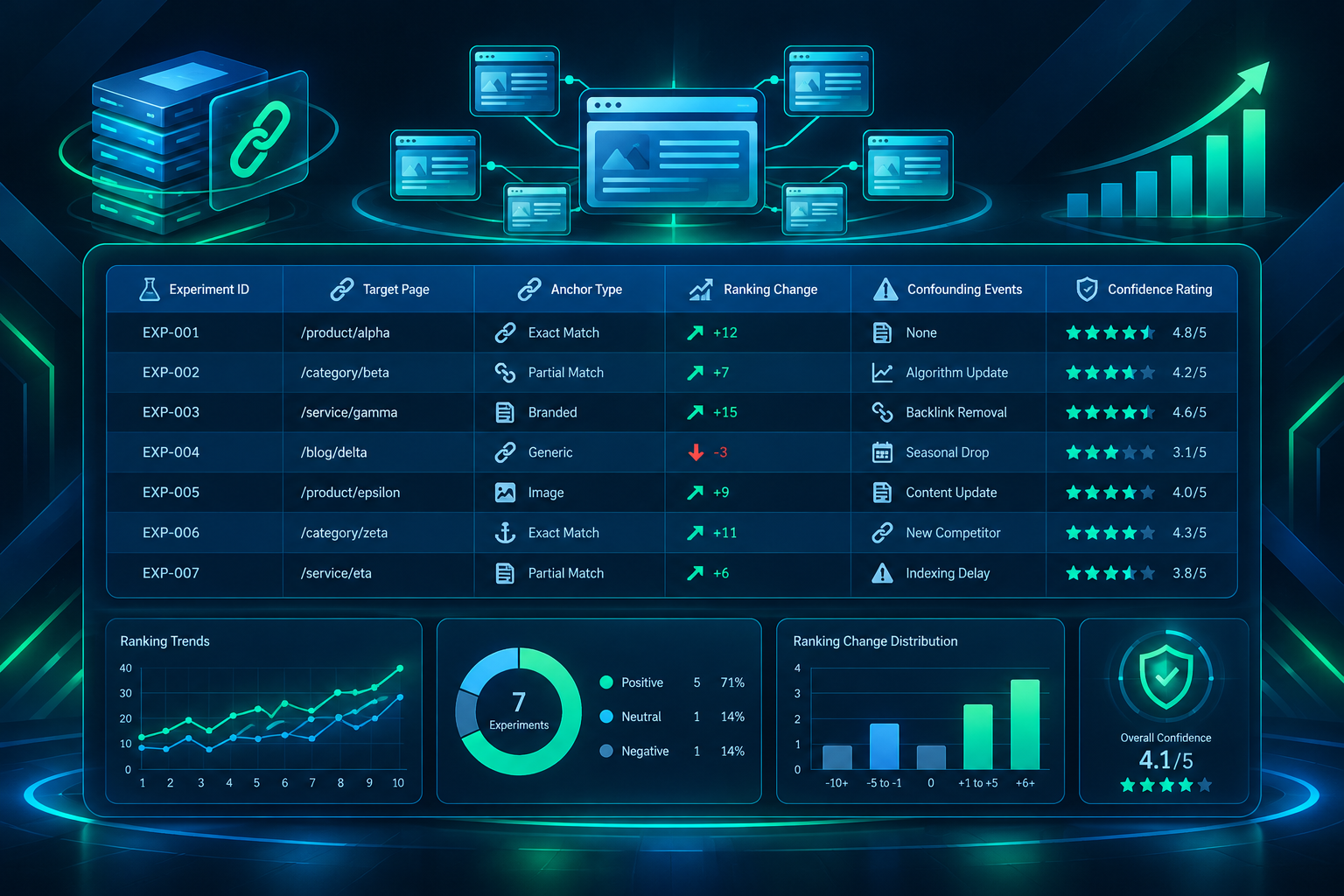
When sharing experiment findings with colleagues, clients, or the broader SEO community, the documentation record is what allows others to evaluate your methodology rather than simply accepting or rejecting your conclusion. Transparent methodology is what distinguishes a useful SEO case study from an unverifiable claim.
Practical Tools for Experiment Documentation
No specialized software is required to document a PBN experiment, but a consistent toolset reduces friction and improves data quality. For rank tracking, tools such as Ahrefs, Semrush, or dedicated rank trackers provide historical position data that can be exported at the end of the experiment window. Google Search Console provides the most direct source of impression and click data for pages you own. For backlink monitoring, Ahrefs and Majestic both provide link discovery timestamps that help you establish when a placement entered their crawl indexes.
For the experiment log itself, a shared spreadsheet with clearly labeled tabs for pre-test baseline, placement details, weekly metric snapshots, confounding factor log, and post-experiment findings covers most use cases. If you are running multiple experiments simultaneously, a project management tool or a simple database can help you maintain separation between experiment records and avoid cross-contamination of data. The specific tools matter less than the consistency with which you use them — switching rank trackers mid-experiment, for example, introduces measurement variance that complicates interpretation.
Frequently Asked Questions
How long should a PBN experiment run before I record findings?
Most practitioners use an eight to twelve week window as a starting point, measured from the date the placement is confirmed live. Ranking responses to new backlinks vary considerably depending on crawl frequency, keyword competitiveness, and the target site’s existing authority. For highly competitive keywords, a longer observation window may be necessary before a stable trend is visible. Define the window before the experiment starts and stick to it, noting any significant events that occurred during the period.
Should I test one PBN link at a time or multiple placements simultaneously?
Testing one placement at a time on a given target page gives you the clearest signal, because multiple simultaneous placements make it difficult to attribute any observed change to a specific link. If your campaign requires multiple placements, consider staggering them and documenting each separately, or designate one page as a controlled test page and another as a production page where you build links at normal pace.
What should I do if rankings drop during the experiment?
A ranking decline during a PBN experiment should be logged with the same detail as an improvement. Check your confounding factor log for algorithm updates or competitor activity that coincides with the drop. Note whether the decline affected only the target page or the broader site. A page-level decline and a sitewide decline are different observations with different potential explanations, and conflating them produces misleading conclusions. Do not assume the PBN placement caused the decline without ruling out alternative explanations.
How do I account for Google algorithm updates in my experiment record?
Log confirmed update dates as they are reported by Google or widely corroborated by rank-tracking aggregators. If a significant update falls within your experiment window, note it in the confounding factor log and lower your attribution confidence rating accordingly. An experiment that coincides with a major algorithm update is not necessarily worthless — the baseline and placement details are still useful for future reference — but the ranking outcome cannot be cleanly attributed to the PBN placement alone.
Can I use the same documentation framework for Tier 2 PBN links?
Yes, with minor adjustments. For Tier 2 placements — links pointing to an intermediate page rather than directly to your target site — document the intermediate page’s metrics and the chain of links involved. The observation window may need to be longer, as the ranking signal must pass through an additional layer before potentially affecting the target page. Note the Tier 2 structure explicitly in your placement record so the experiment can be interpreted correctly.
How specific should my anchor text documentation be?
Record the exact anchor text used, the anchor text type (exact match, partial match, branded, naked URL, or generic), and the existing anchor text distribution for the target page’s backlink profile at the time of placement. This level of detail allows you to assess whether the anchor choice was consistent with the existing profile or represented a meaningful shift, which is relevant context for interpreting any ranking movement that follows.
Turning Experiment Documentation into Actionable Campaign Intelligence
A well-maintained experiment record does more than satisfy methodological standards — it becomes a practical reference for future campaign decisions. When you can point to documented observations showing which domain quality tiers, anchor text approaches, and placement contexts produced measurable ranking signals on comparable pages in comparable niches, your link-building decisions become more informed and more defensible. The documentation framework described here is designed to be lightweight enough to use consistently without becoming a project in itself, while capturing enough detail to make each experiment genuinely interpretable.
If you are evaluating PBN placements for a specific site or campaign and want to discuss placement quality, domain selection criteria, or how to structure a testable link-building approach, PBN Backlinks Service can help you assess the options relevant to your goals. The quality of the placements you test directly affects the quality of the data you collect — so starting with well-documented, high-quality domains and contextual placements gives your experiments the best foundation for producing useful findings.