

Running a private blog network across a team without documented procedures is one of the fastest ways to introduce inconsistency, footprint risks, and operational errors. Whether your team manages a handful of PBN sites or a large-scale network, written operating procedures give every contributor a shared reference point for domain acquisition, content standards, link placement, hosting configuration, and ongoing maintenance. This guide explains how to build that documentation from the ground up, what to include in each procedure, and how to keep it accurate as your network evolves.
Key Takeaways
- Documented PBN operating procedures reduce inconsistency across team members and protect network quality over time.
- Effective documentation covers domain vetting, content production, link placement, hosting setup, and monitoring — each as a separate, clearly owned process.
- Role assignment and access control should be part of the documentation structure, not an afterthought.
- Procedures need a review cycle; a static document becomes a liability as tools, search-engine behavior, and network requirements change.
- Version control and a change log help teams track what changed, when, and why — which matters when diagnosing network issues.
Why Operating Procedures Matter for PBN Teams
A private blog network depends on consistency. Each site in the network needs to meet a defined quality threshold for its content, its backlink profile, its hosting environment, and its placement context. When multiple people contribute to those tasks without shared written standards, the network’s overall quality becomes uneven. One team member might apply strict topical relevance criteria when selecting domains; another might prioritize domain authority metrics without checking content history. One writer might produce substantive articles; another might submit thin content that weakens the site’s credibility. Documented procedures close that gap by making the expected standard explicit and repeatable.
Beyond quality, documented procedures also reduce key-person dependency. If the person who manages hosting configuration or domain renewal leaves the team, their knowledge should already exist in writing. Operational continuity is a practical concern for any PBN team that manages sites over months or years, and documentation is the most direct way to protect it.
Mapping Your PBN Workflows Before Writing Anything
Before writing a single procedure, map the actual workflows your team performs. A PBN operation typically involves several distinct process clusters, and each one needs its own documentation rather than being folded into a single catch-all document. Common clusters include domain research and acquisition, domain vetting and due diligence, hosting and technical setup, content production and publishing, link placement and anchor text management, indexing verification, and ongoing monitoring and maintenance.
Start by listing every recurring task your team performs. For each task, identify who currently performs it, what inputs they need, what decisions they make, and what the expected output looks like. This mapping exercise often reveals undocumented judgment calls — decisions that experienced team members make automatically but that a new contributor would have no way to replicate without guidance. Those judgment calls are exactly what your procedures need to capture.
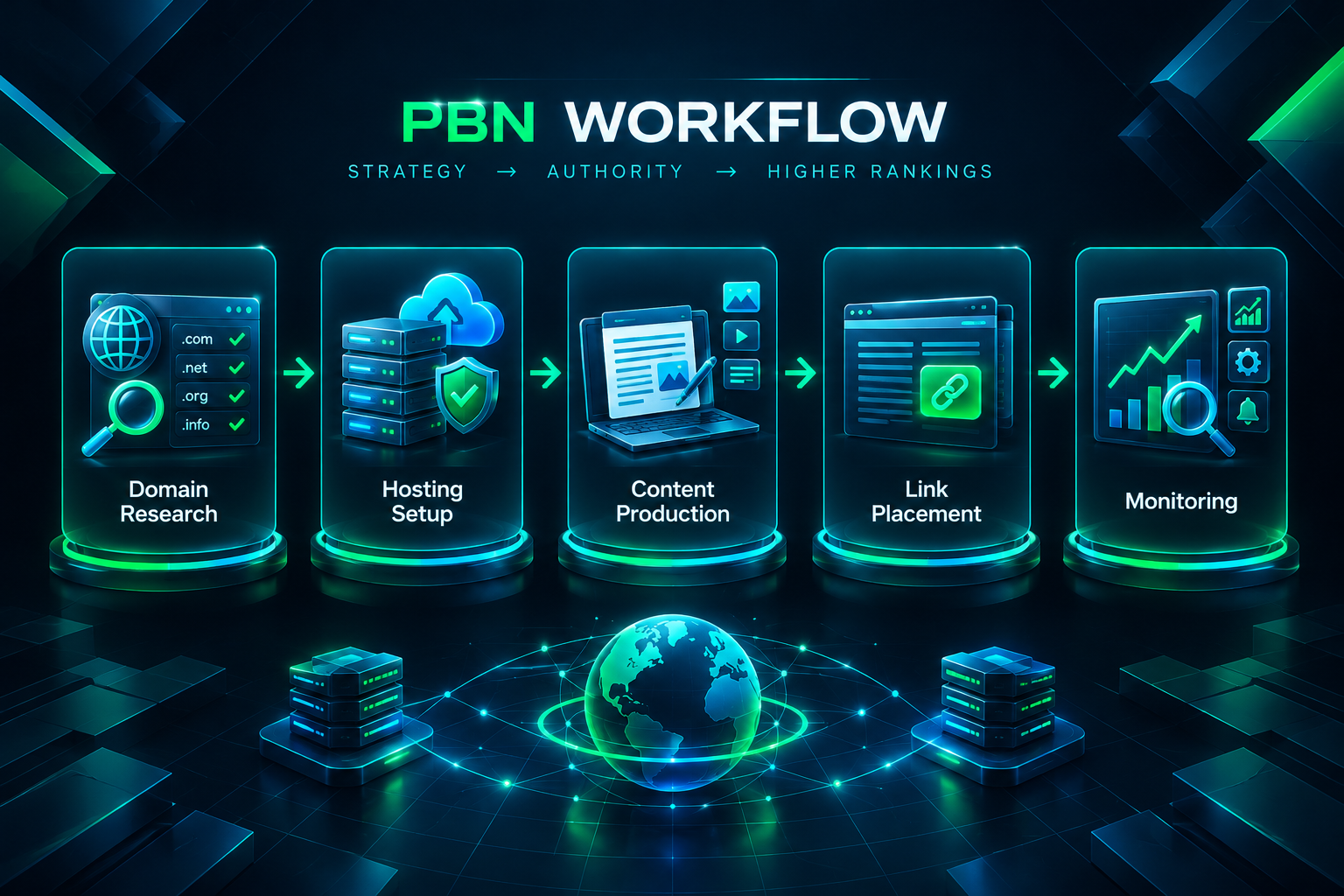
Once you have a complete task list, group related tasks into logical process clusters. Each cluster becomes a separate procedure document. Keeping procedures modular means a team member responsible for content production can read and follow the content procedure without wading through hosting configuration details that are irrelevant to their role.
Core Procedure Documents Every PBN Team Should Maintain
Domain Research and Vetting Procedure
Domain selection is one of the highest-stakes decisions in PBN management, and it is also one of the most variable across team members without written criteria. Your domain vetting procedure should specify which metrics your team uses to evaluate candidate domains, what minimum thresholds apply, and which disqualifying factors automatically remove a domain from consideration. Relevant evaluation factors typically include referring domain count and quality, anchor text distribution, topical relevance to the target niche, archived content history via the Wayback Machine, indexing status, previous spam or manual action history, and trademark considerations.
The procedure should also specify which tools your team uses for each check — for example, whether you use Ahrefs, Majestic, Semrush, or a combination — and how to interpret the outputs. Proprietary metrics such as Domain Rating, Trust Flow, and Domain Authority measure different things and should not be treated as interchangeable. Your procedure should clarify which metric your team prioritizes and why, so that team members are not making inconsistent comparisons across tools.
Include a decision tree or checklist format where possible. A structured checklist is faster to follow under time pressure than a narrative description, and it produces a consistent record that can be reviewed later if a domain’s performance is questioned.
Hosting and Technical Configuration Procedure
Hosting configuration is a technical area where errors are easy to make and difficult to detect without a documented standard. Your hosting procedure should cover how sites in the network are hosted, how IP diversity is managed, which nameserver and DNS configurations are used, how WordPress or other CMS installations are set up, which plugins are installed or avoided, and how site-level settings such as indexing permissions and contact information are configured.
The procedure should also address how hosting accounts are named, billed, and managed. Payment methods, account email addresses, and registrar choices are operational details that affect how the network is administered over time. Documenting these choices creates a reference that prevents inconsistency when new sites are added or when team members change.
Where your team uses tools such as Cloudflare for DNS management or CDN configuration, document the specific settings applied to PBN sites and the rationale for those choices. Avoid documenting settings that are not actually used, as outdated or aspirational documentation creates confusion when team members follow instructions that do not match the live environment.
Content Production and Publishing Standards
Content quality on PBN sites affects both the credibility of the placement and the site’s ability to maintain indexing over time. Your content procedure should define minimum word counts, topical relevance requirements, internal linking expectations, image usage, and the review process before publication. It should also specify what makes content unsuitable — for example, content that is entirely off-topic for the site’s niche, content that is clearly machine-generated without editorial review, or content that duplicates material published elsewhere.
The procedure should address how content is briefed, who writes it, who reviews it, and who publishes it. If your team uses freelance writers, the procedure should include the briefing template and the review criteria so that the person reviewing the content has a consistent standard to apply. Publishing steps should be documented in sequence, including category assignment, metadata, permalink structure, and any post-publication checks such as confirming the article is publicly accessible and not accidentally set to draft or private.
Link Placement and Anchor Text Management
Link placement is the core output of a PBN operation, and it requires its own procedure that covers how placements are requested, how anchor text is selected, how links are inserted into content, and how placements are recorded. Anchor text strategy deserves particular attention in this procedure. Your team should have a documented approach to anchor text variation — including how branded, partial-match, exact-match, and generic anchors are distributed across placements — so that individual team members are not making independent decisions that create an unintended pattern across the network.
The placement procedure should also specify how link targets are selected. Which pages on the target site receive placements, how many placements a single target page receives over a given period, and how placement frequency is managed across the network are all decisions that benefit from written standards. Without documented limits, a team member might place multiple links to the same target page in a short window without realizing that another team member has already done so.
Record-keeping is a critical part of this procedure. Every placement should be logged with the PBN site URL, the target URL, the anchor text used, the date of placement, and the name of the team member who made the placement. This log serves as the primary reference for monitoring, auditing, and managing the network’s link output over time.
Indexing Verification and Monitoring
A link that is not indexed provides no measurable value, so verifying that placements are crawled and indexed is a necessary step in the workflow. Your indexing procedure should specify how and when team members check whether a newly published article has been indexed, which tools or methods are used for that check, and what steps are taken if an article remains unindexed after a defined period.
Ongoing monitoring extends beyond indexing. Your monitoring procedure should cover how the team tracks the health of PBN sites over time — including whether sites remain indexed, whether their backlink profiles change unexpectedly, whether hosting or domain renewals are approaching, and whether any sites show signs of technical problems. Assign clear ownership for monitoring tasks so that checks are not skipped when team members are busy with other work.
Structuring Your Documentation for Team Use
The format of your documentation affects how consistently it is followed. Procedures written as dense narrative paragraphs are harder to follow during active work than procedures structured with numbered steps, decision points, and checklists. For each procedure document, use a consistent template that includes a purpose statement, the scope of the procedure, the roles responsible for each step, the step-by-step process, any decision criteria or thresholds, and a record of the document’s version and last review date.
Store procedures in a shared location that every relevant team member can access. A shared workspace in a tool such as Notion, Confluence, or a well-organized Google Drive folder works for most teams. Avoid storing procedures only in email threads or chat messages, where they are difficult to find and easy to miss when onboarding new contributors.
Use a consistent naming convention for procedure documents so that team members can find the right document quickly. For example, a naming structure such as PBN-OPS-01 Domain Vetting, PBN-OPS-02 Hosting Setup, PBN-OPS-03 Content Standards makes the document set easy to navigate and reference in team communications.
Assigning Roles and Access Control
Documented procedures are most effective when they are paired with clear role assignments. Each procedure should identify which team role is responsible for performing the steps, which role reviews or approves the output, and which role has authority to make exceptions or override a standard decision. Without role clarity, team members may duplicate effort, skip steps they assume someone else will handle, or make decisions outside their area of responsibility.
Access control is a related consideration. Not every team member needs access to every part of the network’s infrastructure. Limiting access to hosting accounts, domain registrar credentials, and link placement logs to the team members who actually need them reduces the risk of accidental changes and simplifies accountability. Your documentation should record which roles have access to which systems, and that record should be updated whenever team membership or responsibilities change.
Version Control and Keeping Procedures Current
A procedure document that is written once and never updated becomes inaccurate as tools change, team practices evolve, and network requirements shift. Build a review cycle into your documentation system from the start. A quarterly review of each procedure is a reasonable starting point for most teams; high-frequency processes or those tied to external tools that change often may need more frequent review.
Each procedure document should include a version number and a change log that records what was changed, when, and by whom. This history is useful when diagnosing network issues — if a problem emerged after a procedure was updated, the change log helps identify whether the update may have contributed to the issue. It also creates accountability for procedure changes, which discourages informal modifications that bypass the team’s agreed standards.
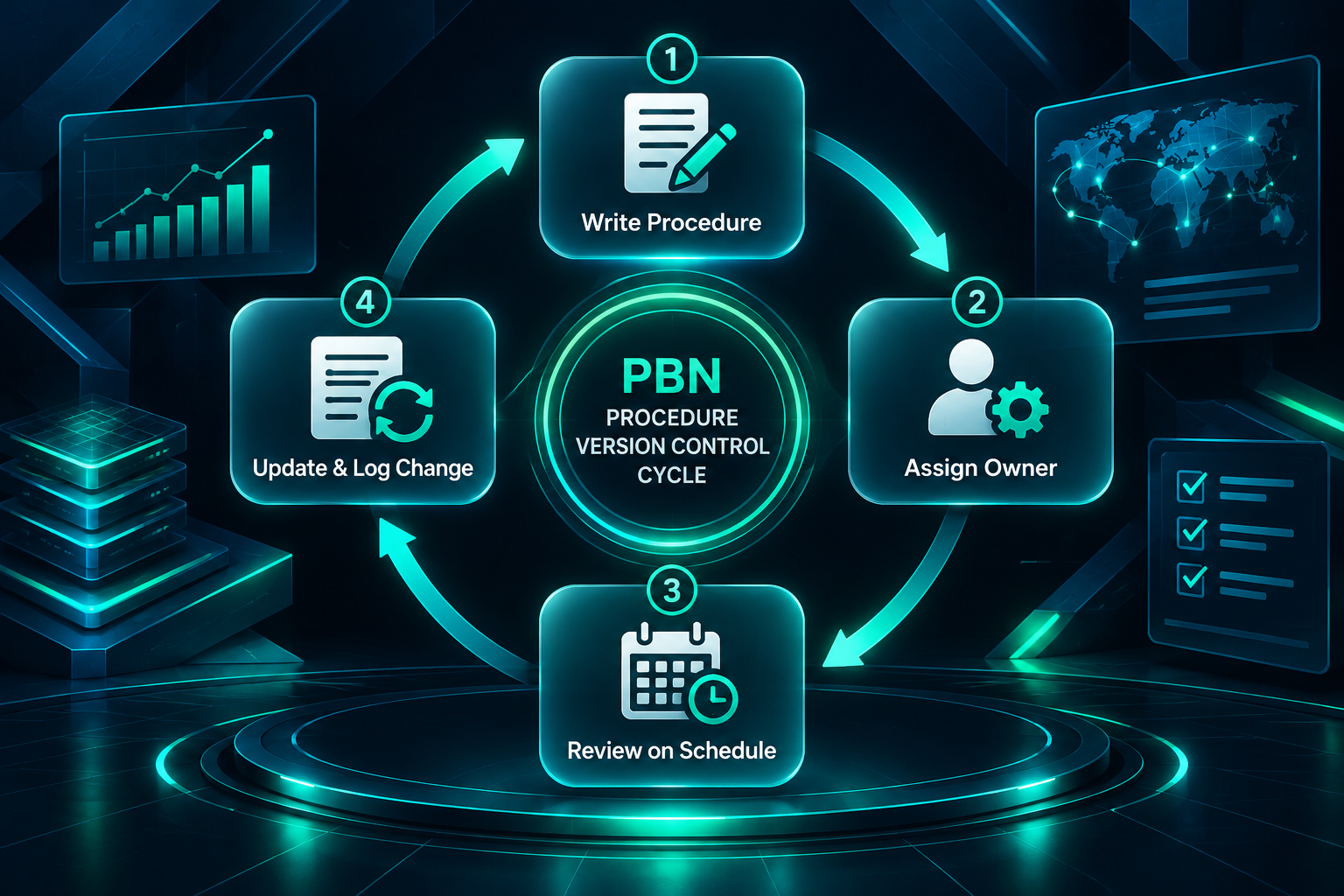
When a tool your team relies on changes its interface, pricing, or data outputs, update the relevant procedure promptly. Outdated tool instructions are a common source of confusion for team members who follow the documented steps and find that the tool no longer behaves as described. Assign a specific role the responsibility for monitoring tool changes and triggering procedure updates when necessary.
Onboarding New Team Members Using Documented Procedures
Documented procedures have a direct practical benefit during onboarding. A new team member who can read a complete, accurate procedure for their assigned tasks can become productive faster and with less supervision than one who relies entirely on verbal instruction or observation. Structure your onboarding process around the procedure documents relevant to the new team member’s role, and include a review step where the new member completes a task and a senior team member checks the output against the documented standard before the new member works independently.
Onboarding also surfaces gaps in existing documentation. When a new team member asks a question that is not answered by the current procedure, that question identifies a gap that should be addressed in the next procedure update. Treat onboarding feedback as a quality input for your documentation rather than a distraction from it.
Common Documentation Mistakes PBN Teams Make
Several documentation errors are common in PBN team environments and worth addressing directly. Writing procedures at too high a level of abstraction is one of the most frequent problems — a procedure that says “select a quality domain” without defining what quality means in measurable terms gives team members no useful guidance. Every decision point in a procedure should have a defined criterion, not a vague instruction to use good judgment.
Another common mistake is documenting the ideal process rather than the actual process. If your team’s real workflow differs from what the procedure describes, team members will follow the real workflow and ignore the document. Procedures should reflect how work is actually done, with improvements introduced deliberately rather than assumed.
Failing to assign ownership for procedure maintenance is a third common error. If no one is specifically responsible for keeping a procedure current, it will drift out of date as the team’s practices evolve. Assign each procedure a named owner whose responsibilities include keeping it accurate and initiating reviews on schedule.
Frequently Asked Questions
How detailed should a PBN operating procedure be?
A procedure should be detailed enough that a competent team member with no prior experience of that specific task can follow it correctly without asking for clarification. If a step requires a judgment call, the procedure should define the criteria for making that judgment. Procedures that are too brief leave too much to individual interpretation; procedures that are excessively long are rarely read in full. Aim for clarity and completeness over length.
Should procedures cover every PBN site individually or apply network-wide?
Most procedures should apply network-wide, with site-specific exceptions documented as addenda or notes within the relevant procedure. If a particular site in the network has a different niche, hosting arrangement, or content standard, note that exception clearly rather than creating an entirely separate procedure set. Network-wide standards make the documentation manageable; site-specific notes handle legitimate variation.
How should a team handle a situation where the documented procedure does not cover an edge case?
Designate a decision authority — typically a senior team member or network manager — who can make a judgment call for edge cases. Document the decision and the reasoning, then review whether the procedure should be updated to cover similar situations in the future. Ad hoc decisions that are never recorded create undocumented precedents that other team members cannot access.
What is the best format for a PBN link placement log?
A spreadsheet or database table works well for most teams. At minimum, each row should record the PBN site URL, the target URL, the anchor text used, the date of placement, and the team member responsible. Additional columns for indexing status, last verified date, and any notes about the placement make the log more useful for monitoring and auditing. Keep the log in a shared location with access limited to team members who need it.
How often should PBN operating procedures be reviewed?
A quarterly review cycle is a reasonable baseline for most procedures. Procedures tied to external tools or platforms that change frequently may need review more often. Any significant change to the network’s strategy, toolset, or team structure should trigger an immediate review of the affected procedures rather than waiting for the scheduled cycle.
Can documented procedures help when diagnosing a network performance issue?
Yes. When a site in the network underperforms or shows unexpected behavior, the procedure documents and placement logs provide a reference for what was done and when. A change log that records procedure updates can help identify whether a change in practice coincided with a change in performance. Without documentation, diagnosing the cause of a network issue relies entirely on team members’ recollections, which are less reliable and harder to verify.
Building Procedures That Grow With Your Network
Documented PBN operating procedures are not a one-time project — they are a living system that should grow and improve alongside the network itself. The teams that maintain the most consistent network quality over time are typically those that treat documentation as an operational asset rather than an administrative burden. Starting with the highest-stakes processes — domain vetting, link placement, and content standards — and building outward from there gives your team a practical foundation without requiring a complete documentation overhaul before any work can begin.
If your team is building or scaling a PBN operation and wants to discuss how placement quality, domain selection criteria, and network management practices fit together, PBN Backlinks Service can help you assess your current approach and identify where structured processes may strengthen your results. Reaching out to review your backlink requirements or placement strategy is a practical starting point for teams at any stage of network development.