

Key Takeaways
- Evaluating an expired domain for PBN use requires checking multiple metrics in combination — no single score is sufficient on its own.
- Backlink profile vetting, anchor text distribution analysis, and domain drop history are among the most commonly overlooked steps.
- A Wayback Machine snapshot review and spam score threshold check can immediately disqualify domains that would otherwise look attractive on paper.
- Topical relevance between the expired domain and your money site significantly affects the value of the inherited authority you receive.
- Google’s evolving spam detection systems mean the bar for what constitutes a safe, usable domain has risen considerably since 2022.
Why Domain Evaluation Matters Before You Buy
An expired domain carries its entire history with it — good and bad. When you build on or redirect from a domain that has a toxic link profile, a prior manual action, or a history of PBN use, you risk importing those problems directly into your own SEO strategy. The purpose of a thorough evaluation process is to confirm that the link equity you expect to inherit is genuine, sustainable, and unlikely to trigger a manual or algorithmic penalty down the line.
Skipping or rushing evaluation is the most common reason PBN investments underperform. A domain that scores well on Domain Authority alone might have an anchor text distribution full of exact-match anchor text from a previous operator’s aggressive campaign, or a backlink profile consisting almost entirely of low-quality directory spam. Neither situation transfers useful ranking power to your money site. A structured evaluation checklist applied before every purchase is the only reliable way to filter out these risks at scale.
Understanding the Core Metrics: What Each Score Actually Measures
Several third-party metrics are used in expired domain evaluation, and each measures something slightly different. Relying on only one creates blind spots.
| Metric | Source Tool | What It Measures | Suggested Minimum |
|---|---|---|---|
| Domain Authority (DA) | Moz | Predicted ranking strength based on link profile | DA ≥ 20 |
| Domain Rating (DR) | Ahrefs | Strength of the referring domain backlink profile | DR ≥ 20 |
| Trust Flow (TF) | Majestic | Link quality relative to trusted seed sites | TF ≥ 12 |
| Citation Flow (CF) | Majestic | Volume of links pointing to the domain | Ratio TF:CF ≥ 0.5 |
| Spam Score | Moz | Probability of penalisation based on link signals | Spam Score < 3% |
| Referring Domains | Ahrefs / Majestic | Number of unique domains linking in | ≥ 20–30 quality RDs |
The Trust Flow to Citation Flow ratio is particularly diagnostic. A high Citation Flow paired with a low Trust Flow typically indicates a domain that has accumulated a large volume of low-quality or spammy links — exactly the pattern that can attract algorithmic scrutiny. A Trust Flow to Citation Flow ratio below 0.4 is generally a warning sign worth investigating further before proceeding.
Domain Rating and Domain Authority both reflect link profile strength, but they are calculated differently and can diverge significantly for the same domain. Cross-referencing both gives a more reliable picture than trusting either in isolation. If a domain scores DA 35 but DR 8, that discrepancy warrants closer examination of the actual referring domain count and the quality of those links.
Step 1 — Check Domain History Using the Wayback Machine
Before spending time on any other metric, pull a Wayback Machine snapshot for the domain. The Internet Archive records how a site looked and what content it hosted across different periods. This single step can immediately disqualify a domain that would otherwise look attractive on paper.
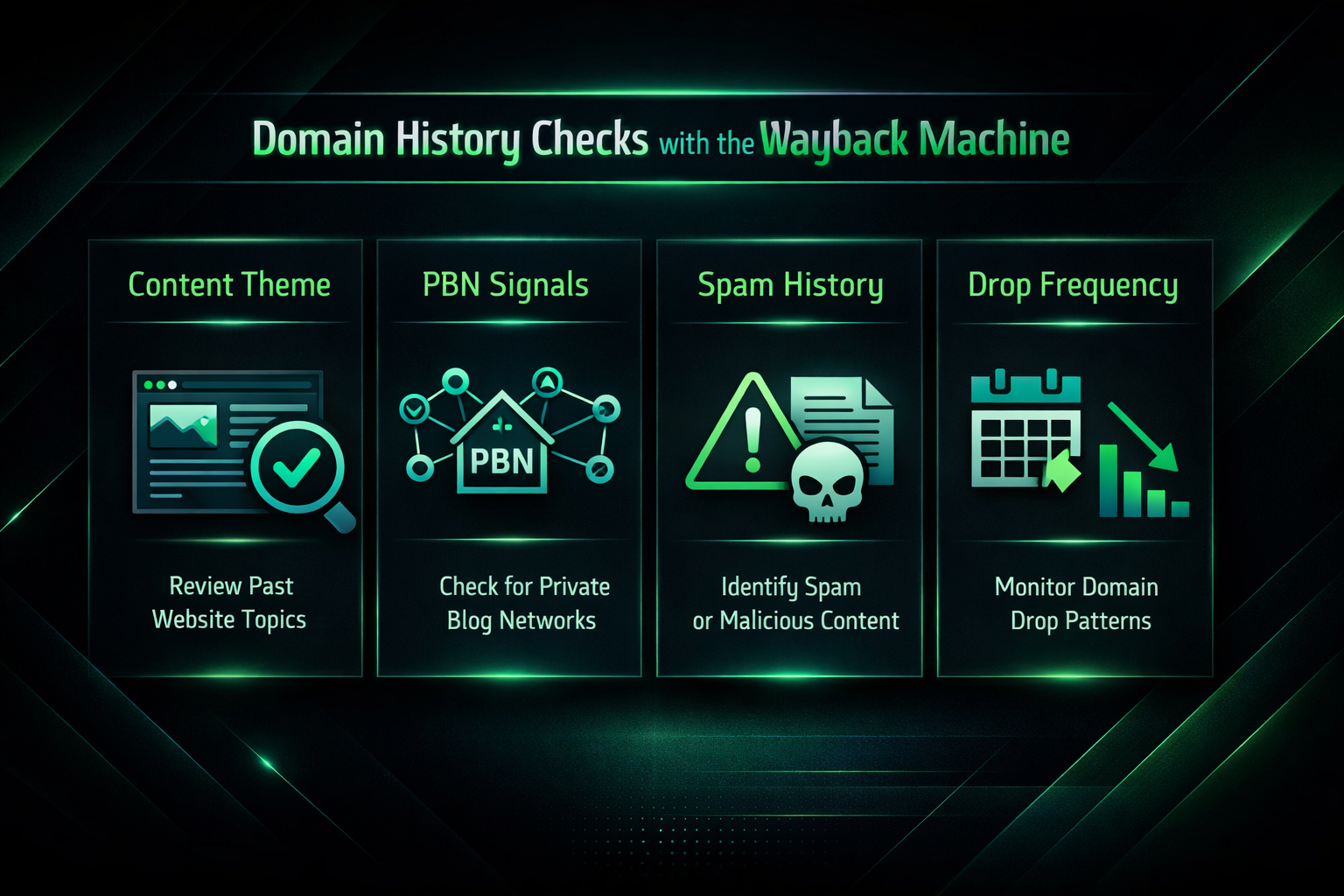
When reviewing Wayback Machine snapshot data, look for the following signals:
- Content theme consistency: Was the site always about the same general topic? Domains that repeatedly switched niches are harder to establish topical authority with and may have accumulated links from several unrelated industries.
- Signs of prior PBN use: Thin content, keyword-stuffed posts, unusual internal linking patterns, or a template-style layout used across hundreds of pages are common indicators that a domain was previously operated as part of a private blog network.
- Spam or adult content: A domain that previously hosted adult, pharmaceutical, gambling, or other high-risk content categories is likely to carry residual associations that affect how crawlers treat it.
- Domain drop frequency: Cross-reference the archive activity with drop history data from tools like ExpiredDomains.net. A domain age signal is only meaningful if the domain was actively maintained. A domain that has dropped and been re-registered multiple times — particularly more than three times in ten years — loses much of the authority value that accumulated during earlier ownership periods.
Domain drop history is a frequently overlooked step. Each time a domain expires and drops, it risks losing a portion of the accumulated authority that made it valuable in the first place. Fewer drops generally mean cleaner, more continuous authority inheritance.
Step 2 — Backlink Profile Vetting in Detail
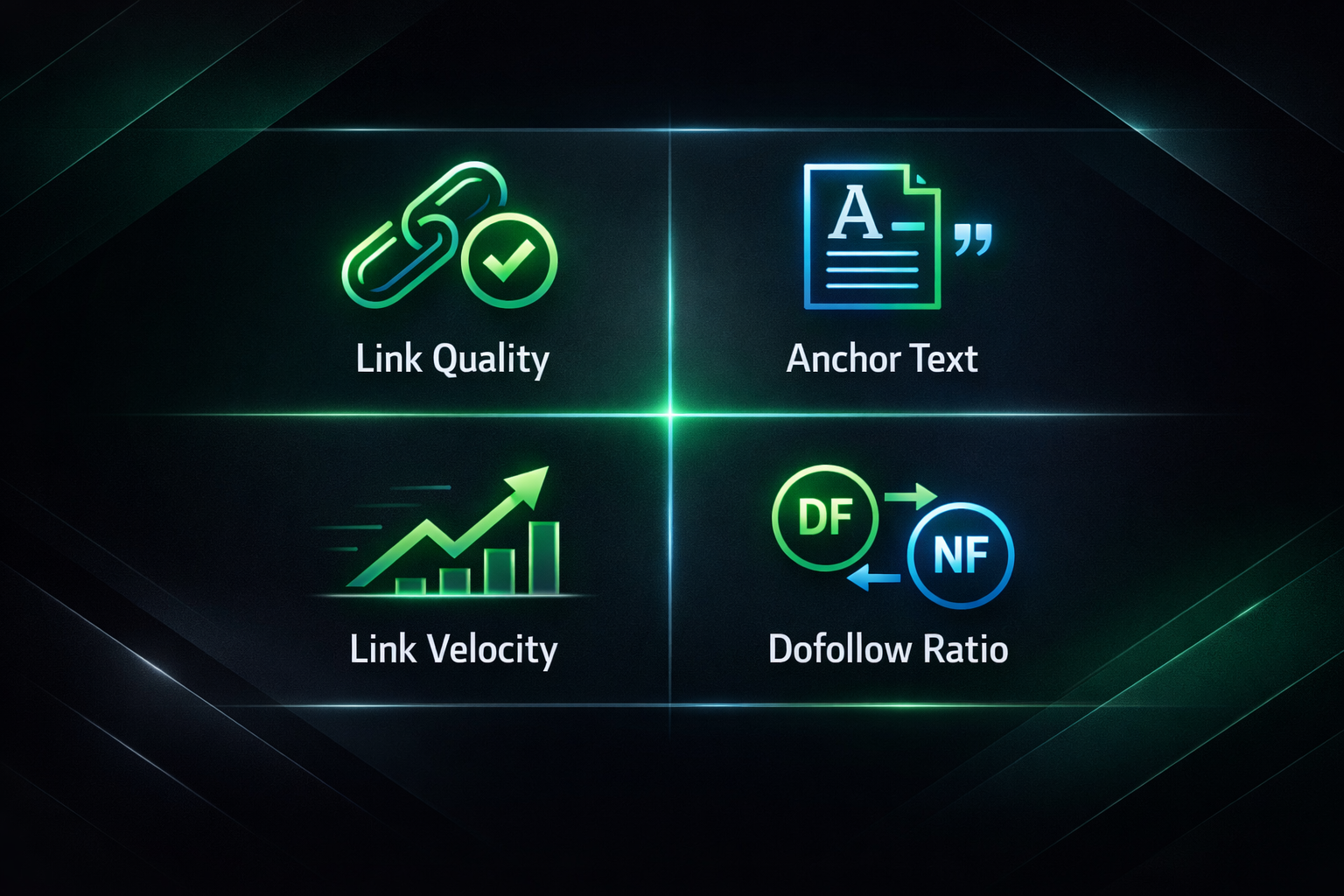
Backlink profile vetting is the most time-intensive part of evaluation, but it is also where the greatest risks and opportunities are identified. Pull the full backlink report from Ahrefs or Majestic and examine it across four dimensions.
Link Quality and Source Diversity
High-quality expired domains accumulate links from editorial sources — news sites, industry publications, genuine blogs in the same niche, academic or government resources. A backlink profile consisting primarily of low-quality web directories, link exchanges, or foreign-language sites with no obvious thematic connection is a warning sign regardless of what the aggregate DA or DR score says. Check the spread of link types: a healthy profile typically includes a mix of editorial links, directory citations, social mentions, and some forum or community references, with editorial links representing the most valuable portion.
Anchor Text Distribution
Anchor text distribution is one of the clearest indicators of whether a previous site owner engaged in manipulative link building. A natural anchor text profile will show a mix of branded anchors, generic phrases such as “click here” or “visit this page”, partial-match terms, and a relatively small proportion of exact-match anchor text targeting commercial keywords. When you see a profile where 40–60% of anchors are exact-match commercial phrases — for instance, “best cheap running shoes” appearing identically across dozens of links — that pattern almost always reflects aggressive link building that increases the risk of an inherited Penguin-era or manual penalty. Prioritise domains where exact-match anchor text represents a modest fraction of the total anchor distribution.
Link Velocity and Spike Patterns
Examine how the backlink count changed over time. A domain that accumulated 200 referring domains in a single month several years ago and has had almost no new links since is exhibiting a link velocity spike pattern consistent with a link scheme. Natural link growth is more gradual and varied. Sudden spikes followed by long stagnation periods should prompt further investigation into what triggered that growth.
Dofollow vs. Nofollow Ratio
The dofollow vs. nofollow ratio matters because only dofollow links pass link equity. A referring domain count of 80 sounds meaningful until you discover that 70 of those domains are linking with nofollow attributes — a common pattern with low-quality directory submissions. Filter the backlink report to dofollow links only and re-assess the referring domain count on that basis before drawing conclusions about the domain’s actual value.
Step 3 — Check for Manual Actions and Penalty History
A domain that has received a manual action from Google is one of the clearest disqualifying signals in expired domain evaluation. Manual actions are issued by human reviewers at Google and can remain attached to a domain even after ownership changes. Unlike algorithmic adjustments, a manual penalty is documented and specific — and recovery from one requires a formal reconsideration request that the new owner would be responsible for submitting.
You cannot directly access a previous owner’s Google Search Console history, but you can look for indirect signals. A sudden, sharp drop in organic traffic visible in Ahrefs or SEMrush historical data — particularly one that aligns with a known Google algorithm update or the timing of Penguin releases — is a strong indicator of a penalty event. Similarly, if the domain appears deindexed (not appearing in Google search results for its own name or former branded terms), that is an immediate disqualifying signal. Before finalising any acquisition, check whether the domain is currently indexed by searching site:domain.com in Google. A deindexed domain should be disqualified unless you have a specific reason to believe the index status is recoverable.
Step 4 — Assess Niche Relevance and Topical Authority
Niche relevance is not just a nice-to-have — it directly determines how much of the domain’s inherited authority transfers meaningfully to your money site. A niche-aligned domain that operated in the same general category as your target site will carry topical signals that reinforce the thematic relevance of any links it subsequently passes. A domain from an unrelated industry passes some general link equity but loses the topical authority component, which is increasingly important under modern ranking systems.
Evaluate niche relevance at two levels. First, assess the overall content theme of the expired domain’s previous incarnation using the Wayback Machine snapshot review you completed in Step 1. Second, examine the topics covered by the domains in its backlink profile. If a domain about cycling equipment has earned links primarily from fitness blogs, sports news sites, and outdoor activity forums, those contextual signals remain even after the content changes — and they reinforce the topical alignment for any money site operating in an adjacent space.
Where exact niche alignment is not available, consider broad category alignment. A domain previously covering health and wellness in general may still be a reasonable fit for a site targeting a specific health subcategory, even if it is not a perfect match. The key question is whether the topical context of both the domain and its linking sources supports the subject matter of your money site.
Step 5 — Evaluate PBN Footprint Risk
PBN footprint risk refers to patterns that could allow search engines to identify a network of sites as being under coordinated ownership and control. While footprint management is partly an operational consideration that comes after acquisition, the domains you choose significantly influence your exposure.
When evaluating a candidate domain with footprint risk in mind, consider the following factors:
- TLD diversity: Operating exclusively within .com or .net TLDs creates a more homogeneous network footprint than incorporating a spread of country-code and alternative TLDs where they make contextual sense.
- Prior PBN associations: If a domain’s backlink profile shows links from other expired or thin-content domains that are themselves interlinked, that is a signal the domain may have already been part of a network. Tools like Majestic can help identify clustering patterns among referring domains.
- WHOIS history: Check historical WHOIS records where available. A domain that cycled through multiple privacy registrations within short periods may have been passed between PBN operators.
- Hosting and registration patterns: Domains registered with the same registrar and hosted on similar IP blocks as other sites in your network create exploitable footprint signals.
Reducing PBN footprint is a long-term operational discipline, but starting with domains that have clean, distinct histories makes that discipline considerably easier to maintain.
Step 6 — Run a Spam and Blacklist Check
Before finalising any domain, run it through a spam score threshold check using at least two tools. Moz’s Spam Score and Majestic’s Trust Flow provide complementary views — high Moz Spam Score combined with low Trust Flow is one of the clearest composite danger signals available. Additionally, check whether the domain appears on any major email or malware blacklists using services like MXToolbox or Google Safe Browsing. Domains previously used for phishing, malware distribution, or spam email campaigns can carry blacklist associations that affect crawlability and user trust signals independently of their link profiles.
A spam score threshold of under 3% on the Moz scale is a commonly cited conservative benchmark. Domains scoring between 3–7% may still be usable if the backlink audit reveals the score is driven by a small number of identifiable spammy links rather than a systemic problem, but anything above 7–8% generally warrants either disqualification or extensive further investigation before proceeding.
Expiring vs. Expired Domains: Which Should You Target?
The distinction between expiring and expired domains affects both the acquisition process and the likelihood of securing quality assets. An expiring domain is one that has lapsed but has not yet completed the full deletion cycle — it may still be in a grace or redemption period. Domains in this stage are often available through auctions on platforms like GoDaddy Auctions, NameBright, or Name.com, and because they have not yet fully dropped, their backlink profiles and indexed content are more likely to remain intact in third-party tool databases.
A fully expired or dropped domain has completed the deletion cycle and become available for open registration. These are often cheaper to acquire but carry greater uncertainty — the gap between the last ownership period and the current data in tools like Ahrefs may mean you are evaluating a historic snapshot rather than the domain’s current state. For higher-value acquisitions where metric integrity matters most, targeting domains through auction before they fully drop is generally the more reliable path, albeit a more competitive and often more expensive one.
Building an Evaluation Checklist and Scoring Template
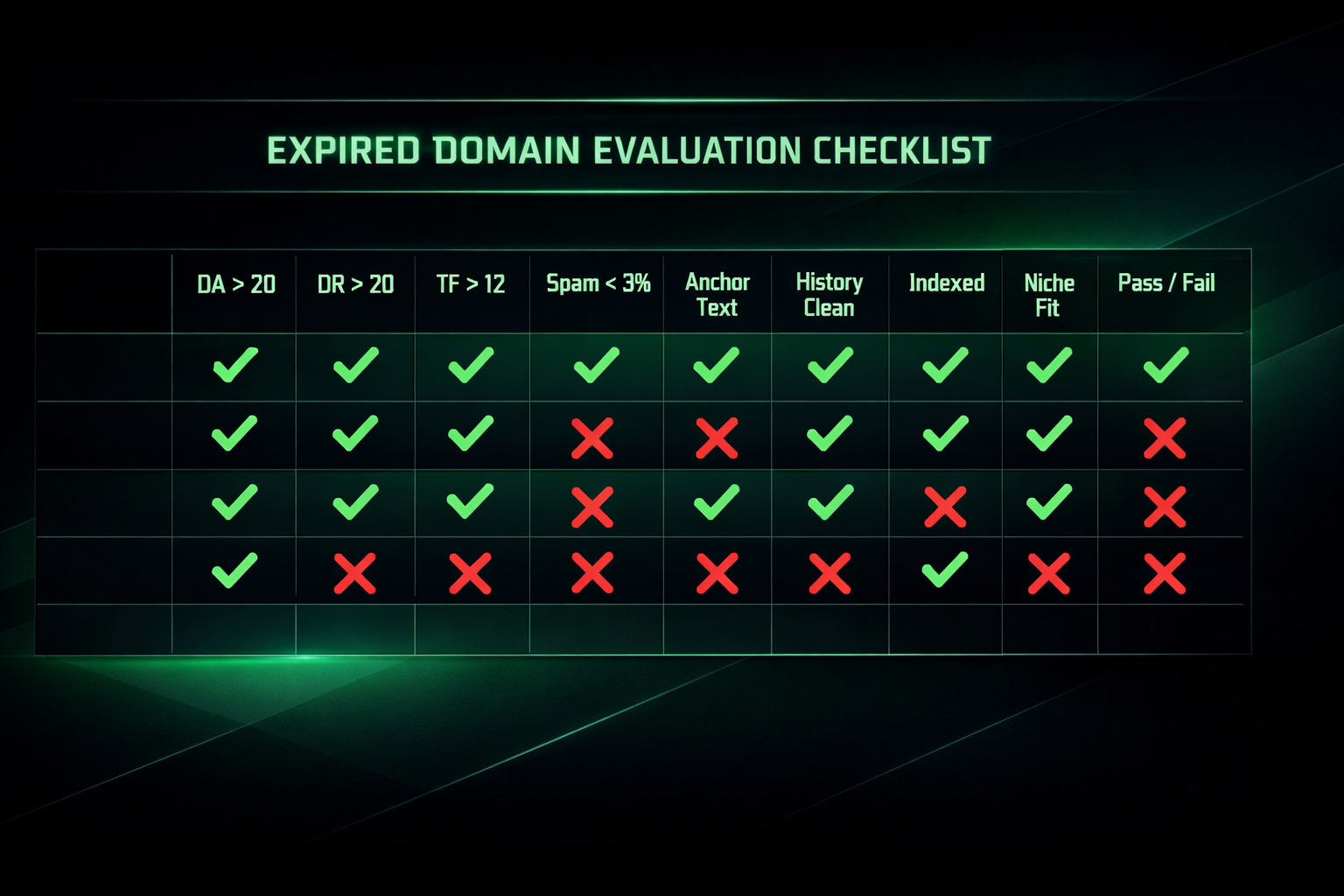
A consistent evaluation checklist is essential when assessing multiple domains efficiently. The following framework can be adapted into a spreadsheet for batch evaluation.
- Domain name and TLD
- Domain age (registration date to expiry)
- Domain drop history (number of drops, dates)
- DA score (Moz) — pass threshold: ≥ 20
- DR score (Ahrefs) — pass threshold: ≥ 20
- Trust Flow (Majestic) — pass threshold: ≥ 12
- Trust Flow to Citation Flow ratio — pass threshold: ≥ 0.5
- Referring domain count (dofollow only) — pass threshold: ≥ 20 quality RDs
- Spam score threshold check — pass threshold: < 3%
- Anchor text distribution — flag if exact-match anchors exceed 25–30% of total
- Wayback Machine snapshot review — content theme consistent? Prior PBN signals?
- Manual action / deindexation check — site: search returns results?
- Blacklist check — clean on MXToolbox and Google Safe Browsing?
- Niche relevance rating — strong / partial / weak alignment with money site
- PBN footprint risk rating — low / medium / high
- Overall pass / conditional / fail decision
Scoring each domain against this checklist before purchase creates an auditable record and prevents gut-feel decisions from overriding objective criteria. Domains that pass all core thresholds but show one amber flag — such as a slightly elevated spam score explained by a handful of identifiable low-quality links — can be reconsidered on a case-by-case basis. Domains with multiple red flags should generally be disqualified regardless of how attractive their headline DA or DR score appears.
Tools to Use in Your Evaluation Workflow
No single tool covers every dimension of expired domain evaluation. A practical workflow combines tools at different stages.
- Ahrefs: Primary tool for DR, referring domain count, backlink profile export, traffic history, and link velocity analysis. Its historical index is one of the most comprehensive available.
- Majestic: Primary tool for Trust Flow, Citation Flow, and the Trust Flow to Citation Flow ratio. Topical Trust Flow breakdown adds useful niche relevance context.
- Moz: Useful for Domain Authority and spam score. Best used alongside Ahrefs and Majestic rather than as a standalone assessment.
- SpamZilla: Purpose-built for expired domain filtering. Allows bulk filtering by DA, DR, TF, spam score, and niche category, significantly reducing the time spent on initial screening.
- DomCop: Aggregates data from multiple sources and allows advanced filtering of auction and dropped domains. Particularly useful for identifying expiring vs. expired domain opportunities in bulk.
- Wayback Machine (archive.org): Free and irreplaceable for domain history review. Always check this manually for shortlisted domains rather than relying on automated summaries.
- ExpiredDomains.net: Useful for drop history data and initial discovery, though metric data should be cross-referenced with Ahrefs and Majestic before any decision is made.
Frequently Asked Questions
How many referring domains does an expired domain need to be worth using in a PBN?
There is no universal number, but a common practical benchmark is at least 20–30 quality dofollow referring domains. The emphasis is on quality — 25 editorial links from genuine niche-relevant sources will generally outperform 150 directory or forum links in terms of the link equity they pass to your money site.
Can I use a domain that was previously part of a PBN?
It is possible, but requires careful judgement. If the prior PBN use was limited, the content history looks reasonable in Wayback Machine snapshots, the backlink profile is clean, and the domain is not deindexed, it may still be viable. However, the risk level is meaningfully higher than with a domain that has no prior network associations. Many experienced operators choose to disqualify these domains as a default rule.
Does the age of an expired domain affect its value?
Domain age signal does play a role, though its direct ranking impact is debated. An older domain with a long, consistent history in one niche is generally preferable to a younger one. More practically, older domains tend to have had more time to accumulate natural editorial links, which is the genuinely valuable component of the domain age signal.
What is the difference between a manual action and an algorithmic penalty?
A manual action is applied by a Google reviewer and is recorded in Google Search Console. It must be resolved through a formal reconsideration request. An algorithmic penalty — such as one triggered by Penguin — is applied automatically when a domain’s link profile matches patterns associated with link manipulation. Both can cause significant ranking suppression, but a manual penalty is generally more severe and more difficult to recover from.
Should I prioritise Trust Flow or Domain Authority when evaluating a domain?
Both metrics provide useful but different perspectives. Trust Flow measures link quality relative to Majestic’s trusted seed sites and is generally considered a more reliable indicator of genuine link quality. Domain Authority is a predictive score based on Moz’s modelling and can be more susceptible to manipulation. Most experienced evaluators treat Trust Flow as the primary quality indicator and use Domain Authority as a supporting reference rather than a lead metric.
How do algorithm updates affect expired domain evaluation criteria?
Google’s spam detection has grown considerably more sophisticated. SpamBrain, Google’s AI-based spam detection system, has become increasingly effective at identifying link schemes and thin content patterns. This means domains that would have been considered safe acquisitions under older evaluation standards may now carry higher risk if their link profiles or content histories include patterns that modern spam classifiers flag. Evaluating domains against current standards — not those from two or three years ago — is essential for managing this risk appropriately.
Deciding Whether an Expired Domain Is Worth Acquiring
The decision to acquire an expired domain for PBN use ultimately comes down to whether the inherited authority is genuine, the history is clean enough to avoid importing penalties, the topical relevance supports your money site’s niche, and the acquisition cost is proportionate to the realistic link value the domain will provide.
A domain that passes all core metric thresholds, shows a clean Wayback Machine snapshot history, carries a natural anchor text distribution, has no deindexation or manual action signals, and offers reasonable niche alignment to your target site represents the kind of asset worth serious consideration. A domain that ticks only two or three of these boxes — regardless of how impressive its headline DA or DR appears — is a risk rather than an investment.
Treating every expired domain acquisition as a multi-step due diligence process, using the evaluation checklist consistently, and cross-referencing at least two independent tools before any purchase decision will significantly improve the quality of your PBN over time. The domains that pass rigorous evaluation are fewer, but the link equity they contribute is considerably more durable and defensible than that from domains acquired on the basis of surface metrics alone.