

A PBN domain with no organic traffic is not automatically a poor choice for a private blog network. Organic traffic is one signal among many, and for most PBN use cases the absence of current visitors tells you very little about the domain’s link equity, historical authority, or suitability as a network asset. What matters is a structured evaluation of the domain’s history, backlink profile, topical relevance, and indexing status — factors that determine whether the domain can pass meaningful link value to your target pages.
Key Takeaways
- Organic traffic is not a reliable standalone indicator of PBN domain quality; a domain can carry strong link equity with zero current visitors.
- Domain history, referring domain quality, topical relevance, and indexing status are the primary evaluation criteria for a PBN domain with no organic traffic.
- Backlink profile analysis using tools such as Ahrefs, Majestic, or Semrush should focus on referring domain quality and anchor text distribution, not raw link counts or proprietary authority scores alone.
- Archived content, previous ownership patterns, and any history of spam or manual actions are critical checks before acquiring a domain for a private blog network.
- A domain that passes all quality checks may still require careful content development and contextual placement to deliver useful link value to target pages.
Why Organic Traffic Is Not the Right Starting Point
When evaluating a domain for a private blog network, many buyers instinctively filter by organic traffic first. This approach misunderstands what a PBN domain is actually being acquired for. A PBN domain is not being purchased to generate its own audience — it is being acquired for the link equity embedded in its backlink profile and the authority signals associated with its history. A domain that previously operated as a niche resource, a regional business site, or an industry directory may have accumulated strong referring domains over years of legitimate operation, then lost all organic traffic simply because the site was abandoned, the content was removed, or the domain expired.
The absence of organic traffic on an expired or aged domain is almost always explained by one of a few straightforward reasons: the site is no longer publishing content, the domain has lapsed and is no longer resolving, or the previous owner stopped maintaining the site before it expired. None of these reasons automatically reduce the link equity that referring domains have already passed to the URL. What matters is whether those referring domains are still linking, whether the links are indexed, and whether the referring domains themselves are credible sources rather than low-quality directories or link farms.
Relying on organic traffic as a proxy for domain quality also introduces a selection bias problem. Domains with active organic traffic are typically still in use, meaning they are rarely available for acquisition at reasonable prices. The most accessible expired and aged domains for PBN use will almost always show little or no current traffic, which makes traffic-based filtering an impractical primary criterion for this asset class.
Domain History: The Foundation of Any Evaluation
Before examining any third-party metrics, the first step in evaluating a PBN domain with no organic traffic is to reconstruct its history. The Wayback Machine (web.archive.org) provides archived snapshots that reveal what the site published, how consistently it was maintained, and whether the content was topically coherent over time. A domain that operated as a genuine resource in a specific niche — publishing original articles, product information, or industry commentary — is a meaningfully different asset from a domain that was previously used as a link farm, a parked page, or a thin affiliate site.
Look for consistency between the domain name, the archived content, and the niche you intend to target. A domain with a history in home improvement, finance, or health that you plan to use for a site in the same vertical carries more topical relevance than a domain whose archived content has no relationship to your target niche. Topical relevance between the PBN domain and the target site is a quality factor that affects how naturally the eventual link placement fits within the content context.
Also check the domain’s ownership history using WHOIS records where available. Frequent ownership changes, particularly in short succession, can indicate that a domain has been cycled through multiple PBN operators or repurposed repeatedly. This pattern does not automatically disqualify a domain, but it warrants closer inspection of the backlink profile to identify whether the link profile reflects genuine historical authority or accumulated manipulation.
Check whether the domain has any trademark conflicts or brand associations that could create legal or reputational complications. A domain that previously belonged to a recognizable brand may carry residual authority signals, but it also carries risks that are unrelated to SEO quality.
Backlink Profile Analysis: What to Look For
The backlink profile is the core of any PBN domain evaluation. Use a tool such as Ahrefs, Majestic, or Semrush to pull the full referring domain list and examine it systematically. The goal is not to find a domain with the highest Domain Rating or Trust Flow score — proprietary authority metrics are useful as a starting point but should not be treated as Google ranking scores or guarantees of link value. The goal is to understand the quality and composition of the links that have historically pointed to the domain.
Referring Domain Quality
Examine the referring domains individually rather than relying solely on aggregate metrics. A domain with 40 referring domains from credible industry publications, regional news sites, and established niche resources is generally a stronger PBN candidate than a domain with 400 referring domains from low-quality directories, comment spam, or unrelated foreign-language sites. Look for referring domains that have their own organic presence, publish real content, and operate in a recognizable niche. The presence of a few high-authority editorial links from credible sources is a positive signal; a backlink profile dominated by footer links, sitewide links, or links from sites with no discernible content is a warning sign regardless of what the aggregate metric shows.
Anchor Text Distribution
Review the anchor text distribution across the domain’s inbound links. A natural anchor text profile for a legitimate site will typically show a mix of branded anchors, URL anchors, generic anchors such as “click here” or “read more”, and a smaller proportion of keyword-rich anchors. A backlink profile where the majority of anchors are exact-match commercial keywords suggests the domain was previously used in an aggressive link-building campaign, which may have already attracted algorithmic scrutiny. This does not automatically disqualify the domain, but it is a factor to weigh against the quality of the referring domains themselves.
Link Loss and Profile Stability
Check the historical link acquisition pattern using the referring domains graph in your chosen tool. A domain that accumulated links gradually over several years and has retained most of them shows a stable, naturally developed profile. A domain that shows a sudden spike in referring domains followed by a sharp decline may have been the subject of a link-building campaign that was subsequently devalued or removed. Significant link loss after a specific date can sometimes correlate with a Google algorithm update or a manual action, though this correlation requires careful interpretation and should not be treated as definitive evidence of a penalty without additional investigation.
Indexing Status of Referring Domains
Verify that the referring domains themselves are indexed in Google. A referring domain that has been deindexed or that no longer resolves provides no active link value regardless of what the backlink tool reports. Spot-check a sample of the most important referring domains by searching for them directly in Google using the site: operator. This step is often skipped but can reveal that a significant portion of a domain’s reported link profile comes from sources that are no longer active or indexed.
Checking the Domain’s Own Indexing History
A PBN domain with no organic traffic may or may not be currently indexed in Google. Check whether the domain itself is indexed by running a site: search in Google. If the domain is not resolving — because it has expired and not yet been re-registered — it will not be indexed, which is expected. If the domain is resolving but shows no indexed pages, this warrants investigation. A domain that was previously indexed and has since been removed from Google’s index may have experienced a manual action or a deindexation event, which would significantly affect its value as a PBN asset.
Use Google Search Console if you have access to the domain after acquisition to check for any manual actions in the Security and Manual Actions report. For domains being evaluated before purchase, the absence of Search Console access means you are working with indirect signals: the Wayback Machine history, the backlink profile pattern, and any observable indexing behavior. If a domain’s archived content appears clean and its backlink profile looks natural but it is not indexed, the most likely explanation is simply that the domain expired and Google dropped it from the index — a recoverable situation once the domain is re-registered and content is published.
Topical Relevance and Niche Alignment
Topical relevance between a PBN domain and the target site it will link to is a meaningful quality consideration. A domain with a history in the legal services niche linking to a personal injury law firm’s target page fits more naturally than a domain with a history in automotive content linking to the same legal page. Search engines have developed increasingly sophisticated methods for understanding the thematic context of a page and its inbound links, which means that topical alignment between the PBN domain’s content history and the target page’s subject matter is worth prioritizing during domain selection.
This does not mean that a domain must be an exact topical match to be useful. A domain with a history in general business content may be a reasonable fit for a range of commercial targets. However, a domain whose archived content is entirely unrelated to any plausible connection with your target niche offers less contextual value than one with at least a thematic overlap. When building or maintaining a private blog network, developing content on each domain that is consistent with its historical niche strengthens the contextual quality of any link placements made from that domain.
Authority Metrics: How to Use Them Without Over-Relying on Them
Proprietary authority metrics — including Ahrefs Domain Rating (DR), Moz Domain Authority (DA), and Majestic Trust Flow (TF) and Citation Flow (CF) — are useful screening tools but should be understood as approximations rather than direct measures of Google ranking influence. Each metric is calculated differently, reflects different aspects of a domain’s link profile, and is updated on different schedules. A domain with a DR of 30 and a clean, topically relevant backlink profile from credible sources may be a stronger PBN asset than a domain with a DR of 50 built on a profile of low-quality directory links.
When using these metrics for PBN domain evaluation, treat them as filters rather than final verdicts. Use DR, DA, or TF to create an initial shortlist, then apply the manual checks described in this article to assess the actual quality of the referring domains, the anchor text distribution, the domain history, and the indexing status. A domain that scores well on proprietary metrics but fails the manual checks is a weaker candidate than one that scores moderately but passes all quality criteria.
Majestic’s Trust Flow to Citation Flow ratio (TF:CF) is sometimes used as a quick indicator of link profile quality. A TF:CF ratio closer to 1:1 or above suggests that the domain’s links come from relatively trusted sources rather than high-volume, low-quality link building. This ratio is a useful starting point but should be verified by examining the actual referring domains rather than accepted as a standalone quality signal.
Spam History and Previous Monetization Patterns
Some expired domains have been used previously as PBN assets, thin affiliate sites, or spam hubs. Identifying this history before acquisition can prevent investing in a domain that carries residual negative signals. Indicators of previous spam use include: a backlink profile dominated by exact-match commercial anchors with no branded or navigational anchors; archived content that consists of thin, templated, or auto-generated text; a pattern of the domain resolving to different sites in quick succession based on Wayback Machine snapshots; and referring domains that are themselves known spam sources or link networks.
Previous use as a PBN asset does not automatically disqualify a domain, but it does mean the domain has already been used to pass links in a way that may have attracted algorithmic attention. If the domain’s backlink profile otherwise looks clean and the referring domains are credible, the previous PBN use may be less significant. If the profile shows signs of aggressive manipulation, the domain is a higher-risk acquisition regardless of its current authority metrics.
Also consider whether the domain was previously monetized through advertising, affiliate programs, or e-commerce. A domain with a history of legitimate commercial operation in a specific niche is generally a cleaner acquisition than one whose only apparent purpose was link passing.
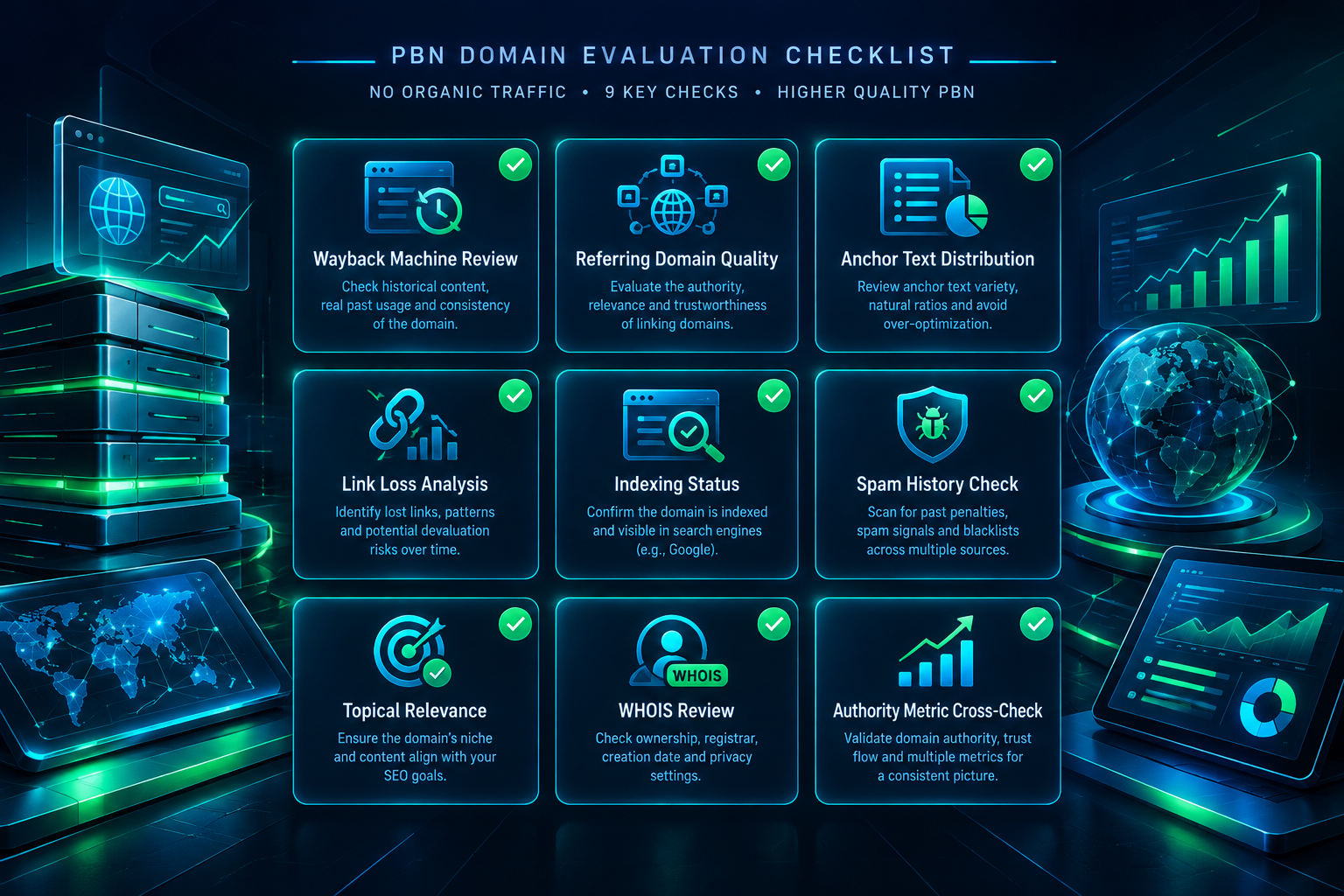
Practical Evaluation Checklist for a PBN Domain With No Organic Traffic
- Wayback Machine review: Confirm the domain published real, topically coherent content over a meaningful period. Look for consistency between the domain name, content theme, and your target niche.
- Referring domain quality check: Use Ahrefs, Majestic, or Semrush to review the top referring domains individually. Prioritize domains with credible, indexed referring sources over raw link counts.
- Anchor text distribution review: Confirm the anchor profile is not dominated by exact-match commercial keywords. A natural mix of branded, URL, generic, and keyword anchors is a positive signal.
- Link loss analysis: Check the referring domains graph for sudden spikes or drops that may indicate previous manipulation or algorithmic devaluation.
- Indexing status check: Verify whether the domain is currently indexed in Google and whether key referring domains are themselves indexed and active.
- Spam and repurposing history: Look for signs of previous PBN use, thin content, or aggressive monetization patterns in the archived content and backlink profile.
- Topical relevance assessment: Evaluate how well the domain’s historical niche aligns with the target site and target page you intend to link to.
- WHOIS and ownership review: Check for frequent ownership changes, trademark conflicts, or brand associations that could create complications.
- Authority metric cross-check: Use DR, DA, TF, and CF as initial filters, then validate with manual checks rather than relying on any single metric.
What Happens After You Acquire the Domain
Acquiring a domain that passes the evaluation criteria above is the beginning of the process, not the end. A PBN domain with no organic traffic will need content development before it can host a contextual link placement. The content published on the domain should be consistent with its historical niche, written to a standard that reflects a genuine resource rather than a placeholder, and structured so that any link placement fits naturally within the editorial context of the page.
Re-registering an expired domain and publishing content does not guarantee immediate re-indexing. Google’s crawl and indexing timelines vary depending on the domain’s previous crawl frequency, the quality of the new content, and the domain’s existing link profile. Submitting the domain’s sitemap through Google Search Console after re-registration can help signal that the domain is active and ready for crawling, though indexing timelines remain variable and are not publicly specified by Google.
Once the domain is indexed and content is published, the link placement itself should be contextual — embedded within relevant content on a page that is topically aligned with the target page. The anchor text used for the placement should be chosen as part of a broader anchor text strategy for the target site, taking into account the existing anchor distribution across the target page’s full backlink profile rather than optimizing the single placement in isolation.
Frequently Asked Questions
Can a PBN domain with no organic traffic still pass link equity?
Yes. Link equity is associated with the referring domains pointing to a URL, not with the current organic traffic of that URL. A domain that has accumulated credible inbound links over its history retains those signals regardless of whether it currently receives visitors. The key question is whether the referring domains are still active, indexed, and linking — not whether the domain itself generates traffic.
Which tool is most reliable for evaluating a PBN domain’s backlink profile?
No single tool provides a complete picture. Ahrefs, Majestic, and Semrush each crawl different portions of the web and update their indexes on different schedules, so cross-referencing at least two tools gives a more reliable view of the referring domain landscape. Majestic’s Trust Flow and Citation Flow metrics are particularly useful for assessing link quality relative to link volume, while Ahrefs’ referring domains graph is helpful for identifying link acquisition patterns over time.
How important is topical relevance when choosing a PBN domain?
Topical relevance between the PBN domain’s historical niche and the target site’s subject matter is a meaningful quality factor. It affects how naturally a link placement fits within the content context and may influence how search engines interpret the thematic relationship between the linking domain and the target page. It is not an absolute requirement, but domains with stronger topical alignment to your target niche are generally preferable when available.
What does a sudden drop in referring domains on a PBN domain indicate?
A sudden drop in referring domains can indicate several things: links were removed by the linking sites, a batch of referring domains became inactive or deindexed, or the domain’s link profile was affected by an algorithmic update. It does not automatically indicate a manual action or a penalty, but it does warrant closer examination of which referring domains were lost and whether the remaining profile is still strong enough to justify acquisition.
Should I avoid a domain that was previously used as a PBN asset?
Previous PBN use is a factor to consider rather than an automatic disqualifier. If the domain’s backlink profile is clean, the referring domains are credible, and the archived content history is coherent, the domain may still be a viable acquisition. If the profile shows signs of aggressive manipulation — heavy exact-match anchors, referring domains from known spam networks, or a history of rapid ownership changes — the risk profile is higher and warrants more careful consideration.
How long does it take for a re-registered expired domain to be re-indexed by Google?
Re-indexing timelines for re-registered expired domains vary and are not publicly specified by Google. Factors that may influence the timeline include the domain’s previous crawl frequency, the quality and volume of new content published, and whether the domain’s existing backlink profile signals activity to Googlebot. Submitting a sitemap through Google Search Console after re-registration is a practical step, but there is no guaranteed timeline for indexing.
Choosing PBN Domains That Hold Up Under Scrutiny
Evaluating a PBN domain with no organic traffic is a structured process that rewards methodical analysis over quick metric-based filtering. The domains most worth acquiring for a private blog network are those with a coherent content history, a backlink profile built from credible referring domains, a natural anchor text distribution, and no significant indicators of previous spam use or aggressive manipulation. Organic traffic is an unreliable proxy for these qualities and should not be the primary filter when assessing expired or aged domains for PBN use.
The evaluation process described here — covering domain history, referring domain quality, anchor text distribution, link loss patterns, indexing status, topical relevance, and spam history — gives you a practical framework for distinguishing domains that carry genuine link equity from those that only appear strong on surface-level metrics. Applying this framework consistently reduces the risk of acquiring domains that underperform or that carry hidden quality problems not visible in aggregate authority scores.
If you are building or expanding a private blog network and want to assess specific domains against these criteria, or if you are looking for vetted PBN placements without the overhead of domain acquisition and network management, PBN Backlinks Service can help you review your requirements and identify options that align with your target niche and campaign goals.